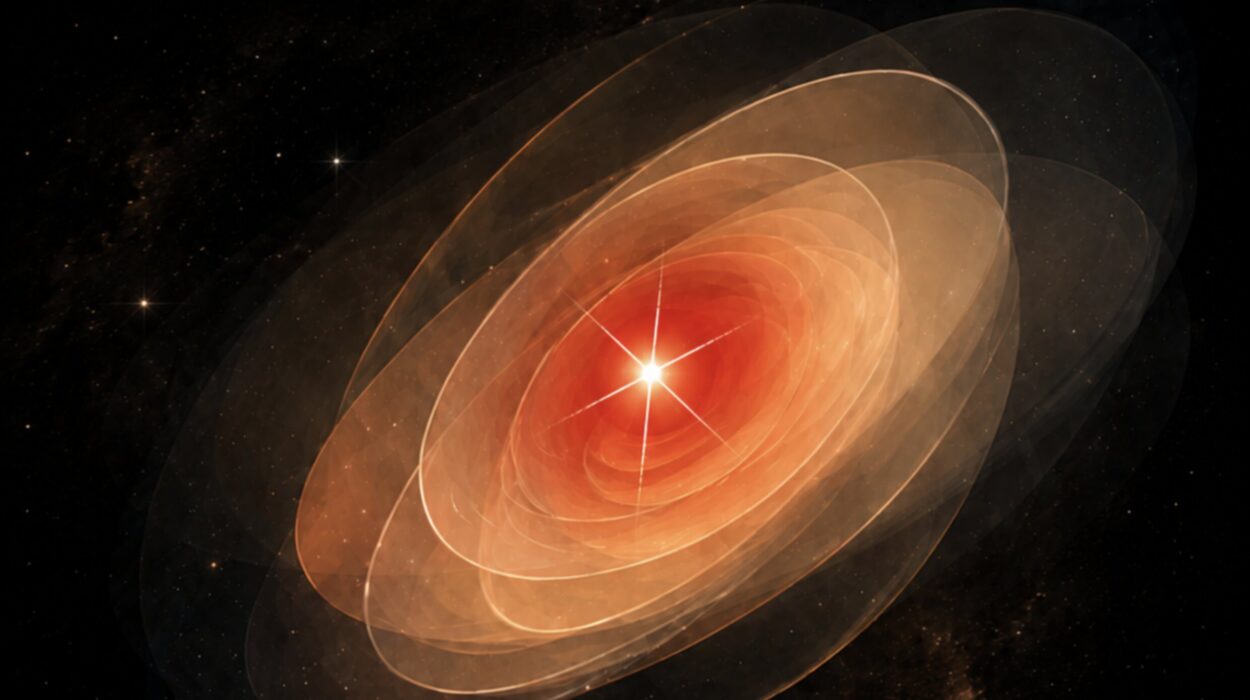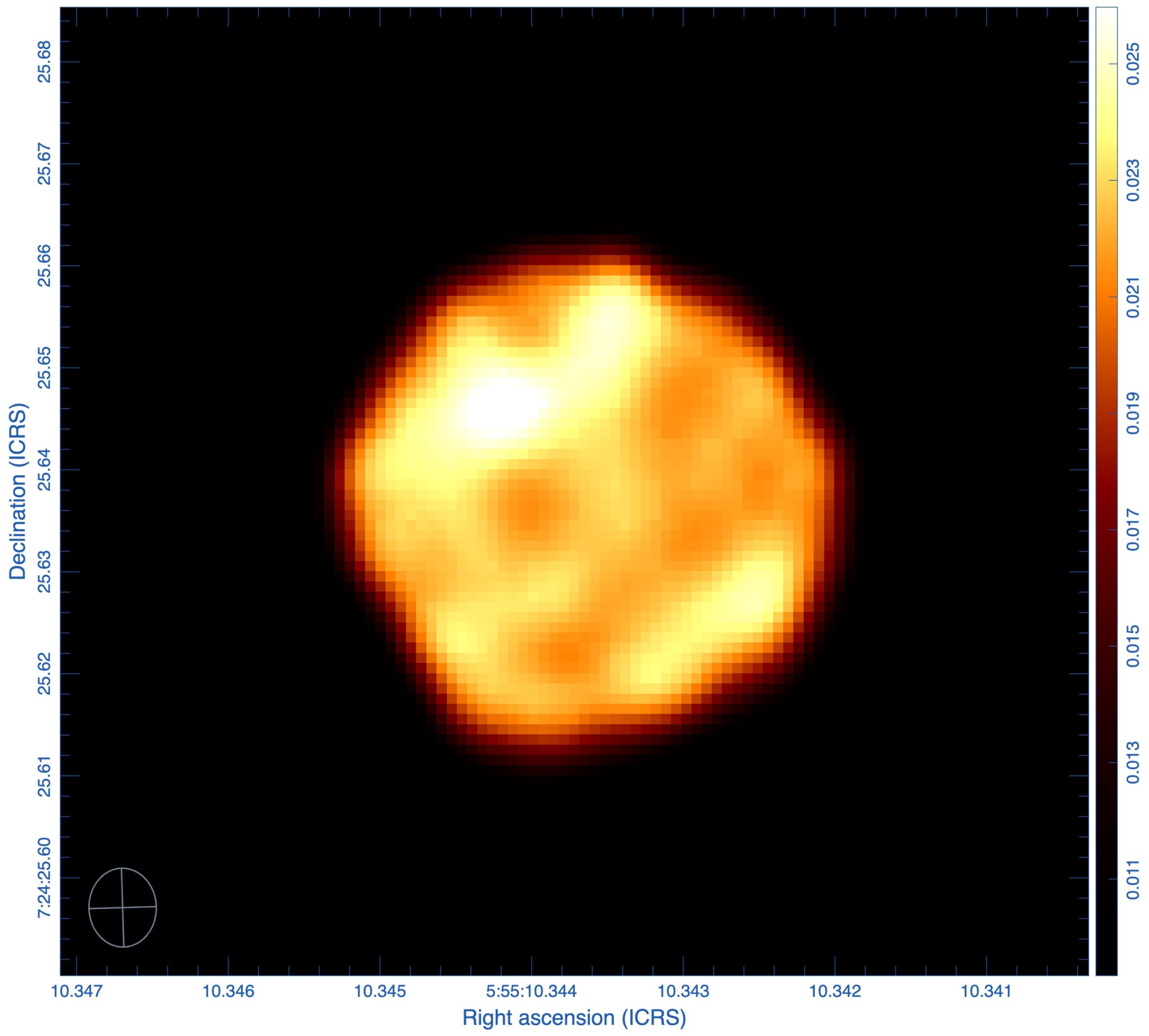
Four years after Betelgeuse suddenly faded, new high-resolution observations show that the red supergiant’s inner atmosphere has become increasingly patchy and asymmetric, with some hot spots hundreds of degrees hotter than nearby areas. The pattern may be related to a much smaller companion star orbiting the giant.
Betelgeuse is a red supergiant and one of the closest stars of its kind. In 2020, it suddenly became about 2.5 times fainter in an event known as the “Great Dimming.” Since then, astronomers have been trying to understand what changed in the star’s surface and inner atmosphere.
Bill Dent of the University of Manchester led a team that has now returned to Betelgeuse with the Atacama Large Millimeter Array, or ALMA. The new observations are the first ALMA observations focused on the star since 2015, before the Great Dimming.
ALMA consists of 66 radio telescopes in Chile’s Atacama Desert. It can observe wavelengths from 0.6 to 1.4 millimeters, which come from a layer just above Betelgeuse’s visible surface. That makes the observations useful for examining the innermost part of the star’s extended atmosphere.
The team used the longest possible separation between ALMA’s antennas to sharpen the images. Favorable weather and newer data-processing methods allowed the astronomers to resolve structures as small as 7 milliarcseconds. At the distance of the Moon, that resolution would correspond to features about 13 meters, or 43 feet, across.
Hot spots have become more uneven
The new images show that Betelgeuse’s inner atmosphere is more uneven and asymmetric than it was in 2015. Some of its hot spots are about 800 degrees hotter than their surroundings.
The observations also reveal peaks and troughs associated with enormous convective cells. Convection occurs when heated gas rises, expands and cools, then sinks back down. Betelgeuse appears to have fewer but much larger convective cells than the Sun.
One particularly bright hot spot was already visible in the 2015 observations. Its persistence suggests that some of these convective features can remain in place for years. The observations also show that the hot spots tend to line up along a particular direction.
That alignment may provide a clue to what is shaping the star’s atmosphere.
A possible link to a companion star
In July 2026, astronomers found strong evidence for a much smaller companion star closely orbiting Betelgeuse. The new ALMA observations indicate that the direction of the hot-spot alignment may be connected to that companion’s orbit.
If the companion’s orbit lies in the same plane as Betelgeuse’s equator, Dent suggests that the brightest and most persistent hot spots could be near the star’s polar regions, where convection may be more active and stable.
The connection is not yet confirmed. The astronomers plan further observations to test whether the hot spots and the companion’s orbit are actually related.
The study was published in Astronomy & Astrophysics.