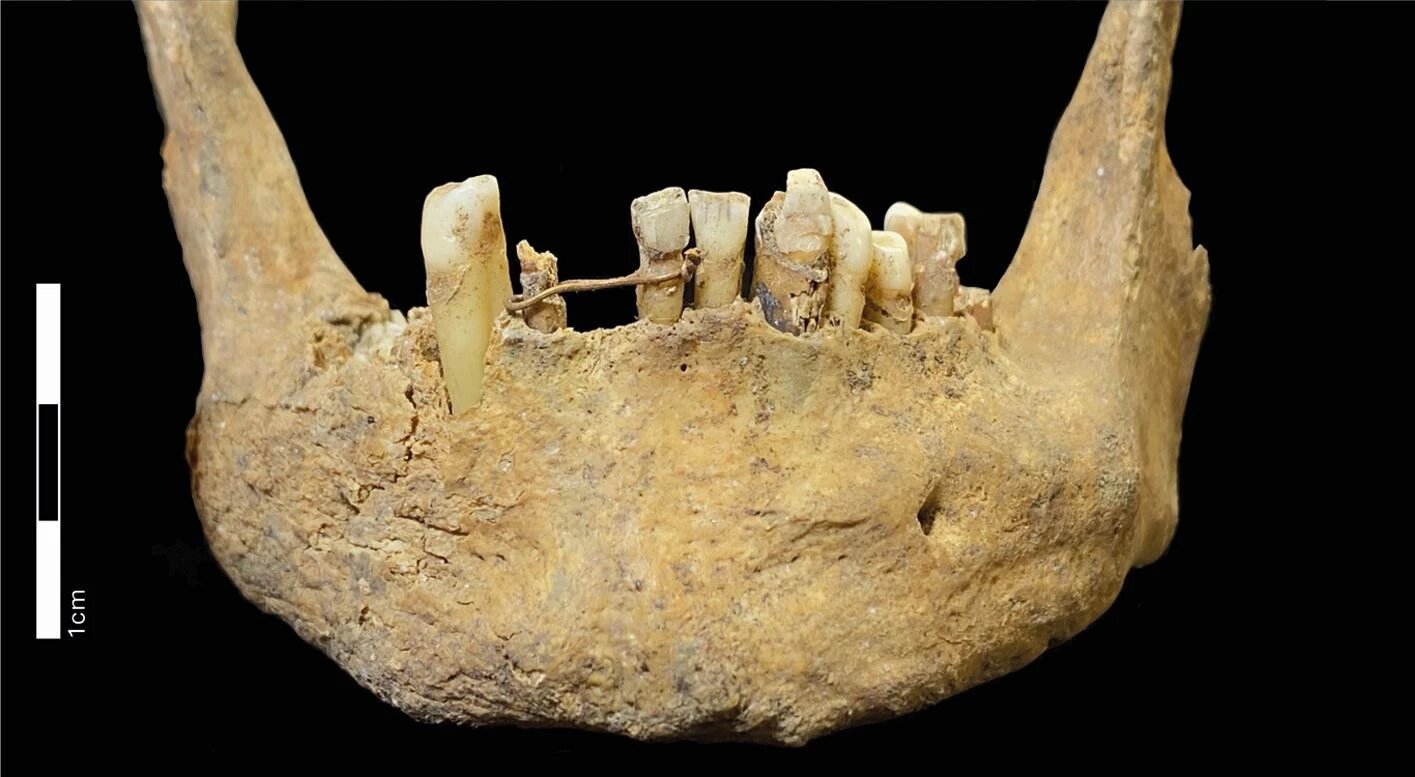
More than five centuries ago, a middle-aged man was buried in Aberdeen with a thin gold wire secured around his teeth. The 20-carat alloy had remained in place for a significant time before his death, and its arrangement appears to have helped support a missing or loose tooth.
The gold wire was found among human remains excavated in 2006 from the East Kirk of St. Nicholas in Aberdeen. About 900 individuals and 3.5 metric tons of disarticulated skeletal material were recovered from the site.
The church had been rebuilt and expanded between the 14th and 16th centuries and was considered one of Scotland’s largest churches at the time.
The ligature was identified later, when researchers reassessed some of the skeletons as part of a project examining changes in health across Scotland. They found a mandible with gold wire connecting several teeth around a missing tooth in the center.
The wire formed a bridge-like arrangement. It may have supported a prosthetic tooth or helped keep a loose tooth in place.
Among the remains of 100 individuals examined for the study, this was the only person with a dental ligature.
The wire stayed in place during his life
Radiocarbon dating placed the man’s burial between 1460 and 1670 CE. Based on skeletal characteristics and dental wear, researchers estimated that he was a middle-aged man.
Marks on his teeth indicated that the gold ligature had been in place for a significant period before his death. That evidence distinguishes this case from some earlier dental ligatures that may have been placed after death as part of burial practices.
Analysis using scanning electron microscopy and X-ray spectroscopy found that the wire was made from a 20-carat gold alloy.
At least 22 goldsmiths were working in Aberdeen during this period who were considered capable of making a simple gold wire and creating the knot needed to secure it. The researchers suggest that the man therefore had access to skilled craftsmanship and was likely wealthy.
They cannot determine whether the dental work itself was carried out in Aberdeen or somewhere else.
Dental treatment existed long before modern dentistry
Formal dentistry did not become an established profession until the 19th century, but people had been attempting to treat and restore teeth for thousands of years.
Archaeological evidence includes possible modifications to teeth with cavities dating to about 14,000 years ago. In Slovenia, beeswax was found in a dental cavity dating to around 6,500 years ago.
Gold and silver wires used to stabilize teeth or replace missing teeth have also been identified in Egypt as early as 2,500 BCE. Some may have been attached after death to make sure a body appeared complete before burial.
In medieval Europe, written medical, surgical and scientific works increasingly discussed oral remedies. But teeth were often treated outside the work of physicians and surgeons, including by specialists known as dentatores.
European archaeological examples of dental ligatures from before the 17th century are rare. None had previously been identified in Scotland.
The reason for the gold treatment is uncertain
The researchers say the man’s dental treatment may have had more than one purpose. Keeping the teeth stable could have helped retain chewing ability and oral function, but social expectations may also have influenced the decision to preserve his teeth.
The study authors point to medieval and early modern beliefs that a person’s physical appearance and perceived health were connected to individual character and sin. They argue that the appearance of a person’s smile could therefore have had social importance for people who could afford such treatment.
The researchers describe the Aberdeen case as part of a growing body of evidence for restorative dental practices in the premodern world.
The study was published in the British Dental Journal.