Long after major Maya cities in northwestern Belize had been abandoned, people continued to return to some of those places for rituals, resetting old monuments and leaving offerings. At Ayiin Winik, archaeologists have now identified what they say is the region’s first reported Late Postclassic altar, adding to evidence that abandoned sacred places remained part of Maya religious activity.
The Classic Maya civilization underwent a major decline between about A.D. 750 and 900, and many cities in northwestern Belize had been abandoned by around A.D. 900. But abandonment did not necessarily mean that these places were forgotten.
Archaeological evidence from several sites indicates that Postclassic Maya people, dating from A.D. 900 to 1542, continued to visit earlier sacred locations and use them for rituals.
At these abandoned sites, visitors sometimes reset monuments by repairing broken pieces or changing their orientation. They also left incensarios, or ceramic objects associated with burning incense, along with other votive offerings. In some cases, they built small altars from piles or stacks of rock.
The researchers describe these practices as part of a broader pattern in which older religious places and symbols continued to be used in new settings. They argue that community-based rituals persisted even as formal, state-controlled religious spectacles declined.
Old monuments were reset and offerings were left behind
Archaeologists excavated two sites in Belize, Kaxil Uinik and Ayiin Winik, examining the positions of monuments, the distribution of artifacts and the types of ceramics found at each location.
At both sites, the evidence points to Postclassic visitors returning to earlier locations. Some monuments had been repositioned, with broken pieces fixed or parts reoriented. Ritual offerings were also found at both sites.
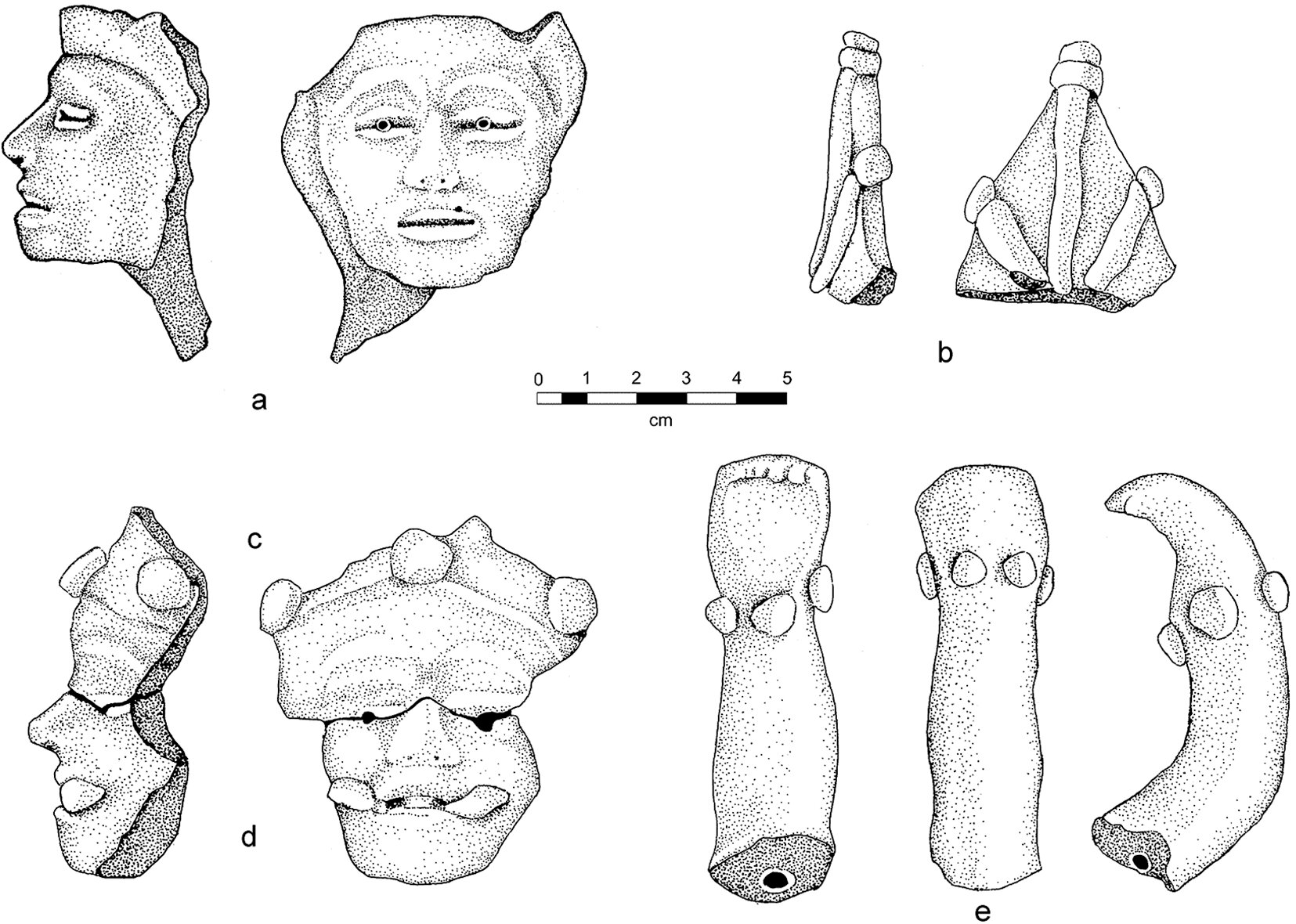
At Kaxil Uinik, the team returned to a monument known as Stela 1, which had first been studied in 1931. Around it, archaeologists found fragments of Late Postclassic Chen Mul incensarios. One fragment had a realistic-looking human face.
The researchers interpret these fragments as offerings. They also say the face may date to the colonial period. The arrangement of the monument pieces suggests that Late Postclassic visitors reset the monument before depositing the offerings.
A small limestone altar at Ayiin Winik
The clearest new evidence came from Ayiin Winik, where archaeologists found a small pile of deliberately arranged limestone blocks surrounded by ceramic incensario fragments.
The limestone appears to have been taken from nearby buildings. Around and on the pile were clustered pieces of ceramics. These included Terminal Classic pottery associated with the site’s latest occupation, as well as 25 fragments identified as Late Postclassic Chen Mul Modeled incensarios.
The Chen Mul fragments were found on the surface or only shallowly buried. Because they were sitting on and immediately around the stone pile, the researchers attribute them to a Late Postclassic visit to the site.
They interpret the stone structure as an altar built during that period. If so, it is the first reported Late Postclassic altar found in the region.
The exact dates remain uncertain
The researchers caution that the dating is not exact. The evidence relies heavily on ceramic typologies, which cannot always provide precise dates.
More research will be needed to refine the dating and determine whether additional Postclassic altars can be identified at other Maya sites.
The study was published in Latin American Antiquity.