When the family of Lord Qiu of the ancient Chinese state of Zeng buried him about 2,600 years ago, they did not simply leave behind a grand set of bronze bells. They deliberately took the bells apart and scattered them, apparently because the political purpose they had once served was no longer appropriate after Zeng and its rival, Chu, made peace.
Qiu lived during the Spring and Autumn period, a time when rival states within the Zhou dynasty competed for power. Zeng occupied a strategic valley connecting the Yangtze River with the Zhou heartland, while the powerful state of Chu challenged its position.
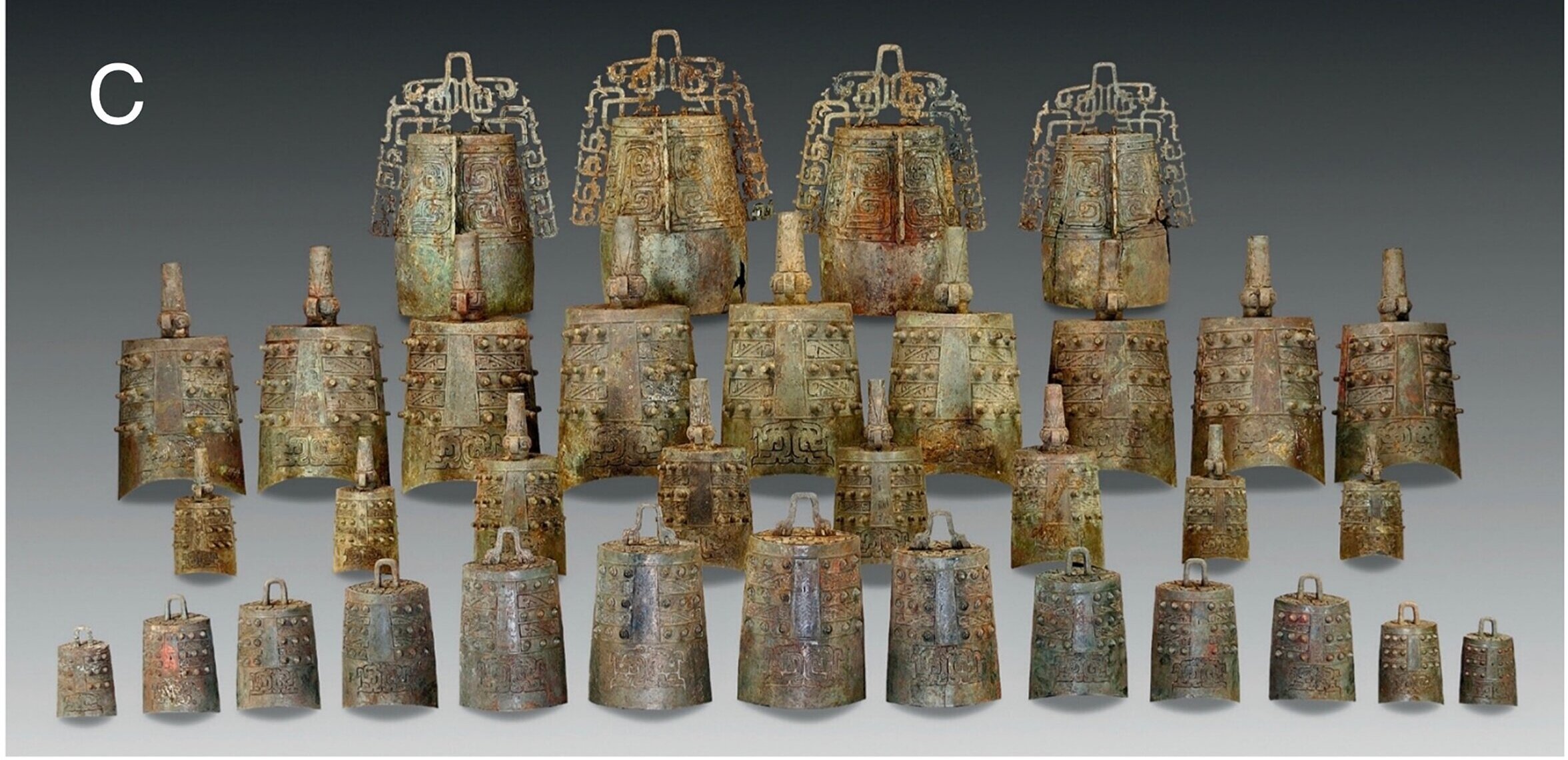
Around 656 or 625 B.C., Qiu commissioned an elaborate collection of bronze bells. They carried dragon designs, quartz inlays and inscriptions praising his ancestors and calling on their powers to protect Zeng from Chu.
The bells were not simply musical objects. In the religious world described by the study, bronze bells were closely connected with their owners and family lineages. Their sound was understood as carrying messages to the heavens.
That role became complicated when Zeng and Chu stopped being enemies. The king of Chu arranged for his sister to marry Qiu, turning the former rivals into allies.
The bells had been created for a world in which Qiu’s ancestors were being called upon to protect Zeng against Chu. By the time Qiu died, that message no longer fit the new relationship between the states.
The bells were taken apart during burial
Archaeological evidence suggests that the bells were deliberately dismantled when Qiu was buried.
The tomb itself remained intact, making looting an explanation for the scattered bells less likely. Their wooden supports had also been broken. The evidence, according to Chinglong Tse, a Ph.D. candidate at the University College London Institute of Archaeology, indicates that the dismantling happened as part of the burial.
The arrangement mattered because the bells’ power was believed to depend on how they were hung and organized on their rack. Once dismantled and scattered, they could no longer perform the role associated with their earlier arrangement.
The burial treatment therefore appears to have been more than the disposal of an unwanted object. It was part of changing what the bells were able to do in the afterlife.
A smaller set replaced them
Qiu’s connection with his ancestors was not considered to end with his death. Rituals were needed to maintain that relationship.
After the original bells were dismantled, a second set was placed in the tomb. These bells were smaller and simpler. Unlike the earlier collection, they were neatly stacked and faced southeast, and their inscriptions were directed only toward the afterlife.
The contrast between the two sets is central to Tse’s interpretation. The first bells had inscriptions tied to the political struggle between Zeng and Chu. The later bells were prepared specifically for Qiu’s existence after death.
The objects were part of a larger belief system
Tse argues that treating ancient artifacts simply as tools can obscure how people in the past understood them.
For the people of the Zhou world described in the study, bells existed within a system involving spirits, ancestors and power. Their meaning cannot necessarily be understood from their physical function alone.
Tse argues that archaeologists can learn more by examining artifacts alongside ancient writings and other analyses rather than assigning them only a functional or symbolic role.
He hopes to investigate one of the cities in Zeng where bronze bells were produced. He said that little is known about how the bells were made in the Zeng state, and that studying their production could provide a clearer understanding of the beliefs and worldviews associated with them.
The study was published in Cambridge Archaeological Journal.