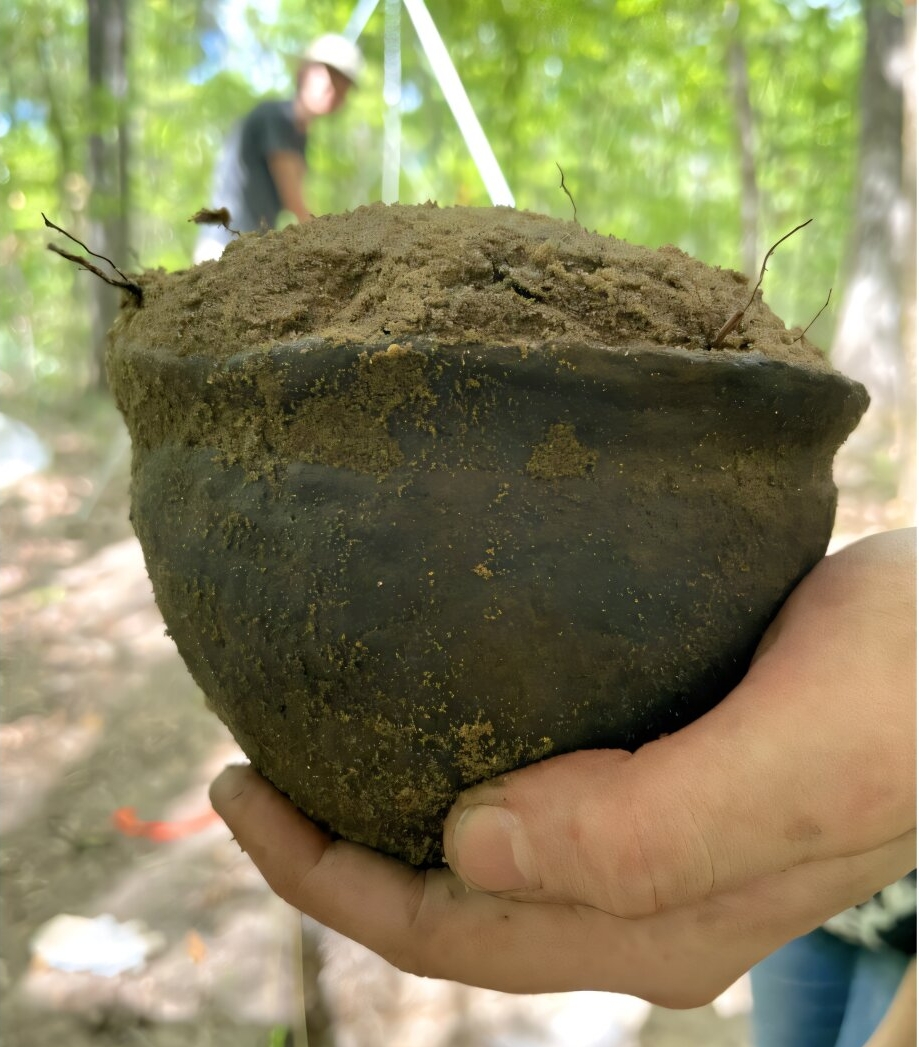
Nearly 400 years after it was made, a small clay pot has been found fully intact at a former Spanish mission in Florida. Archaeologists still do not know what it was used for or why someone placed it in a pit.
The palm-sized, gray vessel was uncovered earlier this year by students excavating Mission San Francisco de Potano in northwest Gainesville. The site was once home to Potano people, members of the Timucua, alongside a Spanish mission established in 1606.
For Gifford Waters, collections manager for historical archaeology at the Florida Museum of Natural History, the vessel’s condition made the find especially unusual.
“Typically, we find things that were broken and discarded,” Waters said. “You don’t leave things behind that you can still use, so why was this purposefully put into a pit?”
The pot survived roughly four centuries underground without breaking. Archaeologists usually encounter pottery as fragments because pressure from burial, shifting soil, development and agriculture can damage even vessels that were originally whole.
The site preserves more than individual objects
Mission San Francisco de Potano was one of more than 100 Catholic missions established in Florida over the following century as part of Spanish efforts to maintain control of the region.
The Potano moved to the area in 1585 after Spanish forces displaced them from their previous home, likely between present-day Payne’s Prairie and Orange Lake. A Spanish friar arrived in 1606 to establish the mission at the Potano village. The mission was abandoned in 1706, and evidence of the settlement later faded from view until artifacts began appearing in the 1950s.
Students now excavate the site as part of a field course taught by Waters and Charles Cobb, curator of historical archaeology at the Florida Museum of Natural History. Their excavation units cover parts of what was once a 17th-century kitchen, a friar’s residence and the surrounding Potano village.
More than 7,000 artifacts have been collected there since 2006. Most are fragments of Native American pottery. The excavations have also produced glass beads, stone tools, nails and animal bones from meals that included turtle, freshwater fish and turkey.
For archaeologists, the location of those objects can be as important as the objects themselves. Concentrations of bone in a particular area, for example, can indicate a cooking space or trash pit.
That context also helps researchers interpret the intact vessel, even though the pot itself provides few direct clues about its purpose.
The pot was found inside a Spanish-made structure
The small vessel was buried within a Spanish-made structure at the site. Archaeologists have not yet determined what that structure was used for.
Historical records indicate that a small group of soldiers was sent to the mission after British raids on Florida missions became more intense in the early 1700s. A gun’s rear sight and a musket side plate found nearby have raised the possibility that the structure was used as soldiers’ barracks.
The pot’s depth and position suggest that it was probably made sometime during the century when the mission was operating. But its design does not match a style the archaeologists recognize, leaving its origin and purpose uncertain.
There are some clues about what it probably was not.
Pots used for cooking often retain burned food and charcoal on their interiors. This vessel lacks that residue, suggesting it was not placed directly over a fire for cooking.
That does not rule out use around a meal. The faint scorch marks on the pot may have come from the original firing process that hardened the clay. Alternatively, the vessel may have been placed near a fire to warm individual portions of food.
For now, neither possibility can be established.
Other pottery points to movement and exchange
The same excavation also produced fragments of a much larger vessel with a markedly different appearance. Its surface was rough, and its composition does not appear to fit local pottery traditions.
Archaeologists suspect the larger vessel may have reached the site through trade with communities around St. Augustine or present-day Jacksonville. Another possibility is that it was brought by someone who had moved to the area and carried different pottery traditions with them.
Those objects fit into a broader pattern at the mission. During its later years, people from different parts of Florida, including Native Americans from different areas, moved into and around the site.
The resulting mixture can be traced in the archaeological record, where differences among artifacts provide evidence of connections as well as changes in traditions over time.
The intact pot remains a particularly unusual part of that record. Archaeologists have not determined why someone put it into the ground or exactly what it once contained. Its value lies partly in that unanswered question and partly in where it was found, alongside the other objects and traces of activity that continue to define life at Mission San Francisco de Potano.