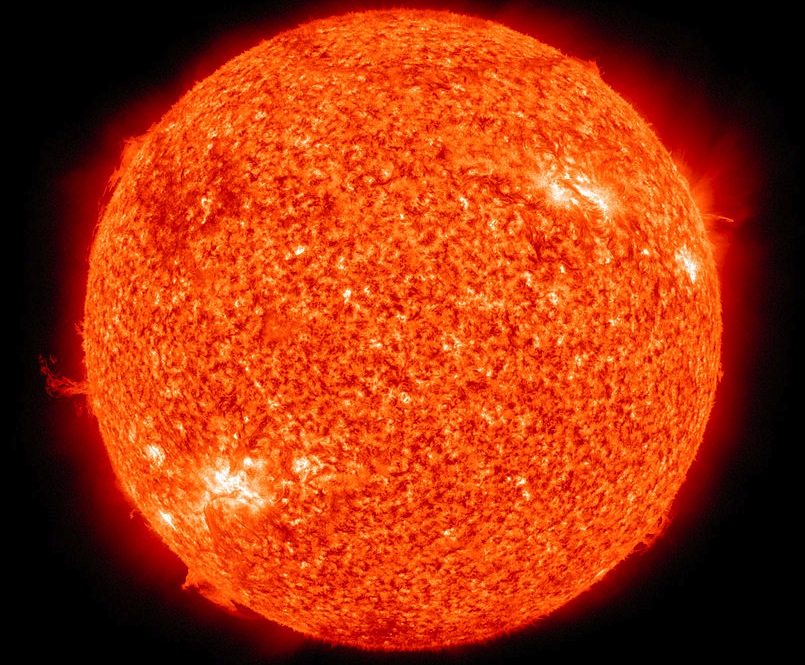
Deep beneath the brilliant surface of the Sun lies a place unlike anywhere else in our solar system—a region where temperatures reach millions of degrees, pressure becomes unimaginably intense, and atoms are transformed into the energy that powers all life on Earth.
This hidden region is called the core of the Sun.
Although humans can never travel there, scientists have studied the Sun’s interior through physics, mathematical models, and observations of solar activity. The core is the Sun’s true energy engine, where nuclear fusion converts matter into enormous amounts of energy. Every sunrise, every green leaf growing on Earth, and every living creature that depends on sunlight exists because of the extraordinary processes happening inside this tiny but powerful region.
The Sun may look like a simple glowing sphere in the sky, but its heart is a vast nuclear furnace that has been operating for about 4.6 billion years.
The Heart of the Sun
The core is the innermost region of the Sun, located at its very center. It extends outward to about 25 percent of the Sun’s radius, reaching approximately 175,000 kilometers from the center.
Although the core occupies only a fraction of the Sun’s total volume, it contains nearly half of the Sun’s mass because matter is compressed extremely tightly by the enormous weight of the layers above it.
The core is where the Sun produces almost all of its energy. Above it are other layers—the radiative zone, the convection zone, the photosphere, and the atmosphere—but these regions mainly transport energy outward. The core is where the original energy creation takes place.
In many ways, the core is like the Sun’s beating heart, continuously releasing the energy that eventually travels across space and reaches Earth as sunlight.
A Place of Extreme Temperature and Pressure
The environment inside the Sun’s core is almost impossible to imagine.
The temperature at the center reaches around 15 million degrees Celsius. At such extreme temperatures, atoms cannot remain in their normal form. Instead, they exist as a hot, electrically charged state of matter called plasma.
But temperature alone is not what makes the core extraordinary. The pressure is also enormous.
The immense gravitational force of the Sun’s outer layers pushes inward with tremendous strength. The pressure at the core is estimated to be more than 200 billion times greater than Earth’s atmospheric pressure at sea level.
Under these conditions, hydrogen nuclei are forced close enough together for nuclear fusion to occur. This process is the source of the Sun’s energy.
The Sun’s Energy Comes From Nuclear Fusion
The core of the Sun is powered by a process called nuclear fusion.
Fusion occurs when small atomic nuclei combine to form a heavier nucleus, releasing energy in the process. Inside the Sun, hydrogen nuclei are fused together to create helium.
The main process responsible for this is known as the proton-proton chain reaction.
During this reaction, four hydrogen nuclei eventually combine to form one helium nucleus. However, the helium nucleus has slightly less mass than the original hydrogen nuclei. The missing mass is converted into energy according to Einstein’s famous equation:
E = mc²
Because the speed of light is an enormous number, even a tiny amount of converted mass produces an incredible amount of energy.
Every second, the Sun converts about 600 million tons of hydrogen into helium. Around 4 million tons of matter are transformed into energy every second, producing the sunlight and heat that sustain Earth.
Why Nuclear Fusion Can Happen Inside the Sun
Under normal conditions, hydrogen nuclei naturally repel each other because they both have positive electrical charges.
For fusion to happen, they must come extremely close together.
The Sun’s core provides the perfect environment for this. The combination of extreme temperature and immense pressure gives hydrogen nuclei enough energy to overcome their electrical repulsion and collide.
When these collisions occur, the strong nuclear force—the force that holds atomic nuclei together—allows them to merge.
This delicate balance has allowed the Sun to shine steadily for billions of years.
If the core were much cooler or less dense, fusion would slow dramatically or stop. If conditions were too extreme, the Sun would behave very differently. The current conditions create a stable nuclear reaction that has maintained the Sun’s brightness for billions of years.
The Journey of Energy From the Core to Earth
The energy created in the Sun’s core does not immediately escape into space.
The journey from the core to the Sun’s surface is incredibly slow.
Energy first moves through the radiative zone, where photons repeatedly collide with particles and gradually transfer energy outward. Because of the dense environment, a photon created in the core may take thousands to hundreds of thousands of years to reach the Sun’s surface.
Eventually, energy reaches the convection zone, where hot plasma rises, cools, and sinks in large circulating movements. This process transports energy closer to the surface.
Once the energy reaches the photosphere—the visible surface of the Sun—it escapes as sunlight and travels through space.
After leaving the Sun, light takes about 8 minutes and 20 seconds to reach Earth.
The sunlight warming your face today began its journey inside the Sun’s core long before human civilization existed.
How Scientists Study the Sun’s Hidden Core
The core of the Sun cannot be directly observed because it is hidden beneath thousands of kilometers of extremely dense material.
However, scientists have developed powerful methods to understand what happens inside it.
One important method is called helioseismology, the study of waves traveling through the Sun. Similar to how earthquakes reveal information about Earth’s interior, vibrations on the Sun’s surface provide clues about its internal structure.
Scientists also study solar neutrinos, tiny particles produced during nuclear fusion.
Neutrinos interact very weakly with matter, allowing them to escape directly from the core and travel to Earth. By detecting these particles, researchers can confirm that nuclear fusion is occurring inside the Sun.
These discoveries have provided strong evidence supporting our understanding of the Sun’s core.
The Core’s Role in Supporting Life on Earth
The Sun’s core may be millions of kilometers away, but its activity controls the conditions necessary for life on Earth.
The energy created through fusion eventually becomes sunlight, which drives Earth’s climate, powers photosynthesis, and supports almost every ecosystem on the planet.
Plants capture sunlight and convert it into chemical energy. Animals and humans depend on plants directly or indirectly for food. The energy stored in fossil fuels also originated from ancient sunlight captured by plants millions of years ago.
In a very real sense, the energy flowing through every living organism on Earth has its origin in the nuclear reactions happening inside the Sun’s core.
The Core Has Been Shining for Billions of Years
The Sun formed approximately 4.6 billion years ago from a massive cloud of gas and dust.
As gravity pulled this material together, the center became increasingly hot and dense. Eventually, conditions became intense enough for nuclear fusion to begin.
Since then, the Sun has continuously transformed hydrogen into helium in its core.
The core has enough hydrogen fuel to continue fusion for roughly another 5 billion years. After that, the Sun will undergo major changes as its supply of hydrogen decreases.
It will eventually expand into a red giant before ending its life as a white dwarf.
The core that now powers the Sun will eventually become part of a completely different cosmic story.
The Core Is Changing Over Time
Although the Sun appears stable, its core is slowly evolving.
As hydrogen is converted into helium, helium gradually accumulates in the core. Because helium does not participate in the same fusion process under current conditions, the composition of the core changes over billions of years.
The increasing amount of helium causes the core to become denser and hotter. As the temperature rises, the Sun’s brightness slowly increases over geological timescales.
When the Sun formed, it was less luminous than it is today. Over the next billion years, its increasing brightness will gradually influence Earth’s environment.
The Sun is not a static object—it is a dynamic star constantly undergoing transformation.
The Core Compared With Other Stars
The Sun’s core operates like the cores of many other stars, but its size and mass place it in a special category.
Stars more massive than the Sun have hotter and denser cores, allowing them to fuse heavier elements such as carbon, oxygen, and silicon during later stages of their lives.
Very massive stars can eventually create elements up to iron before exploding as supernovae.
Smaller stars have cooler cores and burn their fuel more slowly. Some small red dwarf stars can survive for trillions of years because they consume their hydrogen fuel at a much slower rate.
The Sun represents a middle ground—a star massive enough to shine brightly but stable enough to support a long-lasting planetary system.
The Sun’s Core Reveals the Universe’s Greatest Processes
The nuclear reactions occurring inside the Sun’s core are not unique to our star. They represent one of the fundamental processes shaping the universe.
The fusion of hydrogen into helium is responsible for the energy output of countless stars across the cosmos. Stars act as natural laboratories where the elements necessary for planets and life are created.
The oxygen we breathe, the carbon in our bodies, and many elements around us were produced through processes that began inside ancient stars.
By studying the Sun’s core, scientists are not only learning about our own star—they are uncovering the story of how the universe creates and transforms matter.
The Hidden Power Inside the Sun
The core of the Sun is a remarkable place where nature operates at its most extreme. It is a region of unimaginable heat, enormous pressure, and constant nuclear transformation.
Every ray of sunlight that reaches Earth carries energy created in this hidden heart of the Sun. The warmth that allows oceans to flow, forests to grow, and life to thrive began with tiny particles colliding deep inside a star.
Although the Sun’s core remains invisible to human eyes, it is one of the most important places in the known universe. It is a natural nuclear reactor that has illuminated our world for billions of years and will continue to shape the future of our solar system for billions more.
The Sun’s core reminds us that even the most distant and hidden processes can have a profound impact on our daily lives—and that the story of life on Earth is deeply connected to the extraordinary physics happening inside a star.