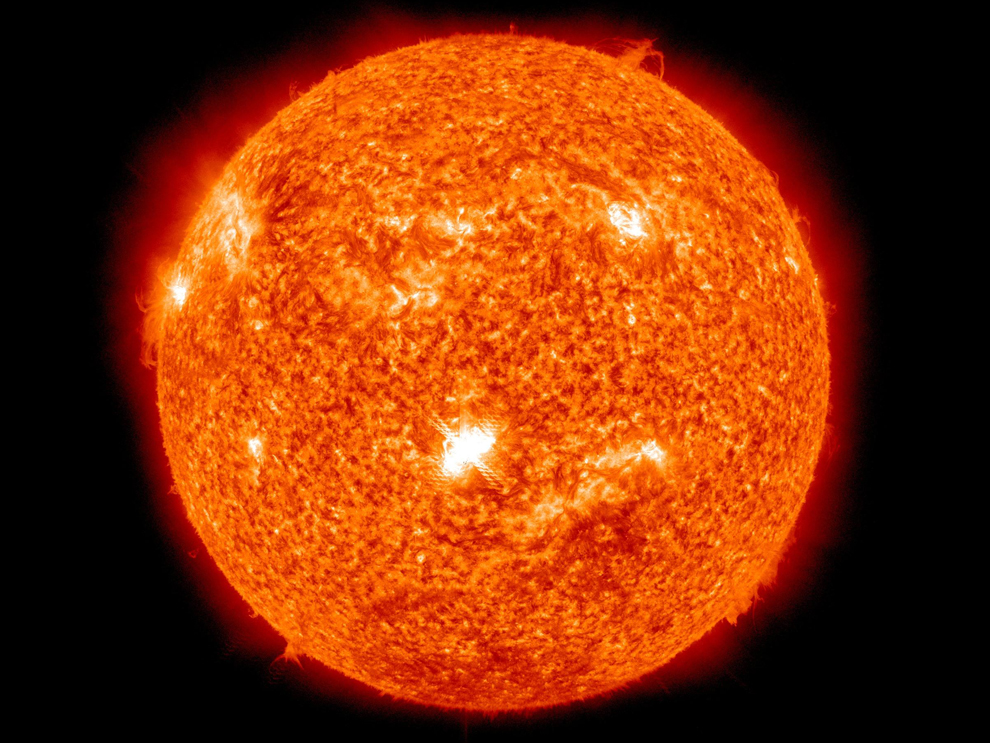
When we look up at the sky, the Sun appears to be a giant glowing sphere that gives us light and warmth every day. It rises in the morning, paints the sky with golden colors, and provides the energy that makes life on Earth possible. But beyond its familiar presence, the Sun is actually a remarkable star—one of hundreds of billions that exist in the Milky Way galaxy.
The Sun is not the largest star, the brightest star, or the hottest star in the universe. Yet it is perfectly suited to support life. Its size, temperature, chemical composition, and long-lasting energy production place it in a special category of stars known as a G-type main-sequence star, often called a yellow dwarf star.
Understanding what type of star the Sun is helps us understand not only our own place in the universe but also how stars are born, evolve, and eventually change over time.
The Sun Is a G-Type Main-Sequence Star
The Sun belongs to a group of stars called G-type main-sequence stars, classified by astronomers as G2V stars.
The “G” refers to its spectral type, which describes the temperature and color of the star. The number “2” indicates its position within the G category, and the Roman numeral “V” means it is a main-sequence star—a star that is currently producing energy through nuclear fusion in its core.
Main-sequence stars are stars in the longest and most stable stage of their lives. During this phase, they convert hydrogen into helium through nuclear fusion, releasing enormous amounts of energy as light and heat.
The Sun has been in this stage for about 4.6 billion years, and it is expected to remain a main-sequence star for roughly another 5 billion years before it begins transforming into a different type of stellar object.
Why Is the Sun Called a Yellow Dwarf?
The term “yellow dwarf” can be misleading because the Sun does not actually appear strongly yellow when viewed from space. Astronauts observing the Sun beyond Earth’s atmosphere see it as nearly white because it emits light across the entire visible spectrum.
From Earth, sunlight often appears yellow because Earth’s atmosphere scatters shorter wavelengths of light, especially blue light. This scattering effect changes the way we perceive the Sun’s color.
The word “dwarf” also does not mean the Sun is small. Compared with many stars, the Sun is relatively average in size. However, astronomically speaking, it is smaller than giant and supergiant stars, so it is classified as a dwarf star.
In reality, the Sun is an enormous object. It contains about 99.8% of the total mass of the Solar System and has a diameter of approximately 1.39 million kilometers.
The Sun’s Place in the Stellar Family
The universe contains an incredible variety of stars. Some stars are much smaller and cooler than the Sun, while others are hundreds or even thousands of times larger.
The smallest stars are red dwarfs, which are cooler, dimmer, and extremely long-lived. They make up the majority of stars in the Milky Way.
At the other end of the scale are massive stars such as blue giants and supergiants, which burn through their fuel rapidly and have much shorter lifetimes.
The Sun sits between these extremes. It is more massive and hotter than red dwarfs but far smaller and cooler than the largest stars.
This middle position gives the Sun a stable lifetime of around 10 billion years, allowing enough time for life to develop on a planet orbiting it.
The Sun’s Size Compared With Other Stars
The Sun may look enormous from Earth because it is only about 150 million kilometers away, but on the cosmic scale, it is considered an average-sized star.
Some stars are dramatically larger. For example, red supergiants can expand to hundreds of times the Sun’s diameter. If one of these stars replaced the Sun, it could extend beyond the orbit of Mars.
However, many stars are also much smaller. Red dwarfs may contain only a fraction of the Sun’s mass and produce far less energy.
The Sun’s moderate size is one of the reasons it has remained stable for billions of years. Larger stars burn their nuclear fuel faster, while smaller stars produce much less energy.
How the Sun Produces Its Energy
Deep inside the Sun’s core, temperatures reach approximately 15 million degrees Celsius. Under these extreme conditions, hydrogen nuclei collide with enough energy to combine and form helium.
This process, called nuclear fusion, releases enormous amounts of energy.
Every second, the Sun converts millions of tons of hydrogen into helium. A small portion of that mass is transformed into energy according to Einstein’s famous equation, E = mc².
That energy travels outward through the Sun’s layers before reaching space as sunlight and heat. A tiny fraction of this energy reaches Earth, but it is enough to drive Earth’s climate, power photosynthesis, and support almost every form of life.
The Sun’s Classification by Temperature and Color
Astronomers classify stars using a system called the spectral classification system, which organizes stars based on their surface temperature.
The main categories are:
O-type stars are the hottest and most massive.
B-type stars are very hot and often blue-white.
A-type stars are white and hot.
F-type stars are slightly cooler.
G-type stars, including the Sun, have moderate temperatures.
K-type stars are cooler and orange.
M-type stars are the coolest and appear red.
The Sun’s surface temperature is about 5,500 degrees Celsius, placing it comfortably within the G-type category.
Although hotter stars exist, the Sun’s temperature is ideal for maintaining a stable environment around Earth.
The Sun’s Layers Reveal Its Nature
Like all stars, the Sun is not a solid object. It is a massive sphere of extremely hot plasma.
Its structure consists of several major layers.
The core is where nuclear fusion occurs.
Surrounding the core is the radiative zone, where energy slowly moves outward through radiation.
Above that is the convection zone, where hot plasma rises and cooler plasma sinks, transporting energy through movement.
The visible surface of the Sun is called the photosphere. This is the layer that produces most of the sunlight we see.
Beyond the photosphere are the Sun’s outer atmospheric layers, including the chromosphere and the corona. The corona is surprisingly much hotter than the surface, reaching millions of degrees Celsius, a mystery scientists are still working to fully explain.
The Sun Is a Middle-Aged Star
The Sun is currently in the middle of its life.
At approximately 4.6 billion years old, it is neither a young star nor an old star. It formed from a massive cloud of gas and dust called a molecular cloud, along with the rest of the Solar System.
For billions of years, it has steadily transformed hydrogen into helium in its core.
Eventually, the hydrogen supply in the core will decrease. When that happens, the balance between gravity and nuclear fusion will change. The Sun will expand into a red giant, becoming much larger and cooler at its surface.
Later, it will shed its outer layers and leave behind a dense, hot core known as a white dwarf.
The Sun will not explode as a supernova because it does not have enough mass to undergo that type of dramatic stellar death.
Why the Sun Is the Perfect Star for Earth
The Sun’s classification as a G-type main-sequence star is one of the reasons Earth can support life.
Its energy output has remained relatively stable over billions of years.
Its temperature allows liquid water to exist on Earth’s surface.
Its lifespan provides enough time for complex life to evolve.
Its location in the Milky Way places Earth in a region where conditions are favorable for planetary development.
A much larger star would have burned out too quickly, while a much smaller star might not provide enough energy for life as we know it.
The Sun is not special because it is the biggest or most powerful star. It is special because it is stable, reliable, and located at exactly the right distance to make Earth a living world.
The Sun Compared With Other G-Type Stars
The Sun is one example of billions of G-type stars that exist throughout the universe.
Many stars share similar characteristics, including comparable temperatures, sizes, and chemical compositions.
Studying these stars helps astronomers understand how common Sun-like systems might be. With modern telescopes, scientists have discovered thousands of planets orbiting other stars, including some around stars similar to the Sun.
These discoveries help researchers investigate one of the biggest questions in astronomy: how common are environments capable of supporting life?
The Sun’s Importance in Astronomy
Because the Sun is the closest star to Earth, it serves as the most detailed laboratory for studying stellar physics.
Scientists can observe its surface activity, magnetic fields, solar storms, and internal processes in ways that are impossible with distant stars.
By understanding the Sun, astronomers can better understand how other stars work.
The Sun provides a reference point for studying stellar evolution, helping scientists compare stars at different stages of their lives.
The Sun: An Ordinary Star With Extraordinary Importance
The Sun is an ordinary star in many ways. It is one among countless G-type stars scattered throughout the universe. It does not possess the extreme size of giant stars or the incredible brightness of some massive stellar objects.
Yet for Earth, the Sun is extraordinary.
It is the source of nearly all the energy that powers our planet. It has guided the evolution of life for billions of years. Its light has shaped ecosystems, climates, and civilizations.
The Sun is a G2V yellow dwarf star, a stable middle-aged star quietly producing energy through nuclear fusion. It represents a remarkable balance of size, temperature, and longevity—a cosmic condition that has allowed a small planet orbiting it to become a world filled with life.
By studying the Sun, we are not only learning about our nearest star. We are uncovering the story of how stars shape the universe and how the light of one ordinary star can transform an entire world.