Every time you look up at the sky, you are looking into the past.
The sunlight warming your face began its journey minutes before it reached you. The light from the Moon left its surface more than a second ago. The glow of nearby stars has traveled for years, while the light from distant galaxies has spent millions—or even billions—of years crossing the vastness of space before finally arriving at Earth.
This remarkable fact is one of the most fascinating ideas in astronomy. Because light travels at a finite speed rather than instantaneously, every observation of the universe is also a glimpse into history. The farther away an object is, the older the light we receive from it.
So, how long does light take to reach Earth? The answer depends entirely on where the light comes from. Light from the Sun arrives in just over eight minutes, while light from the most distant galaxies has been traveling for more than 13 billion years. Understanding these travel times reveals not only the immense scale of the universe but also the extraordinary speed of light itself.
What Is Light?
Light is a form of electromagnetic radiation. It consists of tiny packets of energy called photons, which have no rest mass and travel through the vacuum of space at the fastest speed allowed by the laws of physics.
Visible light is only a small part of the electromagnetic spectrum. Other forms of electromagnetic radiation include radio waves, microwaves, infrared radiation, ultraviolet light, X-rays, and gamma rays. Although these forms of radiation differ in wavelength and energy, they all travel at the same speed in a vacuum.
That speed, known as the speed of light, is exactly 299,792,458 meters per second, or about 300,000 kilometers (186,282 miles) per second.
To appreciate how fast this is, imagine traveling around Earth’s equator. Light could circle our planet about 7.5 times in just one second.
Despite this astonishing speed, space is so unimaginably vast that even light takes time to travel between celestial objects.
Why Doesn’t Light Reach Earth Instantly?
Many people wonder why light, moving at such incredible speed, does not arrive instantly.
The answer is simple: space is enormous.
Although light travels faster than anything else in the universe, the distances between stars, planets, and galaxies are so immense that even light requires measurable amounts of time to cross them.
Think about hearing thunder after seeing lightning. Light reaches your eyes almost instantly because it travels much faster than sound. In space, however, the distances are millions, billions, or even trillions of times greater, making the travel time of light significant.
This means every beam of light carries information from the moment it left its source.
How Long Does Sunlight Take to Reach Earth?
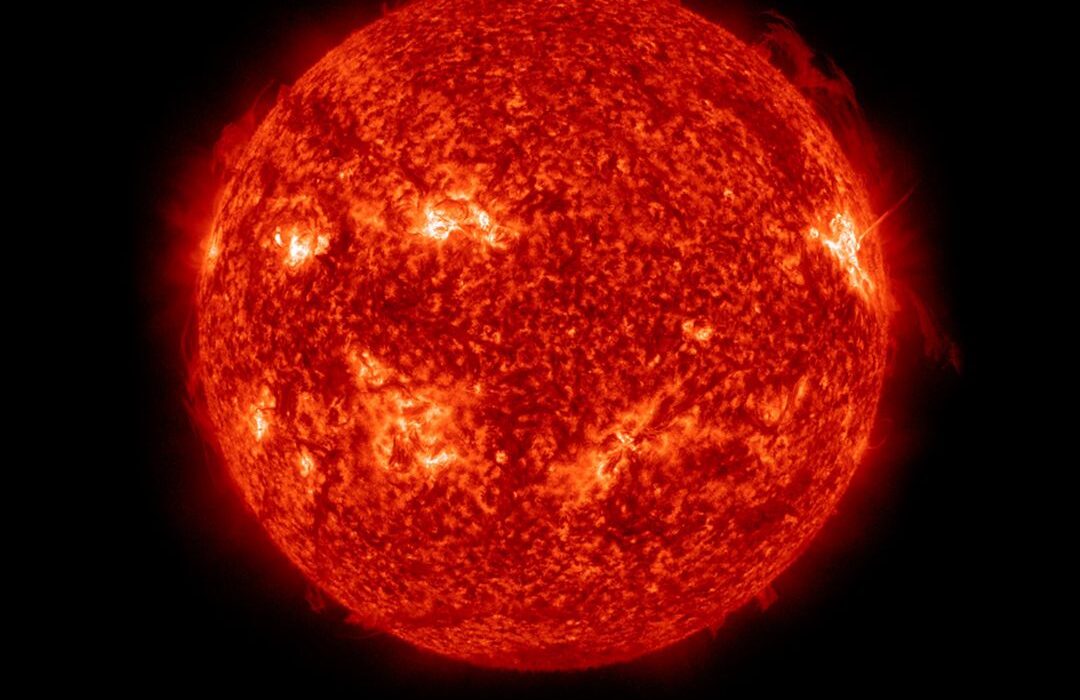
The most familiar source of light is the Sun.
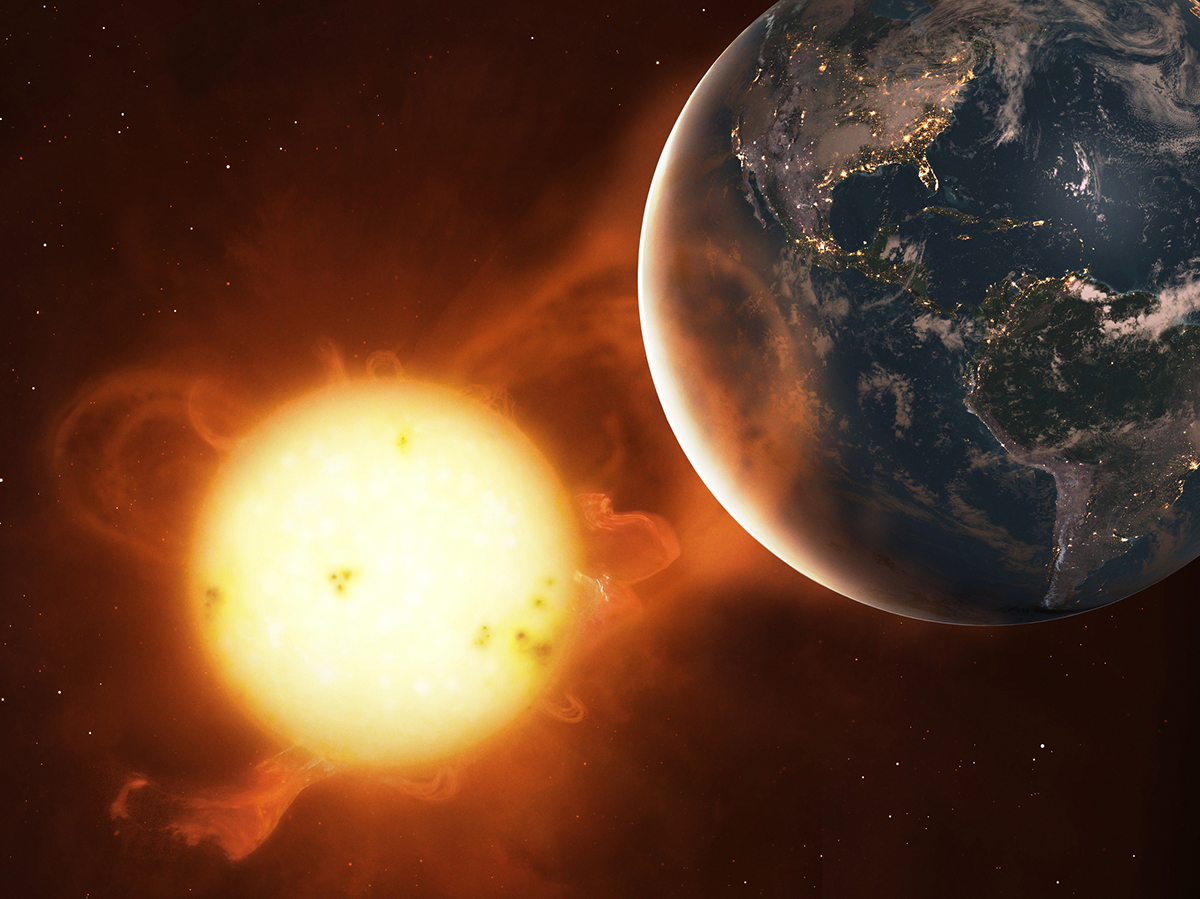
On average, the Sun is about 149.6 million kilometers (93 million miles) from Earth. This average distance is called one astronomical unit (1 AU).
Using the speed of light, scientists calculate that sunlight takes approximately:
8 minutes and 20 seconds
to travel from the Sun to Earth.
This means the sunlight you see right now actually left the Sun more than eight minutes ago.
If the Sun were somehow to disappear instantly—a purely hypothetical scenario—Earth would continue receiving sunlight for another 8 minutes and 20 seconds. Likewise, the gravitational effects of the Sun would also continue for roughly the same amount of time, according to Einstein’s theory of general relativity.
How Long Does Moonlight Take to Reach Earth?
The Moon is much closer than the Sun.
Its average distance from Earth is about 384,400 kilometers (238,855 miles).
Because of this relatively short distance, moonlight takes only about:
1.28 seconds
to reach Earth.
Interestingly, the Moon does not produce its own light. Instead, sunlight first travels to the Moon, reflects off its surface, and then takes another 1.28 seconds to reach us.
So when you admire a full Moon, the light has traveled from the Sun to the Moon and then from the Moon to Earth.
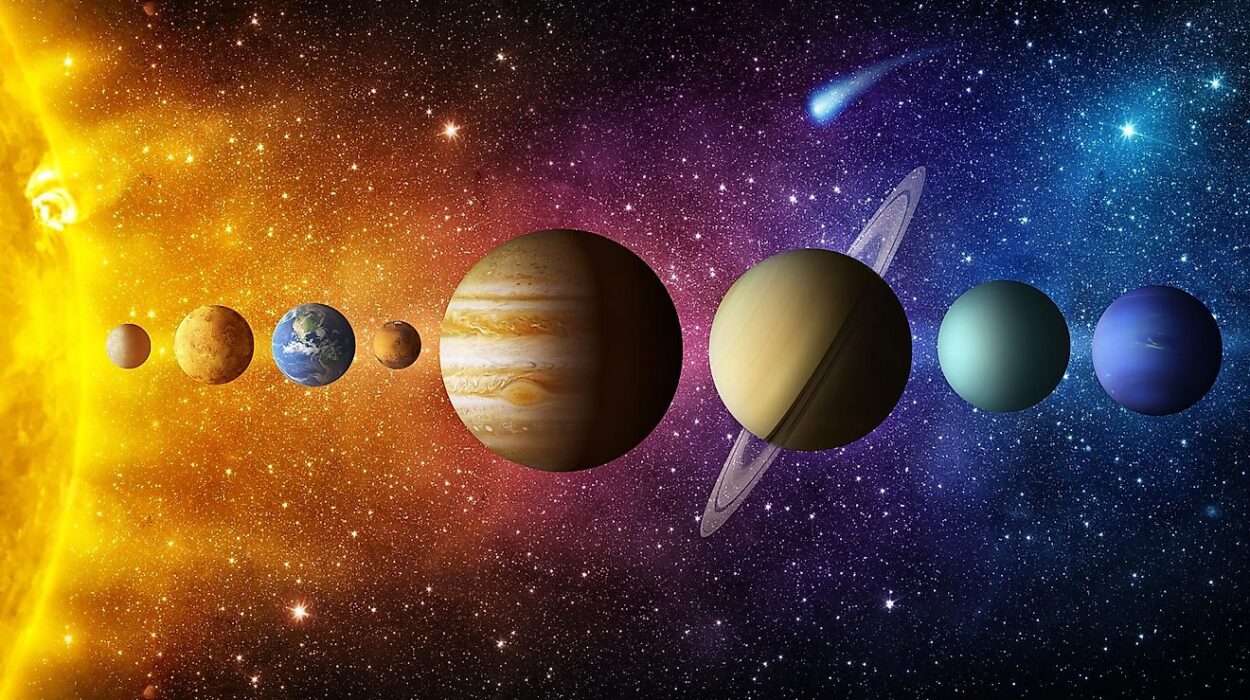
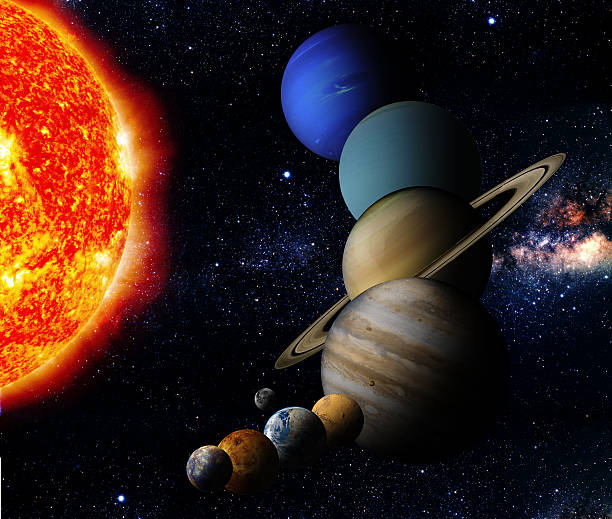
How Long Does Light Take from the Planets?
The planets in our Solar System are constantly moving around the Sun, so their distances from Earth continually change.
As a result, the time light takes to travel from each planet varies.
When Mercury is relatively close to Earth, reflected sunlight may take around five minutes to reach us.
Light from Venus often takes several minutes, depending on its position in orbit.
Mars can appear quite close during certain oppositions or much farther away at other times. Its light may take anywhere from about 3 minutes to over 20 minutes to arrive.
Jupiter’s reflected sunlight usually reaches Earth in about 30 to 50 minutes, depending on the planets’ positions.
Light from Saturn generally takes between 70 and 90 minutes.
For Uranus, the journey often lasts around 2.5 to 3 hours.
Light from Neptune typically requires approximately 4 hours to reach Earth.
These travel times remind us that even within our own Solar System, distances are enormous.
What Is a Light-Year?
Because space is so vast, astronomers rarely measure distances in kilometers when discussing stars and galaxies.
Instead, they use a unit called the light-year.
A light-year is not a measure of time.
It is a measure of distance.
One light-year is the distance that light travels in one year through the vacuum of space.
This distance equals approximately:
9.46 trillion kilometers
or
5.88 trillion miles.
Using light-years makes it much easier to describe the immense distances between stars.
How Long Does Light from the Nearest Star Take?
The nearest star beyond the Sun is Proxima Centauri.
It lies about 4.24 light-years from Earth.
This means the light you see from Proxima Centauri today actually left the star more than four years ago.
If something changed dramatically on Proxima Centauri right now, people on Earth would not know about it for over four years.
Even our closest stellar neighbor is incredibly far away.
Looking at Stars Means Looking into the Past
Every star visible in the night sky is seen as it existed in the past.
Some bright stars are only a few dozen light-years away.
Others are hundreds or even thousands of light-years distant.
For example, if a star is 100 light-years from Earth, the light entering your eyes tonight began its journey 100 years ago.
You are seeing the star exactly as it was a century earlier.
Astronomy is therefore unique among sciences because every observation is also a historical observation.
The universe constantly reveals its past through light.
How Long Does Light Take from the Milky Way?
Our Solar System is located inside the Milky Way Galaxy.
The Milky Way is approximately 100,000 light-years across.
Stars near our Solar System may be only a few dozen or a few hundred light-years away.
However, stars on the opposite side of the galaxy can be more than 70,000 light-years distant.
The light from those stars began its journey long before human civilization existed.
By the time it reaches Earth, countless generations have come and gone.
How Long Does Light Take from Other Galaxies?
The nearest major galaxy to the Milky Way is the Andromeda Galaxy.
It is about 2.5 million light-years away.
When astronomers observe Andromeda, they are seeing it as it existed roughly 2.5 million years ago.
At that time, early human ancestors were still evolving on Earth.
Many other galaxies lie much farther away.
Some are tens of millions of light-years distant.
Others are hundreds of millions.
The most distant galaxies observed by powerful space telescopes are so far away that their light has traveled for more than 13 billion years before reaching Earth.
These ancient photons provide a direct window into the early universe.
How Telescopes Look Back in Time
Modern telescopes do much more than magnify distant objects.
They collect light that has traveled across enormous stretches of space.
Every telescope is effectively a time machine—not because it changes time, but because it captures ancient light.
Small backyard telescopes allow observers to see planets and nearby stars.
Large ground-based observatories reveal distant galaxies.
Space telescopes, free from Earth’s atmosphere, detect incredibly faint light that has traveled for billions of years.
Some observations allow astronomers to study galaxies that formed only a few hundred million years after the Big Bang.
This helps scientists understand how the earliest stars and galaxies formed.
Does Light Ever Slow Down?
In the vacuum of space, light always travels at its maximum speed.
However, when light passes through materials such as water, glass, or Earth’s atmosphere, it moves more slowly.
This slowing does not occur because photons lose energy in the usual sense. Instead, interactions between light and the atoms within the material delay its overall progress.
This is why light bends when entering water or glass, a phenomenon called refraction.
Even so, once light returns to the vacuum of space, it again travels at the universal speed limit.
Why Is the Speed of Light So Important?
The speed of light is one of the most fundamental constants in nature.
It plays a central role in Einstein’s theories of relativity.
It determines how information travels across the universe.
It defines how distances are measured in astronomy.
It influences the behavior of space and time themselves.
Modern technologies also depend on precise knowledge of light’s speed.
Global Positioning System (GPS) satellites account for relativistic effects to maintain accurate navigation.
Fiber-optic communication sends information using pulses of light.
Medical imaging, lasers, and scientific instruments all rely on the predictable behavior of light.
Can Anything Travel Faster Than Light?
According to our current understanding of physics, no object carrying information can travel faster than light through the vacuum of space.
Einstein’s special theory of relativity established this universal speed limit.
Scientists continue exploring theoretical ideas involving wormholes, quantum effects, and the expansion of space itself, but none has demonstrated that usable information can travel faster than light in ordinary space.
For now, the speed of light remains the fastest known speed in the universe.
Light Connects Us to the Universe
Every beam of light arriving at Earth carries a story.
Sunlight tells us about activity on our nearest star.
Moonlight reveals the rugged surface of Earth’s natural satellite.
Starlight carries information about distant suns.
Galactic light reveals the history of cosmic evolution.
Even the faint glow from the edge of the observable universe tells us about events that occurred billions of years before Earth even existed.
Without light, astronomy would be impossible.
Nearly everything scientists know about the universe comes from studying the light that reaches our planet.
The Universe Is Written in Light
One of the most beautiful truths in science is that the night sky is not simply a collection of distant lights. It is a vast archive of cosmic history. Every photon that reaches Earth has traveled an extraordinary journey, carrying information across unimaginable distances and through immense spans of time.
The sunlight that brightens your morning left the Sun just over eight minutes ago. Moonlight is about one and a quarter seconds old. The stars overhead shine with light that may have begun its journey years, centuries, or even thousands of years ago. The most distant galaxies reveal a universe that existed more than 13 billion years in the past.
When you look into the sky, you are not just seeing distant objects—you are witnessing the history of the cosmos, written in light and delivered across the universe at nature’s fastest speed.