Every morning, a familiar golden light rises above the horizon and transforms the darkness into a new day. That light has traveled an enormous distance before reaching your eyes. The source of this warmth and brightness is the Sun, the star that makes life on Earth possible.
Although the Sun appears like a small glowing circle in the sky, it is actually a massive star located far beyond Earth. Its distance is so vast that even the fastest spacecraft humans have ever built would need many months or years to reach it.
So, how far away is the Sun?
The average distance between Earth and the Sun is about 149.6 million kilometers (approximately 93 million miles). This distance is known as one astronomical unit, or 1 AU, and it serves as a fundamental measurement for distances throughout the Solar System.
The Sun is not simply a bright object above us. It is the gravitational center of our cosmic neighborhood, holding planets, asteroids, comets, and countless other objects in their orbits. Understanding its distance helps us understand the scale of our Solar System and our place within the universe.
The Distance Between Earth and the Sun Is Enormous
For humans, distances are usually measured in kilometers, miles, or perhaps the time needed to travel somewhere by car or airplane. But the distance to the Sun is so large that ordinary measurements become difficult to imagine.
If you could drive a car from Earth to the Sun at a constant speed of about 100 kilometers per hour, without stopping for fuel, food, or rest, the journey would take more than 170 years.
A commercial airplane traveling at around 900 kilometers per hour would still need more than 19 years to reach the Sun.
Even the fastest human-made spacecraft require significant time to travel that distance. The Parker Solar Probe, the fastest spacecraft ever built, can move at extraordinary speeds during its close approaches to the Sun, reaching more than 600,000 kilometers per hour relative to the Sun. However, it does not travel directly from Earth to the Sun like a simple journey because it must carefully adjust its orbit using the Sun’s gravity.
These comparisons reveal just how enormous the space between Earth and our star truly is.
Light From the Sun Takes About Eight Minutes to Reach Earth
One of the most fascinating ways to understand the Sun’s distance is through the speed of light.
Light travels faster than anything known in the universe, moving at approximately 299,792 kilometers per second. Despite this incredible speed, sunlight still requires about 8 minutes and 20 seconds to travel from the Sun to Earth.
This means that when you look at the Sun, you are not seeing it exactly as it is at that moment. You are seeing the Sun as it was more than eight minutes earlier.
If the Sun suddenly changed in some way, Earth would not know about it immediately. The information would travel across space at the speed of light and arrive about eight minutes later.
This simple fact reveals something profound about the universe: looking into space is also looking into the past.
Why Is the Sun 149.6 Million Kilometers Away?
The current distance between Earth and the Sun is the result of billions of years of cosmic evolution.
When the Solar System formed about 4.6 billion years ago, a huge cloud of gas and dust collapsed under gravity. Most of the material gathered at the center, creating the Sun, while the remaining material formed planets, moons, asteroids, and other objects.
Earth formed at a distance where temperatures allowed liquid water to exist on its surface. This location, often called the habitable zone, allowed life to develop.
If Earth were much closer to the Sun, temperatures would become too extreme, causing oceans to evaporate and creating conditions similar to Venus. If Earth were much farther away, the planet could become too cold for stable liquid water.
The distance between Earth and the Sun is not perfectly fixed, but it happens to be within a range that has allowed life to flourish for billions of years.
Earth’s Orbit Around the Sun Is Not a Perfect Circle
Many people imagine Earth traveling around the Sun in a perfect circular path. In reality, Earth’s orbit is slightly elliptical, meaning it is shaped more like a stretched circle.
Because of this, Earth’s distance from the Sun changes throughout the year.
At its closest point, called perihelion, Earth is about 147 million kilometers from the Sun.
At its farthest point, called aphelion, Earth is about 152 million kilometers away.
The difference is roughly 5 million kilometers, which may sound enormous but is relatively small compared with the average distance of 149.6 million kilometers.
Interestingly, Earth’s seasons are not caused by this changing distance. Seasons occur because Earth’s axis is tilted as the planet travels around the Sun. This tilt changes the angle and duration of sunlight received by different parts of Earth throughout the year.
The Sun Is Our Closest Star, But Still Extremely Far Away
The Sun is the closest star to Earth, yet it remains incredibly distant compared with everyday experiences.
The next closest star system, Proxima Centauri, is about 4.24 light-years away. That means its light takes more than four years to reach Earth.
By comparison, sunlight reaches Earth in just over eight minutes.
This difference shows how special our relationship with the Sun is. It is close enough to provide energy and warmth, yet far enough away that Earth remains a stable planet where life can exist.
Without the Sun’s energy, Earth’s surface would become dark and extremely cold. Nearly every ecosystem on our planet depends directly or indirectly on sunlight.
How Scientists Measure the Sun’s Distance
Determining the distance to the Sun was one of the great challenges in early astronomy.
Ancient astronomers attempted to estimate the Sun’s distance using observations of shadows, angles, and planetary movements. Their estimates were often inaccurate because they lacked precise instruments.
Modern scientists use highly accurate methods based on radar measurements, spacecraft tracking, and observations of planetary motion.
Radar can be used to measure distances within the Solar System by sending signals toward objects and measuring how long the signals take to return. By combining these measurements with detailed models of planetary orbits, scientists can calculate the astronomical unit with extraordinary precision.
Spacecraft missions have also improved our understanding of the Sun-Earth distance by providing direct measurements of their positions in space.
Why the Sun’s Distance Matters for Life
The distance between Earth and the Sun determines how much solar energy reaches our planet.
The Sun provides the energy that drives Earth’s climate, weather systems, and the water cycle. Plants capture sunlight through photosynthesis, converting solar energy into chemical energy. This process forms the foundation of almost every food chain on Earth.
The amount of sunlight Earth receives depends on several factors, including the Sun’s energy output, Earth’s distance, and the planet’s atmosphere.
A small change in the balance between these factors could dramatically affect Earth’s environment.
The Sun’s distance is therefore not just an astronomical measurement. It is one of the reasons Earth became a world filled with oceans, forests, animals, and life.
The Sun Is Moving Through Space
Although the Sun appears fixed in the sky, it is actually moving through the galaxy.
The Sun, along with the entire Solar System, orbits the center of the Milky Way galaxy at a speed of roughly 828,000 kilometers per hour. One complete orbit takes about 230 million years.
At the same time, Earth continues orbiting the Sun, and the Moon continues orbiting Earth.
The universe is not a collection of stationary objects. Everything is constantly moving, including the star that gives our planet life.
How Big Is the Sun Compared With Its Distance?
The Sun is enormous.
Its diameter is about 1.39 million kilometers, which is roughly 109 times wider than Earth. More than **one million Earths could fit inside the Sun if there were enough space to arrange them.
Despite its huge size, the Sun appears small in our sky because of its great distance.
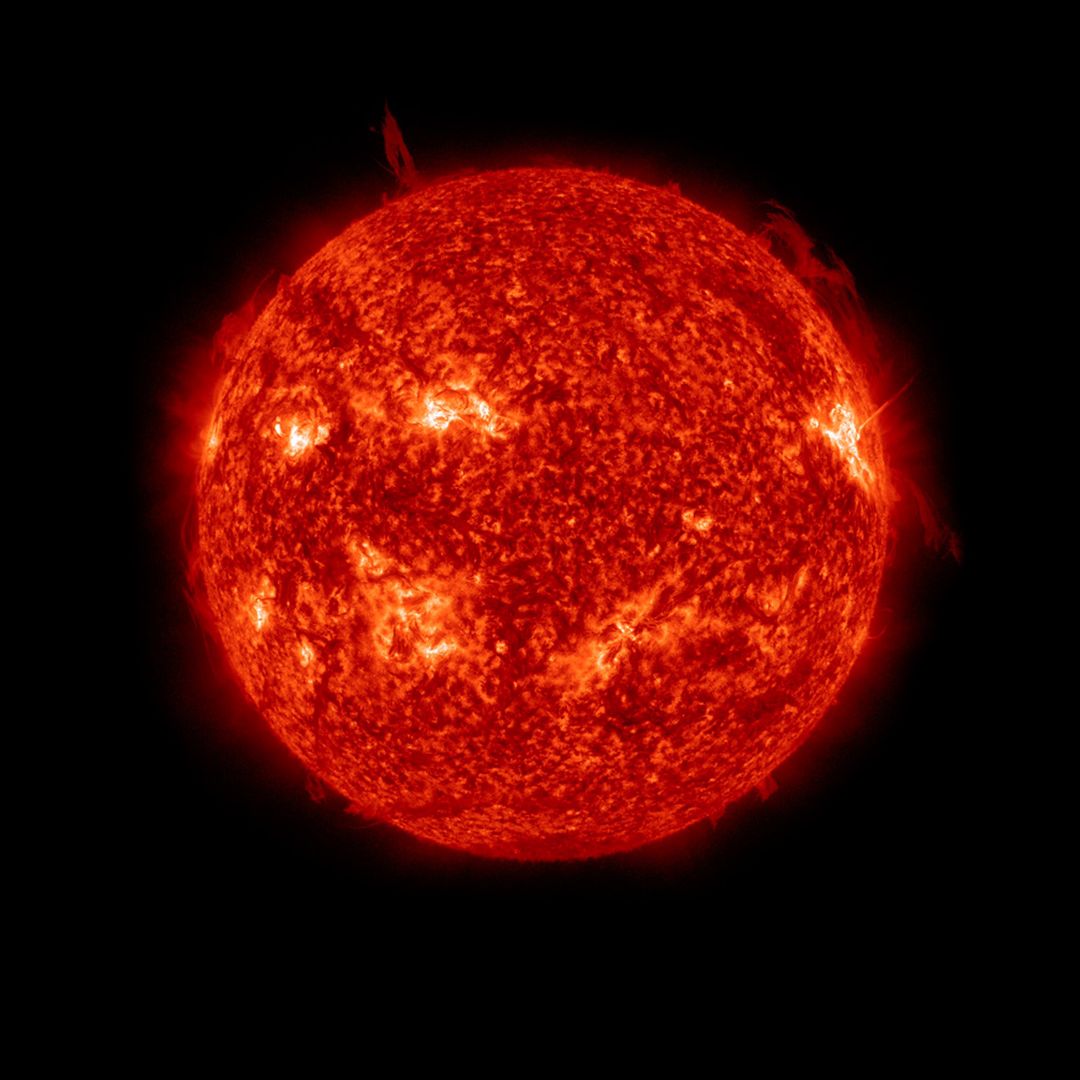
This relationship between size and distance is a perfect example of perspective. The Sun looks like a small disk because it is so far away, but in reality it is a giant sphere of superheated plasma.
The Sun’s Distance Helps Define Our Place in Space
The measurement of 149.6 million kilometers is more than just a number. It provides a reference point for understanding the entire Solar System.
Scientists use astronomical units to describe distances between planets because kilometers become difficult to manage on cosmic scales.
For example, Jupiter is about 5.2 AU from the Sun, while Neptune is about 30 AU away. Beyond Neptune lies the Kuiper Belt, extending tens of astronomical units farther into space.
The Sun’s distance gives astronomers a convenient cosmic ruler for exploring our planetary neighborhood.
A Journey of Light, Energy, and Life
Every ray of sunlight that touches Earth has traveled across an immense ocean of space. It carries energy produced deep inside the Sun through nuclear fusion, where hydrogen atoms combine to form helium and release enormous amounts of energy.
That energy travels outward through the Sun’s layers, escapes into space, crosses 149.6 million kilometers, and finally reaches Earth.
A single beam of sunlight connects a star 150 million kilometers away with oceans, forests, animals, and human beings.
The distance between Earth and the Sun may seem impossibly large, but it is also the perfect cosmic connection that has allowed life to exist.
The Sun: A Distant Star That Feels Close
The Sun is far away—about 149.6 million kilometers from Earth—but its influence reaches every corner of our planet. It controls our climate, powers ecosystems, shapes our days, and provides the energy that sustains life.
When we look at the Sun, we are looking at a star separated from us by an unimaginable distance. Yet every sunrise reminds us that this distant world of fire is deeply connected to our own existence.
The journey of sunlight across space is a reminder of the incredible scale of the universe and the remarkable place Earth occupies within it. Our planet is not too close, not too far, but positioned at a distance where a star’s energy can create something truly extraordinary: a living world.