When most people think about the hottest planet in the Solar System, they immediately guess Mercury. After all, Mercury is the closest planet to the Sun, so it seems logical that it should be the hottest. But nature often surprises us. The title of the hottest planet actually belongs to Venus, Earth’s closest planetary neighbor.
This surprising fact reveals one of the most fascinating stories in planetary science. Venus is a world where temperatures are hot enough to melt lead, where crushing atmospheric pressure would flatten an unprotected spacecraft, and where clouds are made of sulfuric acid instead of water. Yet despite these extreme conditions, Venus is almost the same size as Earth and was likely born from the same cloud of gas and dust billions of years ago.
So why is Venus even hotter than Mercury? The answer lies not in its distance from the Sun, but in the extraordinary atmosphere that surrounds the planet.
Venus Is Not the Closest Planet to the Sun
At first glance, it seems impossible that Venus could be hotter than Mercury.
Mercury orbits the Sun at an average distance of about 58 million kilometers (36 million miles), making it the closest planet to our star. Venus, meanwhile, orbits much farther away at approximately 108 million kilometers (67 million miles).
Because sunlight becomes weaker with distance, Mercury receives roughly twice as much solar energy as Venus.
If distance from the Sun were the only factor controlling planetary temperatures, Mercury would easily be the hottest planet.
But planetary temperatures depend on much more than sunlight alone.
The Real Secret Is Venus’s Atmosphere
The reason Venus is so incredibly hot is its atmosphere.
Unlike Mercury, which has almost no atmosphere at all, Venus is wrapped in an enormously thick blanket of gas.
The atmosphere of Venus is about 96.5% carbon dioxide, with most of the remaining gas being nitrogen. Carbon dioxide is a powerful greenhouse gas that traps heat very efficiently.
This dense atmosphere acts like a giant insulating blanket around the planet.
Sunlight passes through the clouds and reaches the rocky surface. The surface absorbs this energy and warms up. As the hot surface radiates heat back upward as infrared radiation, the carbon dioxide-rich atmosphere absorbs much of that outgoing heat instead of allowing it to escape into space.
The trapped heat builds up over millions of years, creating one of the strongest greenhouse effects known anywhere in the Solar System.
Understanding the Greenhouse Effect
The greenhouse effect is a completely natural physical process.
On Earth, greenhouse gases such as carbon dioxide, methane, and water vapor keep our planet warm enough for liquid water and life to exist. Without this natural greenhouse effect, Earth’s average surface temperature would be around −18°C (0°F) instead of about 15°C (59°F).
Venus, however, takes this process to an extreme.
Its atmosphere contains roughly 90 times more pressure than Earth’s atmosphere at sea level and is packed with carbon dioxide. Almost all the heat reaching the surface becomes trapped beneath this thick atmospheric blanket.
Instead of cooling during the night, Venus remains intensely hot all the time.
The greenhouse effect on Venus is so powerful that it has transformed the planet into a world unlike any other.
Surface Temperatures Hot Enough to Melt Lead
The average surface temperature on Venus is approximately 465°C (869°F).
That is hot enough to melt lead, soften many metals, and destroy most electronic equipment within a short time.
Remarkably, this temperature remains fairly constant across nearly the entire planet.
Whether it is day or night…
Whether you stand near the equator or closer to the poles…
The temperature changes very little.
This happens because the thick atmosphere efficiently circulates heat around the entire planet.
Mercury Gets Extremely Hot—but Also Extremely Cold
Mercury certainly experiences scorching temperatures.
During the daytime, the surface facing the Sun can reach around 430°C (800°F).
That is incredibly hot.
However, Mercury has almost no atmosphere to trap heat.
As soon as the Sun sets, the heat quickly escapes into space.
Nighttime temperatures can plunge to about −180°C (−290°F).
This enormous temperature swing is possible because Mercury lacks the atmospheric insulation that Venus possesses.
Venus, by contrast, remains consistently hotter than Mercury’s daytime maximum.
The Thickest Atmosphere Among the Rocky Planets
The atmosphere of Venus is one of the densest found on any rocky planet.
Standing on the surface of Venus would expose you to atmospheric pressure about 92 times greater than Earth’s sea-level pressure.
This is roughly equivalent to the pressure experienced nearly 900 meters (about 3,000 feet) beneath Earth’s oceans.
Such intense pressure further enhances the greenhouse effect by allowing the atmosphere to hold enormous amounts of heat.
It also makes Venus one of the most hostile environments in the Solar System.
Clouds Made of Sulfuric Acid
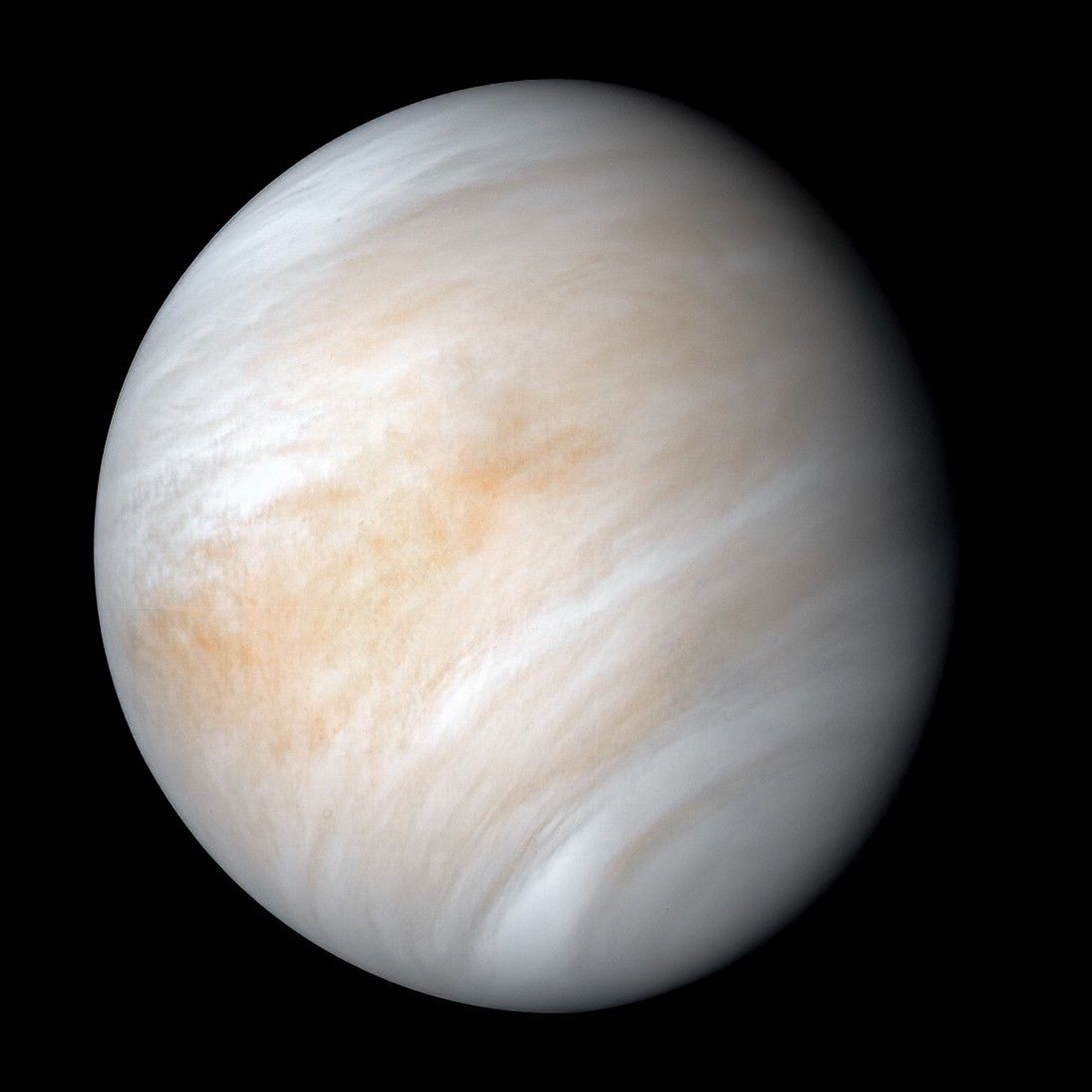
The clouds of Venus look bright and beautiful from space.
But they are anything but welcoming.
Instead of water droplets, these clouds are primarily composed of tiny droplets of sulfuric acid.
These clouds completely hide the planet’s rocky surface from ordinary visible-light telescopes.
Sunlight still penetrates through parts of the cloud layers, but the thick atmosphere beneath them traps much of the outgoing heat.
The clouds also reflect about 75% of the sunlight that reaches Venus.
This means Venus actually absorbs less sunlight than many people expect.
Yet despite reflecting so much solar energy back into space, its powerful greenhouse effect more than compensates, making it the hottest planet.
A Runaway Greenhouse Effect
Scientists believe Venus may have experienced what is known as a runaway greenhouse effect.
Long ago, Venus might have been much more Earth-like.
Some computer models suggest it could even have possessed shallow oceans early in its history, although this remains an active area of scientific research and has not been confirmed.
As the young Sun gradually became brighter, more water would have evaporated into the atmosphere.
Water vapor is itself a strong greenhouse gas.
The increased warming caused even more evaporation.
This positive feedback likely accelerated until enormous amounts of water vapor filled the atmosphere.
Ultraviolet radiation from the Sun eventually broke apart water molecules high above the atmosphere.
The lightweight hydrogen escaped into space, while much of the oxygen reacted with rocks or was otherwise removed through chemical processes.
With its water largely gone, volcanic activity may have continued releasing vast quantities of carbon dioxide.
Over immense periods of time, carbon dioxide accumulated until the runaway greenhouse effect transformed Venus into the scorching world we see today.
Volcanoes May Have Played an Important Role
Venus has thousands of volcanoes scattered across its surface.
Many scientists think volcanic eruptions released enormous amounts of carbon dioxide over billions of years.
Unlike Earth, Venus does not appear to have active plate tectonics like the system that helps recycle carbon into rocks on our planet.
On Earth, carbon dioxide can become locked inside carbonate rocks and eventually be carried into Earth’s interior by moving tectonic plates.
Without an efficient long-term recycling system, carbon dioxide on Venus remained in the atmosphere, allowing the greenhouse effect to grow ever stronger.
Recent spacecraft observations also suggest that at least some volcanoes on Venus may still be geologically active today.
Why Doesn’t the Heat Escape?
On Earth, heat constantly escapes into space.
On Venus, escaping heat faces a major obstacle.
The dense carbon dioxide atmosphere absorbs infrared radiation emitted by the hot surface.
Instead of allowing this energy to escape directly into space, the atmosphere repeatedly absorbs and re-emits it.
This process keeps sending heat back toward the surface, maintaining extraordinarily high temperatures.
It works somewhat like wrapping a hot object in an extremely thick insulating blanket.
The heat has nowhere to go quickly.
Winds Above and Below
The atmosphere of Venus behaves in unusual ways.
High above the clouds, powerful winds race around the planet at speeds exceeding 300 kilometers per hour (about 190 miles per hour).
These winds can circle the planet in just a few Earth days.
Near the surface, however, the dense atmosphere moves much more slowly.
Despite the gentle surface winds, the air is so thick that even slow-moving gas can exert significant force.
The circulation of this massive atmosphere helps distribute heat across the planet, keeping temperatures remarkably uniform.
Day and Night Make Little Difference
On Earth, nighttime brings cooler temperatures because the surface loses heat after sunset.
Venus hardly notices the difference.
Its thick atmosphere stores enormous amounts of thermal energy.
By the time the surface tries to cool, the atmosphere simply radiates much of that heat back downward.
As a result, temperatures stay nearly the same during both day and night.
Venus Rotates Very Slowly
Venus has one of the strangest rotations in the Solar System.
One rotation takes about 243 Earth days, making a Venusian day longer than its year, which lasts about 225 Earth days.
Venus also rotates in the opposite direction compared with most planets.
Although this unusual rotation influences atmospheric circulation, it is not the primary reason Venus is so hot.
The dominant factor remains its extremely dense, carbon dioxide-rich atmosphere.
Spacecraft Have Visited Venus
Because of its extreme environment, Venus is one of the most challenging planets to explore.
Several Soviet Venera spacecraft successfully landed on its surface during the 1970s and 1980s.
These missions transmitted photographs showing a rocky landscape beneath a hazy orange sky.
Most of the landers survived only minutes to a couple of hours before the intense heat and pressure destroyed them.
More recently, orbiting spacecraft have mapped Venus using radar because ordinary cameras cannot see through its thick clouds.
Future missions hope to reveal even more about this mysterious world.
What Venus Teaches Us About Earth
Venus is often called Earth’s “sister planet” because the two worlds are remarkably similar in size, mass, and overall composition.
Yet their environments are dramatically different.
Earth supports oceans, forests, diverse ecosystems, and life.
Venus is an intensely hot, dry world with an atmosphere almost entirely composed of carbon dioxide.
Comparing these neighboring planets helps scientists understand how atmospheres evolve over billions of years.
It also improves our understanding of planetary climate, atmospheric chemistry, and the long-term effects of greenhouse gases under very different conditions.
Could Humans Ever Live on Venus?
Living on the surface of Venus is currently impossible.
The heat, crushing pressure, and corrosive atmosphere make it one of the least hospitable places in the Solar System.
Interestingly, conditions become much less extreme high above the surface.
At altitudes of around 50 to 60 kilometers (31 to 37 miles), temperatures and pressures are closer to those found on Earth.
For this reason, some scientists have proposed the idea of floating research stations or balloons in the upper atmosphere.
These ideas remain theoretical, but they demonstrate how even the harshest planets can inspire creative exploration concepts.
The Importance of Studying Venus
Venus is more than just the hottest planet.
It is a natural laboratory for understanding planetary evolution.
By studying Venus, scientists gain valuable insights into atmospheric physics, volcanic activity, climate change, planetary formation, and the diverse ways rocky planets can develop.
Research on Venus also helps astronomers interpret observations of rocky exoplanets orbiting distant stars.
Many newly discovered planets may resemble Venus more closely than Earth.
Understanding our fiery neighbor therefore improves our understanding of countless worlds across the galaxy.
Conclusion
Venus is the hottest planet in the Solar System not because it is closest to the Sun, but because it possesses one of the most extreme atmospheres ever discovered. Its immense blanket of carbon dioxide traps heat with extraordinary efficiency, creating a runaway greenhouse effect that keeps the surface at an average temperature of about 465°C (869°F)—even hotter than Mercury.
This remarkable planet reminds us that a world’s climate depends on far more than its distance from its star. Atmospheres can dramatically shape a planet’s destiny, turning similar worlds into completely different environments. As scientists continue exploring Venus with new spacecraft and increasingly sophisticated instruments, this mysterious planet will remain one of the most important keys to understanding not only our own Solar System but also the countless rocky planets scattered throughout the universe.