There is a brilliant object that often shines so brightly in the sky that people mistake it for an airplane or even a distant UFO. It appears before sunrise or shortly after sunset, glowing with a steady white light that outshines almost every star. For thousands of years, people across different civilizations admired this mysterious beacon, giving it names inspired by gods, myths, and legends.
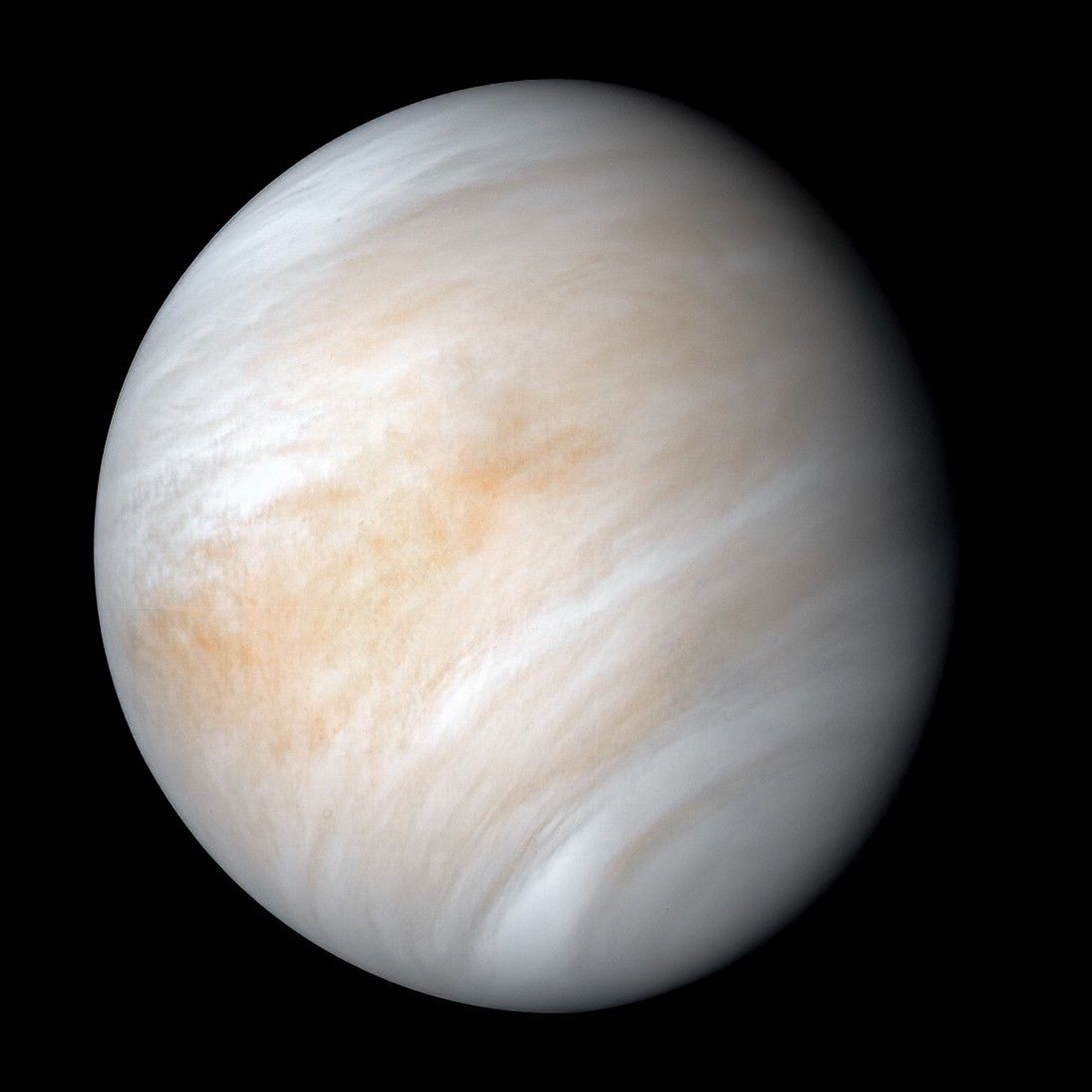
That dazzling object is Venus, the second planet from the Sun and Earth’s closest planetary neighbor for much of its orbit. At first glance, Venus seems like it could be Earth’s twin. It is nearly the same size, has a similar mass, and is made of rocky material just like our own planet.
But appearances can be deceiving.
Beneath its beautiful clouds lies one of the most hostile worlds in the Solar System—a place where temperatures are hot enough to melt lead, the atmosphere is crushingly dense, and clouds rain sulfuric acid. Venus is a world of extremes, and understanding it has changed the way scientists think about planets, climate, and even the possibility of life elsewhere in the universe.
Venus at a Glance
Venus is the second planet from the Sun, orbiting at an average distance of about 108 million kilometers (67 million miles). It completes one trip around the Sun in about 225 Earth days.
Although Venus is slightly smaller than Earth, the two planets are remarkably similar in many ways. Venus has a diameter of about 12,104 kilometers (7,521 miles), making it roughly 95% the size of Earth. It also has nearly the same mass and density, which is why scientists often call Venus Earth’s twin or Earth’s sister planet.
However, the similarities end once you look beneath its thick atmosphere.
Why Is Venus So Bright?
Venus is the brightest planet visible from Earth.
Its extraordinary brightness comes from its thick blanket of clouds, which reflect around 75% of the sunlight that strikes them. This high reflectivity, known as albedo, makes Venus shine brilliantly even though it is farther from Earth than the Moon.
Unlike stars, Venus does not twinkle because it is much closer to Earth than the stars are.
Because Venus stays relatively close to the Sun in our sky, it is usually seen either shortly before sunrise or shortly after sunset. This is why it is often called the Morning Star or the Evening Star, even though it is not actually a star.
Who Named Venus?
The planet is named after Venus, the Roman goddess of love and beauty.
Ancient civilizations noticed its exceptional brightness long before telescopes existed. The Babylonians carefully recorded its movements more than 3,000 years ago. The ancient Greeks once believed the Morning Star and Evening Star were two different objects before realizing they were the same planet.
Nearly every ancient culture recognized Venus because of its striking appearance in the sky.
How Big Is Venus?
Venus is almost the same size as Earth.
If Earth were placed beside Venus, the difference would be surprisingly small. Venus has about 82% of Earth’s mass and approximately 90% of Earth’s surface area.
Because of these similarities, scientists believe both planets likely formed from similar materials about 4.5 billion years ago during the birth of the Solar System.
Yet over billions of years, their histories took dramatically different paths.
Where Is Venus in the Solar System?
Venus is the second planet from the Sun.
Only Mercury orbits closer.
Its neighboring planets are Mercury on the inside and Earth on the outside.
Since Venus orbits inside Earth’s orbit, astronomers call it an inferior planet. This means it never appears far away from the Sun in our sky.
Its greatest apparent separation from the Sun is about 47 degrees, which explains why Venus is visible only during twilight.
What Is Venus Made Of?
Like Earth, Venus is a terrestrial planet, meaning it has a solid rocky surface.
Scientists believe Venus has three major internal layers.
At its center lies a metallic core composed mainly of iron and nickel.
Surrounding the core is a thick rocky mantle.
Above the mantle sits a solid crust made primarily of volcanic rock.
Although the exact structure remains uncertain because no seismic instruments currently operate on Venus, observations suggest its interior resembles Earth’s in many ways.
The Surface of Venus
If you could somehow stand on Venus, you would find yourself in an incredibly strange landscape.
The planet’s surface is covered with enormous volcanic plains, rugged mountains, deep fractures, lava flows, and impact craters.
Much of the surface was reshaped by volcanic activity hundreds of millions of years ago.
Venus has thousands of volcanoes, more than any other rocky planet in the Solar System.
Some scientists suspect that a number of these volcanoes may still be active today. Recent spacecraft observations have revealed changes in volcanic features that may indicate ongoing eruptions, although researchers continue to investigate this possibility.
Because the atmosphere is so dense, sunlight reaching the surface is heavily scattered, creating a dim orange glow rather than bright daylight.
A World Hidden Beneath Clouds
Unlike Mars or the Moon, Venus cannot be seen clearly with ordinary telescopes.
Its entire planet is wrapped in an enormous layer of clouds.
These clouds are not made of water.
Instead, they consist mainly of tiny droplets of sulfuric acid suspended high in the atmosphere.
The cloud layer extends for tens of kilometers and completely hides the surface from visible light.
Scientists had no idea what the surface looked like until radar technology and spacecraft were developed during the twentieth century.
Radar can penetrate the clouds, allowing spacecraft to map the hidden landscape below.
The Hottest Planet in the Solar System
Many people assume Mercury is the hottest planet because it is closest to the Sun.
In reality, Venus is much hotter.
Average surface temperatures reach about 465°C (869°F).
That is hot enough to melt lead.
Even Mercury, despite receiving much more sunlight, becomes cooler than Venus because Mercury has almost no atmosphere to trap heat.
The reason Venus is so incredibly hot lies in its atmosphere.
The Runaway Greenhouse Effect
Venus provides the most dramatic example of the greenhouse effect in the Solar System.
Its atmosphere is composed of about 96.5% carbon dioxide, with most of the remainder being nitrogen and trace gases.
Carbon dioxide traps heat extremely efficiently.
Sunlight passes through the atmosphere and warms the surface.
The hot surface then emits infrared radiation.
Instead of escaping into space, much of this heat becomes trapped by the thick carbon dioxide atmosphere.
Over millions of years, this process created a runaway greenhouse effect, causing temperatures to climb to extraordinary levels.
Scientists study Venus carefully because it helps us understand how greenhouse gases influence planetary climates.
An Atmosphere Unlike Earth’s
The atmosphere of Venus is one of the densest found on any rocky planet.
At the surface, atmospheric pressure is about 92 times greater than Earth’s.
This is roughly equivalent to the pressure experienced nearly 900 meters (about 3,000 feet) beneath Earth’s oceans.
A human without specialized protection would be crushed almost instantly.
The atmosphere is also filled with carbon dioxide, sulfur dioxide, and thick clouds of sulfuric acid.
Despite these harsh conditions, the upper atmosphere is much cooler than the surface.
Does It Rain on Venus?
Venus does have rain—but not in the way we usually imagine.
High in the atmosphere, sulfuric acid droplets form clouds.
Some of these droplets grow large enough to begin falling.
However, the lower atmosphere is so hot that the droplets evaporate long before reaching the surface.
As a result, sulfuric acid rain never actually reaches the ground.
The surface remains completely dry.
Winds on Venus
Near the surface, winds move relatively slowly because of the dense atmosphere.
High above the clouds, however, the situation is completely different.
Powerful winds race around the planet at speeds exceeding 300 kilometers per hour (about 190 miles per hour).
These winds circle the planet much faster than Venus itself rotates, a phenomenon known as atmospheric super-rotation.
Scientists are still studying why Venus’s atmosphere behaves this way.
A Day Longer Than a Year
Venus has one of the strangest rotations in the Solar System.
It rotates incredibly slowly.
One complete rotation takes about 243 Earth days.
Its year, however, lasts only 225 Earth days.
That means a day on Venus is actually longer than its year.
Even more unusual, Venus rotates in the opposite direction compared to most planets.
On Venus, the Sun appears to rise in the west and set in the east.
This backward rotation is called retrograde rotation.
Astronomers are still investigating exactly why Venus spins this way.
Does Venus Have Seasons?
Venus experiences almost no seasons.
Unlike Earth, whose tilted axis creates changing seasons, Venus has an axial tilt of only about 3 degrees.
Because the tilt is so small, sunlight strikes the planet in nearly the same way throughout its year.
Combined with its thick atmosphere, temperatures remain remarkably consistent across most of the planet.
Does Venus Have Moons?
Unlike Earth, Mars, Jupiter, or Saturn, Venus has no natural moons.
It also has no known rings.
Scientists are not entirely certain why Venus lacks a moon.
Its unusual rotational history and early evolution may have prevented long-term satellite formation or survival.
Magnetic Field
Earth’s strong magnetic field protects us from many charged particles coming from the Sun.
Venus does not have a similar global magnetic field.
Instead, interactions between the solar wind and the upper atmosphere create a weak induced magnetic field.
Without a strong protective magnetic shield, the solar wind has gradually stripped away parts of Venus’s atmosphere over billions of years.
Could Life Exist on Venus?
The surface of Venus is far too extreme for any known form of life.
The crushing pressure, scorching temperatures, and chemically hostile environment make survival impossible for organisms as we know them.
However, scientists have wondered whether microscopic life could potentially survive high in the atmosphere, where temperatures and pressures are much milder.
This idea remains highly speculative.
Although some studies have suggested unusual atmospheric chemistry, there is currently no confirmed evidence that life exists on Venus.
Future missions may help answer this fascinating question.
Spacecraft That Explored Venus
Venus has been visited by many spacecraft.
The Soviet Union’s Venera missions achieved remarkable milestones by landing on the surface. Although the extreme environment destroyed the landers relatively quickly, they returned humanity’s first photographs from another planet’s surface.
NASA’s Magellan spacecraft used radar to create highly detailed maps of Venus beneath its thick clouds.
More recently, missions such as Akatsuki, operated by the Japan Aerospace Exploration Agency, have continued studying the planet’s atmosphere and weather.
Future missions from NASA and the European Space Agency aim to investigate Venus’s geology, atmosphere, and possible volcanic activity in unprecedented detail.
Why Scientists Are So Interested in Venus
Venus may hold important clues about Earth’s future.
Billions of years ago, Venus might have had liquid water on its surface. Some computer models suggest that early Venus may even have possessed oceans for extended periods, though this remains an active area of research.
If that was true, something caused the planet to transform into the hottest world in the Solar System.
Understanding exactly how and why that transformation occurred could improve scientists’ knowledge of planetary evolution, climate change, atmospheric chemistry, and the conditions that make planets habitable.
Venus also serves as an important comparison for thousands of rocky exoplanets now being discovered around other stars.
Venus in the Night Sky
Watching Venus is one of the easiest ways to explore astronomy.
Because it shines so brightly, it is often visible even from cities filled with artificial lights.
Through a small telescope, Venus shows phases much like the Moon. Sometimes it appears as a thin crescent, while at other times it looks nearly full.
These changing phases were first carefully observed by Galileo Galilei in the early seventeenth century. They provided strong evidence that Venus orbits the Sun, supporting the heliocentric model of the Solar System.
Even today, seeing Venus through a telescope remains one of the most rewarding experiences for beginning astronomers.
The Future of Venus Exploration
Scientists believe the next generation of missions will reveal more about Venus than ever before.
Advanced radar systems will map its surface in extraordinary detail. Atmospheric probes will measure the planet’s chemistry with greater precision. Orbiters will search for signs of active volcanism, while future landers may survive longer than any before them thanks to improved technology.
Each mission brings us closer to understanding how a planet so similar to Earth became so dramatically different.
Conclusion
Venus is a world of striking contrasts. From Earth, it appears as a beautiful jewel shining brilliantly in the twilight sky. Up close, it reveals an unforgiving landscape hidden beneath thick clouds, where crushing pressure and searing heat create one of the most extreme environments in the Solar System.
Yet this harsh planet is far more than a cosmic curiosity. Venus offers a powerful lesson about planetary evolution, climate, and the delicate balance that makes a world habitable. By studying Venus, scientists gain valuable insights into Earth’s past, the climates of distant exoplanets, and the forces that shape rocky planets throughout the universe.
Every time Venus appears in the evening or morning sky, it reminds us that even our closest planetary neighbor still holds mysteries waiting to be uncovered.