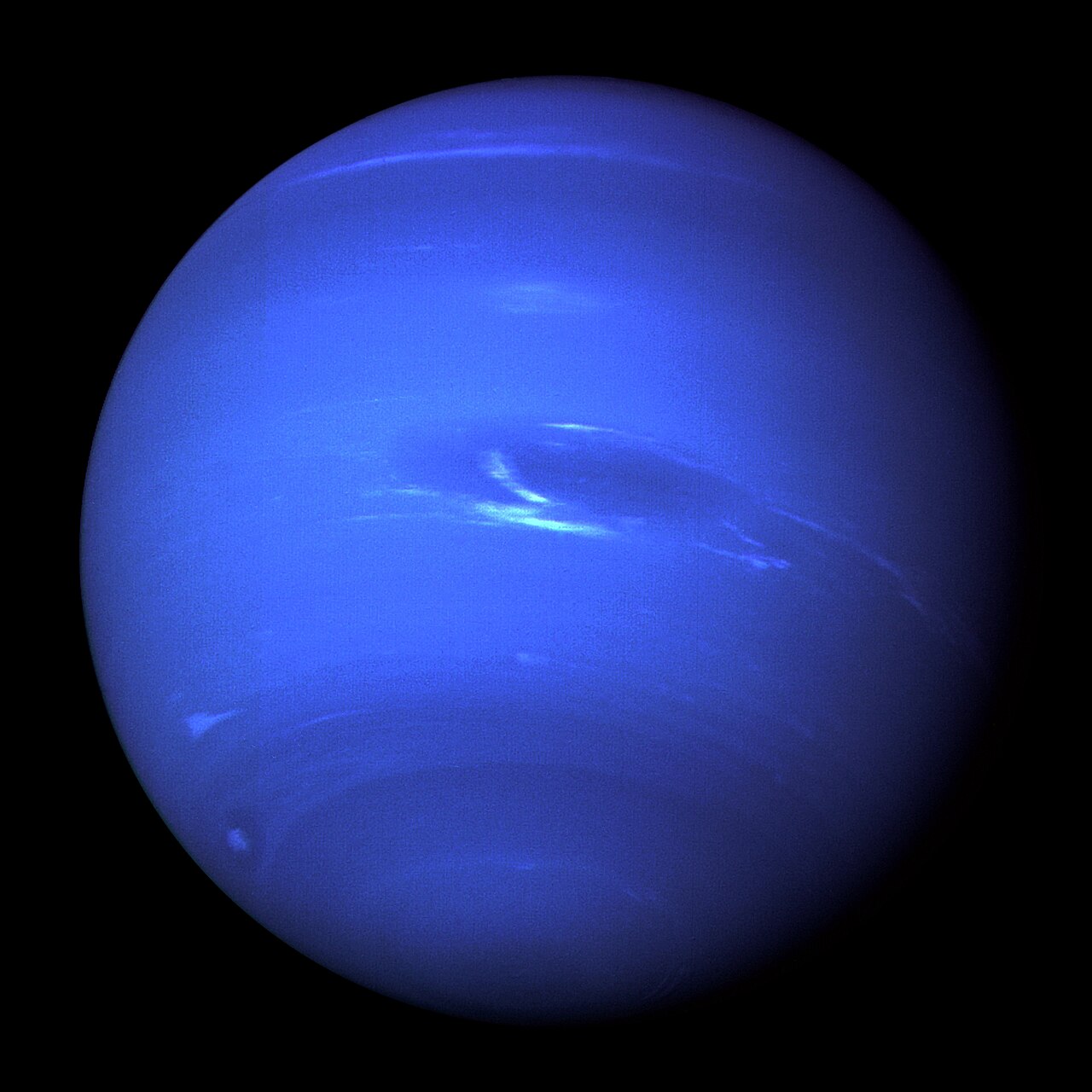
Far beyond the orbit of Saturn and even beyond the icy world of Uranus lies a planet that has fascinated astronomers for generations. Neptune, the eighth and most distant major planet from the Sun, shines with a stunning deep blue color unlike anything else in the Solar System. When spacecraft first sent back close-up images of Neptune, people around the world were amazed. The planet looked like a brilliant sapphire floating in the darkness of space.
But why is Neptune blue? Is it covered by a giant blue ocean? Is its surface made of ice? Does it have blue clouds?
The answer is far more fascinating than any science fiction story. Neptune’s beautiful color comes from a combination of its atmosphere, sunlight, and tiny particles floating high above the planet. It is a perfect example of how the laws of physics and chemistry can create extraordinary beauty on a planetary scale.
Understanding why Neptune is blue also helps scientists learn more about the atmospheres of distant planets, including giant worlds orbiting other stars.
Meeting Neptune
Neptune is the eighth planet from the Sun and the fourth-largest planet by diameter. It belongs to a group of planets known as the ice giants, along with Uranus. Although both planets contain hydrogen and helium like Jupiter and Saturn, they also have much larger amounts of water, ammonia, and methane deep inside their interiors.
Neptune is enormous. It measures nearly 49,500 kilometers (about 30,800 miles) across, making it almost four times wider than Earth. Yet despite its size, it is incredibly far away. On average, Neptune orbits about 4.5 billion kilometers (2.8 billion miles) from the Sun.
At such a great distance, sunlight reaching Neptune is only about one nine-hundredth as bright as the sunlight Earth receives. Even so, enough sunlight reaches the planet to create the beautiful blue appearance we see through telescopes and spacecraft.
Neptune Is Not Blue Because of Water
One of the most common misconceptions about Neptune is that its blue color comes from water.
This idea is understandable because water on Earth often appears blue in oceans and lakes. However, Neptune’s atmosphere is not made of liquid water, and there are no vast blue oceans covering the visible part of the planet.
Instead, what we see is the upper atmosphere—a thick blanket of gases stretching thousands of kilometers above the planet.
The atmosphere is primarily made of hydrogen and helium, with a much smaller amount of methane. Although methane makes up only a small percentage of Neptune’s atmosphere, it plays a major role in determining the planet’s color.
Sunlight Contains Every Color
To understand Neptune’s color, we first need to understand sunlight.
Although sunlight looks white to our eyes, it actually contains all the colors of the visible spectrum.
When sunlight passes through a prism, it separates into red, orange, yellow, green, blue, indigo, and violet.
Every object in the Solar System interacts with sunlight differently.
Some materials absorb certain colors while reflecting others.
A ripe tomato appears red because it reflects red light and absorbs many other colors.
Fresh grass appears green because it reflects green wavelengths.
Neptune follows the same basic principle—but on a planetary scale.
Methane Is the Key Ingredient
The biggest reason Neptune looks blue is methane gas in its atmosphere.
Methane molecules absorb red wavelengths of sunlight much more effectively than blue wavelengths.
When sunlight reaches Neptune, the methane removes much of the red light by absorbing it.
The remaining blue and green light is scattered and reflected back into space.
As a result, anyone observing Neptune from far away sees a planet dominated by shades of blue.
This simple interaction between sunlight and methane creates one of the Solar System’s most recognizable appearances.
Why Isn’t Neptune Green?
This question puzzled scientists for many years.
If methane absorbs red light while allowing both blue and green light to remain, shouldn’t Neptune appear greenish instead of deep blue?
For decades, researchers knew methane alone could not fully explain Neptune’s color.
Modern observations have revealed that another important ingredient is involved.
Tiny particles known as atmospheric aerosols, along with hazes suspended high in Neptune’s atmosphere, influence how light is scattered.
These particles interact with sunlight in ways that suppress some of the green light, allowing the planet to appear richer and bluer than methane absorption alone would produce.
The result is the beautiful deep blue color that makes Neptune stand out among all the planets.
The Difference Between Neptune and Uranus
At first glance, Neptune and Uranus seem very similar.
Both are ice giants.
Both contain hydrogen, helium, and methane.
Both appear blue.
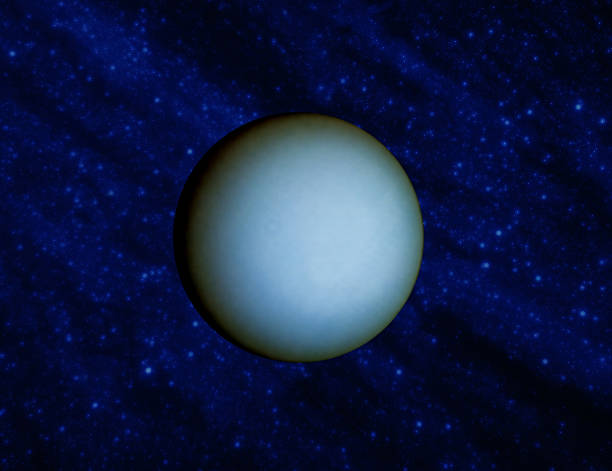
Yet Neptune is noticeably darker and more vividly blue than Uranus.
For many years, this difference remained something of a mystery.
Recent scientific studies suggest that the atmospheres of the two planets are not identical.
Neptune appears to have a thinner haze layer in parts of its atmosphere than Uranus. This difference changes how sunlight is scattered and reflected.
In addition, Neptune’s atmosphere is much more active. Powerful storms, strong winds, and constantly changing clouds help shape the planet’s appearance.
These atmospheric differences likely explain why Neptune displays a deeper, more saturated blue than its neighboring ice giant.
The Atmosphere Is Constantly Changing
Although Neptune appears calm from a great distance, it is actually one of the most dynamic worlds in the Solar System.
Its atmosphere is filled with enormous storms.
White clouds made of methane ice drift through the upper atmosphere.
Dark storm systems sometimes appear and disappear over periods of years.
These changing weather patterns slightly affect how the planet looks over time.
Fortunately, the overall blue color remains because methane continues absorbing red light regardless of the changing clouds.
Neptune Has the Fastest Winds in the Solar System
One of Neptune’s greatest surprises is its weather.
Despite receiving very little heat from the distant Sun, Neptune experiences incredibly powerful storms.
Wind speeds can exceed 2,000 kilometers per hour (about 1,200 miles per hour), making them the fastest sustained planetary winds known in the Solar System.
Scientists are still investigating why such violent weather exists on a planet so far from the Sun.
One possible explanation is that Neptune produces more internal heat than Uranus.
This extra energy may help drive its powerful atmospheric circulation.
These winds transport clouds, reshape storms, and constantly stir the atmosphere where Neptune’s blue color is produced.
Layers of Neptune’s Atmosphere
Neptune’s atmosphere is far from simple.
The upper atmosphere contains hydrogen, helium, and methane, along with hazes and thin clouds.
Lower down, pressure increases enormously.
Clouds made from methane ice form where temperatures are cold enough for methane to condense.
Even deeper, scientists think clouds of ammonia, hydrogen sulfide, and water may exist under crushing pressures.
Far below the visible clouds lies an unusual mantle composed of hot, dense fluids rich in water, ammonia, and methane.
Still deeper is Neptune’s rocky core.
Because we can only directly observe the outer atmosphere, the brilliant blue color comes entirely from these upper atmospheric layers.
What Did Voyager 2 See?
The only spacecraft to visit Neptune up close was Voyager 2.
It flew past the planet in August 1989 after a remarkable journey across the Solar System.
Its images transformed our understanding of Neptune.
Scientists saw bright white methane clouds.
They discovered enormous storms, including the famous Great Dark Spot, a giant weather system similar in some ways to Jupiter’s Great Red Spot.
Voyager 2 also found faint rings, several new moons, and confirmed Neptune’s deep blue appearance with far greater detail than had ever been seen before.
Its observations remain one of the greatest achievements in planetary exploration.
Does Neptune Look Blue to Human Eyes?
This is an interesting question because spacecraft images are often processed to represent colors accurately.
If an astronaut could somehow safely observe Neptune from nearby, the planet would indeed appear blue.
However, the exact shade might differ somewhat depending on lighting conditions, viewing angle, and the sensitivity of human vision.
Modern image processing techniques aim to reproduce colors as realistically as possible based on scientific measurements.
Recent studies using improved atmospheric models have shown that Neptune’s true color is a rich azure blue rather than the exaggerated dark blue sometimes seen in older published images.
Why Studying Neptune’s Color Matters
Neptune’s color is more than just a beautiful feature.
It provides scientists with valuable clues about the planet’s atmosphere.
By analyzing the light reflected from Neptune, researchers can estimate the amounts of methane, determine the thickness of haze layers, study cloud formation, and monitor seasonal changes.
The same techniques are now being used to study planets orbiting distant stars.
When astronomers observe an exoplanet, they often cannot see its surface directly.
Instead, they analyze the light passing through or reflecting from its atmosphere.
The knowledge gained from Neptune helps scientists interpret those distant worlds with greater confidence.
Neptune’s Blue Color Changes With Light
Like many objects in space, Neptune does not always appear exactly the same.
The brightness of sunlight, the angle of observation, cloud coverage, and atmospheric conditions all influence its appearance.
Professional astronomers use instruments that observe many different wavelengths of light, including infrared and ultraviolet radiation.
In these invisible wavelengths, Neptune can look dramatically different from what human eyes would see.
Each wavelength reveals different layers of the atmosphere, helping scientists build a three-dimensional picture of the planet.
A Planet Painted by Physics
Perhaps the most remarkable thing about Neptune’s color is that it is created entirely by natural physical processes.
No giant ocean paints the planet blue.
No mysterious mineral colors its clouds.
Instead, sunlight travels billions of kilometers across space, enters Neptune’s methane-rich atmosphere, loses much of its red light through absorption, and is then scattered by gases and tiny atmospheric particles before returning to space.
What our eyes finally see is the result of countless interactions between photons and molecules.
It is a masterpiece created not by an artist, but by the laws of physics.
Neptune Still Holds Many Mysteries
Although scientists now understand much more about Neptune’s color than they once did, many questions remain unanswered.
Researchers continue investigating how the planet’s hazes form, how its storms evolve, and why its atmosphere behaves differently from Uranus despite their similar compositions.
Future space missions equipped with advanced cameras, spectrometers, and atmospheric probes could reveal details that are impossible to study from Earth alone.
Every new observation helps improve our understanding not only of Neptune but also of giant planets throughout the universe.
Conclusion
Neptune’s magnificent blue color is one of the most beautiful sights in our Solar System, but it is also a story of science in action. Rather than coming from oceans or icy surfaces, the planet’s color is created by methane gas absorbing red sunlight while blue light is scattered back into space. Tiny atmospheric particles and hazes further shape the reflected light, giving Neptune its rich and distinctive appearance.
This distant ice giant reminds us that even something as simple as color can reveal the hidden workings of an entire planet. From billions of kilometers away, Neptune quietly demonstrates how sunlight, chemistry, and atmospheric physics combine to create extraordinary beauty. Every time we look at its brilliant blue disk, we are seeing the elegant result of nature’s fundamental laws operating on a truly planetary scale.