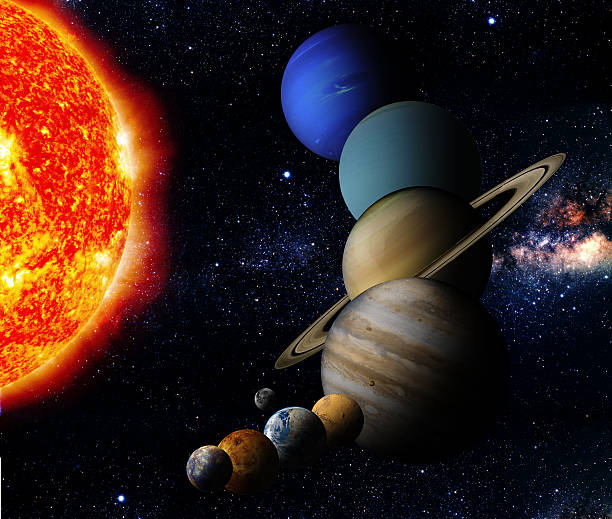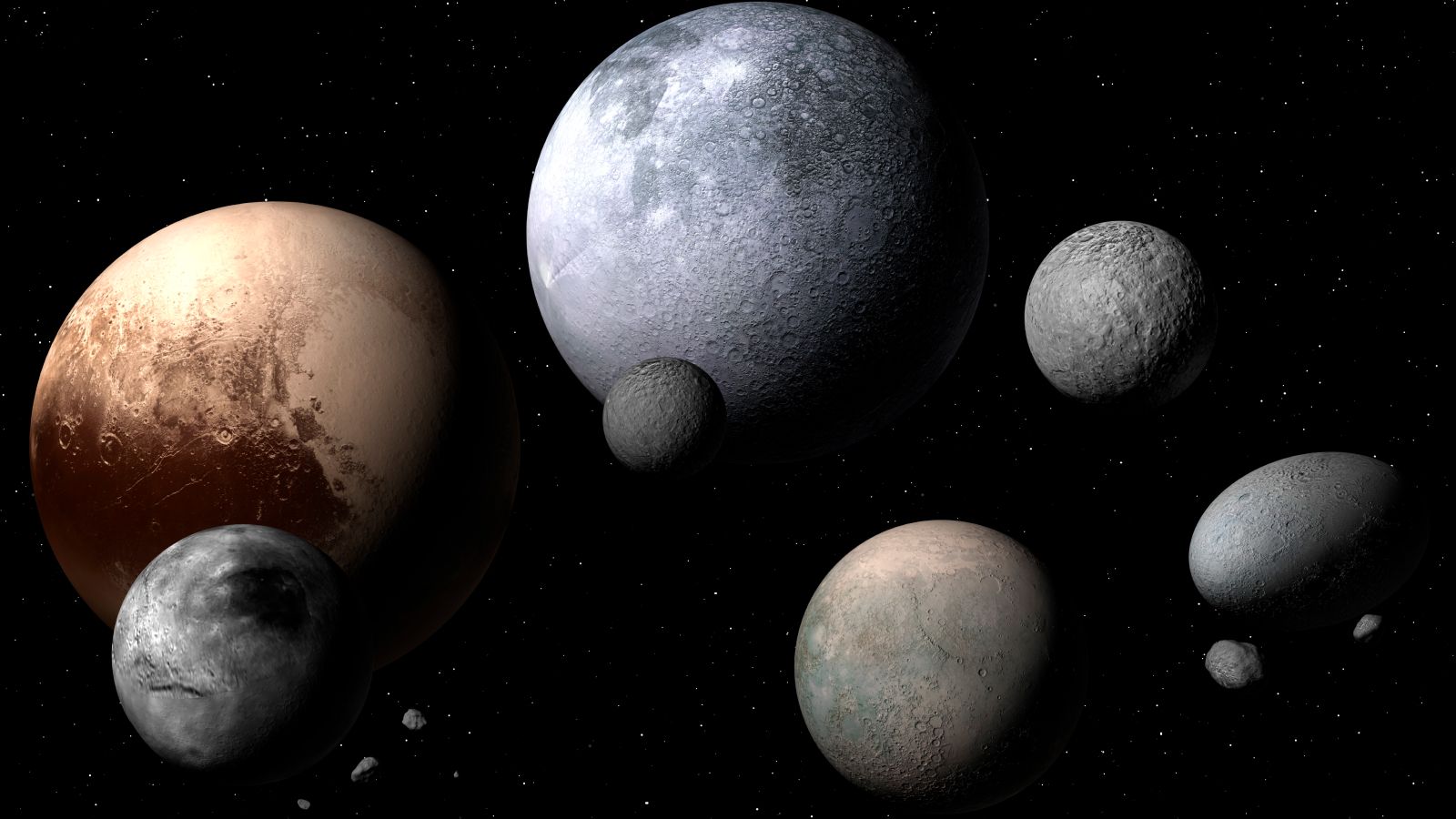
The Solar System is filled with incredible worlds. While most people are familiar with the eight major planets—Mercury, Venus, Earth, Mars, Jupiter, Saturn, Uranus, and Neptune—there are many smaller worlds that are just as fascinating. Some are icy, some are rocky, and some lie so far from the Sun that sunlight is only a faint glow in their skies. Among these remarkable objects is a unique group known as dwarf planets.
Although they share many characteristics with the planets we know, dwarf planets belong to a category of their own. They are worlds large enough to become nearly round under their own gravity, yet they have not completely dominated the regions around their orbits. This seemingly small difference makes them one of the most interesting types of objects in our Solar System.
From the famous Pluto to the distant Eris and the mysterious Sedna, dwarf planets continue to reshape our understanding of how planetary systems form and evolve. They remind us that the Solar System is far richer and more diverse than scientists once imagined.
Understanding the Meaning of a Dwarf Planet
A dwarf planet is a celestial body that orbits the Sun and is massive enough for its own gravity to pull it into a nearly spherical shape. However, unlike the eight major planets, it has not cleared the neighborhood around its orbit of other objects.
This definition was officially established by the International Astronomical Union (IAU) in 2006. The decision created a new category of Solar System objects that sit between planets and smaller bodies such as asteroids.
Despite the name, a dwarf planet is not simply a tiny version of a planet. It belongs to its own scientific classification. In astronomy, the word “dwarf” describes its place in the classification system rather than suggesting that it is less interesting or less important.
Why Was the Term “Dwarf Planet” Created?
For many decades, Pluto was considered the ninth planet in the Solar System. It held this title from its discovery in 1930 until the early twenty-first century.
As telescopes improved, astronomers began discovering many large icy objects beyond Neptune. Some of these objects were surprisingly similar to Pluto. One of them, Eris, was even found to be slightly more massive than Pluto.
Scientists faced an important question. Should every newly discovered Pluto-like object become a planet? If so, the number of planets could continue growing indefinitely as more objects were found.
To solve this problem, astronomers developed a clearer definition of what qualifies as a planet. Under this new definition, Pluto no longer met all the required criteria and was placed into the newly created category of dwarf planets.
Although the decision sparked public debate, it also reflected the growing scientific understanding of the Solar System.
The Official Definition of a Dwarf Planet
According to the International Astronomical Union, a dwarf planet must satisfy several important conditions.
First, it must orbit the Sun directly rather than orbiting another planet.
Second, it must have enough mass for its own gravity to shape it into a nearly round form. This process is known as hydrostatic equilibrium, where gravity pulls material inward until the object becomes almost spherical.
Third, it must not have cleared the neighborhood around its orbit. In other words, it shares its orbital region with many other objects instead of becoming the dominant gravitational body there.
Finally, it must not be a natural satellite, meaning it cannot be a moon orbiting another planet.
These characteristics distinguish dwarf planets from both major planets and smaller Solar System bodies.
What Does “Clearing the Orbit” Mean?
One of the most important differences between a planet and a dwarf planet involves the idea of clearing an orbit.
Over billions of years, the gravity of a large planet either pulls nearby objects into itself, captures them as moons, or pushes them into different orbits. As a result, the planet becomes the dominant object in its region of space.
Earth, for example, dominates the area around its orbit. While small asteroids occasionally cross Earth’s path, our planet is overwhelmingly the largest object in that orbital zone.
Pluto, on the other hand, travels through the Kuiper Belt, a vast region filled with countless icy bodies beyond Neptune. It shares this region with many objects of similar size and therefore has not cleared its neighborhood.
This is the key reason Pluto is classified as a dwarf planet rather than a major planet.
Pluto: The World’s Most Famous Dwarf Planet
No dwarf planet is better known than Pluto.
Discovered in 1930 by American astronomer Clyde Tombaugh, Pluto was celebrated as the Solar System’s ninth planet for more than seventy-five years.
Although smaller than Earth’s Moon, Pluto is a surprisingly complex world. It has towering mountains made of water ice, vast plains covered with frozen nitrogen, glaciers that slowly flow across its surface, and a thin atmosphere that expands and contracts as Pluto moves around the Sun.
In 2015, NASA’s New Horizons spacecraft made the first close flyby of Pluto. The mission completely transformed our understanding of this distant world.
Instead of a frozen, inactive object, scientists found an astonishing landscape filled with young geological features, enormous ice plains, possible cryovolcanoes, and evidence of ongoing geological activity.
Today, Pluto remains one of the most scientifically exciting worlds in the Solar System.
Ceres: The Closest Dwarf Planet
Unlike Pluto, Ceres lies much closer to Earth.
It orbits within the asteroid belt between Mars and Jupiter and is the largest object found there.
Discovered in 1801, Ceres was originally considered a planet before later being classified as an asteroid. In 2006, it became officially recognized as a dwarf planet.
Ceres contains significant amounts of water ice beneath its surface. Scientists believe it may even possess underground reservoirs of salty liquid water.
NASA’s Dawn spacecraft explored Ceres between 2015 and 2018, revealing mysterious bright deposits inside impact craters. These bright areas were eventually identified as salt-rich materials left behind by water that reached the surface and evaporated.
Ceres demonstrates that even relatively small worlds can have surprisingly active geological histories.
Eris: The Discovery That Changed Everything
Eris played a major role in changing how astronomers classify planets.
Discovered in 2005, Eris orbits far beyond Pluto in a distant region known as the scattered disk.
When scientists realized that Eris was similar in size—and even more massive than Pluto—they recognized that the existing definition of a planet was no longer sufficient.
Rather than continually adding new planets to the Solar System, astronomers established the dwarf planet category.
Ironically, Eris itself became one of the first officially recognized dwarf planets.
Although extremely distant from Earth, Eris continues to provide valuable clues about the outer Solar System.
Haumea: A World Unlike Any Other
Haumea is one of the most unusual objects in the Solar System.
Instead of being nearly spherical, it has an elongated, football-like shape because it spins incredibly fast. One complete rotation takes less than four hours, making it one of the fastest-rotating large objects known.
Haumea also possesses a thin ring system, making it one of the few known Solar System bodies outside the giant planets to have rings.
Its surface appears to be covered largely with crystalline water ice, giving it a bright appearance.
Scientists believe Haumea may have formed after a massive collision billions of years ago.
Makemake: A Frozen World Beyond Neptune
Makemake is another dwarf planet located in the Kuiper Belt.
Discovered in 2005, it is slightly smaller than Pluto but still large enough for gravity to shape it into a nearly round object.
Makemake has an extremely cold surface covered with frozen methane and other ices. Temperatures there are so low that many gases freeze into solid form.
Although it lacks a thick atmosphere today, scientists think it may briefly develop a very thin atmosphere when it approaches the Sun during its long orbit.
Makemake also has at least one known moon, helping astronomers estimate its mass.
Are There More Dwarf Planets?
Almost certainly.
Astronomers have already identified several officially recognized dwarf planets, but many more candidates await confirmation.
The outer Solar System contains thousands of icy bodies, and many are large enough that gravity may have shaped them into nearly spherical worlds.
Objects such as Sedna, Orcus, Gonggong, Quaoar, and Salacia are among the most promising dwarf planet candidates. As observations improve, additional objects may eventually receive official dwarf planet status.
Some scientists estimate that the Solar System could contain dozens or even hundreds of dwarf planets.
Where Are Dwarf Planets Found?
Dwarf planets are distributed across different regions of the Solar System.
Ceres resides within the asteroid belt.
Pluto, Haumea, and Makemake are members of the Kuiper Belt, a broad region extending beyond Neptune that contains countless icy objects left over from the formation of the Solar System.
Eris belongs to the scattered disk, where objects follow highly elongated and tilted orbits.
Future discoveries may reveal dwarf planets in even more distant regions, including the mysterious Oort Cloud, which surrounds the Solar System at enormous distances.
What Are Dwarf Planets Made Of?
The composition of a dwarf planet depends largely on its location.
Ceres contains abundant rock mixed with water ice.
The more distant dwarf planets are composed mainly of rock combined with frozen water, methane, nitrogen, carbon monoxide, and other volatile compounds.
Because temperatures in the outer Solar System are incredibly low, substances that exist as gases on Earth remain permanently frozen there.
These frozen materials create colorful surfaces and fascinating geological landscapes unlike anything found on our own planet.
Do Dwarf Planets Have Atmospheres?
Some do.
Pluto possesses a thin atmosphere primarily made of nitrogen, along with small amounts of methane and carbon monoxide.
As Pluto approaches the Sun during its 248-year orbit, surface ice slowly evaporates and thickens the atmosphere.
When Pluto moves farther away, the atmosphere freezes and falls back onto the surface as ice.
This seasonal cycle is unlike anything experienced on Earth.
Other dwarf planets may also develop temporary atmospheres under certain conditions.
Can Dwarf Planets Have Moons?
Yes.
Many dwarf planets have natural satellites.
Pluto has five known moons, with Charon being by far the largest. Charon is so massive relative to Pluto that the two objects orbit a point in space located between them rather than inside Pluto itself.
Haumea, Makemake, and Eris also have moons.
Studying these moons helps astronomers determine the mass, density, and internal structure of their parent dwarf planets.
How Do Scientists Study Dwarf Planets?
Because dwarf planets are extremely distant, studying them is challenging.
Astronomers use powerful ground-based telescopes and space telescopes to observe their brightness, colors, motion, and composition.
Spectroscopy allows scientists to identify the chemical substances present on their surfaces by analyzing reflected sunlight.
Occasionally, spacecraft provide close-up observations.
NASA’s Dawn mission explored Ceres, while the New Horizons mission revolutionized our understanding of Pluto.
Future missions may one day visit other dwarf planets, revealing entirely new worlds.
Why Are Dwarf Planets Important?
Dwarf planets are ancient survivors from the birth of the Solar System approximately 4.6 billion years ago.
Unlike the larger planets, many of them have changed relatively little since their formation.
They preserve valuable clues about the materials that existed when the Sun and planets first formed.
By studying dwarf planets, scientists can learn how planets grow, how icy bodies evolve, how water and organic molecules spread throughout the Solar System, and how planetary systems develop around other stars.
These seemingly small worlds hold enormous scientific importance.
Could Humans Visit a Dwarf Planet?
In theory, yes.
However, reaching most dwarf planets would require long and technically challenging space missions.
The New Horizons spacecraft needed more than nine years to travel from Earth to Pluto, even though it was one of the fastest spacecraft ever launched.
Future generations of spacecraft, powered by more advanced propulsion systems, may someday orbit or even land on additional dwarf planets.
Such missions could reveal hidden oceans, unusual geology, and perhaps entirely new discoveries about the early Solar System.
The Future of Dwarf Planet Exploration
Astronomy continues to advance rapidly.
More powerful telescopes are discovering increasingly distant objects, while improved computer models help scientists understand how dwarf planets formed.
The Vera C. Rubin Observatory and future space telescopes are expected to discover many new objects in the outer Solar System, including additional dwarf planet candidates.
Each discovery expands our picture of the Solar System and reminds us that many worlds remain unexplored.
Conclusion
A dwarf planet is a unique type of celestial body that orbits the Sun, has enough gravity to become nearly round, but has not cleared the surrounding region of its orbit. Although smaller than the eight major planets, dwarf planets are complete worlds with their own landscapes, histories, and scientific mysteries.
From the icy plains of Pluto and the salt-rich surface of Ceres to the distant realms of Eris, Haumea, and Makemake, dwarf planets reveal that our Solar System is far more diverse than once believed. They preserve ancient records of planetary formation, challenge our understanding of what defines a planet, and continue to inspire new discoveries.
Far from being “lesser planets,” dwarf planets are extraordinary worlds in their own right. They remind us that even the smallest members of the Solar System can hold some of the greatest secrets about the origins and evolution of our cosmic neighborhood.