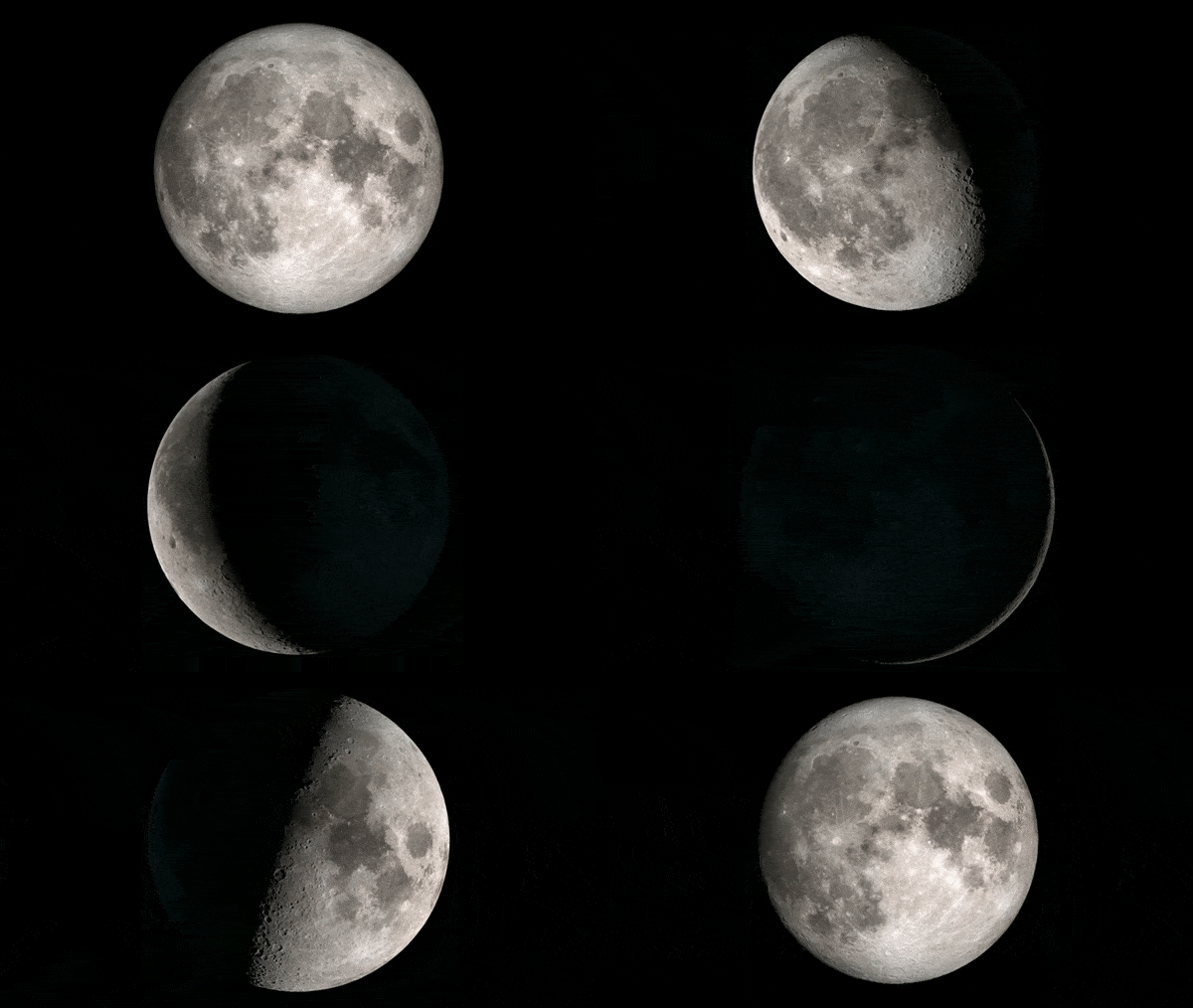
Look up at the night sky on different evenings, and you will notice something fascinating. Sometimes the Moon appears as a thin silver crescent. A week later it grows into a bright half-circle. Soon it becomes a magnificent full Moon that lights up the landscape, only to slowly shrink again until it seems to disappear entirely. This repeating cycle has fascinated humanity for thousands of years, inspiring myths, calendars, festivals, poems, and scientific discoveries.
Yet the Moon itself is not changing shape. It is always a nearly spherical world, quietly orbiting Earth. What changes is how much of its sunlit half we can see from our planet. This beautiful and predictable pattern is known as the Moon’s phases.
Understanding the Moon’s phases not only helps us appreciate the beauty of the night sky but also reveals how Earth, the Moon, and the Sun move together in space. It is one of the easiest and most rewarding astronomical phenomena to observe because anyone can watch it unfold simply by looking up over the course of a month.
What Are the Moon’s Phases?
The Moon’s phases are the different appearances of the Moon as seen from Earth during its monthly orbit around our planet.
The Moon does not produce its own light. Instead, it reflects sunlight, much like a giant mirror in space. At any given moment, half of the Moon is illuminated by the Sun, while the other half remains in darkness. As the Moon travels around Earth, our viewing angle changes, allowing us to see different portions of its sunlit side.
The changing amount of the illuminated half that is visible from Earth creates the familiar cycle of lunar phases.
This cycle repeats approximately every 29.5 days, a period known as the synodic month.
Why Does the Moon Change Shape?
One of the biggest misconceptions is that Earth’s shadow causes the Moon’s phases.
This is not true.
Earth’s shadow only falls on the Moon during a lunar eclipse, which happens only occasionally.
The Moon’s phases occur because of the constantly changing positions of the Sun, Earth, and Moon.
Imagine holding a ball under a bright lamp. The lamp always illuminates one side of the ball. As you walk around the lamp, you see different amounts of the lit side. Sometimes you see almost all of it, sometimes only half, and sometimes almost none.
The Moon behaves in exactly the same way as it orbits Earth.
The Moon’s Journey Around Earth
The Moon completes one orbit around Earth roughly every 27.3 days relative to the stars. However, because Earth is also moving around the Sun, it takes about 29.5 days for the Moon to return to the same phase.
Throughout this journey, the Moon remains about 384,400 kilometers (238,855 miles) away from Earth on average.
Its orbit is slightly elliptical rather than perfectly circular, so its distance varies somewhat during each orbit. However, these distance changes have very little effect on the phases themselves.
The New Moon
The lunar cycle begins with the New Moon.
At this point, the Moon is positioned roughly between Earth and the Sun. The side facing the Sun is brightly illuminated, but the side facing Earth is mostly dark.
As a result, the Moon becomes nearly invisible from Earth.
Although we often think of the New Moon as completely absent, it is still there in the sky. It simply blends into the bright daytime sky because the side facing us receives almost no direct sunlight.
The New Moon marks the beginning of a new lunar cycle.
The Waxing Crescent
Within a day or two after the New Moon, a delicate crescent begins to appear low in the western sky shortly after sunset.
This is called the Waxing Crescent.
The word waxing means growing.
Each evening, the illuminated portion becomes slightly larger as the Moon moves farther along its orbit.
Many people consider this one of the most beautiful lunar phases because the thin crescent often glows against colorful twilight skies.
Sometimes the darker part of the Moon can also be faintly seen. This gentle glow is called Earthshine, produced when sunlight reflects from Earth onto the Moon’s night side.
The First Quarter
About one week after the New Moon, the Moon reaches the First Quarter.
Despite its name, only half of the Moon appears illuminated from Earth.
The term “quarter” refers not to the visible shape but to the Moon having completed about one-quarter of its orbit around Earth.
The line separating the bright and dark portions is known as the terminator. Along this boundary, shadows become especially dramatic, making mountains and craters stand out in striking detail when viewed through binoculars or a telescope.
The Waxing Gibbous
As the Moon continues its orbit, more than half of its visible surface becomes illuminated.
This phase is known as the Waxing Gibbous.
The word gibbous means “more than half but less than full.”
Night after night, the Moon grows brighter and fuller.
During this period, moonlight becomes increasingly strong, illuminating landscapes and making nighttime walks possible without artificial lighting in areas free from light pollution.
The Full Moon
Roughly two weeks after the New Moon, the Moon reaches the Full Moon.
At this stage, Earth lies approximately between the Sun and the Moon, allowing us to see almost the entire sunlit side.
The Full Moon rises around sunset and sets near sunrise, remaining visible throughout the night.
Its brilliant glow has inspired stories, celebrations, and traditions in cultures around the world.
Scientifically, the Full Moon provides excellent opportunities for observing large-scale lunar features with the naked eye, although telescopes often reveal fewer shadows than during other phases because sunlight strikes the surface more directly.
The Waning Gibbous
After the Full Moon, the illuminated portion begins to decrease.
This phase is called the Waning Gibbous.
The word waning means shrinking.
Although the Moon remains mostly illuminated, each night a little more darkness appears along one edge.
The cycle has now entered its second half, gradually moving back toward the New Moon.
The Last Quarter
Around three weeks after the New Moon comes the Last Quarter, also known as the Third Quarter.
Again, only half of the Moon appears illuminated.
This phase occurs when the Moon has completed about three-quarters of its orbit around Earth.
Unlike the First Quarter, the illuminated half is now on the opposite side.
The Last Quarter typically rises around midnight and remains visible during the morning hours.
The Waning Crescent
The final visible stage before the New Moon is the Waning Crescent.
Only a thin crescent remains illuminated.
Each morning before sunrise, the crescent grows thinner until it eventually disappears into the Sun’s glare.
Soon afterward, a New Moon begins another cycle, and the entire process repeats.
This endless rhythm has continued for billions of years.
How Long Does Each Phase Last?
The complete lunar cycle takes approximately 29.5 days.
However, each individual phase does not last exactly the same amount of time.
The transition between phases is continuous rather than sudden.
The Moon changes its appearance slightly every single day—and even from hour to hour.
If you photograph the Moon every night for a month, you can clearly see its gradual transformation.
Why Do We Always See the Same Side of the Moon?
One remarkable fact about the Moon is that we almost always see the same face.
This happens because the Moon is tidally locked to Earth.
The Moon rotates once on its axis in almost exactly the same amount of time it takes to orbit Earth.
As a result, the same hemisphere continually faces our planet.
The far side of the Moon is not permanently dark, as is sometimes mistakenly believed. It receives just as much sunlight as the near side. We simply cannot normally see it from Earth.
Earthshine: The Moon’s Gentle Glow
During the crescent phases, many observers notice a faint glow outlining the Moon’s dark portion.
This phenomenon is called Earthshine.
Sunlight first reflects off Earth’s clouds, oceans, and land, then bounces onto the Moon before returning to our eyes.
In a sense, the Earth becomes a giant mirror illuminating the Moon.
Astronomers sometimes study Earthshine to better understand how Earth might appear to distant observers and even how Earth-like planets around other stars could be detected.
Why Does the Moon Rise at Different Times?
The Moon does not rise at the same time every day.
Instead, it rises approximately 50 minutes later each day.
This happens because the Moon moves eastward in its orbit around Earth while Earth continues rotating.
As a result, different lunar phases appear at different times of day and night.
A Full Moon rises near sunset.
A First Quarter Moon is highest in the evening.
A Last Quarter Moon is best seen before sunrise.
Understanding the phases helps explain these changing rise and set times.
Do the Moon’s Phases Affect Tides?
Yes, the Moon’s phases are closely connected to ocean tides.
The Moon’s gravity constantly pulls on Earth’s oceans, creating tides.
During the New Moon and Full Moon, the Sun, Earth, and Moon are more closely aligned. Their combined gravitational effects produce especially high and low tides known as spring tides.
During the First and Last Quarter phases, the Sun and Moon pull from different directions, producing neap tides, which have a smaller tidal range.
Although the phases themselves do not directly cause tides, they indicate the changing positions responsible for these tidal patterns.
Moon Phases and Eclipses
People often wonder why a lunar eclipse does not occur during every Full Moon or a solar eclipse during every New Moon.
The reason is that the Moon’s orbit is tilted by about 5 degrees relative to Earth’s orbit around the Sun.
Most of the time, the Moon passes slightly above or below the direct alignment needed for an eclipse.
Only when the Sun, Earth, and Moon line up very precisely do eclipses occur.
This is why eclipses are relatively rare compared with the monthly cycle of lunar phases.
The Moon’s Phases Throughout History
Long before modern astronomy, people carefully observed the Moon.
Ancient civilizations used lunar phases to measure time, create calendars, predict seasons, and organize agriculture.
Many religious festivals and cultural traditions are still based on the lunar cycle today.
Sailors used the Moon to navigate.
Farmers watched it to guide planting and harvesting.
Poets celebrated its beauty.
Scientists studied it to unlock the mechanics of the Solar System.
The Moon has served as both a practical guide and a source of inspiration throughout human history.
Observing the Moon
One of the best things about lunar astronomy is its accessibility.
Unlike many celestial objects, the Moon requires no expensive equipment.
Even the naked eye reveals changing phases and large dark regions called lunar maria, which are ancient volcanic plains.
Binoculars uncover hundreds of craters.
Small telescopes reveal mountains, valleys, lava-filled basins, and intricate details along the terminator.
Many experienced observers actually prefer watching the Moon during crescent or quarter phases because the long shadows make surface features appear more dramatic.
Common Misconceptions About the Moon’s Phases
Several myths about the Moon’s phases continue to circulate.
One common belief is that clouds or Earth’s shadow create the phases. In reality, the phases result solely from our changing perspective of the Moon’s sunlit half.
Another misconception is that the Moon only appears at night. In fact, the Moon is often visible during the daytime, depending on its phase and position in the sky.
Some people also believe the Moon changes size dramatically throughout the month. While its apparent size can vary slightly because of its changing distance from Earth, the familiar changing shapes are caused by illumination, not by changes in the Moon itself.
Why the Moon’s Phases Matter
The Moon’s phases are far more than beautiful changes in the night sky.
They provide a living demonstration of how objects move through space. By watching the Moon over a single month, we witness orbital motion, reflected sunlight, changing viewing geometry, and the predictable rhythm of celestial mechanics.
For students, the lunar cycle offers one of the clearest introductions to astronomy. For scientists, it represents the elegant precision of gravitational motion. For everyone else, it is a reminder that the universe follows patterns that can be observed, understood, and appreciated.
Every month, the Moon silently repeats the same graceful dance around Earth. From the invisible New Moon to the dazzling Full Moon and back again, its changing face reminds us that our nearest celestial neighbor is constantly moving, constantly reflecting sunlight, and constantly inviting us to look up with curiosity. The Moon’s phases are not merely changes in appearance—they are a beautiful expression of the dynamic relationship between the Sun, Earth, and Moon, a cosmic rhythm that has illuminated the night sky for billions of years and continues to inspire wonder in every generation.