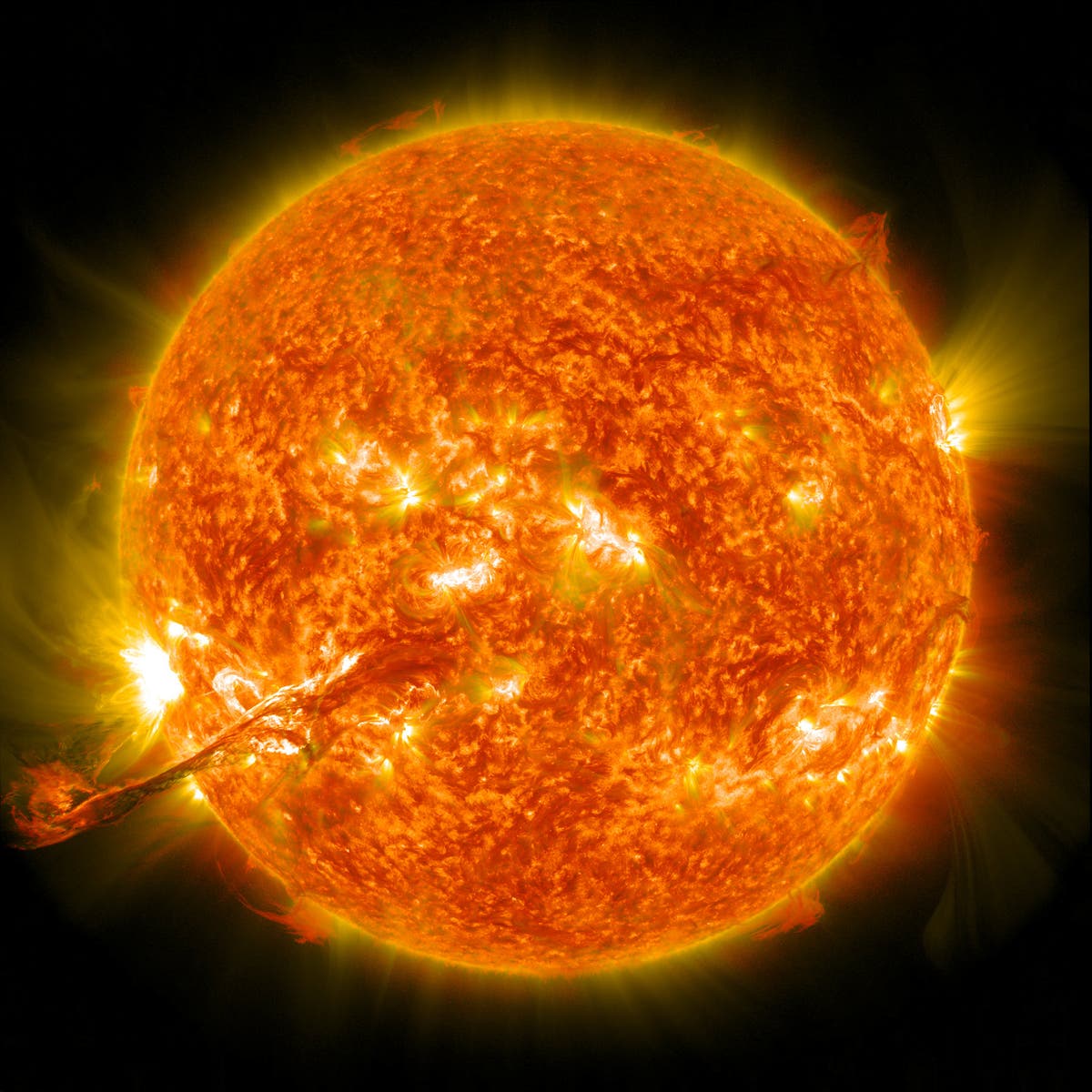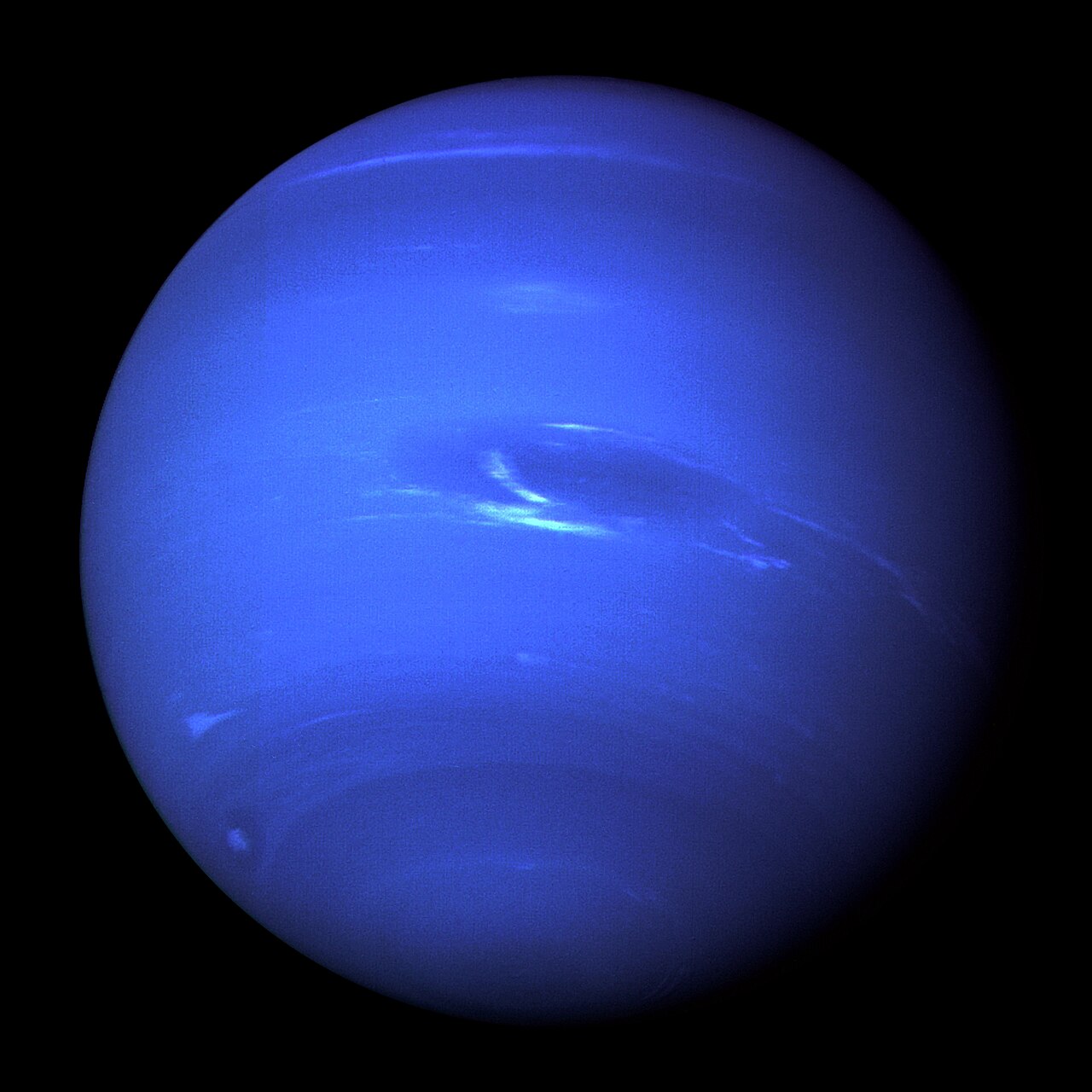
If you could stand on Neptune and look toward the Sun, you would see something that hardly resembles the brilliant star that lights our skies on Earth. Instead of a blazing disk dominating the daytime sky, the Sun would appear as an incredibly bright star—still dazzling, but surprisingly small. Sunlight would be so faint that daytime on Neptune would feel much like twilight on Earth.
This incredible difference exists because Neptune is astonishingly far from the Sun. As the eighth and most distant recognized planet in our Solar System, Neptune orbits in a realm where sunlight takes hours to arrive and temperatures plunge to unimaginable extremes.
But exactly how far away is Neptune? The answer is more fascinating than a single number.
The Average Distance Between Neptune and the Sun
On average, Neptune is about 2.8 billion miles (4.5 billion kilometers) from the Sun.
Astronomers often describe planetary distances using a unit called the Astronomical Unit (AU). One AU is the average distance between Earth and the Sun, which is approximately 93 million miles (150 million kilometers).
Using this scale, Neptune orbits at an average distance of about 30 AU from the Sun.
That means Neptune is roughly 30 times farther from the Sun than Earth is.
To appreciate this enormous distance, imagine placing Earth just one step away from the Sun. Neptune would be about thirty steps away.
Why Neptune’s Distance Changes
Although people often refer to Neptune as being 4.5 billion kilometers from the Sun, this distance is only an average.
Like every planet in the Solar System, Neptune follows an elliptical orbit, not a perfect circle.
An ellipse is only slightly stretched, meaning Neptune’s distance from the Sun changes throughout its long journey.
At its closest point, called perihelion, Neptune is about 4.45 billion kilometers (2.77 billion miles) from the Sun.
At its farthest point, called aphelion, it reaches approximately 4.55 billion kilometers (2.83 billion miles).
These changes are relatively small compared with Neptune’s overall distance, making its orbit one of the most circular among the planets.
How Long Does Light Take to Reach Neptune?
Light travels incredibly fast—about 299,792 kilometers (186,282 miles) per second.
Even at this astonishing speed, sunlight takes much longer to reach Neptune than it does Earth.
Sunlight reaches Earth in about 8 minutes and 20 seconds.
For Neptune, the journey takes approximately 4 hours and 10 minutes.
This means that when sunlight illuminates Neptune, it actually left the Sun more than four hours earlier.
If the Sun were somehow to disappear—which, in reality, cannot happen suddenly because information cannot travel faster than light—Earth would continue receiving sunlight for just over eight minutes, while Neptune would continue seeing the Sun for more than four hours.
How Long Does Neptune Take to Orbit the Sun?
Because Neptune is so far away, it has an enormous path to travel around the Sun.
One complete orbit takes about 164.8 Earth years.
This means that a person born on Neptune would not celebrate their first birthday until more than 164 years had passed on Earth.
Since Neptune was discovered in 1846, it completed its first full observed orbit in 2011.
For astronomers, witnessing an entire Neptunian year was a remarkable milestone that required generations of observations.
Why Is Neptune So Cold?
Distance from the Sun has a major influence on planetary temperature.
Since Neptune receives only about one nine-hundredth of the sunlight that Earth receives, very little solar energy reaches the planet.
Cloud tops on Neptune typically have temperatures around −214°C (−353°F), making it one of the coldest worlds in the Solar System.
At these temperatures, water is completely frozen, and many gases that are common on Earth behave very differently.
Methane, for example, exists as a gas in Neptune’s atmosphere and absorbs red light, giving the planet its beautiful deep blue appearance.
Is Neptune Completely Dark?
Because Neptune is so distant, many people imagine it drifting through complete darkness.
That is not true.
The Sun still shines on Neptune.
Although sunlight is about 900 times weaker than on Earth, it remains bright enough to create daytime.
The Sun would look much smaller in Neptune’s sky, but it would still outshine every other star by a tremendous margin.
The planet experiences day and night just as Earth does because Neptune rotates once every about 16 hours.
How Big Does the Sun Look From Neptune?
The Sun’s apparent size depends on how far away you are.
From Earth, the Sun appears as a bright disk that dominates the sky.
From Neptune, the Sun would appear roughly 30 times smaller in diameter than it does from Earth.
Instead of filling the sky with brilliant light, it would resemble an exceptionally bright star.
Even so, staring directly at it would still be dangerous because it remains intensely luminous.
How Does Neptune Compare With the Other Planets?
The planets become progressively farther from the Sun as you travel outward through the Solar System.
Mercury, the closest planet, orbits at about 0.39 AU.
Venus circles at about 0.72 AU, while Earth travels at 1 AU.
Mars lies at approximately 1.52 AU.
Beyond Mars are Jupiter, Saturn, and Uranus, each occupying increasingly distant orbits.
Neptune, at 30 AU, marks the outer edge of the major planets.
Beyond Neptune lies a vast region populated by icy bodies known as the Kuiper Belt, home to dwarf planets such as Pluto, Haumea, and Makemake.
Even farther away stretches the distant Oort Cloud, a hypothetical spherical reservoir believed to contain countless icy objects and the source of many long-period comets.
How Far Is Neptune From Earth?
The distance between Earth and Neptune is constantly changing because both planets are moving around the Sun.
At their closest, the two planets are roughly 4.3 billion kilometers (2.7 billion miles) apart.
When they are on opposite sides of the Sun, the distance grows to more than 4.7 billion kilometers (2.9 billion miles).
Even traveling at the speed of today’s fastest spacecraft, reaching Neptune requires many years.
How Long Does It Take a Spacecraft to Reach Neptune?
No human has ever traveled anywhere near Neptune.
Only one spacecraft has visited the planet.
NASA’s Voyager 2 launched in 1977 and reached Neptune in August 1989 after a journey lasting almost 12 years.
During its historic flyby, Voyager 2 revealed Neptune in extraordinary detail for the first time.
It discovered new moons, observed powerful storms, studied the planet’s rings, and transformed our understanding of the outer Solar System.
Since then, no spacecraft has returned to Neptune, although scientists continue proposing future missions to explore this fascinating ice giant.
Why Doesn’t Neptune Drift Away?
Given its immense distance, you might wonder why Neptune doesn’t simply drift into interstellar space.
The answer lies in gravity.
Although the Sun’s gravitational pull is much weaker at Neptune’s distance than it is near Earth, it remains strong enough to keep Neptune in a stable orbit.
The balance between Neptune’s forward motion and the Sun’s gravitational attraction causes the planet to continuously fall around the Sun rather than into it.
This same principle keeps every planet in the Solar System following its own orbital path.
What Is Neptune Made Of?
Neptune is often called an ice giant, although it is not a giant ball of frozen ice.
Most of the planet consists of a hot, dense mixture of water, ammonia, and methane deep beneath its atmosphere.
Its outer atmosphere is primarily made of hydrogen and helium, with smaller amounts of methane.
Powerful winds race through Neptune’s atmosphere at speeds exceeding 2,000 kilometers per hour (1,200 miles per hour), making them the fastest sustained winds measured on any planet in the Solar System.
Remarkably, these violent storms occur despite the planet receiving so little energy from the Sun.
Scientists believe Neptune’s internal heat plays an important role in driving its dynamic weather.
Neptune’s Place in the Solar System
Neptune occupies a unique position at the frontier of the planetary Solar System.
Its orbit marks the transition from the familiar planets to the icy populations of the Kuiper Belt.
Because it formed so far from the Sun, Neptune provides scientists with valuable clues about how the outer Solar System developed more than 4.5 billion years ago.
Studying Neptune also helps astronomers understand the many giant planets discovered around other stars, many of which share similarities with our own distant ice giant.
Why Neptune Still Fascinates Scientists
Despite being discovered nearly two centuries ago, Neptune remains one of the least explored planets.
Its enormous distance makes observations difficult, and spacecraft missions require decades of planning and travel.
Many questions remain unanswered.
Scientists are still investigating how Neptune’s magnetic field formed, what powers its surprisingly active atmosphere, how its interior is structured, and whether its deep layers contain exotic forms of matter created under immense pressure.
Every new telescope and every future mission promises to reveal more about this mysterious world at the edge of our planetary neighborhood.
Conclusion
Neptune is, on average, about 2.8 billion miles (4.5 billion kilometers) or 30 astronomical units from the Sun, making it the most distant recognized planet in the Solar System. At that incredible distance, sunlight takes more than four hours to arrive, a single year lasts 164.8 Earth years, and the Sun appears as a brilliant but tiny point of light in the sky.
Yet Neptune is far more than a cold, distant world. It is a dynamic planet with fierce storms, powerful winds, mysterious internal heat, and a rich scientific story that continues to unfold. As astronomers develop more advanced telescopes and future space missions, Neptune will remain one of the most exciting destinations for exploring the outer reaches of our Solar System and deepening our understanding of planets throughout the universe.