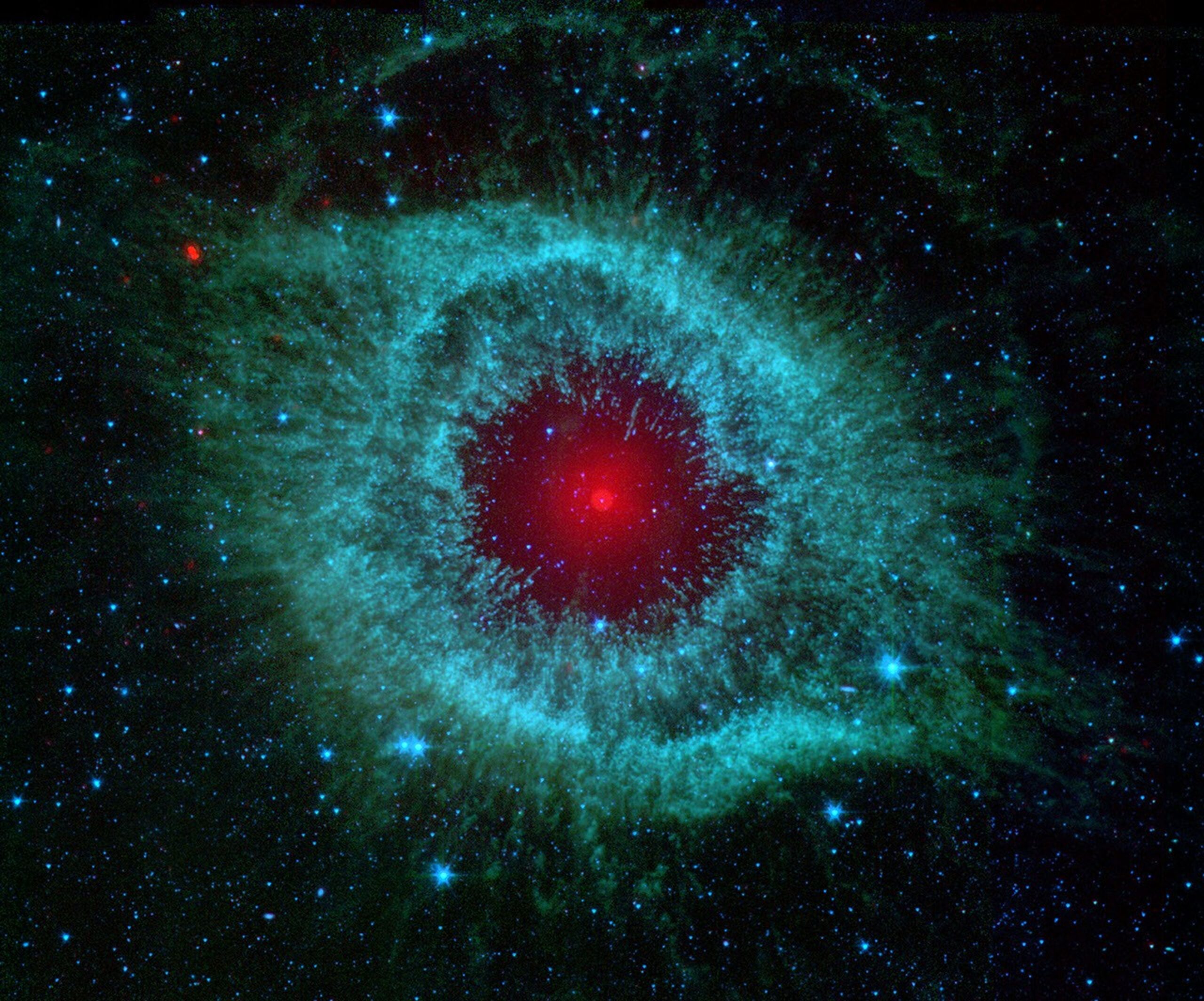
The universe is filled with breathtaking objects, but few are as beautiful and fascinating as the Helix Nebula. Floating silently in the darkness of space, this enormous glowing cloud of gas resembles a giant cosmic eye staring back at us. Because of its striking appearance, it has earned the popular nickname “The Eye of God.” Although this nickname is poetic rather than scientific, it reflects the awe that many people feel when they first see this extraordinary object.
The Helix Nebula is far more than a beautiful sight. It tells the story of how stars like our Sun end their lives. Rather than being a place where stars are born, the Helix Nebula is the spectacular remains of a dying star. It offers astronomers a rare opportunity to witness the final stages of stellar evolution and provides valuable clues about the future of our own solar system billions of years from now.
What Is the Helix Nebula?
The Helix Nebula is a planetary nebula, a type of glowing cloud created when a Sun-like star reaches the end of its life. Despite the name, planetary nebulae have nothing to do with planets. Early astronomers using small telescopes thought these objects looked similar to the disks of distant planets, so the name remained even after scientists understood their true nature.
The Helix Nebula formed when an aging star shed its outer layers into space. Those expanding gases are illuminated by the intensely hot stellar core left behind, causing the nebula to glow in beautiful colors. The result is one of the nearest and best-studied planetary nebulae in the Milky Way.
Because it is relatively close to Earth and remarkably large, the Helix Nebula has become one of the most famous objects in the night sky.
Where Is the Helix Nebula?
The Helix Nebula is located in the constellation Aquarius, often called the Water Bearer. It lies about 650 light-years from Earth, making it one of the closest planetary nebulae known.
Although 650 light-years sounds unimaginably distant, it is relatively nearby on the scale of our galaxy. Light leaving the nebula today will not reach Earth for approximately 650 years, meaning we see the Helix Nebula as it existed centuries ago.
Its proximity allows astronomers to study its structure in remarkable detail using both ground-based observatories and space telescopes.
Who Discovered the Helix Nebula?
The Helix Nebula was discovered in 1824 by the German astronomer Karl Ludwig Harding. At the time, telescopes were far less powerful than those available today, and astronomers could only see it as a faint, hazy object.
As telescope technology improved over the following centuries, scientists gradually uncovered its intricate structure. Modern observatories such as the Hubble Space Telescope, the Spitzer Space Telescope, the James Webb Space Telescope, and numerous powerful ground-based telescopes have revealed stunning details hidden within its glowing gases.
Each new generation of telescopes has deepened our understanding of this remarkable celestial object.
Why Does the Helix Nebula Look Like a Giant Eye?
One of the Helix Nebula’s most recognizable features is its eye-like appearance. The bright ring surrounding a darker center creates an illusion of a giant eye looking into space.
This appearance is created by geometry rather than intention. The nebula is actually a three-dimensional cloud of expanding gas. From Earth’s viewing angle, astronomers observe it almost directly along its axis, making its ring-like structure appear circular.
If viewed from another direction, the Helix Nebula would likely look very different.
Its intricate appearance also comes from dense clumps of gas and dust, glowing shells, and complex filaments shaped by powerful stellar winds.
The Life Story of the Star That Created It
To understand the Helix Nebula, it helps to understand the life cycle of its parent star.
For billions of years, the star generated energy by fusing hydrogen into helium in its core, much like our Sun does today. This nuclear fusion produced enormous amounts of heat and light while balancing the inward pull of gravity.
Eventually, the hydrogen fuel in the core became exhausted.
Without enough hydrogen to sustain fusion in the center, the star began changing dramatically. Its outer layers expanded enormously, transforming it into a red giant. During this stage, the star became much larger but less stable.
Over time, pulsations and stellar winds pushed the outer layers into surrounding space.
Those expanding gases eventually formed the glowing cloud we now call the Helix Nebula.
The White Dwarf at the Center
At the center of the Helix Nebula lies the surviving core of the original star.
This remnant is known as a white dwarf.
Although roughly similar in size to Earth, the white dwarf contains about half the mass of the original star, making it incredibly dense. A single teaspoon of white dwarf material would weigh many tons if brought to Earth.
The white dwarf is extremely hot, with a surface temperature exceeding 100,000 kelvins.
Its intense ultraviolet radiation energizes the surrounding gases, causing them to glow in different colors depending on their chemical composition.
Eventually, over billions of years, the white dwarf will gradually cool and fade.
How Big Is the Helix Nebula?
The Helix Nebula spans approximately 2.5 light-years across, making it one of the largest known planetary nebulae.
To appreciate this size, consider that one light-year is about 9.46 trillion kilometers (5.88 trillion miles).
Even though the nebula appears relatively small in photographs, it is actually enormous.
Its gases continue expanding outward at tens of kilometers per second, slowly dispersing into interstellar space.
Over tens of thousands of years, the nebula will become so diffuse that it will eventually blend into the surrounding galaxy.
Why Does It Glow in Different Colors?
The vivid colors seen in images of the Helix Nebula are produced by different chemical elements emitting light.
Hydrogen often appears reddish.
Oxygen commonly produces blue-green colors.
Nitrogen contributes reddish tones.
These colors arise because energetic ultraviolet radiation from the central white dwarf excites atoms in the surrounding gas. As the atoms return to lower energy states, they emit light at characteristic wavelengths.
Some astronomical images also use false colors to highlight features invisible to the human eye, especially those captured in infrared or ultraviolet wavelengths.
Even when colors are adjusted for scientific purposes, they represent real physical processes occurring within the nebula.
The Mysterious Cometary Knots
One of the Helix Nebula’s most intriguing features is the presence of thousands of small, dense structures known as cometary knots.
These knots resemble tiny comets because each has a compact head and a long tail pointing away from the central star.
Despite their appearance, they are not actual comets.
Instead, they are dense clumps of gas and dust sculpted by intense radiation and stellar winds.
Each knot is several times larger than our Solar System.
Astronomers continue studying these structures to understand how they formed and how they evolve over time.
Observing the Helix Nebula Across the Spectrum
The Helix Nebula appears different depending on the type of light used to observe it.
Visible-light telescopes reveal glowing gases.
Infrared observations penetrate dust and reveal cooler material hidden within the nebula.
Ultraviolet observations emphasize the energetic radiation emitted by the central white dwarf.
Radio observations provide additional information about molecular gas and the nebula’s expanding structure.
Combining observations across the electromagnetic spectrum allows astronomers to build a much more complete picture of the nebula than any single wavelength could provide.
What the James Webb Space Telescope Revealed
The James Webb Space Telescope has provided some of the most detailed infrared images ever taken of the Helix Nebula.
These observations revealed intricate dust structures, delicate filaments, and previously hidden features near the central white dwarf.
Webb’s infrared vision allows astronomers to study cooler regions that are difficult to observe in visible light. It has also improved our understanding of how dust forms and survives during the final stages of stellar evolution.
These discoveries continue helping scientists refine models of how Sun-like stars lose mass before becoming white dwarfs.
Will Our Sun Become a Helix Nebula?
One of the most fascinating aspects of the Helix Nebula is that it offers a glimpse into our own Solar System’s distant future.
The Sun is currently about halfway through its stable lifetime.
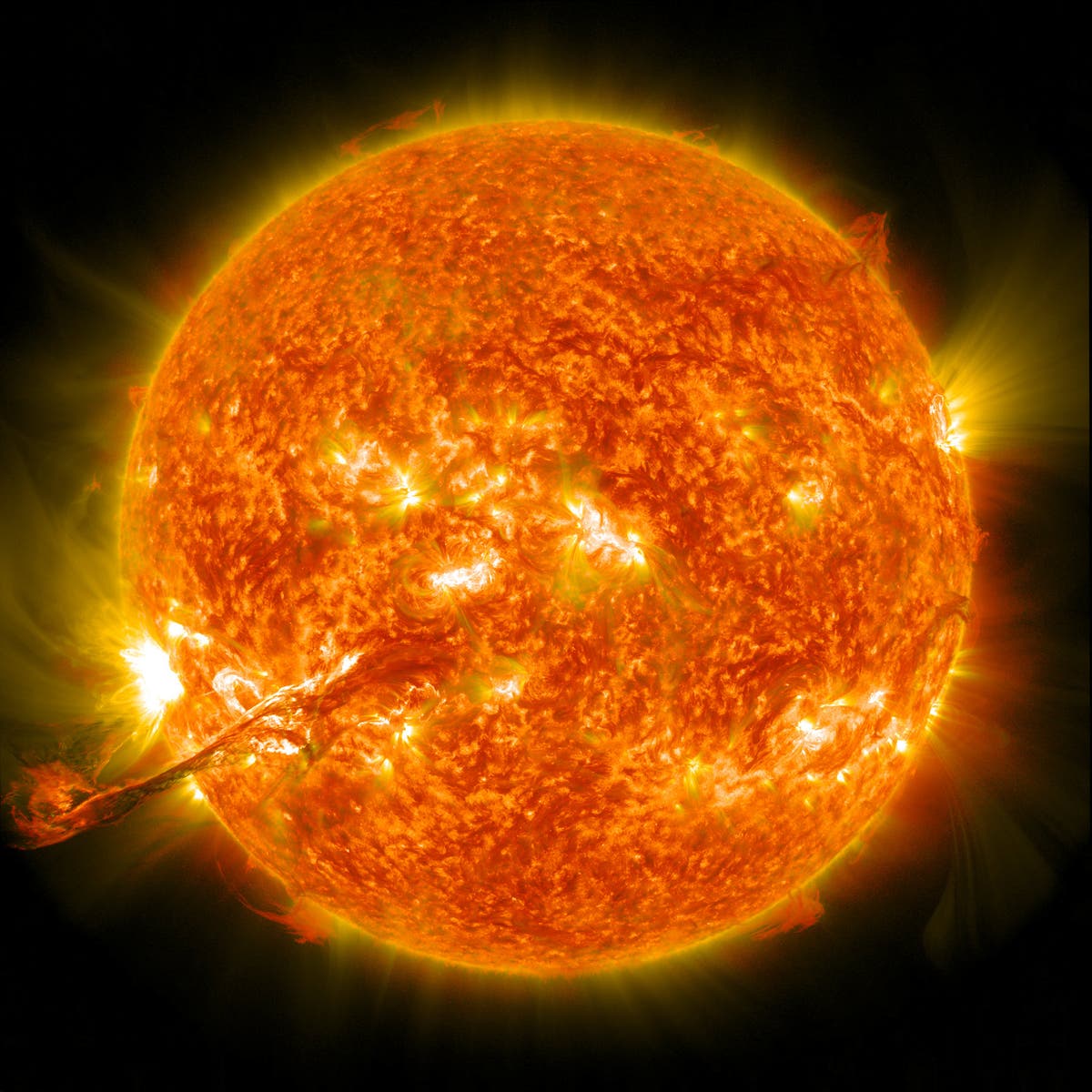
In roughly 5 billion years, it will exhaust the hydrogen in its core and expand into a red giant.
Eventually, it will shed its outer layers into space.
Those gases may form a planetary nebula somewhat similar to the Helix Nebula, although its exact appearance will depend on many factors, including the Sun’s mass loss and surrounding environment.
The remaining core will become a white dwarf that slowly cools over billions of years.
Although the details remain uncertain, the Helix Nebula serves as one of the best natural examples of the fate awaiting stars similar to our own.
Why the Helix Nebula Is Important to Science
The Helix Nebula is much more than an attractive object for astrophotographers.
It allows scientists to investigate the late stages of stellar evolution with exceptional detail because of its relative proximity.
By studying it, astronomers learn how stars return gas and dust to interstellar space.
Those materials eventually become part of new stars, planets, and potentially even future life.
Many of the elements that make up Earth—including carbon, nitrogen, and oxygen—have been recycled through generations of stars that lived and died long before our Solar System formed.
The Helix Nebula represents one chapter in this ongoing cosmic cycle of birth, death, and renewal.
Can You See the Helix Nebula?
Although the Helix Nebula is one of the closest planetary nebulae, it is not easy to observe with the naked eye because its light is spread across a relatively large area.
Under very dark skies, experienced observers using binoculars or small telescopes may detect it as a faint, ghostly patch.
Medium-sized and larger telescopes reveal more of its ring-like structure, especially when used with filters designed for observing nebulae.
Astrophotographers equipped with modern cameras can capture its remarkable colors and delicate details through long-exposure imaging.
A Window Into the Future of Stars
The Helix Nebula reminds us that stars are not eternal. Even stars that shine steadily for billions of years eventually exhaust their fuel and undergo dramatic transformations.
Rather than ending in violent explosions like the most massive stars, Sun-like stars experience a quieter but equally beautiful farewell. They gently release their outer layers, enriching the galaxy with elements that will help create future stars and planets.
In this way, stellar death becomes the beginning of something new.
Conclusion
The Helix Nebula is one of the nearest, largest, and most spectacular planetary nebulae known. Located about 650 light-years away in the constellation Aquarius, it is the glowing remnant of a Sun-like star that reached the end of its life. Its intricate rings, brilliant colors, mysterious cometary knots, and intensely hot central white dwarf provide astronomers with an extraordinary natural laboratory for studying stellar evolution.
More than a beautiful object in the night sky, the Helix Nebula tells a profound story about the life cycle of stars and the ongoing recycling of matter throughout the universe. As scientists continue exploring it with increasingly powerful telescopes, this remarkable nebula continues to deepen our understanding of how stars evolve—and offers a glimpse of what may one day become the final chapter in the story of our own Sun.