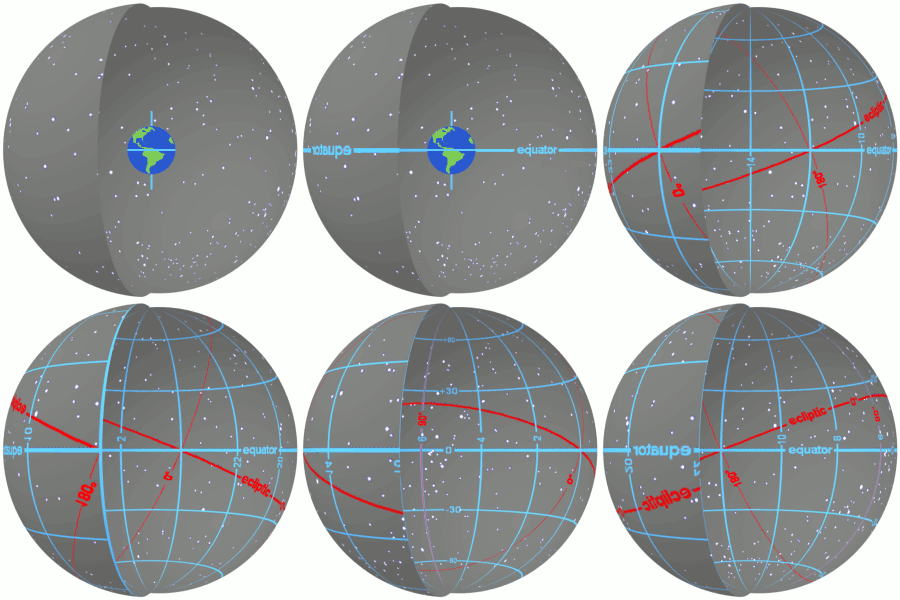
When you step outside on a clear night and look up at the stars, the sky may seem like a vast, beautiful canvas where celestial objects are scattered randomly. Yet astronomers know that every visible star, galaxy, nebula, and planet has a precise location in the sky. Just as every place on Earth can be identified using latitude and longitude, every object in the celestial sphere can be located using a system of celestial coordinates.
One of the most important coordinates in this system is right ascension. Although the term may sound technical at first, the concept is surprisingly straightforward. Right ascension is essentially the celestial equivalent of longitude on Earth. It helps astronomers pinpoint exactly where an object lies in the sky, making it possible to find and track everything from nearby planets to galaxies billions of light-years away.
Without right ascension, modern astronomy would be far more difficult. Telescope operators, spacecraft navigators, astrophotographers, and amateur stargazers all rely on this coordinate to explore the universe with remarkable precision.
Understanding Right Ascension
Right ascension, often abbreviated as RA, is one of the two primary coordinates used in the equatorial coordinate system, the most widely used system for locating objects in the sky. The other coordinate is declination.
Right ascension measures how far east an object lies from a specific reference point on the celestial sphere. Imagine the sky as an enormous globe surrounding Earth. Just as longitude measures positions east or west around Earth’s surface, right ascension measures positions eastward around the celestial equator.
Every celestial object has a right ascension value that remains nearly constant over long periods of time, allowing astronomers everywhere to identify the same object regardless of where they observe from.
Why Astronomers Need Right Ascension
The night sky contains billions of stars and countless other celestial objects. Many of them appear close together, making it impossible to identify them accurately using simple descriptions.
Imagine someone tells you to look for “a bright star near Orion.” While that may work for casual observing, it is far from precise. Professional astronomy requires exact positions.
Right ascension provides that precision.
By combining right ascension with declination, astronomers can determine the exact location of any object on the celestial sphere. Whether observing a nearby asteroid or a distant quasar, these coordinates act like a universal address in the sky.
The Celestial Sphere
To understand right ascension, it helps to imagine the celestial sphere.
The celestial sphere is an imaginary sphere surrounding Earth on which all stars and other celestial objects appear to be projected. Although stars are actually located at vastly different distances from us, they appear to lie on this imaginary sphere when viewed from Earth.
Earth sits at the center of this sphere.
The north and south celestial poles lie directly above Earth’s geographic poles.
The celestial equator is an imaginary extension of Earth’s equator onto the sky.
Right ascension is measured along this celestial equator.
Right Ascension Is Like Longitude
Earth uses latitude and longitude to specify locations.
Latitude measures distance north or south of the equator.
Longitude measures distance east or west from the Prime Meridian.
The celestial coordinate system works in much the same way.
Declination corresponds to latitude.
Right ascension corresponds to longitude.
The important difference is that right ascension is not measured in degrees under normal practice. Instead, it is measured in units of time.
Why Right Ascension Uses Hours Instead of Degrees
One of the most interesting features of right ascension is that it is measured in hours, minutes, and seconds rather than degrees.
There are 24 hours of right ascension around the celestial sphere.
Each hour corresponds to 15 degrees of rotation.
This relationship exists because Earth rotates once every approximately 24 hours.
As Earth turns, the stars appear to move across the sky. Measuring right ascension in time makes it especially convenient for astronomers, since the apparent motion of the sky is directly linked to Earth’s rotation.
The conversion is simple.
One hour of right ascension equals 15 degrees.
One minute of right ascension equals 15 arcminutes.
One second of right ascension equals 15 arcseconds.
This time-based system allows astronomers to predict when celestial objects will cross the local meridian and become easiest to observe.
The Zero Point of Right Ascension
Every coordinate system requires a starting point.
On Earth, longitude begins at the Prime Meridian in Greenwich, England.
In the sky, right ascension begins at a point called the First Point of Aries, also known as the vernal equinox.
This is the point where the Sun crosses the celestial equator each year during the March equinox as it moves northward in the sky.
From this reference point, right ascension increases eastward around the celestial equator until it reaches 24 hours, completing a full circle.
Although Earth’s axis slowly wobbles over thousands of years in a process called precession, astronomers regularly update celestial coordinate systems to account for this gradual change.
Declination and Right Ascension Work Together
Right ascension alone cannot specify a complete location.
It must be paired with declination.
Declination measures how far north or south an object lies from the celestial equator.
It is measured in degrees.
Positive declination indicates locations north of the celestial equator.
Negative declination indicates locations south of it.
Together, right ascension and declination uniquely identify every object visible in the sky.
For example, a star may have a right ascension of 6 hours and a declination of +20 degrees. Those two coordinates describe its exact position on the celestial sphere.
How Right Ascension Changes in the Sky
Although the stars appear to rise in the east and set in the west every night, their right ascension does not change.
Instead, Earth’s rotation causes different right ascension values to pass overhead throughout the night.
As Earth rotates, observers face different parts of the celestial sphere.
This is why constellations visible during winter are different from those seen during summer.
The stars themselves remain nearly fixed relative to one another, while Earth changes its orientation beneath the celestial sphere.
Right Ascension and Sidereal Time
Right ascension has a close relationship with sidereal time.
A sidereal day is the time Earth takes to complete one rotation relative to distant stars rather than the Sun.
It lasts about 23 hours, 56 minutes, and 4 seconds, slightly shorter than a solar day.
When the local sidereal time equals the right ascension of a celestial object, that object is crossing the observer’s meridian.
At this moment, the object reaches its highest point in the sky, making it one of the best times for observation.
This relationship is fundamental in observational astronomy and telescope operation.
Using Right Ascension with Telescopes
Modern telescopes often rely on computerized systems that use right ascension and declination.
After entering an object’s coordinates, the telescope automatically points to the correct location.
Even manually operated equatorial telescopes are designed around the right ascension coordinate.
Their right ascension axis is aligned with Earth’s rotational axis.
This design allows astronomers to track celestial objects by moving only one axis, compensating for Earth’s rotation.
As a result, stars remain centered in the telescope’s field of view even during long observations.
Right Ascension in Star Catalogs
Every professional star catalog includes right ascension.
Whether astronomers study stars, galaxies, planets, nebulae, pulsars, or quasars, their catalogs list celestial coordinates using right ascension and declination.
Some famous examples include the Messier Catalog, the New General Catalogue (NGC), and the Gaia star catalog.
These coordinates allow astronomers worldwide to observe exactly the same object without confusion.
Regardless of language, country, or telescope, right ascension provides a universal method of identifying locations in the sky.
Right Ascension and Astrophotography
Astrophotographers also depend heavily on right ascension.
Long-exposure photographs require telescopes to follow the apparent motion of stars with extreme precision.
Tracking mounts rotate around the right ascension axis at the same rate Earth rotates.
This motion cancels Earth’s rotation, allowing stars to remain sharp instead of appearing as streaks.
Without accurate right ascension tracking, capturing detailed images of galaxies, nebulae, and star clusters would be nearly impossible.
Does Right Ascension Change Over Time?
The right ascension of distant stars remains almost constant over short timescales, but it is not permanently fixed.
Several factors can cause gradual changes.
Earth’s axis slowly shifts because of axial precession.
Some nearby stars move through space, producing what astronomers call proper motion.
Planets, the Moon, asteroids, and comets move continuously against the background stars because they orbit the Sun.
For these reasons, astronomers periodically update celestial coordinate systems to maintain accuracy.
Right Ascension Beyond Visible Stars
Right ascension is not limited to visible stars.
It is used for nearly every kind of astronomical object.
Galaxies have right ascension.
Black holes have right ascension.
Nebulae have right ascension.
Pulsars, exoplanets, quasars, supernova remnants, and even spacecraft observations all use celestial coordinates based on right ascension and declination.
Whether an object is only a few hundred kilometers away or billions of light-years distant, its location on the celestial sphere can be described using the same coordinate system.
How Ancient Astronomy Led to Right Ascension
Long before telescopes existed, ancient astronomers carefully observed the motions of stars.
Civilizations in Mesopotamia, Greece, India, China, and the Islamic world developed increasingly sophisticated methods of mapping the heavens.
As astronomical observations became more accurate, scientists needed a standardized coordinate system.
The equatorial coordinate system eventually became one of the most practical because it is directly tied to Earth’s rotation.
Over centuries, improvements in mathematics, optics, and precision instruments refined right ascension into the highly accurate measurement used today.
Modern space telescopes and observatories continue to rely on this same basic concept.
Why Right Ascension Matters
Right ascension may appear to be a simple coordinate, but it plays an essential role in nearly every branch of observational astronomy.
It allows astronomers to locate celestial objects with precision, compare observations made from different parts of the world, operate automated telescopes, track moving objects, and navigate the vast sky efficiently.
Without right ascension, creating accurate star maps, conducting astronomical surveys, and coordinating observations between observatories would be extraordinarily difficult.
It transforms the seemingly chaotic night sky into an organized map where every object has a precise address.
Conclusion
Right ascension is one of astronomy’s most fundamental concepts. It serves as the celestial equivalent of longitude, measuring an object’s position eastward along the celestial equator from the First Point of Aries. Expressed in hours, minutes, and seconds, it reflects Earth’s rotation and provides a practical way to locate celestial objects across the sky.
When combined with declination, right ascension forms a complete celestial coordinate system that astronomers use to map stars, galaxies, planets, nebulae, and countless other objects with remarkable accuracy. From ancient skywatchers to modern space telescopes, this elegant system has helped humanity explore the universe with confidence and precision. Every time a telescope points toward a distant galaxy or a new comet is discovered, right ascension quietly plays its role, guiding our journey through the cosmos.