When you look up at the night sky, the stars may seem randomly scattered across a vast, endless dome. Yet astronomers know that every star, galaxy, nebula, and planet can be precisely located using a celestial coordinate system, much like places on Earth can be found using latitude and longitude. One of the most important coordinates in this system is declination.
Declination tells us how far north or south a celestial object is from the celestial equator. Whether astronomers are pointing giant observatories toward distant galaxies or amateur stargazers are searching for a bright nebula with a backyard telescope, declination helps them find their target with remarkable accuracy.
Although the concept may sound technical at first, declination is actually simple to understand once you compare it to Earth’s familiar system of latitude.
Understanding Declination
Declination is the angular distance of a celestial object north or south of the celestial equator. It is measured in degrees, just as latitude is measured on Earth.
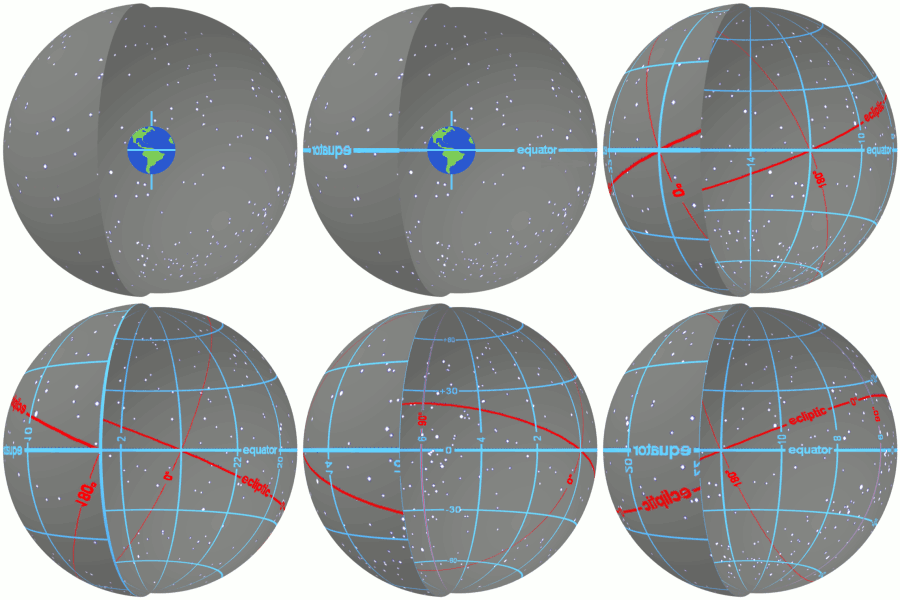
Imagine Earth expanding outward into space. The Earth’s equator extends onto the imaginary celestial sphere, creating the celestial equator. Declination measures how far above or below this celestial equator an object appears.
If an object lies exactly on the celestial equator, its declination is 0°.
If it appears north of the celestial equator, it has a positive declination.
If it appears south of the celestial equator, it has a negative declination.
The value ranges from +90° at the north celestial pole to −90° at the south celestial pole.
Every celestial object visible in the sky has its own declination, allowing astronomers to identify its position precisely.
Declination Is Like Latitude in the Sky
One of the easiest ways to understand declination is to think about latitude on Earth.
Latitude tells us how far north or south a place is from Earth’s equator.
Declination does exactly the same thing, except instead of measuring locations on Earth, it measures the positions of objects in the sky.
For example, New York City lies north of Earth’s equator because it has a positive latitude. Likewise, the bright star Vega lies north of the celestial equator because it has a positive declination.
Similarly, cities in the Southern Hemisphere have negative latitudes, just as stars located south of the celestial equator have negative declinations.
This similarity is no coincidence. The celestial coordinate system was intentionally designed to mirror Earth’s geographic coordinate system, making it much easier for astronomers to describe the positions of celestial objects.
The Celestial Equator
To understand declination fully, it is important to know what the celestial equator is.
The celestial equator is an imaginary circle projected into space directly above Earth’s equator. As Earth rotates, the celestial equator divides the sky into northern and southern halves.
Because Earth’s axis is tilted by about 23.5 degrees, the celestial equator is different from the path followed by the Sun throughout the year, known as the ecliptic.
The celestial equator serves as the zero-point for measuring declination.
Every object in the sky is measured relative to this imaginary reference line.
How Declination Is Measured
Declination is measured in angular units.
Astronomers use degrees (°), arcminutes (‘), and arcseconds (“).
One degree is divided into 60 arcminutes.
One arcminute is divided into 60 arcseconds.
For example, a star might have a declination of:
+38° 47′ 1″
This means the star lies 38 degrees, 47 arcminutes, and 1 arcsecond north of the celestial equator.
Modern telescopes and star catalogs often record declination with extraordinary precision, allowing scientists to locate objects accurately even when they are billions of light-years away.
Positive and Negative Declination
Declination can be either positive or negative.
Positive declination indicates that an object lies north of the celestial equator.
Negative declination indicates that it lies south.
For example, the North Star, Polaris, has a declination close to +89°, meaning it lies very near the north celestial pole.
The Southern Cross, a famous constellation visible from the Southern Hemisphere, has stars with negative declinations because they lie south of the celestial equator.
The sign tells astronomers immediately which half of the sky an object occupies.
The North and South Celestial Poles
The celestial poles are imaginary points in the sky directly above Earth’s North and South Poles.
The north celestial pole has a declination of +90°.
The south celestial pole has a declination of −90°.
As Earth rotates, the stars appear to circle around these poles.
Observers in the Northern Hemisphere see stars revolving around the north celestial pole, while observers in the Southern Hemisphere see stars revolving around the south celestial pole.
These poles define the limits of the declination scale.
Declination and Right Ascension
Declination alone is not enough to identify an object’s exact position.
Astronomers pair declination with another coordinate called right ascension.
If declination is the celestial equivalent of latitude, then right ascension is the equivalent of longitude.
Together they form the celestial coordinate system.
Every star, galaxy, nebula, quasar, and other celestial object has a unique combination of right ascension and declination.
For example, a star’s coordinates might be recorded as:
Right Ascension: 18h 36m 56s
Declination: +38° 47′
These two numbers allow telescopes anywhere in the world to locate the same object.
Why Declination Matters
Declination is one of astronomy’s most useful tools.
Without it, finding objects in the vast sky would be extremely difficult.
Professional observatories use declination when programming computer-controlled telescopes.
Space telescopes rely on celestial coordinates to point toward distant galaxies.
Astronomers publishing research include declination so other scientists know exactly which object was observed.
Planetarium software, smartphone sky apps, and digital star maps all depend on declination to identify objects accurately.
Even amateur astronomers use declination when aligning telescope mounts and locating faint deep-sky objects.
Declination and Your Location on Earth
The visibility of celestial objects depends greatly on your location.
An observer standing near Earth’s North Pole can easily see objects with high positive declinations but cannot see objects far south of the celestial equator.
Conversely, someone near the South Pole sees many objects with large negative declinations but never sees Polaris.
People living near Earth’s equator can observe a much larger portion of the celestial sphere because both northern and southern skies are accessible during different times of the year.
Declination therefore determines whether a celestial object can ever rise above your horizon.
Circumpolar Stars
Some stars never set below the horizon.
These are called circumpolar stars.
Their high positive or negative declinations keep them continuously above the horizon for certain observers.
For example, Polaris remains visible throughout the night for most locations in the Northern Hemisphere because its declination is close to +90°.
Similarly, observers in southern latitudes have their own circumpolar stars surrounding the south celestial pole.
The farther you travel toward either pole, the more circumpolar stars become visible.
Declination Changes for Some Objects
The declinations of distant stars change extremely slowly because they are so far away.
However, some celestial objects have changing declinations.
The Sun’s declination changes continuously throughout the year because Earth orbits the Sun while its rotational axis remains tilted.
At the June solstice, the Sun reaches its maximum northern declination of approximately +23.4°.
At the December solstice, it reaches its maximum southern declination of approximately −23.4°.
During the March and September equinoxes, the Sun crosses the celestial equator, giving it a declination of 0°.
The Moon and planets also experience changing declinations as they move through the sky along their orbits.
Declination and the Seasons
Earth’s axial tilt causes the Sun’s declination to change over the course of a year, creating the seasons.
When the Sun has a positive declination, the Northern Hemisphere receives more direct sunlight and experiences spring and summer.
When the Sun has a negative declination, sunlight is more direct in the Southern Hemisphere, producing its warmer seasons.
This annual migration of the Sun across different declinations determines the changing height of the Sun in the sky and the varying lengths of day and night.
Thus, declination is directly connected to the rhythm of the seasons experienced on Earth.
Magnetic Declination Is Different
The word “declination” is also used in navigation, but it means something entirely different.
Magnetic declination is the angle between geographic north and magnetic north measured by a compass.
This should not be confused with astronomical declination.
Astronomical declination measures positions on the celestial sphere.
Magnetic declination measures differences between Earth’s rotational axis and its magnetic field.
Although they share the same name, they describe completely different phenomena.
Declination in Modern Astronomy
Modern astronomy depends heavily on accurate declination measurements.
Large sky surveys record the declinations of billions of stars.
Space missions use celestial coordinates to navigate spacecraft and point scientific instruments.
Observatories tracking asteroids, comets, supernovae, and distant galaxies all rely on declination.
Computerized telescope mounts automatically use right ascension and declination to locate celestial targets within seconds.
Without this coordinate system, modern astronomical research would be far less efficient.
Measuring Declination in the Past
Long before modern telescopes existed, ancient astronomers recognized that stars occupied fixed positions in the sky.
Greek astronomers developed early celestial coordinate systems more than two thousand years ago.
Later, Islamic astronomers refined star catalogs with increasingly accurate measurements.
The invention of precision instruments such as quadrants, sextants, and transit telescopes greatly improved declination measurements.
Today, satellites like the European Space Agency’s Gaia mission measure stellar positions with astonishing precision, often accurate to tiny fractions of an arcsecond.
These measurements help scientists map the Milky Way in unprecedented detail.
Declination and Star Maps
When you look at a printed star chart or use astronomy software, declination usually appears as horizontal coordinate lines stretching across the map.
These lines help observers determine whether an object is above or below the celestial equator.
Combined with right ascension, they create a grid covering the entire sky.
This celestial grid works much like the network of latitude and longitude lines on a globe, allowing astronomers to locate objects consistently from anywhere on Earth.
Why Every Astronomy Enthusiast Should Learn Declination
For anyone interested in observing the night sky, understanding declination makes astronomy much more enjoyable.
Instead of searching randomly for celestial objects, observers can use coordinates to point telescopes precisely.
Learning declination also helps people understand why certain constellations are visible only from particular parts of the world and why some stars never rise above the horizon at certain locations.
It transforms the night sky from a seemingly chaotic collection of stars into a beautifully organized celestial map.
Conclusion
Declination is one of the most fundamental concepts in astronomy. It measures how far north or south a celestial object lies from the celestial equator, serving as the sky’s equivalent of latitude on Earth. Together with right ascension, declination forms the celestial coordinate system that allows astronomers to pinpoint the locations of stars, planets, galaxies, and countless other objects with remarkable precision.
Whether observing the changing path of the Sun through the seasons, locating a distant nebula with a telescope, or mapping billions of stars across the Milky Way, declination remains an essential tool for exploring the universe. It reminds us that the seemingly endless night sky is not random but carefully ordered, allowing humanity to navigate the cosmos with confidence and curiosity.