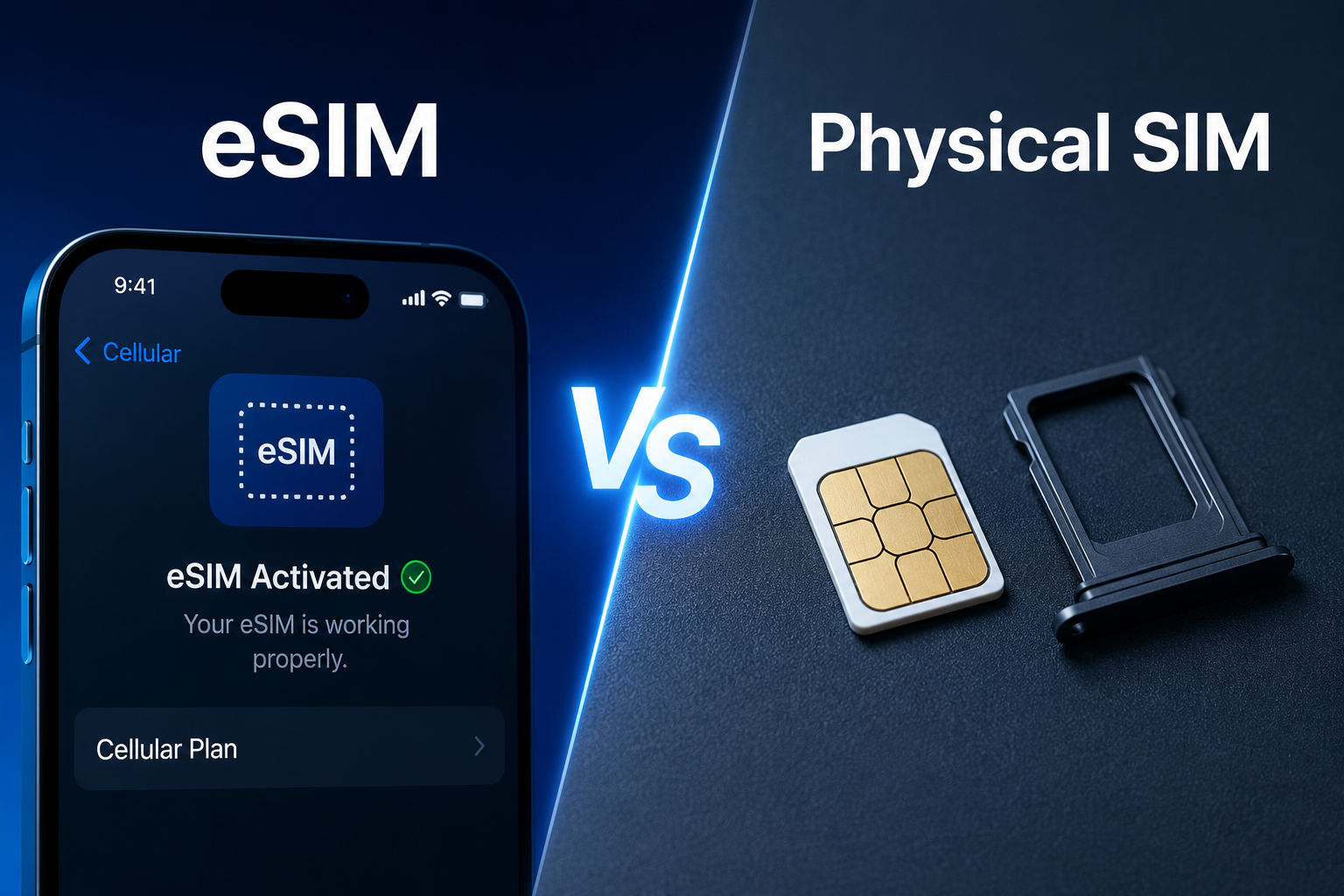
Your smartphone does far more than make calls or send text messages—it connects you to family, work, entertainment, navigation, banking, and nearly every aspect of modern life. But behind every mobile connection is a tiny piece of technology that most people rarely think about: the SIM.
For decades, the physical SIM card has been the invisible key that connects your phone to your mobile network. You may have inserted one into a new phone, swapped it when changing carriers, or searched for a tiny SIM ejector tool at least once. Today, however, a new technology is quietly changing that experience. Instead of inserting a plastic card into your phone, many modern devices let you activate a mobile plan digitally. This technology is called the eSIM.
As more smartphones, smartwatches, tablets, and laptops adopt eSIM technology, many people wonder whether it is time to say goodbye to traditional SIM cards. Is an eSIM actually better? Is it more secure? Does it improve performance? Can you still travel easily or switch carriers?
Understanding the differences between eSIM and physical SIM cards can help you make a better decision when buying your next device or choosing a mobile plan.
What Is a SIM Card?
A SIM, short for Subscriber Identity Module, is a secure chip that identifies your device on a cellular network.
Every SIM contains unique information that allows your mobile carrier to recognize your account. It stores credentials that authenticate your device whenever it connects to a cellular network for voice calls, text messages, and mobile data.
Without a valid SIM or another approved authentication method, a phone cannot normally connect to a cellular carrier, even though it can still use Wi-Fi for internet access.
Although SIM cards have become much smaller over the years—from full-size SIMs to Mini SIM, Micro SIM, and Nano SIM—their fundamental purpose has remained the same.
What Is an eSIM?
An eSIM stands for embedded SIM.
Unlike a traditional SIM card, an eSIM is a small chip that is permanently built into the device during manufacturing. It performs the same essential function as a physical SIM but does not need to be removed or replaced.
Instead of inserting a plastic card, users download a carrier profile electronically. This digital profile securely stores the information needed to connect the device to a mobile network.
In simple terms, a physical SIM is removable hardware, while an eSIM is embedded hardware that is programmed through software.
How Does an eSIM Work?
Although there is no removable card, the technology behind an eSIM is remarkably sophisticated.
When you choose a mobile carrier that supports eSIM, the carrier provides activation information, often in the form of a QR code, an app-based setup, or automatic activation during device configuration.
Your phone downloads the carrier profile securely over the internet or through the mobile network.
Once activated, the eSIM functions almost exactly like a traditional SIM card. It authenticates your device, enables calls and text messages, and provides access to mobile data.
Modern smartphones can store multiple eSIM profiles, although only a limited number can usually be active at the same time, depending on the device.
The Evolution from Plastic to Digital
The journey from physical SIM cards to eSIM technology reflects a broader trend in electronics: reducing moving parts and replacing physical components with digital solutions.
Camera film became digital photography.
DVDs became streaming services.
Paper maps became GPS navigation.
Physical SIM cards are now following a similar path.
Instead of carrying tiny plastic cards that can be lost or damaged, users increasingly manage their mobile connections through software.
How Physical SIM Cards Work
A physical SIM contains a tiny integrated circuit embedded inside a plastic card.
When inserted into a compatible phone, metal contacts connect the SIM chip to the device’s internal electronics.
During startup, the phone communicates with the SIM, verifies the subscriber’s identity, and requests permission to join the mobile network.
Because the SIM is removable, users can simply move it from one phone to another.
This simplicity has made physical SIM cards popular for decades.
Key Differences Between eSIM and Physical SIM
The biggest difference is how they are installed.
A physical SIM must be inserted into a SIM tray.
An eSIM is already inside the device and only requires digital activation.
Physical SIM cards can be removed instantly and placed into another compatible phone.
An eSIM usually requires transferring or reactivating the mobile profile through the carrier or device settings.
From the user’s perspective, both technologies provide the same essential services: voice calls, text messaging, and mobile internet.
The differences mainly involve convenience, flexibility, security, and hardware design.
Which One Is Easier to Set Up?
Years ago, inserting a SIM card was considered simple.
Today, activating an eSIM can be even easier.
Many carriers allow activation within minutes using a QR code or their mobile app.
Some smartphones automatically detect available eSIM plans during setup, making the process almost effortless.
However, the experience depends on carrier support. In regions where eSIM adoption is still growing, activation procedures may vary.
Physical SIM cards remain straightforward because they require little more than inserting the card into the device.
Convenience in Everyday Life
One of eSIM’s greatest strengths is convenience.
Imagine buying a new smartphone.
Instead of waiting for a SIM card to arrive in the mail or visiting a carrier store, you may simply activate your existing number digitally.
There is no SIM tray to open.
No tiny card to lose.
No ejector pin to search for.
Everything happens through software.
For many users, especially those comfortable with digital technology, this creates a much smoother experience.
Traveling Internationally
International travel has become one of the biggest advantages of eSIM technology.
Traditionally, travelers often purchased local SIM cards after arriving in another country.
This usually meant finding a mobile shop, presenting identification where required, replacing the existing SIM, and storing the original card safely.
With eSIM, many travelers can purchase an international data plan before leaving home or immediately after arrival.
They simply download the new mobile profile without removing their primary SIM.
Many modern smartphones even allow a physical SIM and an eSIM to work together, making it easier to keep your home number active while using affordable local data abroad.
Dual SIM Flexibility
Many smartphones now support dual SIM functionality.
This allows users to maintain separate phone numbers on one device.
For example, someone may keep one number for work and another for personal use.
With eSIM technology, dual SIM configurations have become even more flexible.
A device may combine a physical SIM with an eSIM, or in some models, support multiple eSIM profiles. Depending on the hardware, one or more profiles can be active simultaneously.
This flexibility benefits frequent travelers, remote workers, and people who manage multiple mobile plans.
Which Is More Secure?
Security is one of the strongest arguments in favor of eSIM technology.
A physical SIM can be removed if someone gains access to your phone.
Removing the SIM may make it harder to locate a stolen device using certain mobile-network features, although modern tracking systems also rely on internet connectivity and device security features.
An eSIM cannot simply be taken out because it is permanently integrated into the device.
This makes unauthorized physical removal impossible.
In addition, carrier profiles are securely managed using standardized remote provisioning systems designed with strong security measures.
Of course, no technology is completely immune to fraud. Criminals may still attempt social engineering or account takeover attacks against mobile carriers, regardless of whether a user has a physical SIM or an eSIM.
Strong account passwords and multi-factor authentication remain essential.
Can eSIM Improve Phone Design?
Removing the SIM tray creates opportunities for manufacturers.
Although the saved space is relatively small, it can be used more efficiently inside increasingly compact devices.
Manufacturers may use the extra space for larger batteries, improved cameras, better cooling systems, or additional sensors.
Fewer external openings may also simplify device engineering, potentially helping with water and dust resistance when combined with other design improvements.
For smartwatches and very small devices, eliminating a removable SIM tray is especially valuable.
Is Network Performance Different?
Many people wonder whether eSIM provides faster internet.
The answer is generally no.
An eSIM does not increase network speed by itself.
Your mobile performance depends primarily on factors such as network coverage, signal strength, carrier infrastructure, available radio technologies like 4G LTE or 5G, network congestion, and your device’s modem.
Whether your phone uses a physical SIM or an eSIM, download speeds and call quality should be essentially the same when all other conditions are equal.
Battery Life
Using an eSIM does not significantly affect battery life.
Both technologies perform the same authentication functions.
Any difference in power consumption is extremely small and generally not noticeable during normal use.
Battery life is far more influenced by screen brightness, processor activity, network conditions, background applications, and display technology.
Can You Switch Phones Easily?
Physical SIM cards have traditionally been very convenient.
You simply remove the card and insert it into another compatible phone.
The number moves with it.
eSIM transfers have become much easier than they were in the early years of the technology.
Many modern smartphones now support direct eSIM transfer between compatible devices, while others require activation through the mobile carrier.
The exact process depends on both the device manufacturer and the carrier.
Compatibility
Physical SIM cards work with nearly every mobile phone released during the past two decades.
eSIM support is becoming increasingly common but is not yet universal.
Many recent flagship smartphones, premium tablets, laptops, and smartwatches include eSIM capability.
Some newer phone models in certain markets are even sold without a physical SIM tray, relying entirely on eSIM technology.
Before choosing an eSIM-only device, it is important to confirm that your mobile carrier fully supports eSIM activation and management.
Environmental Impact
Although SIM cards are tiny, billions have been manufactured worldwide.
Each physical SIM requires plastic, metal contacts, packaging, transportation, and distribution.
Because eSIMs are built into devices and activated digitally, they can reduce the need for separate plastic cards and associated packaging.
While the environmental savings from each individual device are modest, they may become more meaningful as adoption grows globally.
Are There Any Disadvantages to eSIM?
Despite its many advantages, eSIM is not perfect.
Not every carrier supports it.
Activation procedures can differ between providers, which may confuse some users.
Switching devices may sometimes require contacting the carrier or completing additional verification steps.
For users who frequently move SIM cards between multiple phones, a traditional physical SIM may still feel more convenient in certain situations.
In regions where eSIM infrastructure is still developing, physical SIM cards continue to offer broader compatibility.
Are Physical SIM Cards Becoming Obsolete?
Not immediately.
Physical SIM cards remain widely used around the world and continue to serve billions of mobile subscribers.
However, industry trends suggest that eSIM adoption will continue growing.
Many smartphone manufacturers are expanding eSIM support, and an increasing number of mobile carriers now offer digital activation services.
As networks modernize and users become more familiar with digital provisioning, eSIM is expected to play an increasingly important role in the future of mobile connectivity.
Which One Should You Choose?
The best choice depends on your needs rather than on the technology itself.
If you frequently switch phones by simply moving a SIM card, live in a region where eSIM support is limited, or use older devices, a physical SIM may still be the more practical option.
If you value digital convenience, travel internationally, use multiple mobile plans, or own a recent smartphone with strong carrier support, an eSIM offers a more flexible and streamlined experience.
For many users today, the ideal solution is a device that supports both. This combination provides the familiarity of a physical SIM alongside the convenience and versatility of an eSIM.
The Future of Mobile Connectivity
The evolution from physical SIM cards to eSIM technology reflects a broader shift toward software-defined devices that are easier to configure, manage, and update. While the purpose of both technologies remains the same—to securely connect your device to a mobile network—the way they achieve that goal has changed dramatically.
Physical SIM cards helped power the mobile revolution for more than three decades and continue to play an important role. At the same time, eSIM technology is opening new possibilities for faster activation, seamless international travel, flexible multi-network use, and more efficient device design.
Rather than replacing the core function of the SIM, eSIM reimagines how mobile connectivity is delivered. As carrier support expands and more devices adopt the technology, digital SIMs are likely to become an increasingly common part of everyday life. Whether you use a traditional SIM card, an eSIM, or both, the ultimate goal remains the same: keeping people connected wherever they are in the world.