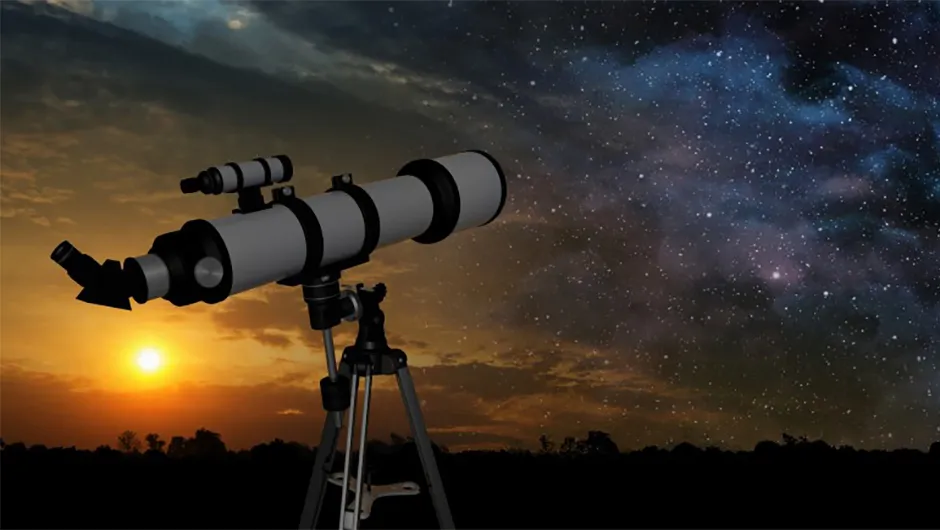
Since the beginning of human history, people have looked up at the night sky with wonder. The stars seemed like tiny glowing dots, the Moon revealed changing shapes, and a few bright planets wandered across the heavens. For thousands of years, these celestial objects inspired stories, myths, and curiosity. But the true nature of the universe remained hidden because the human eye has limits. It can only collect a small amount of light and cannot see distant objects in great detail.
Everything changed with the invention of the telescope. Suddenly, the universe became larger, richer, and far more astonishing than anyone had imagined. Mountains appeared on the Moon. Jupiter was found to have its own moons. Saturn revealed its magnificent rings. Countless stars invisible to the naked eye emerged from the darkness. Today, telescopes allow scientists to observe galaxies billions of light-years away, study planets orbiting distant stars, detect black holes, and even look back toward the earliest moments of the universe.
A telescope is much more than a scientific instrument. It is humanity’s window into the cosmos, helping us explore places we can never visit and revealing secrets carried across space by light.
What Is a Telescope?
A telescope is an optical instrument designed to collect and focus light or other forms of electromagnetic radiation from distant objects, making them appear brighter, larger, and more detailed than they do with the naked eye.
Unlike our eyes, which can gather only a limited amount of light, a telescope collects much more light using a large lens or mirror. The more light it gathers, the fainter and farther away the objects it can observe.
Although many people think telescopes simply “magnify” objects, magnification is not their most important job. Their greatest strength is light-gathering power. By capturing far more light than the human eye can, telescopes reveal objects that would otherwise remain completely invisible.
Whether observing the Moon, a nearby planet, a distant galaxy, or a colorful nebula, every telescope works by collecting light and bringing it into focus.
Why Do We Need a Telescope?
The universe is unimaginably vast. Even the closest stars beyond our Sun are trillions of kilometers away. Because of these enormous distances, light reaching Earth from distant objects is often extremely faint.
Human eyes have evolved for life on Earth, not for exploring the cosmos. They perform remarkably well during the day and can detect many bright stars at night, but they cannot gather enough light to reveal the detailed structure of distant astronomical objects.
A telescope solves this problem by acting like a giant light collector. Its large lens or mirror captures far more light than our pupils ever could.
As a result, astronomers can study:
The surface of the Moon
Planets in our Solar System
Comets and asteroids
Star clusters
Nebulae
Galaxies
Supernova explosions
Black holes
Quasars
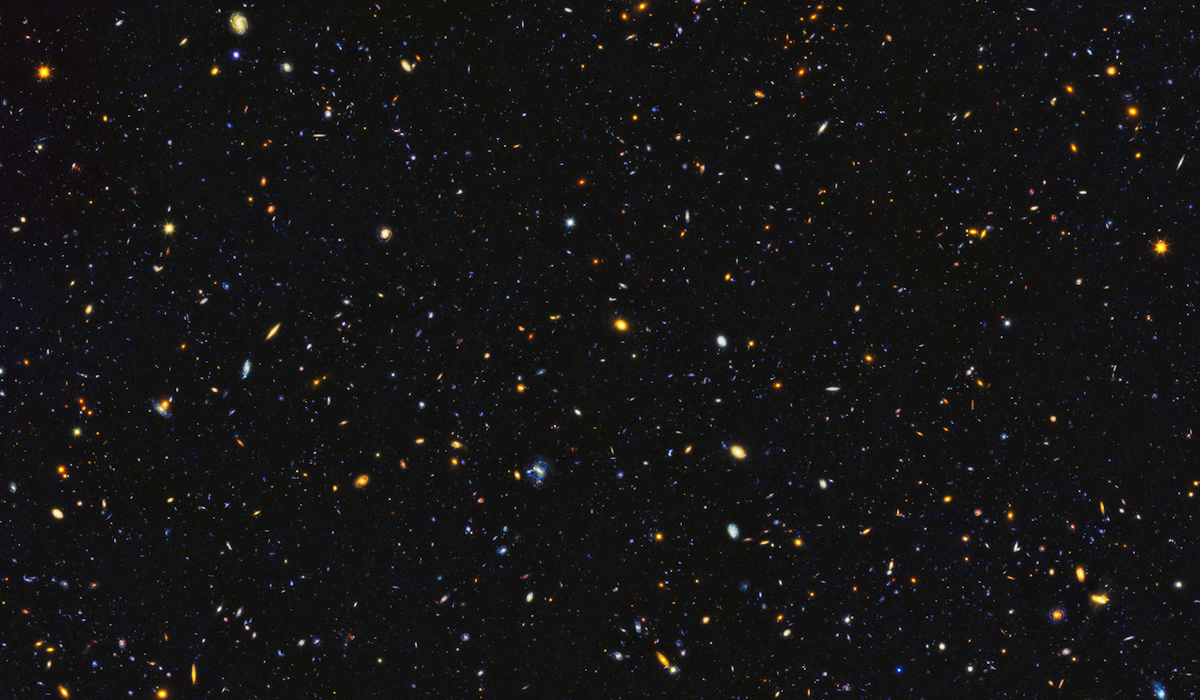
The early universe
Without telescopes, modern astronomy would not exist.
How Does a Telescope Work?
Every telescope follows the same basic principle.
Light from a distant object travels across space, sometimes for millions or even billions of years before reaching Earth. When that light enters a telescope, it is collected by a large optical surface.
In some telescopes, this surface is a lens.
In others, it is a curved mirror.
The collected light is carefully focused to produce a clear image. An eyepiece or digital camera then allows the observer to view or record the image.
Because the telescope gathers much more light than the human eye, faint objects become visible, and fine details become much easier to observe.
Modern telescopes often use highly sensitive electronic detectors instead of human eyes, allowing scientists to measure extremely faint signals with remarkable precision.
The Importance of Light Gathering
Many beginners believe that bigger telescopes are valuable because they produce higher magnification.
In reality, the size of a telescope mainly determines how much light it can collect.
Imagine trying to fill a bucket during a gentle rainstorm. A small bucket collects only a little rain, while a large bucket gathers much more.
A telescope works in a similar way.
A larger lens or mirror captures more incoming light, making faint galaxies, distant stars, and subtle details much easier to observe.
This is why the world’s largest observatories build enormous telescopes with mirrors measuring several meters across.
Their primary goal is not simply to enlarge images but to gather as much light as possible.
The History of the Telescope
The first practical telescopes appeared in the early seventeenth century.
In 1608, Dutch spectacle makers developed simple optical devices that made distant objects appear closer.
Soon afterward, the Italian scientist Galileo Galilei improved these early designs and turned one toward the night sky.
His observations transformed humanity’s understanding of the universe.
Galileo discovered mountains and craters on the Moon, proving that it was not a perfectly smooth sphere.
He observed four large moons orbiting Jupiter, showing that not everything revolved around Earth.
He also saw the phases of Venus, providing strong evidence that Venus orbits the Sun.
These discoveries challenged long-held beliefs and helped establish the modern scientific view of the Solar System.
Since Galileo’s time, telescope technology has advanced dramatically, leading to instruments capable of exploring the deepest regions of space.
Refracting Telescopes
A refracting telescope uses lenses to collect and focus light.
Light enters through a large objective lens at the front of the telescope. This lens bends the incoming light rays until they meet at a focal point.
An eyepiece then magnifies the focused image for viewing.
Refracting telescopes are known for producing sharp, high-contrast images, making them especially popular for observing the Moon, planets, and double stars.
They require relatively little maintenance because their optical components remain permanently aligned inside a sealed tube.
However, very large lenses become heavy, expensive, and difficult to manufacture, limiting the size of refracting telescopes.
Reflecting Telescopes
Reflecting telescopes use curved mirrors instead of large lenses.
A primary mirror collects incoming light and reflects it toward another mirror, which directs the light into an eyepiece or camera.
Most modern research telescopes are reflectors because mirrors can be made much larger than lenses.
Large mirrors also avoid certain optical problems associated with lenses, such as chromatic aberration, where different colors focus at slightly different points.
Reflecting telescopes dominate professional astronomy because they provide excellent light-gathering power while remaining practical to construct.
Catadioptric Telescopes
Some telescopes combine both lenses and mirrors.
These are called catadioptric telescopes.
Popular designs such as Schmidt-Cassegrain and Maksutov-Cassegrain telescopes are compact while providing long focal lengths.
Because they balance portability with excellent optical performance, these telescopes are widely used by amateur astronomers.
They perform well for observing planets, the Moon, star clusters, and many deep-sky objects.
Optical Telescopes
When most people imagine a telescope, they picture an optical telescope.
Optical telescopes detect visible light—the same type of light human eyes can see.
These instruments produce beautiful images of stars, galaxies, nebulae, planets, and other celestial objects.
Many backyard telescopes belong to this category, as do famous research observatories around the world.
Radio Telescopes
The universe emits much more than visible light.
Many astronomical objects produce radio waves that cannot be detected by human eyes.
Radio telescopes collect these invisible signals using enormous dish-shaped antennas.
Instead of producing ordinary photographs, radio telescopes convert radio waves into scientific data that reveal hidden structures throughout the universe.
They have helped astronomers discover pulsars, study clouds of hydrogen gas, observe galaxies hidden by dust, and even produce images of black holes.
Some of the largest radio telescopes span hundreds of meters across, while networks of smaller dishes work together to achieve even greater resolution.
Space Telescopes
Earth’s atmosphere protects life, but it also blocks or distorts much of the electromagnetic radiation arriving from space.
Clouds, weather, air turbulence, and atmospheric absorption can reduce image quality.
To overcome these limitations, scientists place telescopes in space.
Orbiting above Earth’s atmosphere allows these telescopes to obtain exceptionally clear observations.
Space telescopes can also detect ultraviolet radiation, X-rays, infrared light, and other wavelengths that never reach Earth’s surface.
They have transformed astronomy by revealing newborn stars hidden inside dusty clouds, distant galaxies from the early universe, and planets orbiting other stars.
Famous Space Telescopes
Several space telescopes have become icons of scientific discovery.
The Hubble Space Telescope, launched in 1990, has captured some of the most breathtaking images ever taken. It has helped determine the expansion rate of the universe, study galaxy evolution, observe stellar birth and death, and investigate the atmospheres of distant planets.
The James Webb Space Telescope, launched in 2021, observes primarily in infrared light. Its enormous mirror and advanced instruments allow it to peer through cosmic dust, examine the earliest galaxies, study the formation of stars and planets, and analyze the atmospheres of exoplanets with unprecedented sensitivity.
Together, these observatories have greatly expanded our understanding of the universe.
Resolution: Seeing Fine Details
Another important property of telescopes is resolution.
Resolution describes how well a telescope can distinguish small details or separate two objects that appear very close together.
Higher resolution allows astronomers to see fine structures on planetary surfaces, resolve individual stars inside dense clusters, and observe intricate features within galaxies.
Resolution improves as the telescope’s primary lens or mirror becomes larger.
This is another reason why modern observatories build increasingly large telescopes.
Magnification Is Not Everything
Magnification often receives the most attention in advertisements, but experienced astronomers know that it is only one part of telescope performance.
Extremely high magnification does not automatically produce better images.
If a telescope lacks sufficient light-gathering ability or resolution, increasing magnification simply enlarges a blurry image.
The quality of the optics, the size of the primary lens or mirror, atmospheric conditions, and proper focusing are all far more important than magnification alone.
A modest telescope with excellent optics often outperforms a poorly designed telescope claiming extremely high magnification.
Telescopes and Modern Astronomy
Nearly every major discovery in astronomy depends on telescopes.
Scientists use them to measure the distances of galaxies, investigate dark matter, map cosmic microwave background radiation, observe black holes, study exploding stars, and search for planets around other suns.
Modern telescopes are equipped with sophisticated digital cameras, spectrographs, adaptive optics systems, and computer-controlled tracking mechanisms.
These technologies allow astronomers to collect enormous amounts of precise data that would have been unimaginable just a few decades ago.
Telescopes and Amateur Astronomy
You do not need to be a professional scientist to enjoy astronomy.
Millions of amateur astronomers around the world use telescopes from their backyards, parks, and observatories.
Even a small telescope can reveal remarkable sights.
The Moon’s craters become sharp and detailed.
Jupiter’s cloud bands and largest moons become visible.
Saturn’s rings appear as one of the most unforgettable sights in astronomy.
Bright nebulae, star clusters, and nearby galaxies can also be observed under dark skies.
For many people, their first view through a telescope creates a lifelong fascination with the universe.
The Future of Telescopes
Astronomy continues to advance through ever more powerful telescopes.
New observatories are being built with mirrors spanning dozens of meters, allowing scientists to study planets similar to Earth, investigate the first stars, and probe the nature of dark matter and dark energy.
Future space telescopes may directly photograph Earth-like planets around nearby stars and search their atmospheres for chemical signs that could indicate biological activity.
Artificial intelligence, advanced detectors, adaptive optics, and innovative engineering will continue to improve telescope performance, enabling discoveries that are impossible today.
Each new telescope extends humanity’s vision farther into space and deeper into cosmic history.
Why Telescopes Matter
A telescope is far more than an instrument for observing distant objects. It is one of humanity’s greatest tools for discovery. It has changed our understanding of our place in the universe by revealing that Earth is not the center of the cosmos, that our Sun is one star among hundreds of billions in the Milky Way, and that countless other galaxies fill the observable universe.
Every observation made through a telescope adds another piece to the story of the cosmos. These instruments help answer fundamental questions about how stars are born, how galaxies evolve, how planets form, and how the universe itself has changed over billions of years.
Beyond science, telescopes inspire curiosity, imagination, and a sense of connection with the vast universe that surrounds us. They remind us that every point of light in the night sky has a story waiting to be explored.
Conclusion
A telescope is an instrument designed to collect and focus light or other forms of electromagnetic radiation, allowing distant objects to appear brighter, clearer, and more detailed. By gathering far more light than the human eye can, telescopes reveal the hidden beauty and complexity of the universe, from the craters of the Moon to galaxies billions of light-years away.
For more than four centuries, telescopes have driven some of the greatest scientific discoveries in history. They have reshaped our understanding of the Solar System, uncovered the vastness of the cosmos, and continue to push the boundaries of human knowledge. As technology advances, telescopes will remain our most powerful windows into the universe, helping future generations explore mysteries that have yet to be discovered.