The universe is constantly in motion. Stars orbit galaxies, galaxies drift through space, planets circle stars, and even our own Milky Way is traveling through the cosmos. Although these motions often happen over unimaginably large distances, astronomers have developed clever ways to detect them. One of the most powerful tools they use is something called blueshift.
Blueshift is a fascinating phenomenon that reveals when an object in space is moving toward us. It may sound like a simple change in color, but it actually carries a wealth of information about the motion of stars, galaxies, black holes, and even entire clusters of galaxies. By studying blueshift, scientists can measure cosmic speeds, discover hidden planets around distant stars, and better understand the dynamic universe we live in.
Understanding the Meaning of Blueshift
Blueshift occurs when light waves from an object become shorter in wavelength because the object is moving toward the observer.
Light travels as electromagnetic waves. Every wave has a wavelength, which is the distance between one wave crest and the next. Different wavelengths correspond to different colors in the visible spectrum.
Blue light has a shorter wavelength than red light. When a light source moves closer to an observer, its light waves become compressed. This compression shifts the light toward the blue end of the spectrum. This change is called blueshift.
The effect is part of a broader phenomenon known as the Doppler effect, which affects all kinds of waves, including sound and light.
The Doppler Effect: The Science Behind Blueshift
To understand blueshift, it helps to imagine hearing an ambulance.
As the ambulance approaches, its siren sounds higher in pitch. After it passes and moves away, the pitch suddenly becomes lower.
This familiar experience happens because of the Doppler effect.
When the ambulance moves toward you, each new sound wave is emitted from a position slightly closer than the previous one. The waves become squeezed together, creating a higher frequency.
Light behaves in much the same way.
When a star or galaxy moves toward Earth, the light waves it emits are compressed, increasing their frequency and decreasing their wavelength. The result is a blueshift.
When an object moves away, the opposite happens. The light waves stretch out, producing a redshift, where wavelengths become longer.
Light Is More Than Visible Colors
Although the name “blueshift” refers to blue light, the phenomenon applies to the entire electromagnetic spectrum.
Light includes much more than the colors our eyes can see. Radio waves, microwaves, infrared radiation, visible light, ultraviolet radiation, X-rays, and gamma rays are all forms of electromagnetic radiation.
Blueshift simply means that the wavelength becomes shorter than it was originally, regardless of which part of the spectrum it belongs to.
For example, radio waves from a distant galaxy can be blueshifted even though they are completely invisible to human eyes.
How Astronomers Detect Blueshift
Astronomers do not usually determine blueshift by looking for a star that appears blue.
Instead, they analyze light using an instrument called a spectroscope or spectrograph.
When light passes through this instrument, it spreads into a spectrum, much like sunlight passing through a prism.
Within this spectrum are dark or bright lines produced by specific chemical elements. Every element, such as hydrogen, helium, oxygen, or calcium, creates a unique pattern of spectral lines.
Scientists know the exact wavelengths these lines should have when measured in laboratories on Earth.
If the lines appear shifted toward shorter wavelengths, the object is moving toward Earth. The amount of this shift allows astronomers to calculate its speed with remarkable precision.
Why Blueshift Happens
Imagine throwing tennis balls while walking forward.
Each ball starts its journey from a position slightly closer to the person catching it than the previous ball. As a result, the balls arrive closer together.
Light behaves similarly.
As a star moves toward Earth, each new light wave begins from a position closer than the one before it. The waves become compressed, shortening the wavelength.
This compression is not caused by changes in the light itself but by the relative motion between the light source and the observer.
Measuring the Speed of Celestial Objects
One of the greatest strengths of blueshift is that it allows astronomers to measure motion without physically traveling to distant objects.
The greater the blueshift, the faster an object is approaching.
Using mathematical relationships based on the Doppler effect—and, for objects moving at speeds close to the speed of light, Einstein’s theory of special relativity—scientists can determine an object’s velocity with extraordinary accuracy.
This technique is routinely used to study stars, galaxies, nebulae, quasars, and gas clouds throughout the universe.
Blueshift and Our Neighboring Galaxy
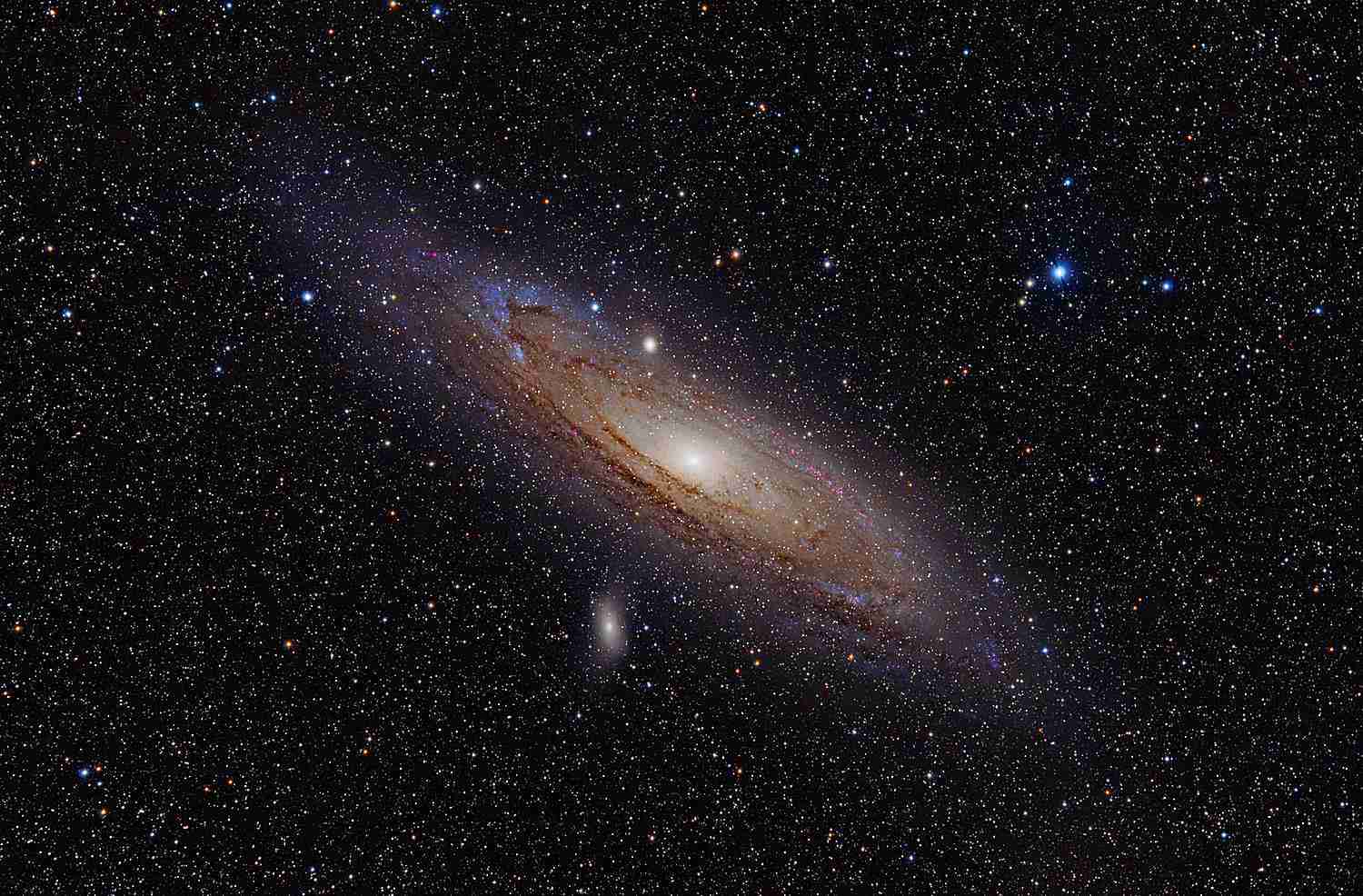
One of the most famous examples of blueshift involves the Andromeda Galaxy, the nearest large spiral galaxy to the Milky Way.
Unlike most galaxies in the observable universe, which are moving away because the universe is expanding, Andromeda is moving toward us.
Its light is measurably blueshifted.
Current observations show that Andromeda is approaching the Milky Way at roughly 110 kilometers (about 68 miles) per second along our line of sight. Although the collision will not happen for about 4 to 5 billion years, the blueshift of its light provides clear evidence of its approach.
Eventually, the Milky Way and Andromeda are expected to merge into a much larger galaxy.
Blueshift in Binary Star Systems
Many stars exist not alone but in pairs known as binary systems.
As the stars orbit one another, one star periodically moves toward Earth while later moving away.
When it approaches us, its light becomes blueshifted.
When it recedes, its light becomes redshifted.
By observing this repeating pattern, astronomers can determine the stars’ orbital periods, masses, and distances from each other.
This method has become one of the most important tools in stellar astronomy.
Discovering Exoplanets Through Blueshift
Blueshift has played a crucial role in the discovery of thousands of planets beyond our Solar System.
A planet’s gravity causes its parent star to wobble slightly as both orbit their common center of mass.
As the star moves alternately toward and away from Earth, its light shifts between blueshift and redshift.
These tiny changes are detected using the radial velocity method.
Even though the planet itself may be invisible, the star’s changing spectrum reveals the planet’s existence, its mass, and the length of its orbit.
Many of the first confirmed exoplanets were discovered using this technique.
Blueshift and Black Holes
Black holes themselves emit no light, but the hot gas surrounding them often shines intensely.
This gas can move at enormous speeds as it spirals inward.
Some of the gas travels toward Earth while other parts move away.
The approaching gas produces blueshift, while the receding gas produces redshift.
By studying these shifts, astronomers can investigate the behavior of matter under extreme gravity and estimate the properties of black holes.
These measurements have greatly expanded our understanding of some of the universe’s most mysterious objects.
Blueshift in Galaxies
Although most galaxies exhibit redshift because the universe is expanding, some nearby galaxies show blueshift.
This usually happens because local gravitational attraction is stronger than the effect of cosmic expansion.
Galaxies within the Local Group, the small collection of galaxies that includes the Milky Way, can move toward one another due to gravity.
Blueshift helps astronomers map these local motions and understand how galaxies interact over billions of years.
Relativistic Blueshift
For objects moving at speeds approaching the speed of light, classical Doppler calculations are no longer sufficient.
Einstein’s theory of special relativity must be used instead.
At these extreme speeds, the relationship between motion and wavelength becomes more complex.
Relativistic blueshift is observed in powerful cosmic phenomena such as jets emitted by supermassive black holes, neutron stars, and certain exploding stars.
Studying these extreme environments helps scientists test fundamental theories of physics.
Can Humans See Blueshift?
In most cases, no.
The amount of blueshift produced by ordinary astronomical objects is far too small for human eyes to notice directly.
Instead, astronomers detect blueshift using highly sensitive instruments that measure wavelengths with extraordinary precision.
Only if an object were moving toward us at an extremely high speed would its color visibly shift toward blue, and such situations are not encountered in everyday life.
Blueshift in Everyday Life
The concept behind blueshift can be understood through familiar experiences, even though we do not normally observe blueshift itself.
The changing pitch of a passing train, motorcycle, or ambulance is an example of the Doppler effect acting on sound waves.
Weather radar uses similar principles to detect the movement of rain, snow, and storms.
Police radar measures vehicle speeds using Doppler shifts in radio waves.
Medical ultrasound can detect blood flow by measuring tiny Doppler shifts in reflected sound waves.
Although these examples involve sound or radio waves rather than visible light, they rely on the same fundamental physics as astronomical blueshift.
Blueshift and the Expanding Universe
One of the greatest discoveries in modern astronomy is that the universe is expanding.
Because of this expansion, most galaxies are moving away from us, causing their light to become redshifted.
Blueshift is therefore relatively uncommon on the largest cosmic scales.
When astronomers find a blueshifted galaxy, it usually means that local gravitational forces dominate its motion.
Studying these exceptions helps scientists understand both galaxy evolution and the balance between gravity and cosmic expansion.
How Scientists Calculate Blueshift
Astronomers compare the wavelength of a spectral line observed from a distant object with the wavelength measured in laboratories on Earth.
The difference between these two values reveals how much the light has shifted.
For objects moving much slower than the speed of light, the shift provides a straightforward estimate of their velocity toward or away from Earth.
For very high-speed objects, relativistic equations based on Einstein’s special relativity are required to obtain accurate results.
Modern observatories can measure wavelength changes that are incredibly small, allowing astronomers to detect motions of only a few meters per second in some cases.
Why Blueshift Is Important
Blueshift is much more than a change in the color of light.
It serves as one of astronomy’s most valuable investigative tools.
Without blueshift, scientists would have far less information about how stars move, how galaxies interact, how planets orbit distant suns, and how matter behaves around black holes.
It enables researchers to transform tiny shifts in light into detailed knowledge about objects located hundreds, thousands, or even billions of light-years away.
Every spectrum collected by a telescope contains clues about motion, and blueshift is one of the keys to unlocking those clues.
Common Misunderstandings About Blueshift
Many people believe that blueshift means an object actually looks blue.
This is usually not true.
Blueshift refers to a change in wavelength, not necessarily to a visible change in color. The shift is often far too small for human vision to detect.
Another misconception is that only blue stars experience blueshift.
In reality, any object emitting electromagnetic radiation can exhibit blueshift if it is moving toward the observer, regardless of its actual color.
Blueshift also does not mean an object is getting brighter. Brightness depends on factors such as distance, luminosity, and intervening material, not simply on the direction of motion.
The Future of Blueshift Research
As telescopes become more powerful and spectrographs more precise, astronomers continue to use blueshift to explore the universe with increasing accuracy.
New observatories are measuring the motions of stars throughout the Milky Way, studying galaxies in unprecedented detail, and searching for Earth-like exoplanets around nearby stars.
Future missions will use increasingly sensitive instruments to detect even smaller Doppler shifts, revealing worlds that are currently beyond our reach and helping scientists investigate some of the deepest mysteries in astrophysics.
Conclusion
Blueshift is a fundamental phenomenon that occurs when light from an object moving toward an observer is compressed into shorter wavelengths. Rooted in the Doppler effect, it provides astronomers with a powerful way to measure motion across the universe. From revealing the approach of the Andromeda Galaxy to discovering planets around distant stars and probing the environments of black holes, blueshift has become an essential tool in modern astronomy.
Although invisible to the naked eye in most situations, the information carried by blueshift allows scientists to explore the dynamic nature of the cosmos with remarkable precision. Every tiny shift in a beam of light tells a story about movement, gravity, and the ever-changing universe, reminding us that even across billions of light-years, light continues to carry the secrets of the stars.