For thousands of years, comets have fascinated people around the world. Their glowing heads and long, shimmering tails suddenly appear in the night sky, often leaving observers in awe. Ancient civilizations sometimes viewed them as mysterious omens or signs from the heavens. Today, thanks to centuries of scientific discovery, we know that comets are not supernatural objects. They are ancient travelers from the outer reaches of our Solar System, carrying valuable clues about how the Sun, planets, and even the building blocks of life may have formed.
Comets are much more than beautiful objects in the night sky. They are frozen relics from the birth of the Solar System, preserving material that has remained largely unchanged for more than 4.5 billion years. Every time a comet approaches the Sun, it puts on a spectacular display while revealing secrets about our cosmic past.
Understanding What a Comet Is
A comet is a small celestial object made primarily of ice, dust, rock, and frozen gases that orbits the Sun. Unlike planets or moons, comets usually follow highly elongated, or oval-shaped, orbits that carry them from the cold outer Solar System toward the warm inner regions before sending them back into deep space.
When a comet is far from the Sun, it looks like a small, dark, frozen object. However, as it travels closer to the Sun, solar heat causes its icy surface to warm. The frozen materials begin changing directly from solid ice into gas through a process called sublimation. This escaping gas carries dust into space, creating the comet’s glowing atmosphere and its famous tail.
Because of this dramatic transformation, comets are often described as “dirty snowballs” or “icy dust balls.” While these nicknames capture their icy nature, scientists now know that comets are complex mixtures of water ice, frozen carbon dioxide, carbon monoxide, methane, ammonia, organic compounds, dust, and rocky material.
How Comets Formed
Comets are among the oldest objects in the Solar System.
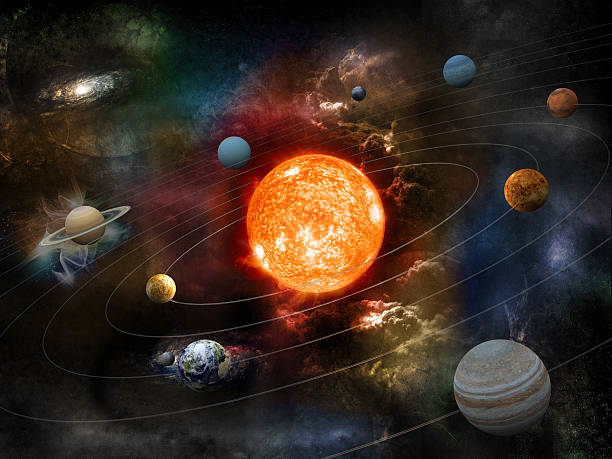
About 4.6 billion years ago, the Solar System formed from a vast cloud of gas and dust called the solar nebula. As gravity pulled this material together, the Sun formed at the center, while planets gradually developed from surrounding material.
Not all of the original material became part of planets. Some leftover ice, rock, and dust remained in the cold outer regions of the Solar System, where temperatures were low enough for water and other volatile substances to freeze. Over time, these frozen leftovers became comets.
Because they have experienced relatively little change since their formation, comets act like cosmic time capsules. Studying them helps scientists understand the conditions that existed when the Solar System was born.
The Parts of a Comet
Although a comet may appear as a simple bright object in the sky, it has several distinct parts that become visible when it approaches the Sun.
At the center lies the nucleus, which is the comet’s solid core. The nucleus contains frozen water, carbon dioxide, carbon monoxide, ammonia, methane, dust, rocks, and organic molecules. Most comet nuclei are only a few kilometers across, although some are much larger. Despite their impressive appearance in the sky, comet nuclei are surprisingly dark because they reflect very little sunlight.
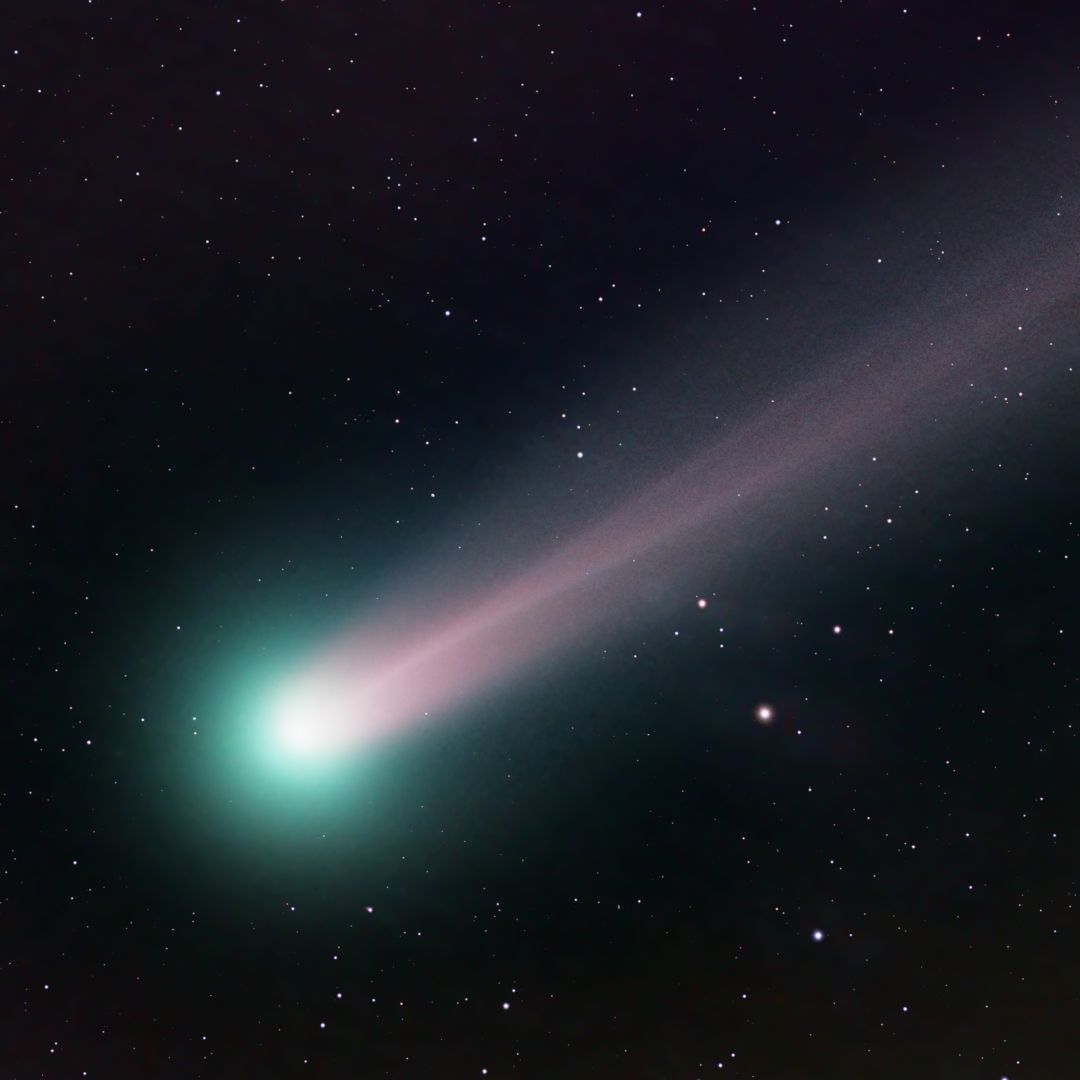
As sunlight heats the nucleus, gases escape into space and form a large cloud surrounding it. This glowing cloud is called the coma. The coma can grow to tens of thousands—or even hundreds of thousands—of kilometers across, making it much larger than the nucleus itself.
The most recognizable feature is the comet’s tail. In fact, many comets develop two different tails. One is a dust tail made of tiny particles pushed away by sunlight. The other is an ion tail, formed when gas molecules become electrically charged by solar radiation and are swept away by the solar wind.
These tails can stretch for millions of kilometers across space.
Why Comets Have Tails
A comet’s tail is created only when it comes close enough to the Sun.
Far from the Sun, a comet remains frozen, and little or no gas escapes from its surface. As it moves inward, increasing temperatures cause ice to vaporize. Escaping gases carry dust away from the nucleus, producing the coma and tails.
One interesting fact is that a comet’s tail always points away from the Sun, regardless of the direction in which the comet is traveling.
This happens because sunlight exerts pressure on dust particles, while the solar wind—a continuous stream of charged particles flowing outward from the Sun—pushes ionized gas directly away from the Sun.
As a result, even when a comet is moving away from the Sun, its tail continues pointing in the opposite direction from the Sun.
What Are Comets Made Of?
Modern spacecraft and telescopes have revealed that comets contain a fascinating mixture of materials.
Water ice is usually the most abundant component. Frozen carbon dioxide, carbon monoxide, methane, and ammonia are also common. Along with these ices are silicate minerals, dust grains, rocky fragments, and a variety of carbon-containing organic molecules.
Scientists have detected dozens of different chemical compounds in comets, including some that are considered important ingredients for life.
Although finding these molecules does not mean comets contain life, it suggests they may have helped deliver some of the chemical building blocks needed for life to the early Earth.
Where Do Comets Come From?
Most comets originate from two distant regions beyond the major planets.
One source is the Kuiper Belt, a vast region beyond Neptune filled with icy objects. Many short-period comets, which return to the inner Solar System every few decades or centuries, come from this region.
The second source is the Oort Cloud, a hypothetical but strongly supported spherical cloud of trillions of icy bodies surrounding the Solar System at enormous distances. Long-period comets that may take thousands or even millions of years to complete a single orbit are believed to originate there.
Gravitational interactions with passing stars or giant planets can occasionally disturb these distant icy bodies, sending them toward the Sun.
Types of Comets
Astronomers generally classify comets according to the length of their orbital periods.
Short-period comets complete an orbit around the Sun in less than 200 years. Many of them originate in the Kuiper Belt and are influenced by the gravity of Jupiter.
Long-period comets require more than 200 years to complete one orbit. Some return only after thousands or millions of years, while others may pass through the inner Solar System only once before leaving forever.
There are also rare comets that travel on nearly straight paths and may never return after passing the Sun.
Famous Comets in History
Some comets have become famous because they are bright enough to be seen without a telescope.
Halley’s Comet is perhaps the best-known example. It returns to the inner Solar System approximately every 76 years, allowing some people to see it twice during their lifetime. Historical records show that humans have observed Halley’s Comet for more than two thousand years.
Comet Hale-Bopp became one of the brightest comets of the twentieth century, remaining visible to the naked eye for many months.
Comet NEOWISE amazed skywatchers in 2020 with its spectacular tail, becoming one of the brightest comets visible from Earth in decades.
Each appearance of a bright comet reminds us that the Solar System remains an active and dynamic place.
How Comets Differ from Asteroids
Comets and asteroids are both small bodies that orbit the Sun, but they differ in composition and behavior.
Asteroids are primarily made of rock and metal. Most are found in the asteroid belt between Mars and Jupiter. Because they contain relatively little ice, they usually do not develop glowing comas or long tails.
Comets contain significant amounts of frozen materials. When they approach the Sun, these ices vaporize, producing the bright coma and tails that distinguish comets from asteroids.
Some objects blur the distinction between the two categories, showing characteristics of both, but in general, comets are icy while asteroids are mostly rocky.
Can Comets Hit Earth?
Yes, although such events are extremely rare.
Throughout Earth’s history, comets and asteroids have occasionally collided with our planet. Large impacts can release enormous amounts of energy and significantly affect Earth’s environment.
Modern astronomy continuously monitors near-Earth objects to identify any potential collision risks. While scientists carefully track known comets, no large comet currently poses an imminent threat to Earth.
Most comets pass safely through the Solar System without coming anywhere near our planet.
Why Scientists Study Comets
Comets are valuable scientific targets because they preserve ancient material from the Solar System’s formation.
By studying their composition, scientists learn about the conditions that existed billions of years ago.
Space missions have transformed our understanding of comets. In 2004, the European Space Agency launched the Rosetta mission, which successfully orbited Comet 67P/Churyumov–Gerasimenko. In 2014, Rosetta’s Philae lander became the first spacecraft to land on a comet’s surface.
These missions revealed detailed information about comet chemistry, surface features, and activity, helping scientists understand how these icy bodies evolve over time.
Researchers are especially interested in whether comets delivered large amounts of water and organic molecules to the early Earth. While the answer is still being investigated, many scientists believe comets may have contributed some of the ingredients that eventually supported the emergence of life.
Comets in Human History
Long before modern science, comets inspired wonder and fear.
Many ancient cultures interpreted them as signs of war, disaster, or major political change because they appeared suddenly and unpredictably.
As astronomy advanced, scientists realized that comets are natural objects following predictable orbits governed by gravity.
This shift from superstition to scientific understanding represents one of humanity’s greatest intellectual achievements. Today, when a bright comet appears, people celebrate the opportunity to witness a rare celestial event rather than fearing it.
Observing a Comet
Most comets are too faint to see without telescopes or binoculars. Occasionally, however, a particularly bright comet becomes visible to the naked eye.
The best time to observe a bright comet is usually when it is closest to both the Sun and Earth while still appearing in a dark sky after sunset or before sunrise.
Unlike stars, which appear as tiny points of light, a bright comet often looks fuzzy, with a glowing head and a graceful tail stretching across the sky.
Because every comet follows its own orbit, no two appearances are exactly alike.
What Comets Tell Us About the Universe
Every comet is a messenger from the distant past.
Its frozen materials have remained preserved for billions of years, carrying information about the earliest stages of our Solar System. By analyzing these ancient objects, scientists gain insights into planetary formation, the distribution of water, the chemistry of the early Solar System, and the processes that continue shaping planetary systems throughout the universe.
Comets remind us that the Solar System is not static but constantly evolving. They connect the distant outer regions of our cosmic neighborhood with the inner planets, including Earth.
Conclusion
A comet is a small icy body that orbits the Sun, composed of frozen gases, dust, rock, and organic materials left over from the formation of the Solar System. Although it appears as a brilliant object with a glowing tail when near the Sun, this spectacular display is simply the result of sunlight heating its frozen surface, releasing gas and dust into space.
Far more than beautiful celestial visitors, comets are among the oldest and most scientifically valuable objects in our Solar System. They preserve a record of conditions that existed billions of years ago, helping scientists explore the origins of planets, the history of water, and the chemical ingredients that may have contributed to life on Earth. Each comet that lights up the night sky is a reminder that our universe is filled with ancient travelers carrying stories from the dawn of the Solar System, waiting to be discovered.