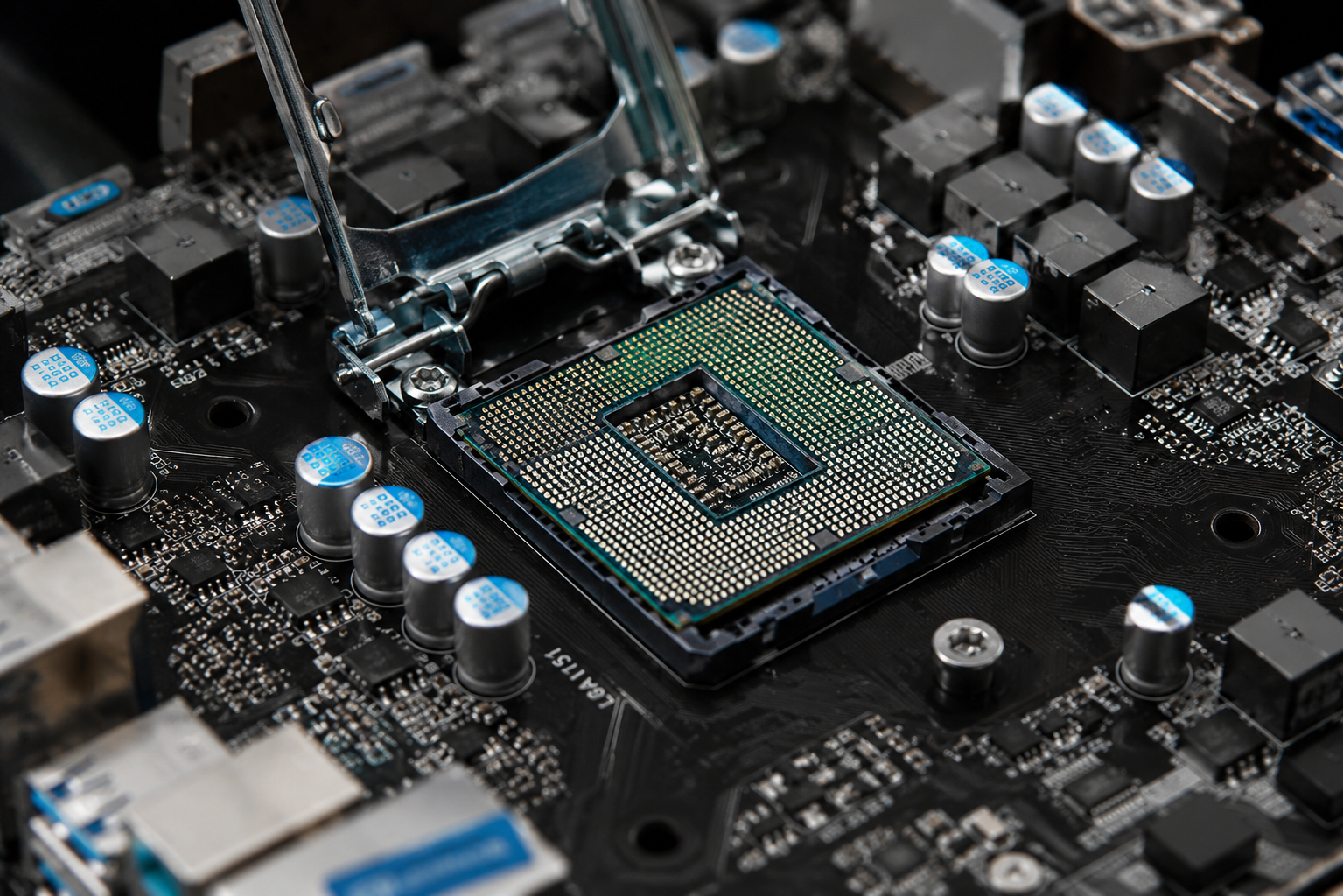
Imagine waking up in the morning and finding that your smartphone no longer works. Your laptop refuses to turn on. Your car cannot start. The internet disappears. Hospitals lose access to advanced medical equipment. Satellites stop communicating, and modern factories grind to a halt.
It sounds like a scene from a science-fiction movie, but nearly all of these technologies depend on one remarkable invention: the semiconductor.
Although most people never see one, semiconductors are among the most important materials ever discovered. They are the invisible foundation of modern electronics, making possible everything from smartphones and artificial intelligence to electric vehicles, spacecraft, and supercomputers.
The digital age exists because scientists learned how to control the movement of electricity inside tiny pieces of semiconductor material. This achievement transformed the world and continues to shape the future of technology.
What Is a Semiconductor?
A semiconductor is a material whose ability to conduct electricity lies between that of a conductor and an insulator. In other words, it can conduct electricity under certain conditions but block it under others.
This unique property makes semiconductors incredibly useful because engineers can precisely control when and where electricity flows.
Conductors, such as copper and silver, allow electric current to move easily. Insulators, such as rubber, glass, and plastic, strongly resist the flow of electricity.
Semiconductors occupy the middle ground. By carefully changing their physical or chemical properties, scientists can make them either conduct electricity or stop it almost instantly.
This controllability is what makes modern electronic devices possible.
Why Are Semiconductors So Important?
Electricity is the language of electronics. Every computer, smartphone, television, game console, and smart appliance processes information by controlling electrical signals.
A semiconductor acts like an intelligent traffic controller for these signals. Instead of allowing electricity to flow all the time, it can turn the current on or off with extraordinary precision.
This simple ability forms the basis of digital electronics.
Computers store information using binary digits, commonly called bits. Each bit has only two possible values: 0 or 1.
Semiconductor devices can represent these two states by either blocking electrical current or allowing it to pass.
Billions of these tiny electronic switches work together inside a computer processor, performing trillions of calculations every second.
The Discovery of Semiconductors
Scientists first noticed unusual electrical behavior in certain materials during the nineteenth century.
Unlike metals, these materials did not always conduct electricity the same way. Their conductivity changed depending on temperature, light, or impurities.
At first, these observations seemed like scientific curiosities.
Everything changed in the twentieth century when researchers realized these materials could replace bulky vacuum tubes.
Vacuum tubes made early computers possible, but they were large, fragile, generated enormous heat, and consumed significant power.
The invention of the transistor in 1947 revolutionized electronics.
John Bardeen, Walter Brattain, and William Shockley developed the first practical transistor at Bell Laboratories.
This breakthrough marked the beginning of the semiconductor revolution.
Today, nearly every electronic device contains billions of transistors built from semiconductor materials.
Silicon: The King of Semiconductors
Although several materials can function as semiconductors, silicon is by far the most widely used.
Silicon is the second most abundant element in Earth’s crust after oxygen.
It is found in sand, quartz, and many types of rock.
Silicon possesses several characteristics that make it ideal for electronic devices.
It forms stable crystals.
It remains reliable over a wide range of temperatures.
It is relatively inexpensive.
It naturally forms a thin layer of silicon dioxide, which serves as an excellent electrical insulator for manufacturing integrated circuits.
Because of these advantages, nearly every computer processor, memory chip, and smartphone chip is made primarily from silicon.
The region around San Francisco famous for semiconductor companies is called “Silicon Valley” because of this remarkable material.
Other Semiconductor Materials
While silicon dominates the electronics industry, it is not the only semiconductor.
Germanium was widely used in early transistors before silicon became the industry standard.
Gallium arsenide is valuable in high-speed communication systems and satellite technology because electrons move through it faster than through silicon.
Silicon carbide performs exceptionally well under high temperatures and high voltages, making it useful in electric vehicles, renewable energy systems, and industrial equipment.
Gallium nitride has become increasingly important in fast chargers, radar systems, radio-frequency communication, and modern power electronics because of its efficiency.
Researchers also continue exploring entirely new semiconductor materials for future technologies.
How Electricity Moves Through a Semiconductor
To understand semiconductors, it helps to imagine electricity flowing like water through pipes.
In a metal conductor, the pipe is always open, allowing water to flow freely.
In an insulator, the pipe is completely blocked.
A semiconductor behaves more like an adjustable valve.
Sometimes it allows electricity to flow.
Sometimes it blocks the flow almost entirely.
Scientists control this behavior by carefully changing the semiconductor’s internal structure.
This ability to regulate electrical current with incredible precision makes semiconductors unlike any other material.
Atoms Inside a Semiconductor
Everything is made of atoms.
Each silicon atom contains fourteen electrons arranged in different energy levels.
The outermost electrons are especially important because they participate in chemical bonds and electrical conduction.
In a pure silicon crystal, each silicon atom shares electrons with four neighboring atoms.
This creates an orderly crystal structure that is stable but not highly conductive.
To improve conductivity, scientists intentionally add tiny amounts of other elements.
This process is known as doping.
What Is Doping?
Despite its name, doping has nothing to do with sports.
In semiconductor manufacturing, doping means introducing extremely small quantities of impurity atoms into pure silicon.
These impurities dramatically change how electricity moves through the material.
Adding phosphorus provides extra electrons that can move freely.
This creates what is known as an n-type semiconductor.
Adding boron creates tiny spaces where electrons are missing.
These spaces are called holes.
This produces a p-type semiconductor.
Although holes are not actual particles, they behave as positive charge carriers because nearby electrons move to fill them.
The interaction between electrons and holes forms the basis of nearly every semiconductor device.
The PN Junction
One of the most important inventions in electronics is the PN junction.
It forms where p-type and n-type semiconductors meet.
At this boundary, fascinating electrical behavior emerges.
Electric current flows easily in one direction but is strongly restricted in the opposite direction.
This property allows engineers to create electronic components that control electrical signals with remarkable accuracy.
The PN junction is the foundation of diodes, transistors, LEDs, solar cells, and countless other electronic devices.
Without it, modern electronics would not exist.
The Transistor: The Building Block of Modern Electronics
If the semiconductor is the foundation of modern technology, the transistor is its most important building block.
A transistor is a tiny semiconductor device that can amplify electrical signals or act as an electronic switch.
Every time you tap your smartphone screen, open an app, stream a video, or search the internet, billions of transistors rapidly switch on and off.
Modern processors contain astonishing numbers of transistors.
High-performance computer processors and AI chips often contain tens of billions of these microscopic switches.
Each transistor is incredibly small, yet together they perform calculations that once required rooms filled with equipment.
Integrated Circuits
Early electronic devices were assembled from individual components connected by wires.
This approach quickly became too large and inefficient.
The solution was the integrated circuit.
Instead of building each transistor separately, engineers manufacture millions—or even billions—of transistors directly onto a single piece of silicon called a chip.
These integrated circuits dramatically reduced size while increasing speed, reliability, and energy efficiency.
Modern microchips can perform billions of operations every second while fitting comfortably on a fingertip.
Semiconductor Chips
People often use the words “chip” and “semiconductor” interchangeably, but they are not exactly the same.
A semiconductor is the material, such as silicon.
A chip is the finished electronic device manufactured using semiconductor materials.
Inside a chip are transistors, wiring, memory cells, logic circuits, and many other microscopic structures.
These chips become the brains of electronic systems.
Every smartphone, computer, smartwatch, gaming console, smart television, and modern automobile contains multiple semiconductor chips.
How Chips Are Manufactured
Creating semiconductor chips is one of the most sophisticated manufacturing processes ever developed.
Production begins with highly purified silicon.
The silicon is melted and grown into a nearly perfect cylindrical crystal.
This crystal is sliced into extremely thin circular wafers.
Engineers then build microscopic electronic structures on the wafer using techniques including photolithography, chemical deposition, ion implantation, etching, and polishing.
Modern manufacturing creates features measured in nanometers.
A nanometer is one billionth of a meter.
For comparison, a human hair is roughly 80,000 to 100,000 nanometers wide.
Many modern transistors are only a few nanometers in size.
Manufacturing these devices requires extraordinary precision because even tiny defects can prevent a chip from functioning correctly.
Why Smaller Chips Matter
Over decades, semiconductor manufacturers have steadily reduced transistor sizes.
Smaller transistors allow more components to fit onto a chip.
This usually leads to faster performance, lower power consumption, and greater computing capability.
Packing billions of transistors into tiny spaces has enabled today’s smartphones to outperform the room-sized computers of previous generations.
Although making transistors ever smaller has become increasingly difficult, engineers continue developing innovative designs to improve performance.
Semiconductors in Smartphones
Every smartphone contains multiple semiconductor chips.
The main processor executes instructions.
Graphics processors render games and videos.
Memory chips store applications and data.
Wireless communication chips connect to Wi-Fi, Bluetooth, and cellular networks.
Image processors improve camera quality.
AI processors accelerate machine learning tasks such as voice recognition, photo enhancement, and language translation.
Without semiconductors, smartphones simply could not exist.
Semiconductors in Computers
Desktop computers and laptops depend on semiconductor technology for nearly every function.
Central processing units perform calculations.
Graphics processors generate images.
Memory stores information.
Solid-state drives use semiconductor memory instead of spinning disks.
Networking chips enable internet communication.
Power management chips regulate electricity throughout the system.
Every click, keystroke, and video call depends upon countless semiconductor devices working together.
Semiconductors in Artificial Intelligence
Artificial intelligence has dramatically increased demand for advanced semiconductor chips.
Training large AI models requires enormous computational power.
Specialized AI accelerators, graphics processors, and neural processing units perform billions or trillions of mathematical operations every second.
These semiconductor chips enable image recognition, language translation, medical diagnosis, autonomous driving, robotics, and scientific research.
As AI becomes more capable, semiconductor technology continues advancing alongside it.
Semiconductors in Cars
Modern vehicles are essentially computers on wheels.
A typical car may contain dozens or even hundreds of semiconductor chips.
These chips manage engine performance, braking systems, airbag deployment, navigation, entertainment, battery management, climate control, parking assistance, and safety features.
Electric vehicles rely even more heavily on semiconductors to efficiently control electric motors, charging systems, and battery performance.
Autonomous driving technologies also depend on powerful semiconductor processors capable of interpreting data from cameras, radar, and other sensors in real time.
Semiconductors in Medicine
Healthcare has been transformed by semiconductor technology.
MRI scanners, CT scanners, ultrasound machines, digital X-ray systems, heart monitors, insulin pumps, pacemakers, and wearable health devices all rely on semiconductor electronics.
Modern medical diagnostics require extremely sensitive sensors and powerful processors capable of analyzing vast amounts of data with exceptional accuracy.
These technologies improve diagnosis, treatment, and patient care worldwide.
Semiconductors in Space
Space exploration depends heavily on semiconductors.
Satellites use semiconductor chips to process communications, navigation signals, weather observations, and scientific measurements.
Spacecraft rely on radiation-resistant semiconductor electronics capable of surviving harsh environments.
Mars rovers, space telescopes, and planetary probes all perform complex operations using advanced semiconductor technology.
Without these devices, exploring the Solar System would be nearly impossible.
The Global Importance of Semiconductor Manufacturing
Semiconductors have become one of the world’s most strategically important technologies.
Modern economies depend upon a steady supply of chips.
When semiconductor production slows, industries across the globe feel the impact.
The worldwide chip shortage that began during the COVID-19 pandemic demonstrated how essential semiconductors have become.
Automobile production declined.
Consumer electronics experienced delays.
Manufacturers struggled to obtain critical components.
Governments and companies increasingly recognize semiconductor manufacturing as a matter of economic resilience and national security.
The Future of Semiconductor Technology
Researchers continue pushing semiconductor technology into exciting new frontiers.
Engineers are developing faster processors, more efficient power electronics, and advanced memory technologies.
Three-dimensional chip designs allow more components to be stacked vertically, improving performance without simply making transistors smaller.
New semiconductor materials promise faster communication, better energy efficiency, and higher operating temperatures.
Quantum computing may eventually introduce entirely new approaches to information processing, although conventional semiconductor chips will likely remain essential for many years.
Artificial intelligence, robotics, autonomous vehicles, renewable energy, and next-generation communication systems will all depend upon continued advances in semiconductor technology.
Challenges Facing the Semiconductor Industry
Despite tremendous progress, the semiconductor industry faces significant challenges.
Manufacturing facilities require enormous investments, often costing tens of billions of dollars.
Fabrication plants must maintain exceptionally clean environments because microscopic particles can damage delicate chips.
As transistor sizes approach atomic dimensions, engineers encounter increasingly complex physical limitations.
Researchers must continually invent new materials, manufacturing methods, and chip architectures to sustain improvements in computing performance.
These challenges make semiconductor research one of the most advanced and demanding fields in modern science and engineering.
Why Semiconductors Matter More Than Ever
Although semiconductors are invisible to most people, they shape nearly every aspect of modern life.
They enable communication across continents, power lifesaving medical equipment, guide spacecraft through deep space, drive scientific discovery, and support the digital services billions of people use every day.
From the smartphone in your pocket to the satellites orbiting Earth, from artificial intelligence to renewable energy systems, semiconductors quietly make modern civilization possible.
As technology continues evolving, these remarkable materials will remain at the heart of innovation, helping humanity solve increasingly complex challenges while opening doors to discoveries we have yet to imagine.
The semiconductor is far more than a piece of silicon. It is one of humanity’s greatest scientific achievements—a tiny material with the extraordinary ability to transform electricity into information, information into technology, and technology into a better understanding of the world around us.