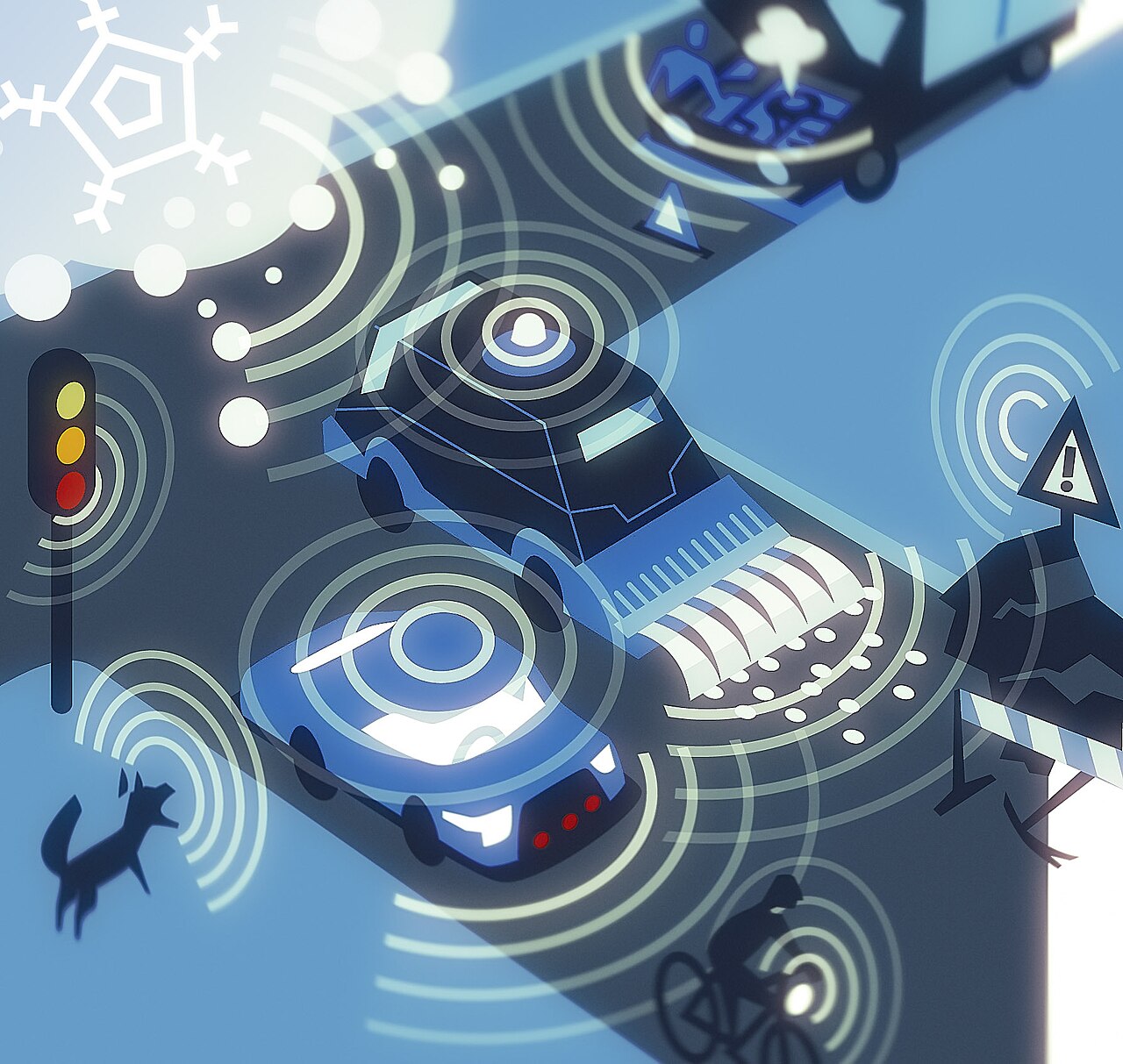
Imagine driving down a busy road on a rainy evening. As you approach an intersection, your car suddenly warns you that another vehicle is about to run a red light—even though you cannot see it yet because a large truck is blocking your view. At the same moment, the traffic signal adjusts its timing to reduce congestion, while a nearby ambulance sends a message that it is approaching, allowing your vehicle to suggest the safest route to move aside.
This may sound like something from a futuristic movie, but it is exactly the kind of world that Vehicle-to-Everything (V2X) technology is designed to create.
For more than a century, vehicles have relied mainly on what drivers can see with their own eyes. In recent years, cameras, radar, and sensors have greatly improved road safety. Yet even the most advanced sensors have limitations. They cannot see through buildings, around sharp corners, or beyond large vehicles. They can only detect what is within their field of view.
V2X changes this by giving vehicles the ability to communicate. Instead of simply observing the world around them, vehicles can exchange information with other vehicles, roads, traffic systems, pedestrians, and communication networks. This creates a transportation system that is more aware, more connected, and potentially much safer.
What Is Vehicle-to-Everything (V2X)?
Vehicle-to-Everything, commonly abbreviated as V2X, is a communication technology that enables vehicles to exchange information with other vehicles, transportation infrastructure, pedestrians, and communication networks in near real time.
The goal of V2X is simple but powerful: allow vehicles to share important information before dangers become visible or accidents occur.
Rather than acting alone, each connected vehicle becomes part of a larger intelligent transportation system.
As information flows continuously between vehicles and their surroundings, drivers and automated driving systems can make faster and more informed decisions.
Why Was V2X Developed?
Road transportation has transformed human civilization, but it also brings challenges.
Every day, traffic congestion wastes time and fuel. Road accidents cause injuries and loss of life. Emergency vehicles are delayed by heavy traffic. Drivers often encounter unexpected hazards that are impossible to see in advance.
Traditional safety systems rely heavily on onboard sensors.
Cameras provide visual information.
Radar measures distance and speed.
Ultrasonic sensors assist during parking.
LiDAR, in some vehicles, creates detailed three-dimensional maps of nearby surroundings.
Although these technologies are highly effective, they cannot detect objects hidden behind buildings, large trucks, or hills.
V2X fills this gap by allowing vehicles to receive information directly from external sources rather than relying only on their own sensors.
How Does V2X Work?
At its core, V2X is a wireless communication system.
Each equipped vehicle contains communication hardware capable of sending and receiving digital messages.
These messages travel over dedicated wireless technologies designed for transportation applications.
Instead of transmitting personal information, V2X primarily exchanges safety-related data.
For example, a vehicle can share its current position, speed, direction of travel, acceleration, braking status, and other operational information.
Nearby vehicles receive these messages almost instantly.
Using this information, onboard computers evaluate possible risks and provide warnings or automatically assist driving systems if necessary.
This continuous exchange creates what engineers often call cooperative awareness.
Instead of every vehicle working independently, they cooperate by sharing information.
The Different Forms of V2X
V2X is actually a family of communication technologies rather than a single system.
Each form connects vehicles with a different part of the transportation environment.
Together, they create a highly connected mobility network.
Vehicle-to-Vehicle Communication
Vehicle-to-Vehicle communication, often called V2V, allows nearby vehicles to exchange information directly.
Suppose one vehicle suddenly applies its brakes because of an obstacle on the road.
Through V2V communication, following vehicles may receive a warning almost immediately—even before the driver notices the brake lights ahead.
Similarly, vehicles approaching an intersection can exchange their positions and directions to help identify potential collision risks.
Because these messages travel electronically rather than relying on human reaction alone, valuable fractions of a second may be gained.
Those moments can sometimes prevent accidents.
Vehicle-to-Infrastructure Communication
Vehicle-to-Infrastructure communication, or V2I, connects vehicles with road infrastructure.
Traffic lights, road signs, bridges, construction zones, and highway monitoring systems can all become part of the communication network.
Imagine approaching an intersection.
Instead of waiting until the traffic light becomes visible, your vehicle already knows whether the light is green, yellow, or red.
Roadside systems may also warn about icy roads, flooding, accidents, lane closures, or road construction farther ahead.
Infrastructure can even collect traffic information from many vehicles to improve signal timing and reduce congestion.
Vehicle-to-Pedestrian Communication
Pedestrians remain among the most vulnerable road users.
Vehicle-to-Pedestrian communication, or V2P, aims to improve their safety.
Future smartphones, wearable devices, bicycles, or other connected equipment could communicate with nearby vehicles.
If a pedestrian begins crossing a road while distracted or hidden from the driver’s view, the system may alert both the pedestrian and the approaching vehicle.
This communication adds another layer of protection beyond cameras and radar.
Vehicle-to-Network Communication
Vehicle-to-Network communication, known as V2N, connects vehicles with cloud services and communication networks.
Through this connection, vehicles can receive weather forecasts, traffic updates, navigation information, software updates, and emergency alerts.
Cloud computing also allows transportation systems to analyze information from thousands of vehicles simultaneously, helping improve traffic management across entire cities.
Vehicle-to-Grid Communication
Another emerging application is Vehicle-to-Grid (V2G) communication.
Electric vehicles contain large rechargeable batteries.
When connected to the electrical grid, some future systems may allow these batteries not only to receive electricity but also to return electricity to the grid under carefully managed conditions.
This could help stabilize power supplies during periods of high electricity demand while making greater use of renewable energy sources.
Wireless Communication Technologies Behind V2X
Several wireless technologies can support V2X communication.
One approach uses Dedicated Short-Range Communications (DSRC), which was developed specifically for transportation safety applications.
Another approach uses Cellular Vehicle-to-Everything (C-V2X) technology, which builds upon modern cellular communication systems.
As fifth-generation mobile networks, commonly known as 5G, continue to expand, they offer faster communication, lower delays, and improved reliability for many V2X applications.
Future sixth-generation communication technologies may further enhance these capabilities.
Why Speed Matters
One of the most important aspects of V2X is extremely fast communication.
When vehicles travel at highway speeds, even a delay of one second can mean moving dozens of meters before receiving a warning.
For collision prevention, messages often need to be exchanged within milliseconds.
Modern V2X systems are designed to minimize communication delays so warnings arrive quickly enough to support safe driving decisions.
V2X and Autonomous Vehicles
Autonomous vehicles rely heavily on cameras, radar, LiDAR, satellite navigation, and artificial intelligence.
V2X provides another valuable source of information.
Instead of only seeing what its sensors detect, an autonomous vehicle can learn about hazards beyond its direct line of sight.
For example, another vehicle several hundred meters ahead may detect slippery pavement and immediately share that information.
An autonomous vehicle receiving the message can adjust its speed before reaching the dangerous area.
Although self-driving vehicles can operate without V2X, communication technology can significantly enhance their awareness and decision-making.
How V2X Improves Road Safety
Road accidents often occur because drivers have incomplete information.
Visibility may be blocked.
Weather may reduce reaction time.
Drivers may become distracted.
Unexpected events may happen too quickly to avoid.
V2X helps reduce uncertainty by sharing information before danger becomes visible.
Warnings may involve sudden braking ahead, vehicles approaching blind intersections, pedestrians entering crosswalks, emergency vehicles nearby, or hazardous road conditions.
Rather than replacing driver attention, V2X provides additional information that can support safer decisions.
Reducing Traffic Congestion
Traffic congestion affects millions of people every day.
Connected vehicles can help transportation systems understand traffic flow in real time.
Road management centers may use this information to optimize traffic signals, recommend alternative routes, and reduce bottlenecks.
Drivers benefit from smoother travel, while cities may reduce unnecessary fuel consumption and emissions caused by stop-and-go traffic.
Helping Emergency Vehicles
Emergency vehicles often lose valuable time because other drivers do not notice them immediately.
With V2X communication, ambulances, fire trucks, and police vehicles can send electronic alerts to nearby vehicles before becoming visible.
Drivers receive earlier warnings, giving them more time to move safely out of the way.
Traffic signals may even adjust automatically to provide faster routes for emergency responders.
Supporting Public Transportation
Buses and public transportation systems may also benefit from V2X.
Traffic signals could prioritize buses running behind schedule, helping improve reliability.
Transit agencies could monitor vehicle locations more accurately while providing passengers with more precise arrival information.
Better coordination can improve the overall efficiency of urban transportation.
V2X and Electric Vehicles
Electric vehicles are becoming increasingly common worldwide.
V2X can help electric vehicles locate available charging stations, estimate travel range more accurately, and communicate with charging infrastructure.
Future charging networks may automatically reserve charging spaces or optimize charging times based on electricity demand.
This intelligent coordination can improve both convenience and energy efficiency.
Cybersecurity Is Essential
Because V2X involves wireless communication, cybersecurity is extremely important.
Vehicles must verify that messages come from trusted sources.
Encryption helps protect transmitted information from unauthorized access.
Authentication systems help prevent malicious devices from sending false safety messages.
Researchers continue developing secure communication methods to protect connected transportation systems.
Without strong cybersecurity, public trust in connected vehicles would be difficult to achieve.
Privacy Considerations
Although V2X exchanges information, protecting user privacy remains a major design goal.
Most safety messages are designed to communicate vehicle movement rather than personally identifying drivers.
Engineers and regulators work to ensure that communication systems provide safety benefits while minimizing unnecessary collection of personal information.
Balancing connectivity with privacy will remain an important challenge as V2X expands.
Challenges Facing V2X
Despite its enormous potential, V2X still faces several challenges.
Many roads currently lack connected infrastructure.
Not all vehicles are equipped with compatible communication technology.
Different countries may adopt different technical standards.
Communication systems must remain reliable in dense urban environments, tunnels, mountains, and severe weather.
Building nationwide connected transportation networks requires significant investment, careful planning, and international cooperation.
The Future of Smart Transportation
Transportation is gradually becoming more intelligent.
Vehicles are no longer isolated machines.
They are evolving into connected computers capable of communicating with their environment.
Future cities may integrate connected cars, buses, bicycles, drones, traffic signals, charging stations, and emergency services into unified transportation networks.
Artificial intelligence may analyze enormous amounts of traffic data to improve efficiency while reducing accidents and emissions.
V2X will likely become one of the key technologies supporting this transformation.
Everyday Life With V2X
Imagine beginning your morning commute.
Before leaving home, your vehicle already knows the best route based on current traffic conditions.
As you drive, nearby vehicles quietly exchange safety information.
The traffic lights coordinate with approaching traffic to improve flow.
Construction zones warn vehicles well in advance.
A cyclist hidden around a corner is detected through communication rather than direct sight.
An ambulance approaching from several streets away alerts nearby vehicles before its siren can be heard.
Most of this communication happens automatically in the background.
The driver simply experiences a smoother, safer journey.
That is the vision behind Vehicle-to-Everything technology.
Conclusion
Vehicle-to-Everything (V2X) is a groundbreaking communication technology that allows vehicles to exchange information with other vehicles, road infrastructure, pedestrians, communication networks, and even electrical grids. By enabling vehicles to share real-time information beyond what cameras and sensors alone can detect, V2X has the potential to make transportation safer, more efficient, and better connected.
Although the technology is still being introduced in many parts of the world, its scientific foundation is already well established. Advances in wireless communication, artificial intelligence, cloud computing, and intelligent transportation systems are steadily bringing the vision of connected mobility closer to everyday reality. As more vehicles and roads become connected, V2X may transform transportation in much the same way that the internet transformed communication—creating a future where vehicles do not simply move, but also communicate, cooperate, and help protect everyone on the road.