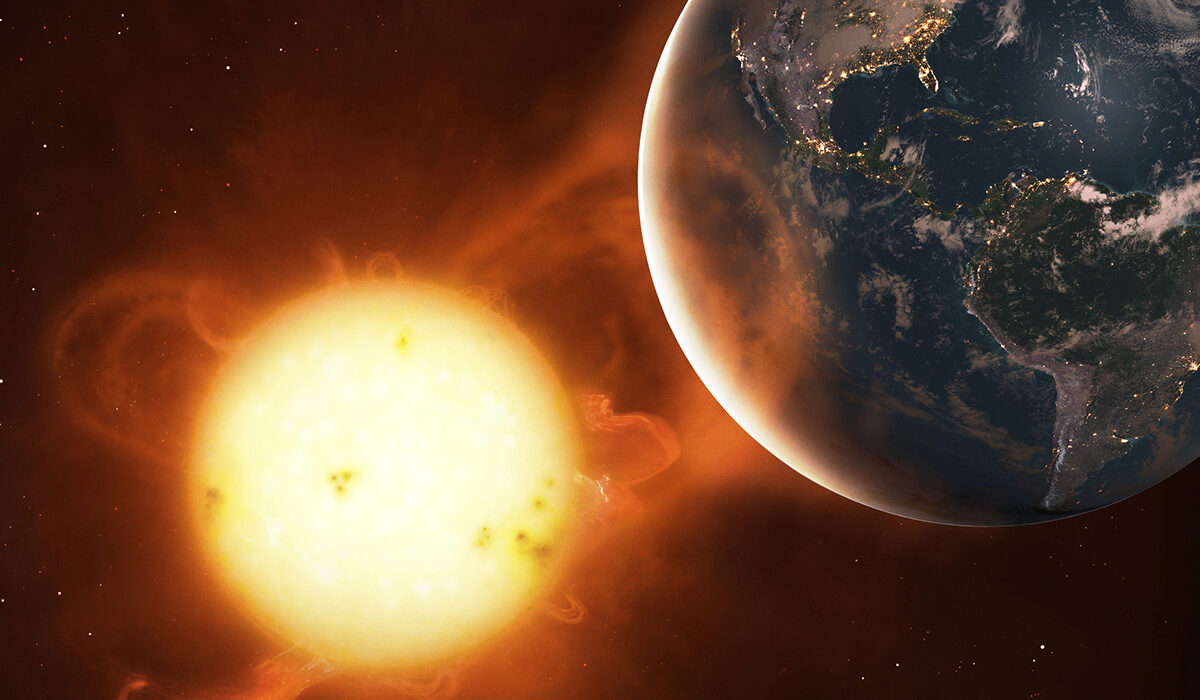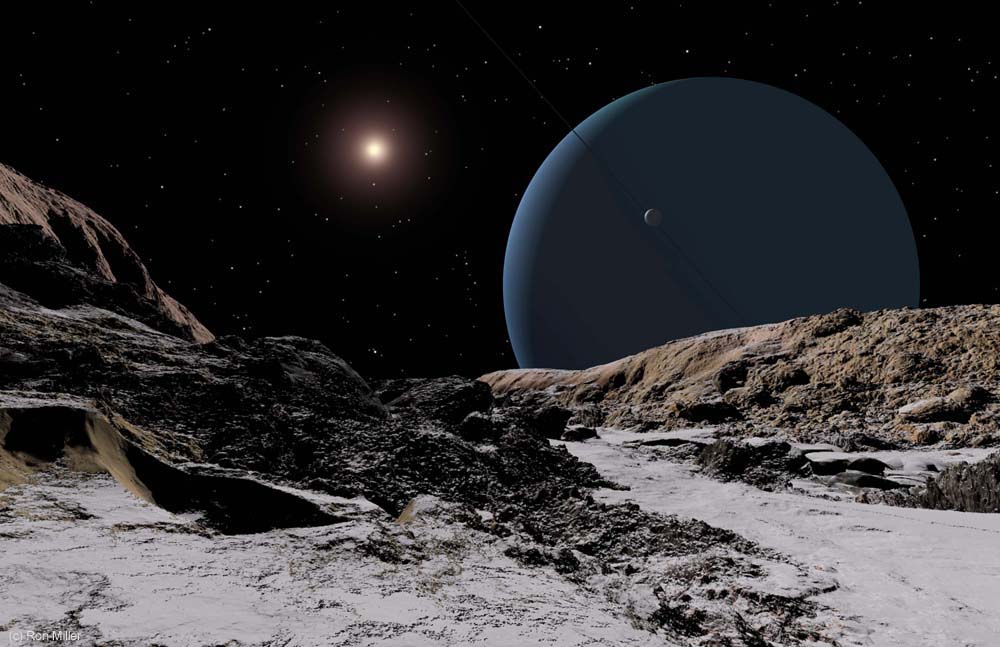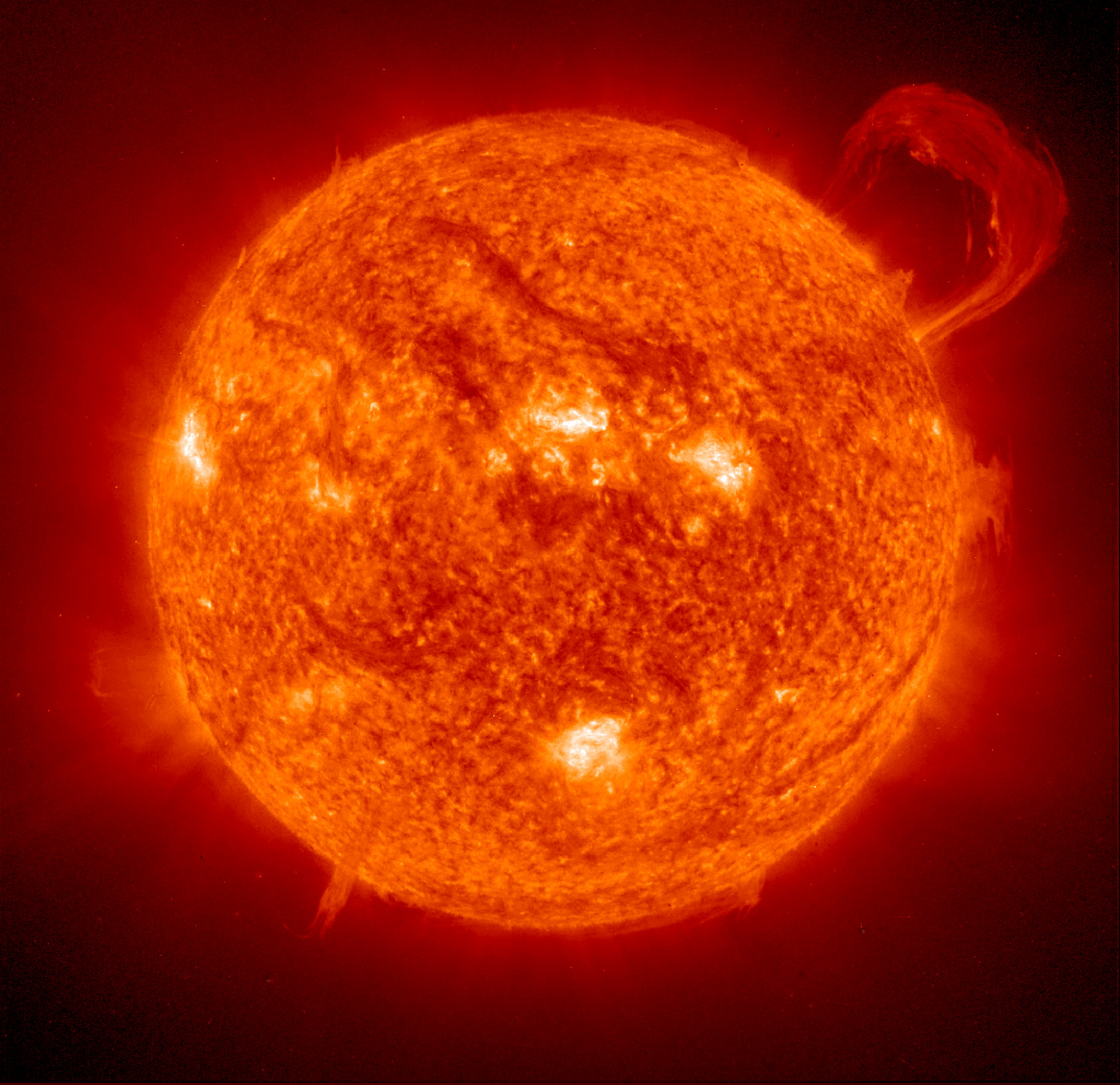
Every morning, without asking for attention, the Sun rises and transforms the world. Darkness gives way to daylight, birds begin to sing, plants open their leaves, and life awakens. It is so familiar that it is easy to forget just how extraordinary it truly is. The Sun is not simply a bright object in the sky—it is a giant star, a powerful nuclear furnace, and the reason life exists on Earth.
Everything from the warmth on your skin to the food on your plate can be traced back to the Sun. It drives Earth’s climate, powers photosynthesis, shapes the seasons, and influences the entire Solar System. Without it, our planet would become a frozen, lifeless world drifting through space.
Yet despite its importance, the Sun is only one of hundreds of billions of stars in our Milky Way galaxy. What makes it special is not that it is unique, but that it is our star—the one around which our entire planetary system revolves.
Understanding the Sun is one of the greatest achievements of science. It has helped us unlock the secrets of stars across the universe and has revealed the incredible forces that shape the cosmos.
The Sun Is a Star
Many people think of the Sun and stars as different kinds of objects, but they are fundamentally the same. The Sun is a star—a massive, glowing sphere of hot gas held together by its own gravity.
Like other stars, the Sun shines because of nuclear fusion occurring deep inside its core. This process releases enormous amounts of energy that travel outward into space as light and heat.
The main difference between the Sun and the stars we see at night is distance. The Sun appears much larger and brighter simply because it is incredibly close compared to every other star. The nearest star beyond the Sun, Proxima Centauri, is about 4.24 light-years away, while the Sun is only about 150 million kilometers (93 million miles) from Earth.
If the Sun were moved as far away as the nearest stars, it would appear as just another tiny point of light in the night sky.
How Big Is the Sun?
The Sun is enormous.
Its diameter is about 1.39 million kilometers (864,000 miles), making it approximately 109 times wider than Earth.
If the Sun were an empty sphere, it could hold about 1.3 million Earths inside it.
Its mass is even more impressive. The Sun contains about 99.8% of all the mass in the Solar System. Every planet, moon, asteroid, comet, and dwarf planet combined make up only a tiny fraction of the Solar System’s total mass.
Because of its immense gravity, the Sun controls the motions of everything orbiting it.
Where Is the Sun?
The Sun lies at the center of the Solar System.
Earth and the other planets travel around it in nearly elliptical orbits. Mercury is the closest planet, while Neptune is the farthest of the eight major planets.
The Sun itself is not at the center of the Milky Way galaxy. Instead, it orbits the galactic center at a distance of about 26,000 light-years.
It takes the Sun roughly 225 to 250 million years to complete one journey around the galaxy. This enormous orbit is sometimes called a “galactic year.”
Since the dinosaurs lived on Earth, the Sun has completed only about one orbit around the Milky Way.
What Is the Sun Made Of?
Although the Sun appears solid from Earth, it has no solid surface.
Instead, it is made almost entirely of extremely hot gas and plasma.
Plasma is often called the fourth state of matter. It forms when atoms become so hot that electrons separate from atomic nuclei, creating a mixture of charged particles.
The Sun is composed mainly of hydrogen, which accounts for about 73% of its mass.
Helium makes up about 25%.
The remaining small percentage consists of heavier elements such as oxygen, carbon, neon, nitrogen, magnesium, silicon, sulfur, and iron.
These heavier elements are present in relatively small amounts but provide valuable clues about how the Sun formed.
How the Sun Formed
The Sun was born about 4.6 billion years ago.
Its story began inside a giant cloud of gas and dust called a molecular cloud.
Gravity slowly pulled part of this cloud together.
As more material accumulated, the growing cloud became denser and hotter.
Eventually, a young protostar formed at its center.
The pressure and temperature inside the core continued increasing until they became high enough for hydrogen nuclei to begin fusing into helium.
Once nuclear fusion started, the Sun officially became a star.
The leftover gas and dust surrounding the newborn Sun gradually formed the planets, moons, asteroids, and comets that make up today’s Solar System.
Why Does the Sun Shine?
The Sun shines because of nuclear fusion.
Deep inside its core, temperatures reach about 15 million degrees Celsius (27 million degrees Fahrenheit).
At these incredible temperatures, hydrogen nuclei move so rapidly that they overcome their natural electrical repulsion and fuse together.
Four hydrogen nuclei are ultimately transformed into one helium nucleus through a series of nuclear reactions.
A tiny amount of mass disappears during this process.
According to Einstein’s equation E = mc², that missing mass is converted into energy.
This energy is released in the form of gamma rays, neutrinos, and kinetic energy.
Over time, the energy slowly makes its way toward the Sun’s surface before escaping into space as sunlight.
Every second, the Sun converts about 600 million tons of hydrogen into helium.
The amount of energy released is so enormous that it powers the entire Solar System.
The Layers of the Sun
The Sun has several distinct layers, each playing an important role in its behavior.
At the center lies the core, where nuclear fusion produces energy.
Surrounding the core is the radiative zone. Here, energy travels outward mainly through radiation. A single photon can take thousands to hundreds of thousands of years, and possibly much longer depending on the path it follows, to gradually move through this dense region because it is repeatedly absorbed and re-emitted.
Above the radiative zone is the convection zone.
In this layer, hot plasma rises toward the surface while cooler plasma sinks downward, creating enormous convection currents similar to boiling water.
The visible “surface” of the Sun is called the photosphere.
Although it appears smooth from Earth, powerful telescopes reveal countless bright granules created by rising hot gas.
Above the photosphere lies the chromosphere, a thin layer visible during total solar eclipses as a reddish glow.
The outermost layer is the corona.
The corona extends millions of kilometers into space and reaches temperatures of over one million degrees Celsius—much hotter than the visible surface below. Scientists are still investigating exactly why the corona is so extraordinarily hot.
How Hot Is the Sun?
The Sun is unimaginably hot.
The photosphere has a temperature of about 5,500 degrees Celsius (about 9,900 degrees Fahrenheit).
The core is much hotter, reaching approximately 15 million degrees Celsius.
The corona becomes even hotter than the surface, exceeding one million degrees Celsius.
These enormous temperatures allow atoms to exist as plasma and drive the Sun’s remarkable activity.
How Sunlight Reaches Earth
Although sunlight seems instantaneous, it takes time to travel through space.
Light moves at approximately 300,000 kilometers per second (186,000 miles per second), the fastest known speed in the universe.
Even at this incredible speed, sunlight takes about 8 minutes and 20 seconds to travel from the Sun to Earth.
This means we always see the Sun as it was just over eight minutes ago.
If the Sun suddenly disappeared—which physics tells us would not happen in this way—we would continue seeing it and feeling its gravitational influence for about eight minutes before both effects reached Earth.
The Sun’s Gravity Holds the Solar System Together
Gravity is the invisible force that keeps the Solar System organized.
The Sun’s enormous mass creates a powerful gravitational field that keeps planets in stable orbits.
Without the Sun’s gravity, Earth and the other planets would no longer orbit a central star. Instead, they would continue moving through space along paths determined by their existing velocities.
The balance between gravity pulling planets inward and their forward motion creates stable orbits that have lasted for billions of years.
Sunspots and Solar Activity
The Sun is far from calm.
Its surface constantly changes because of powerful magnetic fields.
Dark regions called sunspots appear where intense magnetic fields reduce the flow of heat from below, making those areas cooler than their surroundings. Even though they look dark by comparison, sunspots are still extremely hot.
The number of sunspots rises and falls during an approximately 11-year solar cycle.
Periods of high activity produce more sunspots, solar flares, and coronal mass ejections.
These events can affect Earth in surprising ways.
Solar Flares and Coronal Mass Ejections
Solar flares are sudden bursts of energy caused by the rapid release of magnetic energy in the Sun’s atmosphere.
They produce intense radiation across the electromagnetic spectrum.
Sometimes the Sun also launches enormous clouds of charged particles into space.
These eruptions are known as coronal mass ejections.
When these particles reach Earth, they interact with our planet’s magnetic field.
Strong solar storms can disrupt radio communications, damage satellites, interfere with GPS signals, and affect electrical power systems.
Fortunately, Earth’s magnetic field provides significant protection against most harmful charged particles.
The Solar Wind
The Sun continuously releases a stream of charged particles known as the solar wind.
This flow travels throughout the Solar System, carrying the Sun’s magnetic field with it.
The solar wind shapes comet tails, influences planetary magnetic fields, and creates a vast bubble around the Solar System called the heliosphere.
Earth’s magnetic field deflects much of the solar wind, helping protect our atmosphere from being stripped away over long timescales.
The Sun Creates the Northern and Southern Lights
One of the Sun’s most beautiful effects can be seen near Earth’s polar regions.
When charged particles from the solar wind collide with atoms in Earth’s upper atmosphere, they produce glowing curtains of light called auroras.
The Aurora Borealis, or Northern Lights, appears in the Northern Hemisphere.
The Aurora Australis, or Southern Lights, appears in the Southern Hemisphere.
Different atmospheric gases produce different colors, including green, red, purple, and blue.
These spectacular displays are a visible reminder that Earth and the Sun are deeply connected.
The Sun Makes Life Possible
Nearly every form of life on Earth depends directly or indirectly on sunlight.
Plants capture sunlight through photosynthesis.
Using sunlight, water, and carbon dioxide, plants produce sugars that store chemical energy while releasing oxygen.
Animals depend on plants either directly or indirectly for food.
The oxygen we breathe also comes largely from photosynthesis.
The Sun drives weather systems, ocean currents, and the water cycle.
It influences ecosystems, agriculture, and climate.
Without the Sun, photosynthesis would stop, temperatures would rapidly fall, and life as we know it could not survive.
Is the Sun Unique?
The Sun is an average-sized star.
Astronomers classify it as a G-type main-sequence star, often called a yellow dwarf.
Some stars are much smaller, such as red dwarfs.
Others are vastly larger, including blue giants, red supergiants, and hypergiants.
Despite being ordinary by stellar standards, the Sun has proven to be remarkably stable.
Its steady energy output over billions of years has allowed life to evolve on Earth.
How Long Will the Sun Live?
Stars do not shine forever.
The Sun is currently about 4.6 billion years old and is roughly halfway through its main hydrogen-burning stage.
Scientists estimate it has enough hydrogen fuel to continue shining for about another 5 billion years.
As hydrogen in the core becomes depleted, the Sun will gradually change.
It will expand into a red giant, becoming much larger than it is today.
During this stage, its outer layers will likely engulf Mercury and Venus. Whether Earth survives as a planet or is consumed depends on the complex balance between the Sun’s expansion and the outward migration of Earth’s orbit due to the Sun’s mass loss, and scientists continue to study this question.
Eventually, the Sun will shed its outer layers into space, creating a beautiful planetary nebula.
Its remaining core will become a white dwarf—a hot, dense stellar remnant about the size of Earth.
Over trillions of years, the white dwarf will slowly cool.
How Scientists Study the Sun
Scientists observe the Sun using both ground-based observatories and space telescopes.
Special instruments detect visible light, ultraviolet radiation, X-rays, radio waves, and infrared light.
Space missions have transformed our understanding of the Sun.
The Parker Solar Probe has traveled closer to the Sun than any previous spacecraft, directly sampling parts of the Sun’s outer atmosphere and solar wind.
The Solar Orbiter provides detailed views of the Sun’s surface, magnetic fields, and polar regions.
These missions help scientists better understand solar activity and improve forecasts of space weather that can affect technology on Earth.
Fascinating Facts About the Sun
The Sun rotates, but not as a solid object. Because it is made of plasma, its equatorial regions rotate faster than its polar regions.
Its light contains every color of the visible spectrum, which combine to appear white. Earth’s atmosphere scatters shorter wavelengths of light more strongly than longer wavelengths, making the Sun often appear yellow from the ground.
The Sun produces tiny particles called neutrinos in vast numbers every second. Trillions of these nearly massless particles pass through your body each second without causing harm because they interact only very weakly with matter.
The Sun is also moving through the Milky Way galaxy at an average speed of about 220 kilometers per second (roughly 490,000 miles per hour), carrying the entire Solar System with it.
The Sun’s Place in the Universe
Although the Sun dominates our daily lives, it is just one star among hundreds of billions in the Milky Way.
Beyond our galaxy lie hundreds of billions of other galaxies, each containing countless stars.
This perspective makes the universe seem unimaginably vast.
Yet it also highlights something remarkable.
The same physical laws that govern the Sun also govern distant stars billions of light-years away.
By understanding our own star, astronomers gain insights into stellar evolution throughout the universe.
Conclusion
The Sun is far more than a bright light in the daytime sky. It is a giant star powered by nuclear fusion, the gravitational anchor of the Solar System, and the ultimate source of energy for nearly all life on Earth. Every ray of sunlight carries a story that began deep within the Sun’s core, where hydrogen atoms fuse into helium and release the energy that warms our planet, illuminates our days, and fuels the living world.
For billions of years, the Sun has shaped Earth’s climate, guided the evolution of life, and inspired human curiosity. As science continues to explore its mysteries with increasingly advanced telescopes and spacecraft, our nearest star remains both a familiar companion and an extraordinary laboratory for understanding the universe itself.