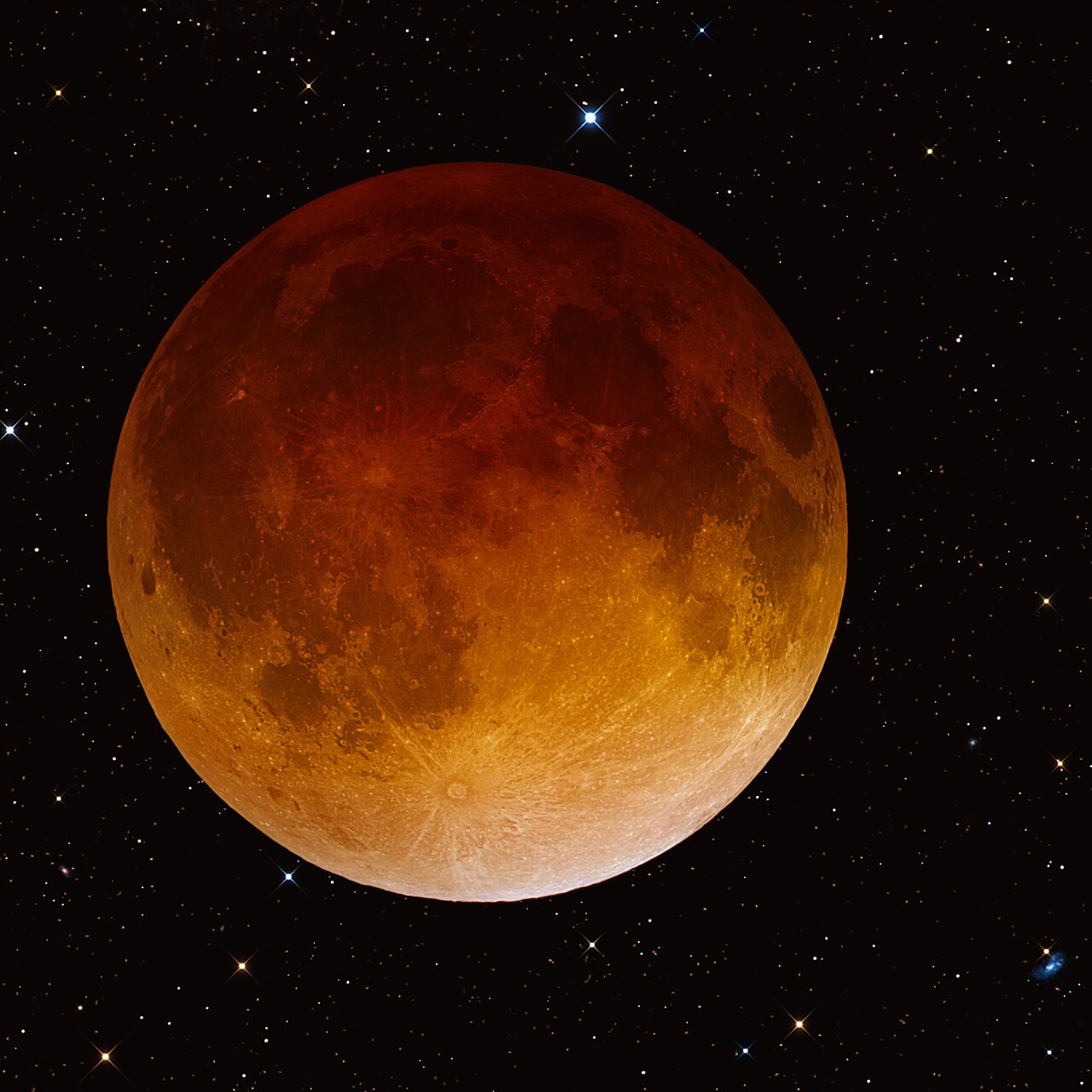
There are few sights in the night sky as captivating as a lunar eclipse. On an ordinary evening, the Moon shines brightly, reflecting sunlight onto Earth. Then, slowly and almost magically, a dark shadow begins to creep across its surface. As the minutes pass, the familiar silvery Moon transforms into a deep copper-red orb, glowing softly against the darkness of space.
For thousands of years, people looked at this extraordinary event with awe and wonder. Ancient civilizations often believed that a dragon, wolf, or giant creature was swallowing the Moon. Some thought it was a sign from the gods or a warning of coming disasters. Today, thanks to centuries of scientific discovery, we know that a lunar eclipse is not a supernatural event. It is a beautiful and predictable consequence of the way the Earth, Moon, and Sun move through space.
Understanding what causes a lunar eclipse not only explains one of nature’s most spectacular sky shows but also reveals how the motions of our solar system work with incredible precision.
Understanding the Earth, Moon, and Sun
To understand a lunar eclipse, it helps to first understand the relationship between the Earth, the Moon, and the Sun.
The Earth travels around the Sun once every year. At the same time, the Moon orbits the Earth approximately once every 27.3 days relative to the stars, while the familiar cycle of lunar phases—from one full Moon to the next—takes about 29.5 days because the Earth is also moving around the Sun.
The Moon does not produce its own light. Instead, it reflects sunlight, much like a giant mirror in space. The side of the Moon facing the Sun is illuminated, while the opposite side remains dark.
As the Moon orbits Earth, we see different portions of its sunlit half, creating the familiar lunar phases: new Moon, crescent, first quarter, gibbous, full Moon, and back again.
A lunar eclipse can happen only during one of these phases.
A Lunar Eclipse Happens During a Full Moon
A lunar eclipse is only possible when the Moon is full.
During a full Moon, the Earth lies approximately between the Sun and the Moon. The Moon’s Earth-facing side is fully illuminated by sunlight, making it appear bright in the night sky.
If the Earth, Moon, and Sun line up closely enough in space, the Earth blocks sunlight from reaching the Moon.
Instead of being illuminated directly by the Sun, the Moon passes into Earth’s shadow.
That is a lunar eclipse.
This alignment is known as a syzygy, a term astronomers use when three celestial bodies line up.
Although every lunar eclipse occurs during a full Moon, not every full Moon produces a lunar eclipse. The reason lies in the Moon’s orbit.
Why Doesn’t Every Full Moon Have a Lunar Eclipse?
This is one of the most common questions about lunar eclipses.
If a full Moon places Earth between the Sun and the Moon, why doesn’t an eclipse happen every month?
The answer is that the Moon’s orbit is tilted.
The Moon’s orbital plane is inclined by about 5 degrees relative to Earth’s orbital plane around the Sun, known as the ecliptic.
Because of this slight tilt, the Moon usually passes a little above or a little below Earth’s shadow during a full Moon.
Most months, the alignment is close but not perfect.
Only when the full Moon occurs near one of the points where the Moon’s orbit crosses the ecliptic—called nodes—does the Moon pass through Earth’s shadow.
That is when a lunar eclipse takes place.
Earth’s Shadow Has Two Parts
Earth’s shadow is not simply one dark cone extending into space.
It has two distinct regions.
The outer portion is called the penumbra.
Here, the Earth blocks only part of the Sun’s light. Some sunlight still reaches the Moon.
The inner region is known as the umbra.
Inside the umbra, the Earth completely blocks direct sunlight.
The type of lunar eclipse depends on which part of Earth’s shadow the Moon passes through.
What Is a Penumbral Lunar Eclipse?
A penumbral lunar eclipse occurs when the Moon travels only through Earth’s penumbra.
Because only part of the sunlight is blocked, the Moon merely appears slightly dimmer than usual.
Many people do not even notice a penumbral eclipse unless they compare photographs taken before and during the event.
Although subtle, it is still a genuine lunar eclipse caused by Earth’s shadow.
What Is a Partial Lunar Eclipse?
A partial lunar eclipse happens when only part of the Moon enters Earth’s umbra.
One portion of the Moon remains brightly illuminated while another gradually darkens.
As the eclipse progresses, Earth’s curved shadow slowly moves across the lunar surface.
The curved edge of the shadow provided one of the earliest pieces of evidence that Earth is spherical. Ancient Greek philosophers noticed that Earth’s shadow was always round during lunar eclipses, regardless of the Moon’s position in the sky.
What Is a Total Lunar Eclipse?
A total lunar eclipse occurs when the entire Moon passes into Earth’s umbra.
At first glance, you might expect the Moon to disappear completely.
Instead, something remarkable happens.
The Moon often turns shades of orange, copper, or deep red.
This dramatic transformation has earned total lunar eclipses the popular nickname “Blood Moon.”
The Moon is not glowing on its own.
It is still being illuminated by sunlight, but in an indirect way.
Why Does the Moon Turn Red?
The red color of a total lunar eclipse is one of nature’s most fascinating optical effects.
Although Earth blocks direct sunlight, some sunlight still passes through Earth’s atmosphere before reaching the Moon.
As sunlight travels through the atmosphere, shorter blue wavelengths are scattered in all directions by air molecules, a process called Rayleigh scattering.
This is the same reason the daytime sky appears blue.
The remaining red and orange wavelengths continue through the atmosphere and are bent, or refracted, into Earth’s shadow.
These reddish rays gently illuminate the Moon even while it sits inside the umbra.
In a sense, every sunrise and sunset occurring around Earth’s edge at that moment contributes a little red light to the eclipsed Moon.
The result is the beautiful copper-red glow seen during a total lunar eclipse.
Why Are Some Lunar Eclipses Brighter Than Others?
Not all total lunar eclipses look the same.
Some appear bright orange.
Others become dark crimson or even brownish.
The difference depends largely on Earth’s atmosphere.
If the atmosphere is relatively clear, more red sunlight passes through it and reaches the Moon, making the eclipse brighter.
If large volcanic eruptions have recently filled the atmosphere with ash and tiny particles, much less sunlight can pass through.
In those cases, the eclipsed Moon may appear unusually dark.
Atmospheric dust, pollution, clouds, and other conditions also influence the eclipse’s appearance.
How Long Does a Lunar Eclipse Last?
A lunar eclipse unfolds slowly.
Unlike a solar eclipse, which may reach totality for only a few minutes, a total lunar eclipse can last much longer.
The entire event—from the Moon first entering Earth’s penumbra until it completely leaves the shadow—can take several hours.
The period during which the Moon remains fully inside Earth’s umbra can last more than an hour, depending on the exact geometry of the alignment.
This slow pace allows observers plenty of time to watch the changing colors and shadows.
Can Everyone on Earth See a Lunar Eclipse?
A lunar eclipse is visible from anywhere on Earth where the Moon is above the horizon.
This makes lunar eclipses much easier to observe than solar eclipses.
While a total solar eclipse can only be seen along a narrow path across Earth’s surface, a total lunar eclipse can be enjoyed by millions of people spread across entire continents.
If it is nighttime where you live and the Moon is above the horizon, you may be able to watch the eclipse from beginning to end.
Is It Safe to Watch a Lunar Eclipse?
Yes.
A lunar eclipse is completely safe to observe with your unaided eyes.
Unlike a solar eclipse, there is no danger in looking directly at the Moon.
No special glasses or filters are needed.
Binoculars and telescopes can make the view even more spectacular by revealing craters, mountains, and subtle color variations across the lunar surface during the eclipse.
How Often Do Lunar Eclipses Occur?
Lunar eclipses happen several times each year, although not all are total.
Typically, there are between two and five lunar eclipses annually, including penumbral, partial, and total eclipses.
Total lunar eclipses are less common than penumbral eclipses because they require especially precise alignment.
The exact number varies from year to year depending on the geometry of the Earth-Moon-Sun system.
How Ancient People Explained Lunar Eclipses
Long before astronomy became a science, lunar eclipses inspired myths across cultures.
Some believed a giant animal was eating the Moon.
Others thought spirits or supernatural beings were responsible.
People often beat drums, rang bells, or made loud noises in hopes of driving away whatever they imagined was attacking the Moon.
As astronomical knowledge advanced, these mythical explanations gave way to scientific understanding.
Today, scientists can predict lunar eclipses years—even centuries—in advance using the precise motions of Earth and the Moon.
What Lunar Eclipses Have Taught Scientists
Lunar eclipses have played an important role in the history of science.
Ancient astronomers used them to study Earth’s shape.
Later observations improved our understanding of the Moon’s orbit.
Modern scientists continue to use lunar eclipses to investigate Earth’s atmosphere.
Because sunlight passes through the atmosphere before reaching the eclipsed Moon, careful measurements of the Moon’s brightness and color provide information about atmospheric dust, aerosols, and other particles.
Lunar eclipses have also helped scientists refine orbital calculations with remarkable precision.
Lunar Eclipse Versus Solar Eclipse
Although both events involve alignments of the Earth, Moon, and Sun, they are very different.
A lunar eclipse occurs when Earth moves between the Sun and the Moon, casting Earth’s shadow on the Moon.
A solar eclipse happens when the Moon moves between the Sun and Earth, casting the Moon’s shadow onto Earth.
Lunar eclipses occur during a full Moon.
Solar eclipses occur during a new Moon.
A lunar eclipse is visible across much of Earth’s nighttime side.
A total solar eclipse is visible only within a narrow path where the Moon’s shadow falls.
Unlike solar eclipses, lunar eclipses are perfectly safe to watch without protective equipment.
The Predictable Rhythm of the Sky
One of the most remarkable aspects of lunar eclipses is their predictability.
The movements of Earth and the Moon follow the laws of gravity with extraordinary precision.
Astronomers know exactly when future eclipses will occur because they understand these orbital motions in great detail.
One famous pattern is the Saros cycle, lasting about 18 years, 11 days, and 8 hours. After one Saros cycle, the Earth, Moon, and Sun return to nearly the same relative positions, producing a very similar eclipse.
This cycle has been used for centuries to forecast eclipses with impressive accuracy.
A Beautiful Reminder of Our Place in the Universe
A lunar eclipse is much more than a beautiful nighttime spectacle. It is a visible demonstration of gravity, orbital motion, sunlight, and Earth’s atmosphere working together in perfect harmony. Every eclipse reminds us that our planet is part of a dynamic celestial system governed by the same physical laws that shape the entire universe.
As Earth’s shadow slowly sweeps across the Moon, we witness a cosmic alignment that has fascinated humanity for thousands of years. What once inspired myths and legends is now understood through science, yet the sense of wonder remains unchanged.
The next time the full Moon begins to darken and slowly glows with a deep red light, you will know exactly what is happening. It is not magic or mystery—it is the graceful dance of the Earth, Moon, and Sun, unfolding exactly as the laws of nature predict, and offering one of the most breathtaking displays the night sky has to offer.