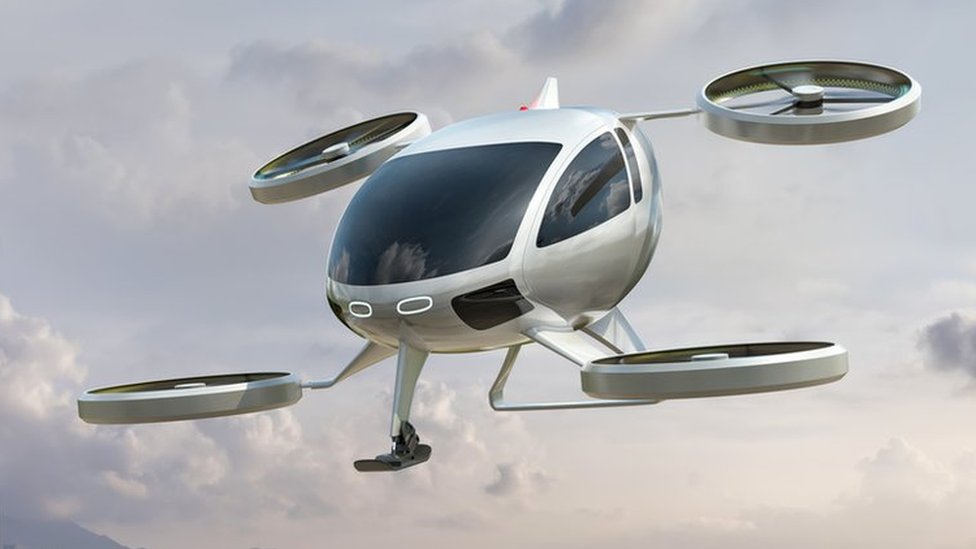
Imagine standing on the rooftop of a busy city building during the morning rush. Below you, streets are packed with cars, buses, and motorcycles moving slowly through traffic. Instead of joining the congestion, you step into a sleek electric aircraft. Within moments, it lifts gently into the air, rises above the skyline, and quietly carries you to your destination in just a few minutes.
For decades, this scene existed only in science fiction. Flying taxis appeared in futuristic movies, books, and television shows as symbols of tomorrow’s cities. Today, however, the idea is moving closer to reality. Around the world, engineers, scientists, aviation experts, and technology companies are developing aircraft designed to transport passengers quickly through the air for short-distance urban travel.
Although flying taxis are not yet a common part of everyday life, remarkable progress has been made. Prototype aircraft have completed successful test flights, governments are creating new aviation regulations, and researchers continue improving the technology needed to make urban air travel safe, efficient, and environmentally responsible.
The future of flying taxis is no longer simply about imagination. It is becoming one of the most exciting engineering projects of the twenty-first century.
What Is a Flying Taxi?
A flying taxi is a small aircraft designed to carry passengers over relatively short distances, especially within or between cities. Unlike conventional airplanes, many flying taxis are designed to take off and land vertically, eliminating the need for long airport runways.
Most future flying taxis are expected to belong to a new category of aircraft called electric Vertical Takeoff and Landing, commonly known as eVTOL aircraft.
These vehicles combine ideas from helicopters, drones, and airplanes. They use multiple electric propellers to lift into the air before flying efficiently toward their destination.
Instead of replacing large commercial airplanes, flying taxis are intended to provide fast transportation for local or regional travel.
Why Are Flying Taxis Being Developed?
Modern cities face growing transportation challenges.
As urban populations increase, traffic congestion becomes more severe. People often spend hours commuting each week, wasting valuable time and increasing fuel consumption.
Flying taxis aim to use the largely empty airspace above cities instead of crowded roads.
A journey that might require an hour by car could potentially take only fifteen or twenty minutes by air, depending on distance, weather, and air traffic.
Flying taxis may also provide faster transportation to airports, hospitals, business districts, and remote communities where road travel is slow or difficult.
Their goal is not simply faster travel but creating a new transportation option that complements existing roads, trains, and buses.
The Science That Makes Flying Taxis Possible
Flying taxis operate according to the same physical principles as every other aircraft.
Four fundamental forces determine whether an aircraft can fly.
Gravity pulls the aircraft downward.
Lift pushes it upward.
Thrust moves it through the air.
Drag resists its movement.
Engineers carefully design flying taxis so that lift exceeds the aircraft’s weight during takeoff while maintaining stability and efficiency throughout the flight.
Advanced computer systems continuously monitor these forces to ensure safe operation.
How Flying Taxis Take Off
One of the greatest innovations in modern flying taxi design is vertical takeoff.
Instead of accelerating along a runway like an airplane, most eVTOL aircraft use several electric propellers positioned around the vehicle.
When these propellers begin spinning, they push air downward.
According to Newton’s Third Law of Motion, pushing air downward creates an equal and opposite upward force that lifts the aircraft.
Once the flying taxi reaches a suitable altitude, many designs tilt their propellers or adjust their flight systems to move forward more efficiently.
This transition allows the aircraft to travel quickly while using less energy than hovering.
Electric Power Is Changing Aviation
Unlike traditional helicopters that usually rely on fuel-burning engines, many flying taxis are powered by electricity.
Large rechargeable battery packs supply energy to electric motors connected to multiple propellers.
Electric motors offer several important advantages.
They are quieter than conventional aircraft engines.
They contain fewer moving parts, reducing maintenance requirements.
They respond almost instantly to changes in power.
They produce no direct exhaust emissions while operating.
These characteristics make electric propulsion especially attractive for aircraft that may operate frequently near residential areas.
The Importance of Batteries
Batteries are one of the most important parts of any electric flying taxi.
They store the electrical energy needed to power the motors throughout the flight.
Battery technology directly affects several important factors.
Flight range depends on how much energy batteries can store.
Passenger capacity depends partly on battery weight.
Flight duration is limited by available energy.
Recharge time influences how quickly aircraft can return to service.
Today’s lithium-ion batteries have made electric aviation possible, but researchers continue developing new battery technologies that could provide greater energy storage, faster charging, improved safety, and longer operating life.
Intelligent Computers Keep Flying Safe
Flying is much more demanding than driving.
Even small changes in wind direction or aircraft balance require immediate corrections.
Modern flying taxis rely heavily on sophisticated flight computers.
These computers monitor hundreds of measurements every second.
They track altitude, speed, aircraft orientation, battery condition, motor performance, weather information, and navigation data.
If one propeller needs to spin slightly faster than another to maintain stability, the computer can make the adjustment almost instantly.
Many modern aircraft would be extremely difficult for humans to control without these advanced computerized systems.
Artificial Intelligence Will Play an Important Role
Artificial intelligence is expected to become increasingly important in future flying taxi operations.
AI systems may help optimize flight routes, predict weather conditions, avoid obstacles, monitor aircraft health, and assist pilots during complex situations.
Some future aircraft may achieve high levels of automation, although aviation authorities are expected to require rigorous safety testing before fully autonomous passenger flights become common.
Rather than replacing human oversight entirely, AI is more likely to function as a highly capable assistant that improves safety and efficiency.
Quiet Flight Matters
Noise is one of the biggest concerns for urban aviation.
Traditional helicopters can generate significant noise because of their large rotor blades and powerful engines.
Flying taxis are being designed to operate much more quietly.
Instead of using one or two large rotors, many eVTOL aircraft distribute lift across several smaller propellers.
Electric motors also produce less mechanical noise than internal combustion engines.
Although flying taxis will not be completely silent, engineers are working to reduce their sound levels so they can operate more comfortably in populated areas.
Where Will Flying Taxis Land?
Flying taxis require specially designed landing areas.
Many future cities may build facilities known as vertiports.
A vertiport is similar to a small airport but designed specifically for vertical takeoff and landing aircraft.
These facilities may be located on rooftops, parking structures, transportation hubs, hospitals, or dedicated urban sites.
Vertiports are expected to include passenger waiting areas, battery charging or replacement equipment, aircraft maintenance facilities, and communication systems.
The development of this infrastructure will be essential before flying taxis can operate on a large scale.
Air Traffic in the Sky
Managing thousands of flying taxis presents an enormous challenge.
Unlike roads, the sky has no painted lanes or traffic lights.
Future urban air mobility systems will rely on advanced digital air traffic management.
Aircraft will continuously communicate with navigation satellites, weather services, other nearby aircraft, and ground control systems.
These communication networks will help maintain safe distances between vehicles while selecting efficient flight paths.
Automation will likely play a major role in coordinating these complex traffic patterns.
Safety Comes First
Passenger safety remains the highest priority.
Before flying taxis enter widespread commercial service, they must meet strict aviation safety standards.
Manufacturers conduct extensive testing to evaluate aircraft performance under a wide range of conditions.
Many flying taxi designs include multiple independent electric motors.
If one motor experiences a problem, the remaining motors may continue operating, allowing the aircraft to maintain controlled flight or perform a safe landing, depending on the design and circumstances.
Backup electrical systems, redundant flight computers, and continuous monitoring further improve reliability.
The aviation industry has built its reputation on rigorous safety procedures, and flying taxis will be expected to meet similarly demanding standards.
Weather Remains a Challenge
Weather has always influenced aviation.
Strong winds, thunderstorms, lightning, heavy rain, dense fog, and icy conditions can affect flight safety.
Flying taxis will need sophisticated weather monitoring systems to determine whether conditions are suitable for takeoff.
Some flights may be delayed or canceled during severe weather, just as commercial airline flights sometimes are today.
Reliable weather forecasting will remain an important part of urban air transportation.
Environmental Benefits and Challenges
Many people hope flying taxis can contribute to cleaner transportation.
Electric propulsion produces no direct emissions during flight.
If batteries are charged using renewable electricity generated from solar, wind, or hydroelectric power, overall greenhouse gas emissions may be reduced.
However, environmental impacts depend on many factors.
Battery manufacturing requires raw materials and energy.
Electricity generation varies between countries.
Aircraft production also consumes resources.
Scientists therefore evaluate the complete life cycle of these vehicles when assessing their environmental impact.
Continued improvements in battery technology and renewable energy may further increase their environmental benefits.
Flying Taxis and Emergency Services
Flying taxis could have uses beyond passenger transportation.
Future aircraft may assist emergency medical services by rapidly transporting doctors, medical equipment, or patients between hospitals.
They could deliver supplies to disaster zones where roads have been damaged.
Firefighters and rescue teams might use similar aircraft to reach difficult locations more quickly.
These applications could save valuable time during emergencies.
Challenges That Still Need Solutions
Despite impressive technological progress, important challenges remain.
Battery energy density must continue improving to allow longer flights while keeping aircraft lightweight.
Manufacturing costs need to decrease before flying taxis become affordable for widespread use.
Cities must build landing infrastructure.
Governments need to establish regulations covering pilot certification, maintenance, air traffic management, cybersecurity, and passenger safety.
Public acceptance is equally important.
People must trust that these aircraft are safe, reliable, and practical before they become a common transportation option.
How Flying Taxis Could Transform Cities
If flying taxis become widely available, cities may gradually change.
Travel between airports and downtown areas could become much faster.
Business meetings across a metropolitan area might require only a short flight instead of a long drive.
Urban planning could include networks of vertiports connected to buses, trains, and subway systems.
Some neighborhoods may become more accessible without constructing additional highways.
Flying taxis are unlikely to replace traditional transportation completely.
Instead, they may become one part of an integrated transportation system where people choose the most efficient option for each journey.
Will Everyone Own a Flying Taxi?
Most experts believe personal ownership will not happen immediately.
Initially, flying taxis are expected to operate as shared transportation services, much like today’s ride-hailing systems or urban helicopter services.
Passengers would book flights using mobile applications.
Professional operators or trained pilots would oversee flights, depending on the level of automation approved by aviation authorities.
As technology matures and costs decrease over many years, ownership models may evolve, but widespread personal flying vehicles remain a long-term possibility rather than an immediate reality.
The Future of Urban Air Mobility
Flying taxis are part of a broader vision known as urban air mobility.
This concept includes passenger transportation, cargo delivery, emergency services, infrastructure inspection, and other low-altitude aviation activities within and around cities.
Urban air mobility aims to create a transportation network where ground vehicles and aircraft work together rather than compete.
Future travelers might ride a train to a transportation hub, transfer to a flying taxi, and reach their destination in a fraction of today’s travel time.
Achieving this vision will require advances in engineering, artificial intelligence, battery technology, communication systems, and aviation regulation.
Looking Ahead
The story of transportation has always been one of innovation. Humanity progressed from walking to riding horses, from sailing ships to steam engines, from automobiles to airplanes. Each breakthrough changed the way people lived, worked, and connected with the world.
Flying taxis may represent the next chapter in that journey. While many technical, economic, and regulatory challenges remain, today’s research and testing show that this vision is grounded in real science rather than fantasy.
The skies above our cities may one day become carefully organized transportation corridors, helping people travel more efficiently while reducing pressure on crowded roads.
Conclusion
The future of flying taxis is one of the most exciting frontiers in modern transportation. Powered largely by electric propulsion, guided by advanced computer systems, and supported by breakthroughs in aviation engineering, these aircraft have the potential to transform short-distance travel within and between cities. Although they are still in the early stages of development, successful test flights and rapid technological progress demonstrate that urban air mobility is steadily moving from concept to reality.
Flying taxis will not solve every transportation problem, nor will they replace cars, buses, trains, or airplanes. Instead, they are likely to become an important addition to existing transportation networks, offering faster travel for certain journeys while opening new possibilities for emergency services, business travel, and sustainable urban mobility. As science, engineering, and technology continue to advance, the dream of everyday flight may gradually become an ordinary part of life, changing not only how we travel but also how we imagine the cities of the future.