Every day, millions of people ask artificial intelligence questions, translate languages, write emails, summarize documents, generate stories, and even have conversations that feel surprisingly natural. You can ask an AI assistant about the weather, request a recipe, solve a math problem, or brainstorm ideas for a project, and within seconds, it responds with coherent and meaningful text.
It can almost seem as if the AI truly understands language in the same way a human does.
But does it?
The answer is both fascinating and more complicated than it first appears.
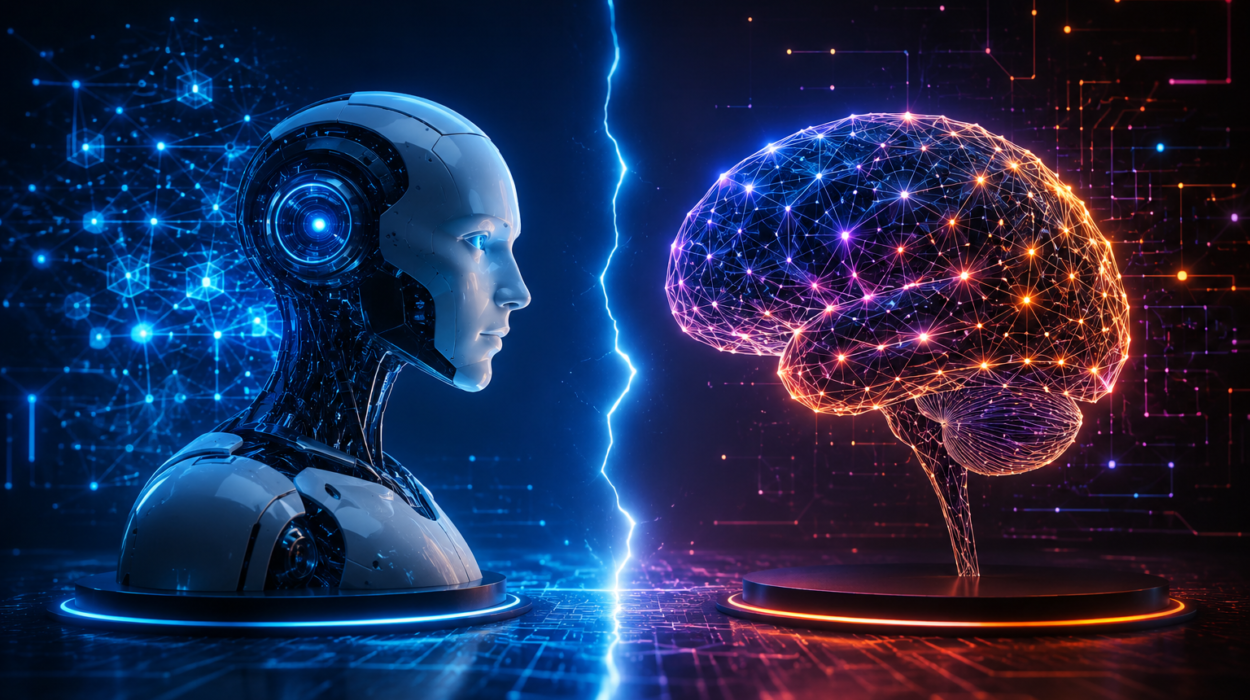
Artificial intelligence has become remarkably good at processing and generating human language, yet it does so in a fundamentally different way from people. Humans understand language through lived experiences, emotions, sensory perception, and years of interaction with the world. Modern AI, on the other hand, learns from enormous amounts of text and identifies patterns that allow it to predict and generate meaningful responses.
Understanding how AI processes language reveals one of the greatest scientific and technological achievements of the modern era. It combines computer science, mathematics, linguistics, neuroscience, and statistics into a field known as Natural Language Processing (NLP).
What Does It Mean to Understand Language?
Language is much more than words.
Every sentence carries meaning, context, emotion, grammar, cultural references, and sometimes hidden intentions. When someone says, “It’s getting cold in here,” they may simply be describing the temperature—or they may actually be asking someone to close a window.
Humans naturally interpret these subtle meanings because our brains combine language with knowledge, memory, experience, and social understanding.
For a computer, however, language is not naturally meaningful.
Computers do not instinctively know what a tree looks like, what happiness feels like, or why a joke is funny. Everything they “know” must come from data and algorithms.
Teaching computers to process human language has therefore been one of the biggest challenges in artificial intelligence.
The Birth of Natural Language Processing
Natural Language Processing, often abbreviated as NLP, is the branch of artificial intelligence that enables computers to work with human language.
The field began decades ago with relatively simple systems that relied on carefully written grammar rules and dictionaries.
Early language-processing programs could recognize keywords or follow fixed patterns, but they struggled whenever people used unexpected wording or complex sentences.
Human language is incredibly flexible.
The same idea can be expressed in countless different ways.
People use slang, idioms, sarcasm, metaphors, abbreviations, and regional expressions. We often leave information unstated because listeners naturally fill in the gaps.
These characteristics make language challenging even for humans, let alone computers.
As computing power increased and larger collections of digital text became available, researchers shifted toward machine learning approaches that allowed computers to discover language patterns automatically rather than relying only on manually written rules.
Language Is Data
To an AI model, language begins as data.
Every book, newspaper article, research paper, conversation, website, and document contains patterns.
Words appear together in predictable ways.
Some combinations occur frequently, while others are rare.
For example, the word “coffee” often appears near words like “cup,” “drink,” “morning,” or “café.”
The word “planet” frequently appears alongside “orbit,” “star,” “gravity,” or “solar.”
By analyzing billions or even trillions of words, AI gradually learns statistical relationships between words, phrases, and ideas.
These relationships become the foundation for generating meaningful responses.
Breaking Sentences Into Pieces
Before AI can process language, it first divides text into smaller units called tokens.
A token may represent a whole word, part of a word, punctuation mark, or occasionally an entire short phrase.
For example, the sentence
“The cat sat on the mat.”
may be divided into individual tokens representing each word and punctuation mark.
Longer or more complex words may be broken into multiple pieces.
Using tokens allows AI systems to efficiently process many different languages and handle unfamiliar words.
Instead of memorizing every possible word, the model learns how smaller language pieces combine to create meaning.
Learning Patterns Instead of Memorizing
One common misconception is that AI simply memorizes sentences.
In reality, modern language models are designed to learn patterns rather than store complete conversations.
During training, the model repeatedly encounters sentences with missing words.
Its task is to predict what comes next.
At first, its guesses are poor.
After processing enormous amounts of text, however, the model gradually becomes better at recognizing relationships among words.
It begins to understand that certain grammatical structures occur regularly.
It learns that adjectives usually describe nouns.
It discovers that verbs often follow subjects.
It notices that discussions about planets frequently include gravity, stars, or space.
Over time, these statistical patterns become increasingly sophisticated.
Rather than memorizing every sentence, the AI develops an internal mathematical representation of language.
Neural Networks Inspired by the Brain
Modern AI language systems use mathematical models known as artificial neural networks.
Although inspired by the human brain, these networks are much simpler than biological neurons.
Artificial neural networks consist of many interconnected computational units.
Each unit performs small mathematical calculations.
As information flows through the network, millions or even billions of parameters are adjusted during training.
These adjustments help the model improve its predictions.
The network gradually learns which language patterns produce the most accurate results.
Despite their inspiration from neuroscience, artificial neural networks do not function like human brains.
They are mathematical systems optimized for finding patterns in data.
The Transformer Revolution
One of the most important breakthroughs in modern artificial intelligence came with the introduction of the Transformer architecture in 2017.
Before transformers, many language models processed sentences one word at a time.
This made it difficult to understand relationships between words separated by long distances.
Transformers introduced a mechanism called attention, allowing the model to examine many words in a sentence simultaneously.
Instead of focusing only on the immediately previous word, the model can determine which earlier words are most important for understanding the current one.
For example, in a long paragraph discussing Earth, the word “it” might refer to the planet rather than another object.
Attention mechanisms help the model identify these relationships much more effectively.
This innovation dramatically improved language understanding and became the foundation of today’s most advanced language models.
Learning Meaning Through Context
Context is one of the most important aspects of language.
Consider the word “bank.”
In one sentence, it may refer to a financial institution.
In another, it may describe the side of a river.
Humans usually determine the correct meaning instantly.
Modern AI does something similar by examining surrounding words.
If nearby words include “money,” “loan,” or “account,” the model recognizes the financial meaning.
If the sentence mentions “river,” “water,” or “fishing,” the environmental meaning becomes more likely.
Rather than assigning one fixed definition to every word, AI learns flexible representations that change depending on context.
This ability greatly improves translation, summarization, question answering, and conversation.
Word Embeddings: Turning Language Into Mathematics
Computers ultimately work with numbers, not words.
To process language mathematically, AI converts words into numerical representations called embeddings.
Words with similar meanings tend to receive similar mathematical representations.
For example, “doctor” and “physician” become mathematically closer than “doctor” and “mountain.”
Likewise, “dog” is generally closer to “puppy” than to “airplane.”
These numerical relationships help AI recognize similarities between words, even when they are not identical.
Embeddings allow language to become something mathematics can describe.
Training on Massive Amounts of Text
Modern AI language models are trained using extraordinarily large collections of text.
These datasets may include books, articles, educational materials, scientific literature, publicly available web pages, and many other written sources.
The sheer scale of training is one reason modern AI performs far better than earlier systems.
By encountering countless examples of grammar, reasoning, explanation, storytelling, dialogue, and factual writing, the model develops broad statistical knowledge about language.
Importantly, training does not involve understanding in the human sense.
Instead, the model repeatedly adjusts billions of numerical parameters to improve its ability to predict text.
Understanding Grammar Without Explicit Rules
Children often learn grammar gradually through experience.
Similarly, modern AI can learn grammatical structures without programmers writing every rule manually.
By observing millions of examples, the model discovers patterns such as subject-verb agreement, sentence structure, punctuation, and word order.
It becomes capable of producing grammatically correct sentences in many different styles.
This learning emerges naturally from exposure to data rather than explicit instruction.
How AI Answers Questions
When you ask an AI a question, several processes occur almost instantly.
The model first converts your message into tokens.
It analyzes relationships among the words.
Using patterns learned during training, it predicts the most appropriate sequence of response tokens.
Each newly generated token influences the prediction of the next one.
This process continues until the complete response is produced.
Although it appears conversational, the system is continuously making highly sophisticated statistical predictions.
Why AI Sometimes Makes Mistakes
Despite impressive abilities, AI does not always produce correct answers.
Because language models generate responses based on learned patterns rather than direct reasoning about reality, they may occasionally produce inaccurate information.
Sometimes the model confidently generates incorrect facts.
Researchers often refer to these incorrect but plausible-sounding outputs as hallucinations.
Hallucinations occur because the model predicts text that appears statistically appropriate, even when supporting evidence is absent.
For this reason, important information generated by AI should always be verified using reliable sources, especially in medicine, law, science, finance, and public policy.
Can AI Truly Understand Language?
This question remains an active area of scientific and philosophical debate.
AI clearly demonstrates remarkable language abilities.
It can summarize books, answer questions, translate languages, explain scientific concepts, generate computer code, and hold lengthy conversations.
However, many researchers distinguish between processing language and experiencing understanding.
Humans connect language to perception, emotions, physical experiences, intentions, and consciousness.
AI lacks these biological experiences.
Instead, it builds mathematical representations from textual patterns.
Whether this constitutes genuine understanding depends partly on how one defines the word “understanding.”
Scientists continue exploring this question.
AI Learns From Probability
Every word generated by AI is based on probability.
Rather than choosing words randomly, the model estimates which next token is most likely to fit the context.
Imagine completing the sentence:
“The Earth revolves around the…”
Most people immediately think of “Sun.”
AI arrives at the same prediction because it has encountered countless examples where those words occur together.
This probability-based approach allows the model to generate coherent paragraphs, answer questions, and even write creative stories.
Different Languages, One Mathematical System
One remarkable feature of modern AI is its ability to process many human languages.
Although English, Arabic, Chinese, Spanish, Bengali, Japanese, and hundreds of other languages differ greatly, AI represents them within shared mathematical structures.
This allows multilingual models to translate between languages, recognize similar meanings across cultures, and answer questions in multiple languages.
The underlying mathematics remains the same even though the written symbols differ dramatically.
AI and Human Communication
AI is increasingly becoming a communication tool.
Students use it for learning.
Researchers summarize scientific papers.
Businesses automate customer support.
Doctors organize medical documentation.
Programmers write software more efficiently.
Writers brainstorm ideas.
People use AI to translate conversations across language barriers.
In each case, language serves as the bridge between humans and machines.
Ethical Challenges
As AI language technology becomes more powerful, important ethical questions arise.
How should misinformation be prevented?
How can harmful biases in training data be reduced?
How should privacy be protected?
Who is responsible when AI generates inaccurate information?
Researchers, governments, educators, and technology companies continue working to address these challenges.
Building trustworthy AI requires not only technical advances but also careful ethical decision-making.
The Future of Language AI
Language AI continues improving rapidly.
Researchers are developing systems that better understand long conversations, combine text with images, audio, and video, and work alongside humans in increasingly sophisticated ways.
Future AI may assist scientists in analyzing research, help teachers personalize education, improve healthcare communication, and make information more accessible across languages.
At the same time, scientists remain focused on improving accuracy, reliability, transparency, and safety.
The goal is not simply to create machines that generate fluent text but to build systems that provide useful, dependable assistance while respecting human values.
A New Way of Communicating With Machines
For most of human history, interacting with computers required specialized commands, programming languages, or complex interfaces. Modern AI has changed that relationship. Today, people can often communicate with computers using ordinary human language.
This shift represents one of the most significant developments in the history of computing. Instead of forcing humans to adapt to machines, AI is increasingly adapting to the way humans naturally speak and write.
Although today’s AI does not understand language exactly as people do, it has become extraordinarily skilled at recognizing patterns, interpreting context, and generating meaningful responses. These abilities arise from advances in machine learning, neural networks, transformer architectures, and vast amounts of training data.
Understanding how AI processes language also reminds us of something remarkable about ourselves. Human language is one of the most complex creations of the human mind, shaped by culture, history, creativity, and shared experience. By studying how machines learn language, scientists are also gaining new insights into the nature of communication, intelligence, and learning itself.
The journey is far from over. As research continues, AI language systems will likely become more capable, more reliable, and more deeply integrated into everyday life. Yet their greatest value will remain the same: helping people communicate, discover knowledge, solve problems, and explore ideas in ways that were once impossible.