Every morning, the Sun rises over the horizon as if it has always been there. Its warm light wakes forests, powers oceans, feeds plants, and makes life on Earth possible. For billions of people throughout history, the Sun has been a symbol of life, hope, and time itself. Yet this brilliant star had a beginning. There was a time when the Sun did not exist, when our Solar System was nothing more than a cold cloud of gas and dust drifting through the vast darkness of space.
The story of how the Sun formed is one of the greatest stories science has uncovered. It is a tale of gravity, cosmic clouds, powerful forces, and extraordinary transformations that unfolded over millions of years. It is also the story of how Earth, the planets, and ultimately life itself came to exist.
Before the Sun, There Was Only a Giant Cloud
Around 4.6 billion years ago, there was no Sun, no Earth, and no Solar System. Instead, a massive cloud of gas and microscopic dust floated within one of the spiral arms of the Milky Way galaxy.
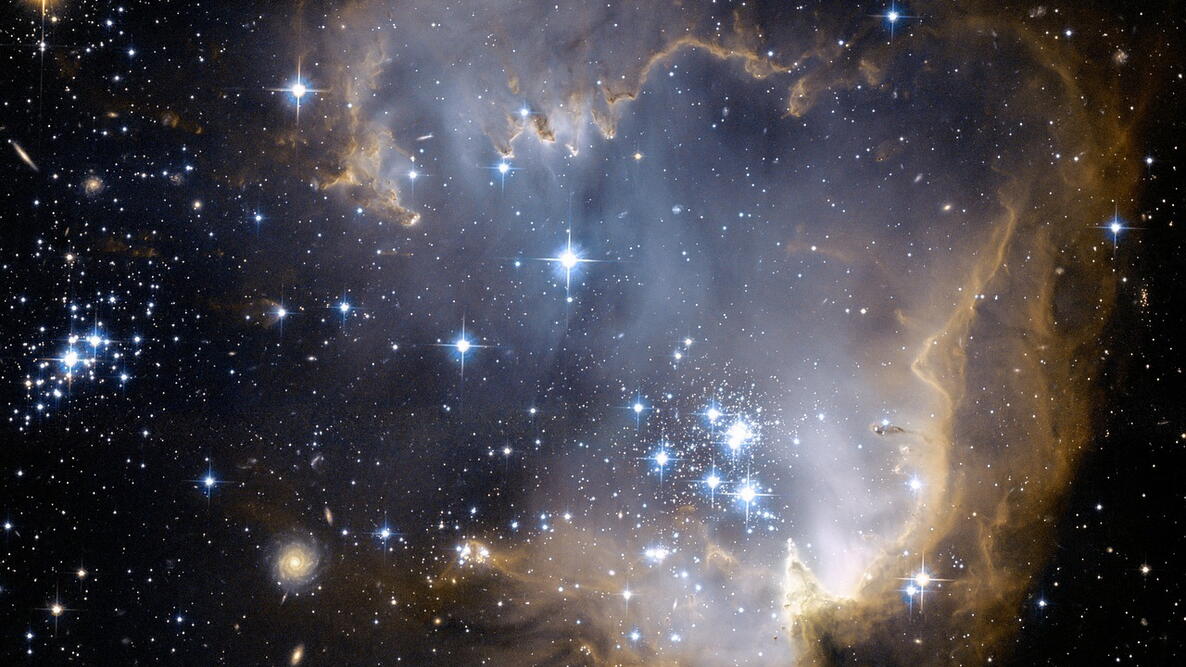
Astronomers call these enormous clouds molecular clouds because they contain molecules such as hydrogen (H₂), along with helium and tiny amounts of heavier elements. These clouds are incredibly cold, with temperatures often falling below –260°C (–436°F). At such low temperatures, atoms move very slowly, allowing gravity to gradually pull material together.
Hydrogen made up most of the cloud. Helium was the second most abundant element. Tiny grains of carbon, oxygen, silicon, iron, and other heavier elements were mixed throughout the cloud. These heavier elements had been created inside older generations of stars that lived and died long before our Sun was born.
In a very real sense, the Sun—and everything in the Solar System—is made from recycled stardust.
What Started the Sun’s Formation?
One of the biggest questions in astronomy is what caused this quiet cloud to begin collapsing.
Scientists believe that the collapse was likely triggered by a nearby event that disturbed the cloud. One leading idea is that a nearby massive star reached the end of its life and exploded as a supernova. Such explosions send powerful shock waves racing through space.
When one of these shock waves passed through part of the molecular cloud, it compressed the gas and dust. The increased density strengthened gravity, causing the cloud to begin collapsing under its own weight.
Although astronomers cannot directly observe the Sun’s birth, they see similar star-forming regions throughout our galaxy today. These observations strongly support this explanation.
Gravity Took Control
Once the cloud began collapsing, gravity became the dominant force.
As more material fell inward, the cloud became denser and smaller. Gravity pulled billions upon billions of tons of gas toward the center.
This collapse was not instantaneous. It likely continued for hundreds of thousands of years.
As the cloud shrank, something remarkable happened. Gravitational energy was converted into heat. The center of the collapsing cloud grew hotter and hotter.
The more material that accumulated, the stronger gravity became, accelerating the process even further.
Why the Cloud Began to Spin Faster
The original cloud was not perfectly still. Even a tiny amount of rotation became important as the cloud collapsed.
As the cloud became smaller, it spun faster due to the conservation of angular momentum. This is the same physical principle that causes an ice skater to spin faster when pulling in their arms.
Instead of collapsing into a perfect sphere, the rotating cloud gradually flattened into a large disk.
At the center of this spinning disk, more and more material gathered into what would eventually become the Sun.
The surrounding disk contained the remaining gas and dust that would later form the planets, moons, asteroids, and comets.
The Birth of a Protostar
As gravity continued compressing material at the center, a new object formed.
Astronomers call this early stage a protostar.
A protostar is not yet a true star because it has not started nuclear fusion in its core. Instead, it shines because gravitational collapse releases enormous amounts of energy.
During this phase, the young Sun was surrounded by thick clouds of gas and dust that blocked visible light. If someone could somehow have watched from far away, the protostar would have been hidden inside a dense cocoon.
Powerful jets of gas also erupted from the poles of the protostar. These jets helped carry away excess angular momentum, allowing more material to fall inward.
Modern telescopes frequently observe protostars in distant star-forming regions that look remarkably similar to what scientists believe our Sun once resembled.
The Solar Nebula
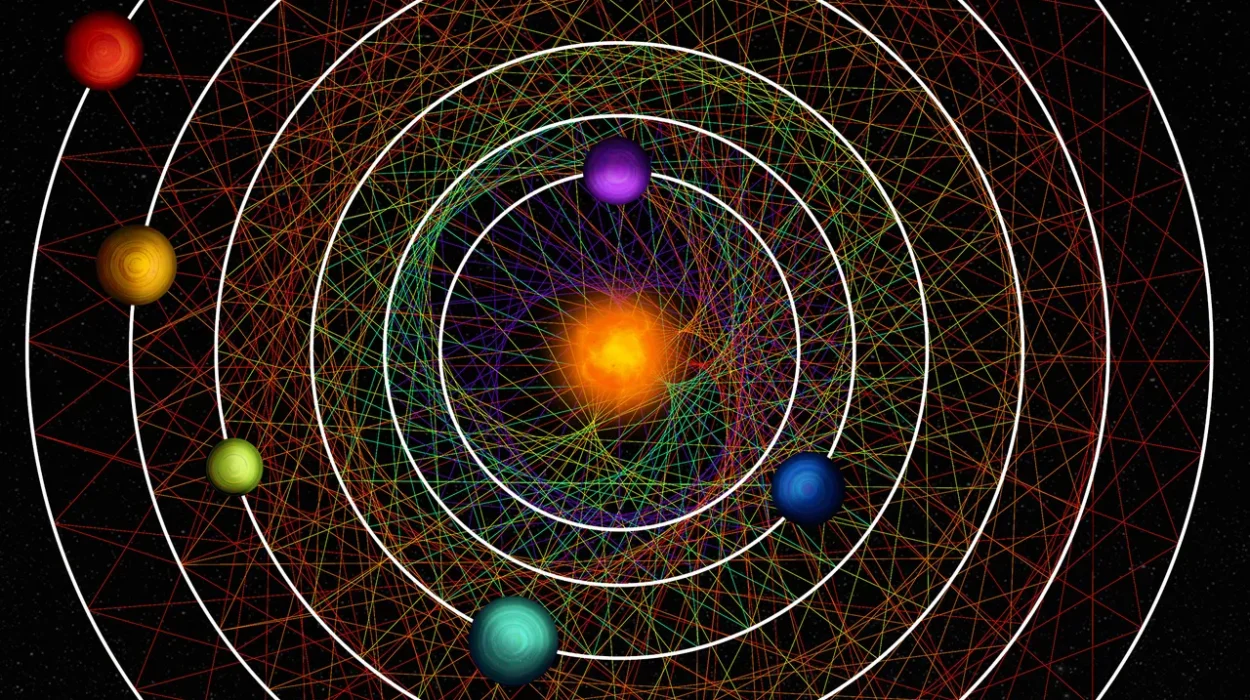
The spinning disk surrounding the young Sun is known as the solar nebula or protoplanetary disk.
This enormous disk stretched billions of kilometers into space.
Inside the disk, countless dust particles continuously collided. Some collisions caused particles to stick together.
Tiny grains became pebbles.
Pebbles became rocks.
Rocks grew into larger bodies.
Over millions of years, gravity helped these growing objects attract even more material.
Eventually, they became planetesimals, then protoplanets, and finally the planets we know today.
While the Sun was forming at the center, the rest of the Solar System was taking shape around it.
The Core Became Incredibly Hot
As the protostar gained mass, its core became denser and hotter.
Temperatures climbed into the millions of degrees.
Pressure also increased enormously.
Gravity continuously squeezed the core tighter, raising both temperature and pressure to extraordinary levels.
Eventually, conditions became extreme enough for one of nature’s most powerful processes to begin.
Nuclear Fusion Ignited
The defining moment in the Sun’s birth occurred when the core reached approximately 15 million degrees Celsius (27 million degrees Fahrenheit).
At this temperature, hydrogen nuclei moved so rapidly that they could overcome their natural electrical repulsion.
When hydrogen nuclei collided under these extreme conditions, they fused together to form helium.
This process is called nuclear fusion.
Fusion releases enormous amounts of energy because a tiny fraction of the original mass is converted directly into energy according to Einstein’s famous equation:
E = mc²
This energy travels outward from the core and eventually escapes into space as sunlight and heat.
The moment sustained nuclear fusion began, the Sun officially became a true star.
A Balance That Lasts Billions of Years
Once fusion started, the Sun reached a remarkable balance.
Gravity constantly tries to pull the Sun inward.
At the same time, energy produced by nuclear fusion creates pressure pushing outward.
These two opposing forces balance each other almost perfectly.
Astronomers call this state hydrostatic equilibrium.
As long as enough hydrogen remains in the core, the Sun remains stable.
This balance has allowed the Sun to shine steadily for about 4.6 billion years.
Clearing the Neighborhood
The newborn Sun was much more active than it is today.
It produced intense radiation and powerful streams of charged particles known as the solar wind.
These powerful outflows gradually swept away much of the leftover gas and dust surrounding the young Solar System.
Once this material disappeared, planet formation largely came to an end.
The Solar System became a much clearer and more stable place.
The planets continued orbiting the Sun, following paths that have remained remarkably stable ever since.
The Sun Today
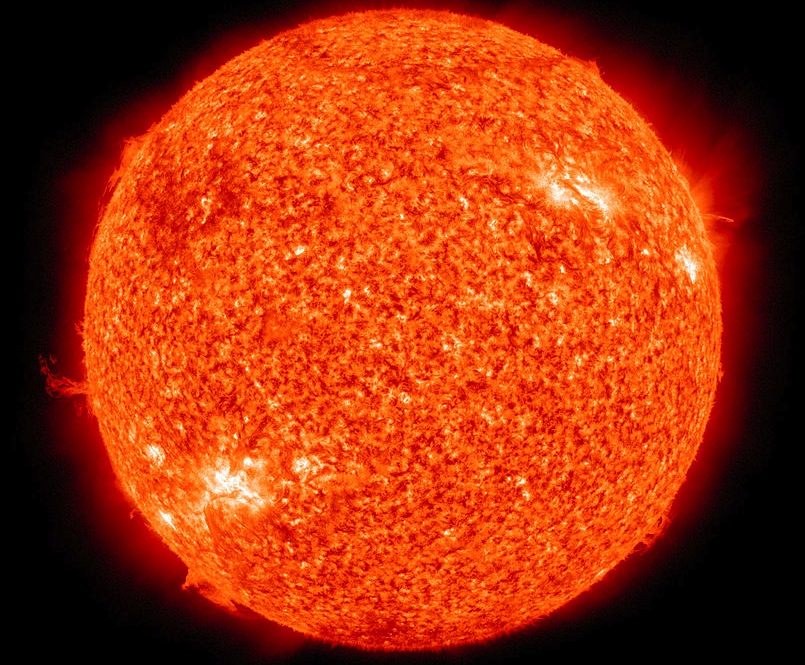
Today, the Sun is a G-type main-sequence star, often called a yellow dwarf.
It contains about 99.86% of all the mass in the Solar System.
Its diameter is approximately 1.39 million kilometers (864,000 miles).
Every second, the Sun converts roughly 600 million tons of hydrogen into helium through nuclear fusion. During this process, about 4 million tons of mass are transformed into energy each second.
Although these numbers are almost impossible to imagine, the Sun contains enough hydrogen to continue shining for approximately another 5 billion years.
Evidence for How the Sun Formed
Scientists were not present to witness the Sun’s birth, so how do they know this story?
The evidence comes from many independent sources.
Powerful telescopes observe young stars forming inside molecular clouds throughout the Milky Way. These stellar nurseries display every stage predicted by current theories.
Meteorites preserve ancient material that formed during the earliest history of the Solar System. By measuring radioactive isotopes within these rocks, scientists have determined that the Solar System formed about 4.567 billion years ago.
Computer simulations based on the laws of gravity, fluid dynamics, and nuclear physics successfully reproduce the formation of stars from collapsing molecular clouds.
The structure of our Solar System also supports this picture. Nearly all the planets orbit the Sun in the same direction and within nearly the same flat plane, exactly as expected if they formed from a rotating disk.
Together, these lines of evidence provide a consistent and scientifically robust explanation for the Sun’s origin.
The Sun Is Still Changing
Although the Sun appears constant from our perspective, it is slowly evolving.
Each second, hydrogen in its core becomes slightly less abundant while helium accumulates.
Over millions and billions of years, these gradual changes alter the Sun’s internal structure.
As a result, the Sun is actually brighter today than it was when it first formed.
Scientists estimate that the young Sun produced only about 70% of its current brightness. Even so, Earth’s atmosphere and greenhouse gases helped keep the planet warm enough for liquid water to exist.
What Will Happen in the Future?
The Sun will not shine forever.
In about 5 billion years, most of the hydrogen in its core will be exhausted.
Without enough hydrogen fusion in the core, gravity will once again begin to dominate.
The core will contract while the outer layers expand dramatically.
The Sun will become a red giant, growing so large that it may engulf Mercury and Venus. Whether Earth survives this expansion remains uncertain, but even if it does, our planet will become far too hot to support life as we know it.
Eventually, the Sun will shed its outer layers into space, creating a beautiful glowing shell of gas known as a planetary nebula.
The remaining core will become a white dwarf, an extremely hot, dense stellar remnant roughly the size of Earth.
Over trillions of years, the white dwarf will slowly cool and fade.
Our Origins Are Connected to the Sun
Every living thing on Earth owes its existence to the Sun.
Plants use sunlight to perform photosynthesis, producing the oxygen we breathe and forming the base of nearly every food chain.
Earth’s climate, weather, oceans, and ecosystems all depend on the steady energy flowing from our star.
Even the atoms in our bodies tell a deeper story. While hydrogen originated shortly after the Big Bang, many of the heavier elements that make up our bones, blood, and brains were forged inside ancient stars that lived before the Sun. When those stars died, they scattered their elements into space, enriching the cloud that eventually collapsed to form our Solar System.
The Sun is therefore not an isolated object. It is part of a much larger cosmic cycle in which stars are born, live, and die, giving rise to new generations of stars and planets.
Conclusion
The formation of the Sun was not a sudden event but a slow and magnificent process that unfolded over millions of years. It began with a cold cloud of gas and dust drifting through the Milky Way. Gravity drew that cloud inward, creating a spinning disk with a growing protostar at its center. As pressure and temperature increased, nuclear fusion ignited, transforming the protostar into the brilliant star that continues to illuminate our world today.
For approximately 4.6 billion years, the Sun has remained the heart of our Solar System, providing the energy that sustains Earth’s climate and all known life. Its story reminds us that even the brightest star in our sky began as a quiet cloud in the darkness of space—and that the same laws of physics shaping distant galaxies also shaped the world we call home.