The internet has changed dramatically over the past three decades. Websites that once displayed only text now stream ultra-high-definition videos, power online gaming, support video conferencing, and deliver complex web applications that rival desktop software. As websites became more sophisticated, the technology carrying internet traffic also had to evolve.
For many years, HTTP relied on a transport protocol called TCP. Although TCP has been remarkably reliable since the early days of the internet, it was designed in an era when websites were far simpler than they are today. Modern web applications require lower latency, faster connection setup, smoother performance on mobile networks, and better resilience when network conditions change.
To solve these challenges, engineers developed QUIC, a completely new transport protocol that forms the foundation of HTTP/3. Instead of simply improving older technologies, QUIC rethinks how internet connections work, making websites feel faster and more responsive while improving security and reliability.
Today, whenever you open many popular websites, stream videos, or use modern cloud services, there is a good chance that QUIC is working quietly behind the scenes.
What Is QUIC?
QUIC, originally short for Quick UDP Internet Connections, is a modern transport protocol designed to provide secure, low-latency communication across the internet.
Unlike earlier transport protocols that were developed decades ago, QUIC was created specifically for today’s internet, where billions of users connect through fiber broadband, Wi-Fi, and constantly changing mobile networks.
QUIC combines several important functions into a single protocol. It handles reliable data delivery, connection management, congestion control, packet recovery, and encryption. Traditionally, these responsibilities were spread across multiple protocols such as TCP and TLS. QUIC integrates them into one streamlined system.
The protocol was initially developed by Google to improve web performance. After years of testing and collaboration with internet engineers around the world, it was standardized by the Internet Engineering Task Force (IETF). HTTP/3 was then built directly on top of QUIC instead of TCP.
Understanding HTTP Before HTTP/3
To appreciate why QUIC is so important, it helps to understand how earlier versions of HTTP worked.
HTTP, or Hypertext Transfer Protocol, is the language browsers and web servers use to communicate.
When you visit a website, your browser sends HTTP requests asking for HTML pages, images, videos, style sheets, JavaScript files, and many other resources. The server responds by delivering those files.
For decades, these requests traveled using TCP, or Transmission Control Protocol.
TCP was designed to guarantee reliable communication. It carefully checks whether every packet arrives correctly and retransmits any missing information. This reliability made TCP the backbone of the internet.
However, TCP was created long before modern websites existed.
As web applications became increasingly complex, engineers began encountering limitations that were difficult to overcome without redesigning the underlying transport layer.
The Problems with TCP
TCP is extremely reliable, but reliability sometimes comes at the cost of speed.
Before any website data can be transferred, TCP requires a connection setup process known as the three-way handshake. This exchange ensures that both devices are ready to communicate.
If the connection also needs encryption through TLS, additional communication occurs before the browser can begin downloading webpage content.
Although these exchanges happen very quickly, they still introduce delays known as latency.
For users with high-speed internet, these delays may seem insignificant.
For users on slower mobile networks or high-latency satellite connections, they become much more noticeable.
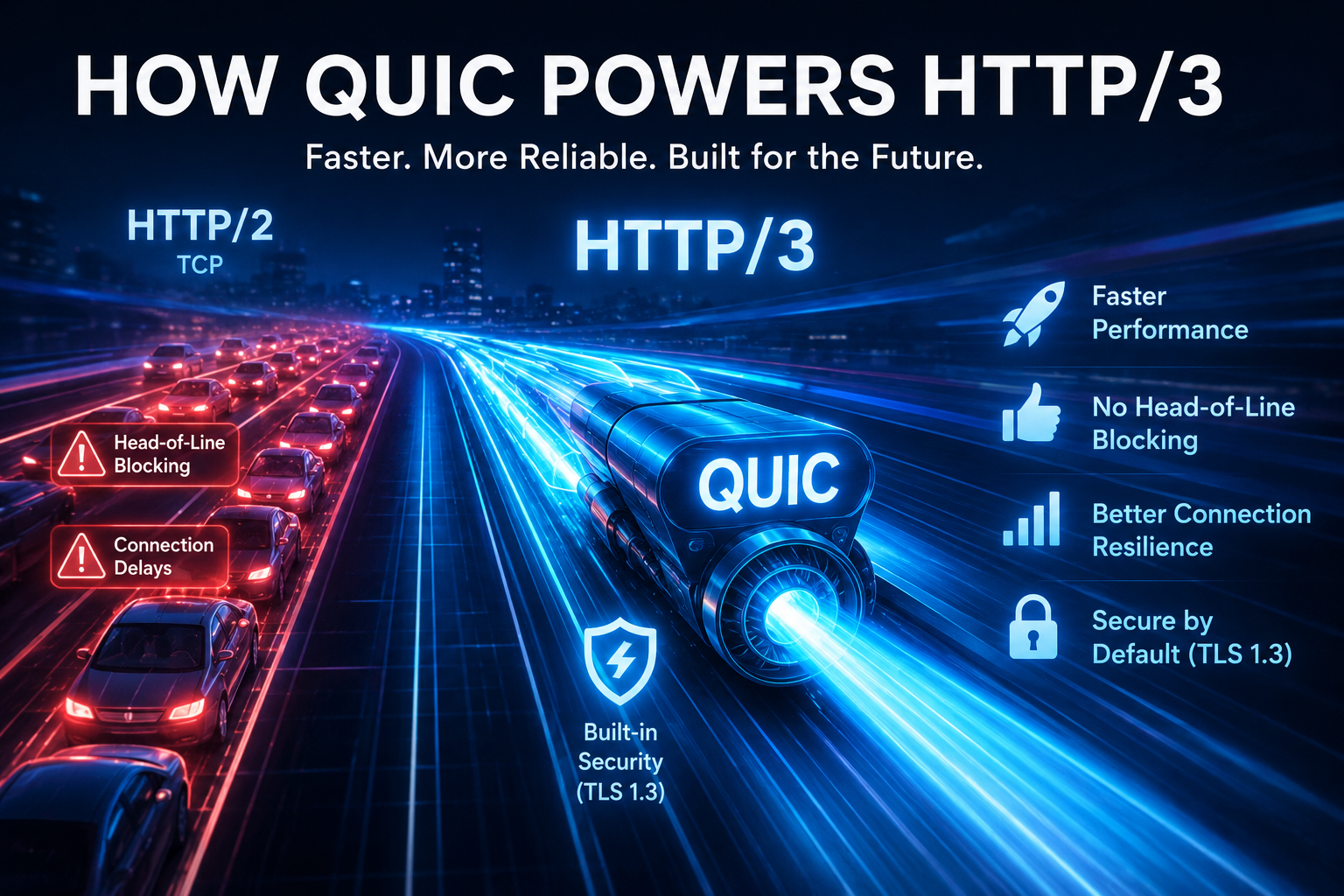
TCP also suffers from a phenomenon called head-of-line blocking.
Imagine downloading ten files simultaneously. If one packet in the middle becomes lost during transmission, TCP pauses delivery of all subsequent packets until the missing one is successfully retransmitted.
Even if the remaining packets have already arrived safely, the application must wait.
This unnecessary delay slows webpage loading and reduces responsiveness.
Why UDP Became the Foundation
Rather than modifying TCP, QUIC uses UDP, or User Datagram Protocol.
UDP is much simpler than TCP.
Unlike TCP, UDP does not automatically establish reliable connections or guarantee packet delivery.
Instead, it simply sends packets without requiring acknowledgments before transmitting additional data.
At first glance, this may sound less reliable.
However, QUIC builds its own sophisticated reliability mechanisms on top of UDP.
This approach gives developers much greater flexibility because they can redesign reliability without changing the operating system’s TCP implementation.
Since QUIC operates primarily in user space rather than deep inside the operating system kernel, improvements can be deployed much faster.
Browsers and servers can update QUIC independently without requiring users to install entirely new operating systems.
How QUIC Powers HTTP/3
HTTP/3 uses QUIC as its transport layer instead of TCP.
This single architectural change transforms how browsers and servers communicate.
When a browser connects to an HTTP/3 website, QUIC establishes an encrypted connection almost immediately.
Instead of relying on separate protocols for transport and encryption, QUIC integrates encryption directly into the connection process.
This reduces delays while simplifying communication.
Once connected, HTTP requests travel through QUIC streams.
These independent streams are one of QUIC’s most important innovations.
Each webpage resource—such as an image, script, or stylesheet—can be transferred independently.
If one stream experiences packet loss, the others continue uninterrupted.
This eliminates the head-of-line blocking problem that affected TCP.
The result is smoother and faster webpage loading, particularly on networks where packet loss occurs.
Faster Connection Establishment
One of QUIC’s biggest advantages is reducing the time required to establish secure connections.
Earlier HTTPS connections required separate TCP and TLS handshakes before transferring webpage data.
QUIC combines these processes into a much more efficient exchange.
For first-time connections, fewer communication rounds are required.
Even more impressive, returning visitors may benefit from a feature known as zero round-trip time, or 0-RTT.
With 0-RTT, a browser that has previously connected to a server can begin sending application data immediately without repeating the entire handshake process.
This dramatically reduces latency for repeat visits.
While 0-RTT requires careful handling because replay attacks are possible under certain circumstances, properly designed applications can safely use it for many types of requests.
Built-In Encryption from the Beginning
Security is no longer optional on the modern internet.
Almost every major website now uses HTTPS.
QUIC was designed with this reality in mind.
Unlike TCP, which can operate with or without encryption, QUIC requires encryption from the very beginning of every connection.
It incorporates TLS 1.3 directly into its design.
This means every HTTP/3 connection is encrypted by default.
Integrating encryption into the transport protocol also simplifies protocol negotiation and reduces connection delays.
Users benefit from stronger security without sacrificing performance.
Independent Streams Improve Performance
Modern webpages often require hundreds of individual resources.
Images, fonts, scripts, advertisements, videos, icons, and style sheets may all load simultaneously.
Under TCP, packet loss affecting one resource could delay many others.
QUIC solves this through multiplexed streams.
Each resource travels through its own independent stream within the same connection.
If packets are lost in one stream, only that stream pauses.
All remaining streams continue normally.
As a result, webpage rendering continues with minimal interruption.
Users experience smoother browsing even under less-than-perfect network conditions.
Better Performance on Mobile Networks
One of QUIC’s greatest strengths appears on mobile devices.
Smartphones constantly switch between different networks.
A user may leave home Wi-Fi, connect to cellular service, enter public Wi-Fi, and return to mobile data within minutes.
Traditional TCP connections often break during these network changes because they are tied to specific IP addresses.
QUIC introduces connection identifiers that remain independent of IP addresses.
When the underlying network changes, QUIC can often continue using the existing connection instead of forcing the browser to establish a completely new one.
This feature, called connection migration, greatly improves the browsing experience on mobile devices.
Video calls, streaming services, and downloads become much more resilient during network transitions.
Smarter Packet Recovery
Every internet connection occasionally loses packets.
Wireless interference, congestion, or temporary routing problems can all cause packet loss.
TCP recovers missing packets effectively but often waits longer than necessary before retransmitting them.
QUIC includes more flexible loss detection and recovery algorithms.
Because the protocol evolves more rapidly than traditional TCP implementations, researchers continue improving these algorithms over time.
This results in quicker recovery from temporary network problems and smoother performance during real-world internet use.
Congestion Control in QUIC
Internet congestion occurs when too much data competes for limited network capacity.
Without proper congestion control, excessive packet loss and poor performance can occur.
Like TCP, QUIC carefully regulates transmission speed based on network conditions.
However, because QUIC operates in user space, developers can experiment with newer congestion control algorithms much more easily.
Different implementations may optimize performance for various environments, including mobile devices, cloud computing, or high-speed fiber networks.
This flexibility allows continuous innovation without waiting for operating system updates.
Why Websites Feel Faster
Many users notice that HTTP/3 websites simply feel more responsive.
This improvement comes from multiple small optimizations working together.
Connection setup requires fewer communication exchanges.
Packet loss affects fewer resources.
Encrypted communication begins immediately.
Independent streams prevent unnecessary delays.
Connection migration avoids interruptions during network changes.
Together, these improvements reduce latency, which is often more noticeable than raw download speed.
Even if internet bandwidth remains unchanged, reducing waiting time makes websites appear significantly faster.
QUIC Improves Video Streaming
Streaming services transmit enormous amounts of data continuously.
Any interruption in communication can reduce video quality or cause buffering.
QUIC helps maintain smoother streaming by recovering quickly from packet loss while allowing unaffected streams to continue delivering data.
Its ability to adapt rapidly to changing network conditions is particularly valuable for users watching videos over mobile networks.
Lower latency also benefits live streaming, where minimizing delays between broadcasters and viewers is increasingly important.
Benefits for Online Gaming
Online games depend heavily on low latency.
Even delays measured in milliseconds can affect gameplay.
Although many multiplayer games already use UDP directly, web-based gaming platforms increasingly benefit from QUIC’s balance of reliability, speed, and encryption.
Fast packet recovery and reduced connection overhead help improve responsiveness for browser-based games and cloud gaming services.
Supporting Modern Cloud Applications
Today’s web applications behave much more like desktop software than traditional websites.
Email platforms, collaborative document editors, cloud storage systems, financial applications, and productivity suites constantly exchange information with servers.
These applications benefit enormously from lower latency and uninterrupted communication.
QUIC enables smoother interactions by minimizing delays while maintaining secure encrypted connections.
Users experience faster synchronization and more responsive interfaces.
QUIC and Browser Support
Modern web browsers have embraced QUIC and HTTP/3.
Most major browsers now support HTTP/3 automatically whenever compatible servers are available.
Users typically do not need to change any settings.
If both the browser and website support HTTP/3, the connection upgrades automatically.
Otherwise, browsers simply fall back to earlier HTTP versions without affecting usability.
This gradual deployment strategy has helped accelerate HTTP/3 adoption across the internet.
Server Adoption Continues to Grow
Major websites, cloud providers, and content delivery networks increasingly support HTTP/3.
Many web hosting platforms now enable HTTP/3 with minimal configuration.
Popular web servers have also added QUIC support, making deployment easier for website operators.
As internet infrastructure continues modernizing, HTTP/3 adoption is expected to expand steadily across both large and small websites.
Challenges of QUIC
Despite its many advantages, QUIC also introduces new challenges.
Because QUIC encrypts much of its protocol metadata, traditional network monitoring tools have less visibility into traffic than they did with TCP.
Network administrators have developed new diagnostic techniques to accommodate these changes.
Implementing QUIC is also more complex than implementing traditional TCP communication because it combines multiple responsibilities into a single protocol.
Servers, browsers, firewalls, and networking equipment all required updates before widespread deployment became possible.
Nevertheless, the long-term performance benefits have made these challenges worthwhile.
QUIC Beyond HTTP/3
Although QUIC is best known as the foundation of HTTP/3, its usefulness extends far beyond web browsing.
Researchers and developers are exploring how QUIC can support additional internet protocols, real-time communication, media streaming, virtual private networks, and future networking applications.
Its flexible architecture makes it an attractive foundation for many emerging internet technologies.
As networking requirements continue evolving, QUIC may power far more than webpages alone.
The Future of Internet Communication
The internet has continuously evolved since its creation, adapting to new technologies and growing demands. Each generation of protocols has addressed the limitations of the one before it. HTTP/3 and QUIC represent one of the most significant advances in this ongoing evolution.
By replacing TCP with a modern transport protocol built around low latency, integrated security, independent streams, and rapid connection establishment, QUIC enables websites and applications to perform better under real-world conditions. Whether browsing on a desktop computer, streaming videos over mobile networks, participating in online meetings, or using cloud-based software, users benefit from faster, more reliable communication without needing to understand the technology working behind the scenes.
As more websites, browsers, and internet services adopt HTTP/3, QUIC is becoming an essential part of the web’s infrastructure. It is helping build an internet that is not only faster but also more secure, more resilient, and better prepared for the increasingly connected world of the future.