Modern technology feels almost magical. You tap a smartphone screen, and an app opens instantly. You press the power button on a laptop, and within seconds you’re writing an email, editing photos, or watching a movie. A gaming console renders breathtaking virtual worlds in real time, while artificial intelligence can answer questions in moments. Behind these seemingly effortless experiences lies an invisible network of tiny electronic components working together at astonishing speeds.
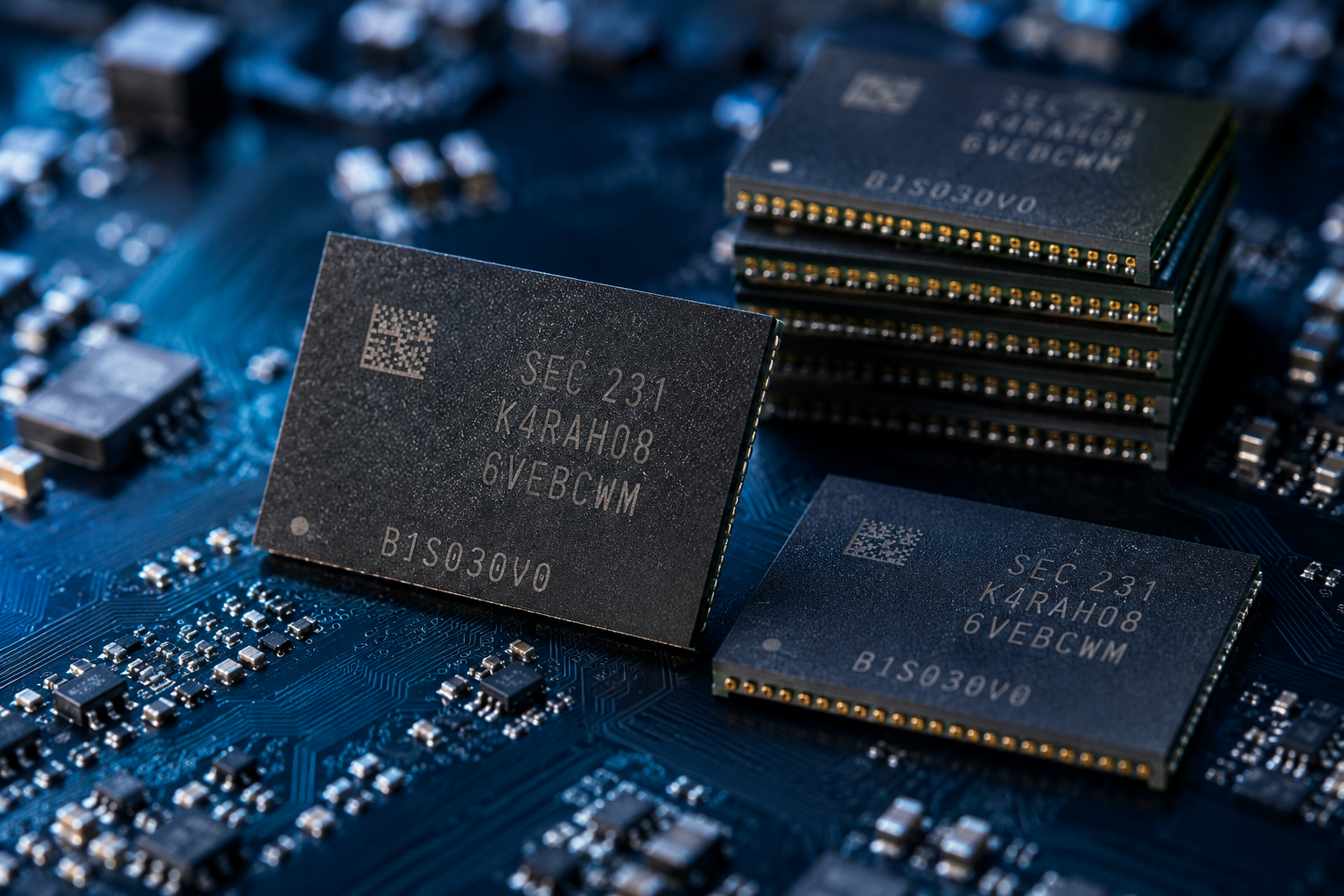
Among the most important of these components are memory chips. Although processors such as CPUs and GPUs often receive the most attention, they cannot achieve their full potential without fast and efficient memory. Memory chips serve as the computer’s workspace, constantly storing, retrieving, and transferring data so that every part of a device can operate smoothly.
Whether you’re browsing the web, editing a video, training an AI model, or playing the latest video game, memory chips play a central role in determining how fast and responsive your device feels.
What Are Memory Chips?
Memory chips are semiconductor devices designed to store digital information. They hold the instructions and data that computers, smartphones, tablets, servers, and countless other electronic devices need to perform tasks.
Unlike storage devices such as solid-state drives (SSDs) or hard drives, which keep data even after power is turned off, many memory chips temporarily store information while a device is operating. This temporary storage allows processors to access data much more quickly than they could from permanent storage alone.
Every photo you edit, every webpage you visit, every game you play, and every document you create relies on memory chips moving information rapidly between different parts of the system.
Why Processors Need Memory
A processor is often called the brain of a computer, but even the smartest brain cannot work efficiently without quick access to information.
Imagine a chef preparing a complicated meal. If every ingredient were stored in a warehouse several miles away, cooking would become painfully slow because the chef would constantly need to wait for ingredients to arrive. Instead, chefs keep commonly used ingredients close at hand on the kitchen counter.
Computers work in a remarkably similar way.
The processor performs calculations at extraordinary speeds, often billions of operations every second. However, if it must constantly wait for data to arrive from slower storage devices, much of its processing power goes unused.
Memory chips solve this problem by keeping important data much closer to the processor, dramatically reducing waiting time.
The Memory Hierarchy
Modern computers use several different types of memory, each designed for a specific purpose.
Closest to the processor are registers, which are tiny but incredibly fast storage locations built directly into the CPU.
Next comes cache memory, which stores frequently used information so the processor can retrieve it almost instantly.
After cache comes Random Access Memory, commonly known as RAM. RAM provides a much larger working area where programs and operating systems temporarily store active data.
Farther away are storage devices such as SSDs and hard drives. These hold files permanently but operate much more slowly than RAM.
This layered design, known as the memory hierarchy, allows computers to balance speed, capacity, and cost.
Understanding RAM
RAM is one of the most important memory chips inside any computer.
Whenever you open an application, launch a game, or load a webpage, the necessary data is copied from permanent storage into RAM.
Because RAM is much faster than SSDs or hard drives, the processor can access this information quickly.
As you switch between applications, edit documents, or browse the internet, RAM continuously stores changing information.
However, RAM is volatile memory, meaning its contents disappear when power is turned off.
This temporary nature makes RAM perfect for active computing tasks while permanent storage retains files for long-term use.
How Faster Memory Improves Speed
The speed of memory directly influences how efficiently a processor works.
Every instruction executed by a CPU requires data.
If the processor receives information immediately, it can continue working without interruption.
If data arrives slowly, the processor pauses while waiting.
These tiny pauses happen billions of times every second.
Reducing even a small amount of waiting can significantly improve overall system performance.
Faster memory allows applications to launch more quickly, games to load faster, and complex calculations to finish sooner.
Memory Bandwidth
One important characteristic of memory is bandwidth.
Memory bandwidth describes how much information can move between memory and the processor in a given amount of time.
A higher bandwidth means larger amounts of data can flow every second.
This becomes especially important in activities involving enormous datasets, such as video editing, scientific simulations, artificial intelligence, and modern gaming.
Graphics processors often require extremely high memory bandwidth because they process millions of pixels simultaneously.
Without sufficient bandwidth, even the most powerful processor cannot reach its maximum performance.
Memory Latency
Another important factor is latency.
Latency measures how quickly memory responds after receiving a request.
Imagine asking someone for a book.
Bandwidth represents how many books they can carry at once.
Latency represents how long they take to begin bringing the first book.
Even if memory can transfer huge amounts of data, high latency may delay processing.
Modern memory technologies aim to improve both bandwidth and latency, allowing processors to work more efficiently.
Cache Memory: The Processor’s Fastest Assistant
Cache memory is one of the fastest types of memory in a computer.
Located inside or very close to the processor, cache stores information that the CPU expects to use repeatedly.
Because accessing cache takes far less time than accessing RAM, the processor can perform calculations much more efficiently.
Modern processors usually include multiple cache levels, often called L1, L2, and L3 cache.
L1 cache is the smallest but fastest.
L2 provides more capacity with slightly slower access.
L3 offers even greater storage while remaining much faster than system RAM.
This layered cache system greatly reduces the number of times the processor must retrieve information from slower memory.
Dynamic RAM
Most computers use Dynamic Random Access Memory, or DRAM, as their main system memory.
DRAM stores each bit of information using tiny capacitors that gradually lose their electrical charge.
To preserve stored data, the memory controller must refresh the contents thousands of times every second.
Although refreshing consumes energy, DRAM offers high storage density, making it practical for laptops, desktops, servers, and smartphones.
Its combination of relatively low cost and large capacity has made it the dominant form of computer memory for decades.
Static RAM
Static Random Access Memory, known as SRAM, operates differently.
Instead of capacitors, SRAM stores information using transistor circuits that maintain data as long as power remains available.
Because SRAM does not require constant refreshing, it responds much more quickly than DRAM.
However, SRAM uses significantly more transistors for each stored bit, making it larger, more expensive, and less dense.
For this reason, SRAM is mainly used for processor caches rather than as primary system memory.
Graphics Memory
Graphics processing units rely on specialized memory designed for enormous data transfer rates.
Graphics memory stores textures, images, lighting information, geometry, and other visual data.
Modern graphics memory technologies, including GDDR and High Bandwidth Memory (HBM), provide extremely high bandwidth needed for realistic graphics and complex visual effects.
As video games become more detailed and artificial intelligence increasingly uses graphics processors for computation, graphics memory continues to evolve rapidly.
Memory in Smartphones
Smartphones depend heavily on efficient memory chips.
Every photo taken, every social media app opened, every navigation route calculated, and every video streamed involves rapid data movement.
Mobile memory technologies are specifically designed to provide high performance while consuming as little power as possible.
This balance extends battery life without sacrificing responsiveness.
Advances in mobile memory have allowed smartphones to perform tasks that once required powerful desktop computers.
Memory and Multitasking
Modern operating systems allow multiple applications to run simultaneously.
You might stream music while browsing the internet, downloading files, and chatting with friends.
Each application requires memory.
Larger amounts of RAM allow more programs to remain active without forcing the operating system to constantly move data between RAM and slower storage.
As available memory increases, multitasking becomes smoother and more responsive.
This is why computers with more RAM often feel noticeably faster during everyday use.
Memory and Gaming
Video games place enormous demands on memory systems.
Modern games continuously load high-resolution textures, three-dimensional environments, physics simulations, character animations, and sound effects.
Fast memory helps reduce loading times and improves frame rates.
It also minimizes delays when players move through large virtual worlds.
Insufficient memory may force games to repeatedly retrieve data from slower storage, causing noticeable pauses or reduced performance.
Memory and Artificial Intelligence
Artificial intelligence has dramatically increased the importance of memory technology.
AI models often process billions of mathematical calculations involving enormous datasets.
These calculations require constant movement of data between processors and memory.
If memory cannot deliver information quickly enough, expensive AI processors remain underutilized.
Modern AI accelerators therefore use advanced memory technologies capable of supplying vast amounts of data every second.
As AI models continue growing larger, memory performance has become nearly as important as processor performance itself.
Memory in Data Centers
The internet depends on millions of servers operating inside data centers.
Every online search, video stream, cloud document, and social media post involves servers processing huge quantities of information.
These servers require large amounts of high-speed memory to handle thousands or even millions of simultaneous users.
Efficient memory systems improve response times while reducing energy consumption and operating costs.
As cloud computing expands, memory technology continues becoming a critical part of digital infrastructure.
Memory and Energy Efficiency
Performance is only one part of the story.
Memory chips also consume electricity.
In battery-powered devices such as smartphones and laptops, efficient memory helps extend battery life.
Engineers continually develop new memory technologies that deliver greater speed while reducing energy consumption.
Lower power usage also reduces heat generation, allowing devices to operate more comfortably and reliably.
Energy-efficient memory has become increasingly important as computing spreads into wearable devices, electric vehicles, and massive cloud data centers.
Advances in Memory Technology
Memory technology continues advancing rapidly.
Engineers are increasing storage density by packing billions of transistors into remarkably small chips.
New manufacturing techniques reduce electrical interference while improving speed and efficiency.
Three-dimensional chip designs stack memory vertically, allowing greater capacity without increasing chip size.
Researchers are also exploring emerging technologies such as MRAM, ReRAM, Phase-Change Memory, and other forms of non-volatile memory that could combine the speed of RAM with the permanent storage capabilities of SSDs.
Although many of these technologies are still developing, they represent exciting possibilities for the future of computing.
Why More Memory Doesn’t Always Mean Faster Performance
Having more memory is beneficial, but capacity alone does not guarantee better performance.
If a computer already has enough RAM for its workload, adding even more may produce little noticeable improvement.
Other factors—including processor speed, memory bandwidth, storage performance, software optimization, and graphics capability—also influence overall responsiveness.
The best performance comes from a balanced system where each component complements the others.
How Engineers Measure Memory Performance
Scientists and engineers evaluate memory using several important measurements.
Capacity indicates how much information the memory can store.
Speed determines how quickly information can be transferred.
Bandwidth measures the amount of data that moves per second.
Latency measures response time after a request.
Power consumption indicates how much electricity the memory requires.
Reliability ensures data remains accurate during operation.
Together, these characteristics help determine how effectively memory supports modern computing.
The Future of Memory Chips
The future promises even faster and more intelligent memory systems.
Artificial intelligence, virtual reality, autonomous vehicles, advanced robotics, and scientific supercomputers all require enormous amounts of high-speed memory.
Future memory chips will likely become more energy efficient, more compact, and capable of transferring data at unprecedented speeds.
Researchers are also investigating ways to place memory even closer to processors, reducing communication delays and improving overall efficiency.
As semiconductor manufacturing continues evolving, memory will remain one of the most important technologies driving innovation across nearly every field of computing.
The Invisible Engine Behind Modern Computing
Memory chips rarely receive the same attention as processors, graphics cards, or dazzling software, yet they are among the most essential components inside every digital device. They provide the fast, temporary workspace that allows processors to think, calculate, create, and respond in real time.
Every smooth animation, every instantly opened application, every streamed movie, every AI-generated answer, and every complex scientific simulation depends on memory delivering information exactly when it is needed. As technology continues advancing, memory chips will remain the invisible engine powering faster computers, smarter devices, and the next generation of digital innovation.