Imagine a large city with no neighborhoods, no traffic signals, no security checkpoints, and no walls separating homes, businesses, schools, and hospitals. If a fire started in one building, it could quickly spread throughout the entire city. If a criminal entered one area, reaching every other location would be far too easy. Such a city would be chaotic, inefficient, and vulnerable.
A computer network can face a similar problem if everything is connected without boundaries. When every device can communicate freely with every other device, cyberattacks, malware, and unauthorized access can spread rapidly. This is where network segmentation becomes essential.
Network segmentation is one of the most important cybersecurity practices used by organizations around the world. It divides a network into smaller, isolated sections, making systems easier to manage, faster to operate, and much more secure. Whether protecting a hospital’s patient records, a bank’s financial systems, or a family’s smart home devices, network segmentation helps ensure that problems remain contained instead of affecting an entire network.
As cyber threats become increasingly sophisticated, network segmentation has evolved from an optional design choice into a fundamental part of modern network security.
Understanding Network Segmentation
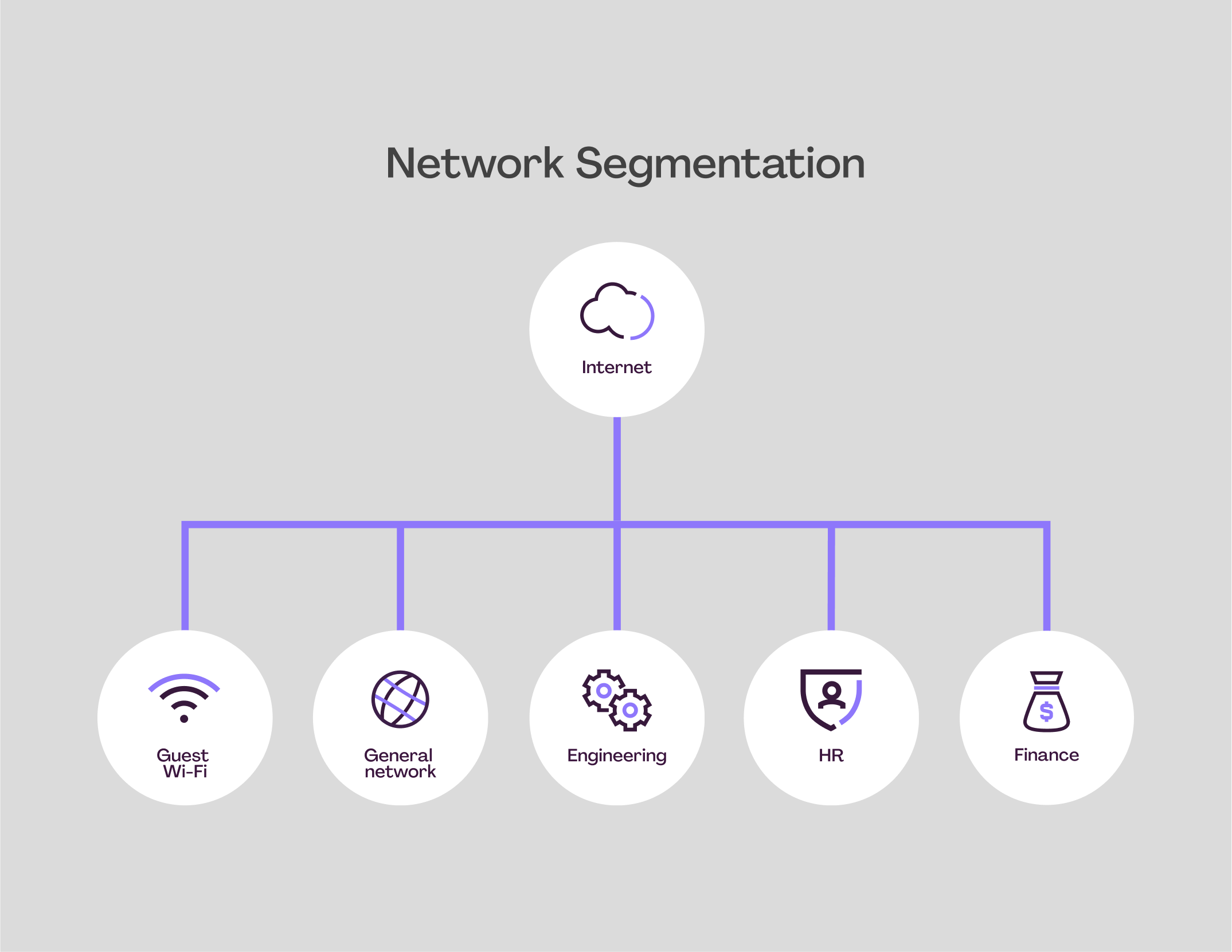
Network segmentation is the practice of dividing a computer network into multiple smaller networks, often called segments, zones, or subnets. Each segment contains devices, applications, or users that share similar functions, security requirements, or communication needs.
Instead of allowing every computer or device to communicate freely with every other device, network segmentation creates controlled pathways. Traffic moving between segments is monitored, filtered, and often restricted according to predefined security policies.
Think of a modern office building. Employees may have access to their own workspaces, but they cannot freely enter server rooms, executive offices, or research laboratories without authorization. Doors, security badges, and access controls protect sensitive areas while still allowing people to perform their jobs.
Network segmentation works in much the same way, creating digital boundaries that control how information moves throughout a network.
Why Network Segmentation Matters
Modern organizations rely on thousands—or even millions—of connected devices. Computers, smartphones, printers, servers, security cameras, cloud services, industrial equipment, and Internet of Things (IoT) devices all communicate across networks.
If these devices exist on one large, unrestricted network, a single compromised device can become an entry point for attackers.
For example, imagine a company where an employee accidentally opens a malicious email attachment. Malware infects the employee’s computer. If the entire network is unrestricted, that malware may spread to file servers, databases, financial systems, customer information, and backup servers within minutes.
If the network is properly segmented, however, the infected computer remains isolated within its own section. Security controls can prevent the malware from reaching critical systems, significantly reducing the damage.
This containment is one of the greatest strengths of network segmentation.
How Network Segmentation Works
Every network consists of devices exchanging information through data packets.
In a flat network, these packets can often travel almost anywhere without significant restrictions.
In a segmented network, communication follows carefully designed rules.
Routers, switches, firewalls, software-defined networking platforms, and access control systems examine traffic moving between segments. They determine whether communication should be allowed, denied, or inspected further.
For example, an employee’s laptop may communicate with email servers and internal applications but may not have permission to access payroll databases.
Similarly, guest Wi-Fi users can browse the internet without being able to reach company servers.
Each communication request is evaluated based on security policies rather than automatically trusted.
The Main Goal of Network Segmentation
The primary purpose of network segmentation is limiting unnecessary communication.
Every device does not need access to every other device.
By allowing only required connections, organizations reduce opportunities for attackers.
Security professionals often describe this concept as reducing the “attack surface.” Fewer available pathways mean fewer opportunities for malicious activity.
Network segmentation also supports the cybersecurity principle known as least privilege, which means users and systems receive only the access they genuinely need to perform their tasks.
Types of Network Segmentation
Network segmentation can be implemented in several different ways depending on an organization’s size, technology, and security requirements.
Traditional segmentation relies on physical infrastructure. Separate switches, routers, cables, and hardware create independent network sections.
Logical segmentation uses technologies such as Virtual Local Area Networks (VLANs), allowing multiple isolated networks to exist on shared physical equipment.
Microsegmentation provides an even finer level of security by creating policies around individual workloads, virtual machines, applications, or devices. Rather than protecting only large network sections, microsegmentation controls communication at a much more detailed level.
Cloud environments also use segmentation through virtual private clouds, security groups, network access control lists, and software-defined networking technologies.
Although these approaches differ technically, they all share the same objective: controlling how information flows between systems.
Physical Network Segmentation
Physical segmentation separates network components using dedicated hardware.
Different departments may have completely separate switches, routers, or even separate cable systems.
This approach provides strong isolation because devices are physically disconnected.
Critical infrastructure, military systems, industrial control networks, and highly sensitive research facilities often use physical segmentation for maximum protection.
While highly secure, physical segmentation can also be more expensive due to additional equipment and maintenance.
Logical Network Segmentation
Most organizations rely primarily on logical segmentation.
Instead of installing separate hardware for every department, administrators use software configurations to create isolated network sections.
Virtual Local Area Networks, commonly known as VLANs, are among the most widely used logical segmentation technologies.
A single network switch can support multiple VLANs, allowing finance, engineering, human resources, and guest users to remain isolated while sharing the same physical infrastructure.
Logical segmentation offers flexibility, scalability, and lower costs compared to fully physical separation.
Microsegmentation
As cyber threats have evolved, traditional segmentation has become less sufficient.
Modern attackers often attempt lateral movement after compromising one device. Lateral movement refers to an attacker’s ability to move from one system to another inside a network.
Microsegmentation significantly limits this movement.
Instead of protecting only entire departments, security policies can isolate individual servers, applications, containers, or virtual machines.
Even systems within the same department may have different communication permissions.
This granular control greatly reduces opportunities for attackers to expand their access.
Internal Firewalls
Firewalls are often associated with protecting networks from the internet.
However, internal firewalls also play an essential role in network segmentation.
These firewalls inspect traffic moving between internal network segments.
For example, communication between employee computers and financial databases may pass through an internal firewall that checks identity, permissions, and security policies before allowing access.
Internal firewalls create multiple layers of defense instead of relying solely on one protective perimeter.
Virtual Local Area Networks
Virtual Local Area Networks, or VLANs, are one of the most common segmentation technologies.
A VLAN allows administrators to group devices together regardless of their physical location.
Employees on different floors may belong to the same VLAN if they perform similar work.
Conversely, two computers sitting next to each other may belong to completely different VLANs because they serve different purposes.
This flexibility simplifies network management while improving security.
Access Control Lists
Access Control Lists, often abbreviated as ACLs, help define communication rules between network segments.
An ACL specifies which devices, users, protocols, or applications may communicate with one another.
For example, a rule may allow accounting computers to access financial servers while preventing guest devices from doing so.
ACLs function like security checkpoints, evaluating traffic before permitting communication.
Network Segmentation in Cloud Computing
Cloud computing has transformed network architecture.
Instead of relying solely on physical hardware, organizations now operate virtual servers across multiple data centers worldwide.
Cloud providers offer sophisticated segmentation tools that create isolated virtual networks.
Applications can operate within separate environments while communicating only when authorized.
This architecture helps organizations secure cloud workloads without sacrificing flexibility.
Cloud segmentation has become particularly important as businesses increasingly adopt hybrid and multi-cloud environments.
Network Segmentation and Zero Trust
Network segmentation plays a central role in the cybersecurity model known as Zero Trust.
Traditional security assumed that devices inside a network were generally trustworthy.
Zero Trust rejects this assumption.
Instead, every user, device, and application must continuously prove its identity and authorization before receiving access.
Segmentation supports Zero Trust by ensuring that authenticated users gain access only to specific resources rather than the entire network.
Even if an attacker compromises one account, strict segmentation limits what can be reached.
Benefits of Network Segmentation
One of the greatest benefits is improved cybersecurity.
If ransomware infects one department, segmentation helps prevent it from spreading throughout the organization.
Sensitive information remains protected behind multiple security controls.
Network segmentation also improves performance.
Broadcast traffic remains within smaller network segments, reducing unnecessary congestion and improving efficiency.
Troubleshooting becomes easier because administrators can isolate problems more quickly.
Compliance with data protection regulations also becomes more manageable.
Many industries require strict separation of sensitive information, including healthcare records, financial data, and government information.
Segmentation helps organizations meet these security requirements.
Network Segmentation in Hospitals
Hospitals manage numerous connected systems.
Medical imaging devices, patient monitoring equipment, electronic health records, laboratory systems, billing platforms, guest Wi-Fi, and administrative computers all share network resources.
Without segmentation, malware reaching a visitor’s smartphone could potentially threaten life-saving medical equipment.
Proper segmentation isolates clinical devices from guest networks while protecting sensitive patient information.
This architecture improves both cybersecurity and patient safety.
Network Segmentation in Banks
Financial institutions process enormous amounts of sensitive information every second.
Customer accounts, payment systems, ATMs, online banking platforms, fraud detection systems, and employee workstations require different security levels.
Segmentation separates these systems so that compromising one service does not automatically expose every financial resource.
Multiple security boundaries help defend against fraud and cybercrime.
Network Segmentation in Manufacturing
Modern factories increasingly rely on connected industrial control systems.
Robotic equipment, production lines, quality control sensors, office computers, and internet-connected devices often operate simultaneously.
Industrial equipment may require highly specialized communication while remaining isolated from employee email systems.
Segmentation protects production environments from cyber threats that could disrupt manufacturing operations.
Home Network Segmentation
Although often associated with businesses, network segmentation also benefits households.
Many homes now contain dozens of connected devices.
Smart televisions, security cameras, voice assistants, gaming consoles, laptops, smartphones, smart thermostats, and Wi-Fi appliances all share internet access.
Creating separate networks for trusted personal devices and Internet of Things devices can improve security.
Many modern home routers support guest networks that isolate visitors from personal computers and shared files.
This simple form of segmentation helps reduce cybersecurity risks at home.
Challenges of Network Segmentation
Designing an effective segmented network requires careful planning.
If segmentation rules are too restrictive, legitimate communication may fail, disrupting business operations.
If rules are too permissive, attackers may still find pathways through the network.
Maintaining segmentation also requires continuous monitoring.
Organizations regularly add new devices, applications, cloud services, and remote workers.
Security policies must evolve alongside these changes.
Large enterprises may manage thousands of segmentation rules, making automation increasingly important.
Common Mistakes
Some organizations believe that simply creating VLANs automatically provides complete security.
In reality, VLANs alone do not guarantee protection.
Without proper firewalls, access controls, and monitoring, attackers may still move between segments.
Another common mistake is leaving default configurations unchanged.
Poorly configured devices can unintentionally create communication paths that bypass intended security boundaries.
Regular security assessments help identify these weaknesses before attackers exploit them.
The Role of Artificial Intelligence
Artificial intelligence is beginning to transform network segmentation.
AI-powered security platforms analyze enormous amounts of network traffic, identifying unusual communication patterns that may indicate cyberattacks.
Machine learning algorithms can recommend segmentation improvements based on observed network behavior.
Some advanced systems automatically adjust security policies in response to evolving threats while minimizing disruption to legitimate users.
Although human expertise remains essential, AI increasingly serves as a powerful tool for strengthening network defenses.
Network Segmentation and Ransomware Defense
Ransomware has become one of the most damaging forms of cybercrime.
Its effectiveness often depends on the attacker’s ability to spread across a network.
Well-designed segmentation dramatically limits this movement.
Even if one workstation becomes infected, isolated network zones can prevent ransomware from reaching backups, databases, domain controllers, or critical business applications.
This containment gives security teams valuable time to detect, isolate, and eliminate threats before they become catastrophic.
The Future of Network Segmentation
The future of networking is becoming increasingly dynamic.
Organizations now manage traditional data centers, cloud platforms, edge computing devices, remote employees, and billions of Internet of Things devices.
Static network designs are giving way to intelligent, software-defined architectures.
Future segmentation systems will likely become more automated, adaptive, and context-aware.
Security policies may change instantly based on user identity, device health, application behavior, geographic location, and real-time threat intelligence.
This evolution reflects the growing complexity of modern digital environments.
Why Network Segmentation Is Essential
Network segmentation is far more than a networking technique—it is a cornerstone of modern cybersecurity. By dividing large networks into smaller, carefully controlled sections, organizations can reduce cyber risk, improve performance, simplify management, and protect their most valuable information.
As digital systems continue to expand and cyber threats become more sophisticated, the importance of network segmentation will only grow. Whether safeguarding a multinational corporation, a hospital, a government agency, a school, or a connected home, segmentation creates meaningful boundaries that keep problems contained instead of allowing them to spread unchecked.
In today’s interconnected world, no network can eliminate every risk. But with thoughtful network segmentation, organizations can build stronger defenses, respond more effectively to attacks, and create resilient digital environments where information flows securely, efficiently, and with confidence.