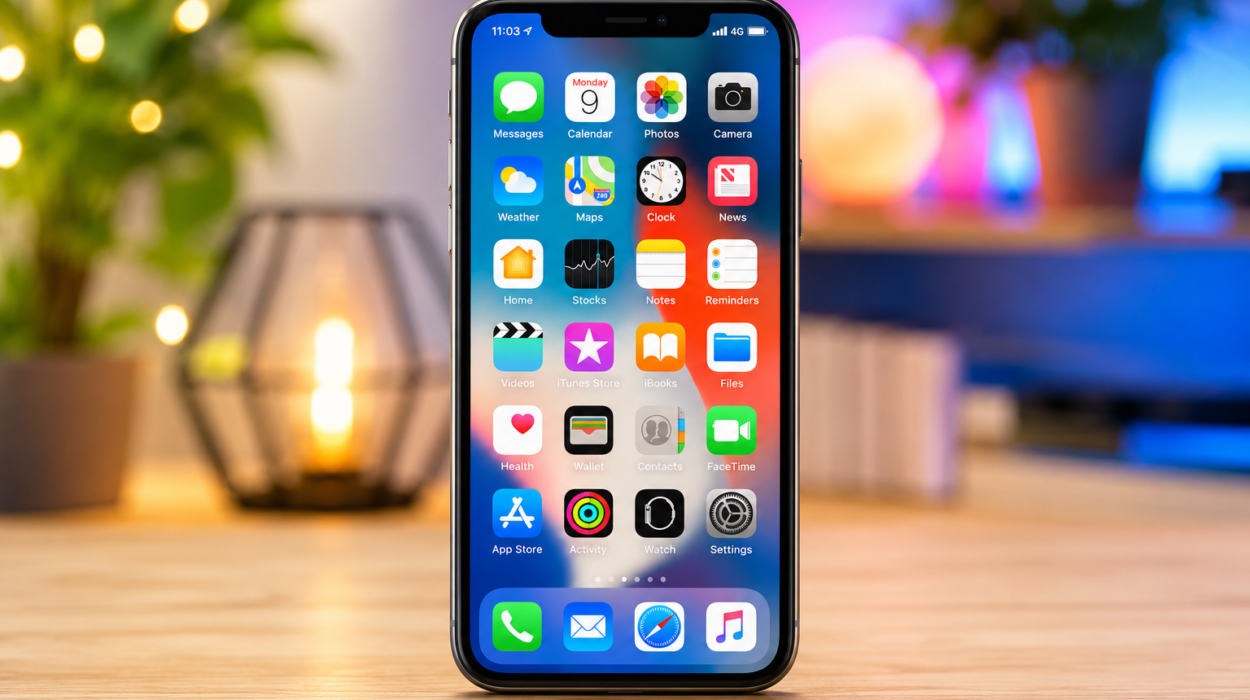
Take a look at your smartphone. It can stream movies, take stunning photos, navigate with GPS, connect to Wi-Fi and 5G, play games with console-like graphics, recognize your face, and even translate languages in real time. Just a few decades ago, accomplishing all of these tasks would have required an entire room filled with computers.
Today, all of this incredible computing power fits into a single chip smaller than a postage stamp.
That tiny piece of silicon is known as a System-on-a-Chip, or SoC. It is one of the most important inventions in modern electronics, quietly powering billions of smartphones, tablets, smartwatches, laptops, gaming devices, smart TVs, drones, cars, and even spacecraft.
Although most people never see an SoC, it acts as the central brain of countless electronic devices. Without it, modern mobile technology simply would not exist.
What Is a System-on-a-Chip (SoC)?
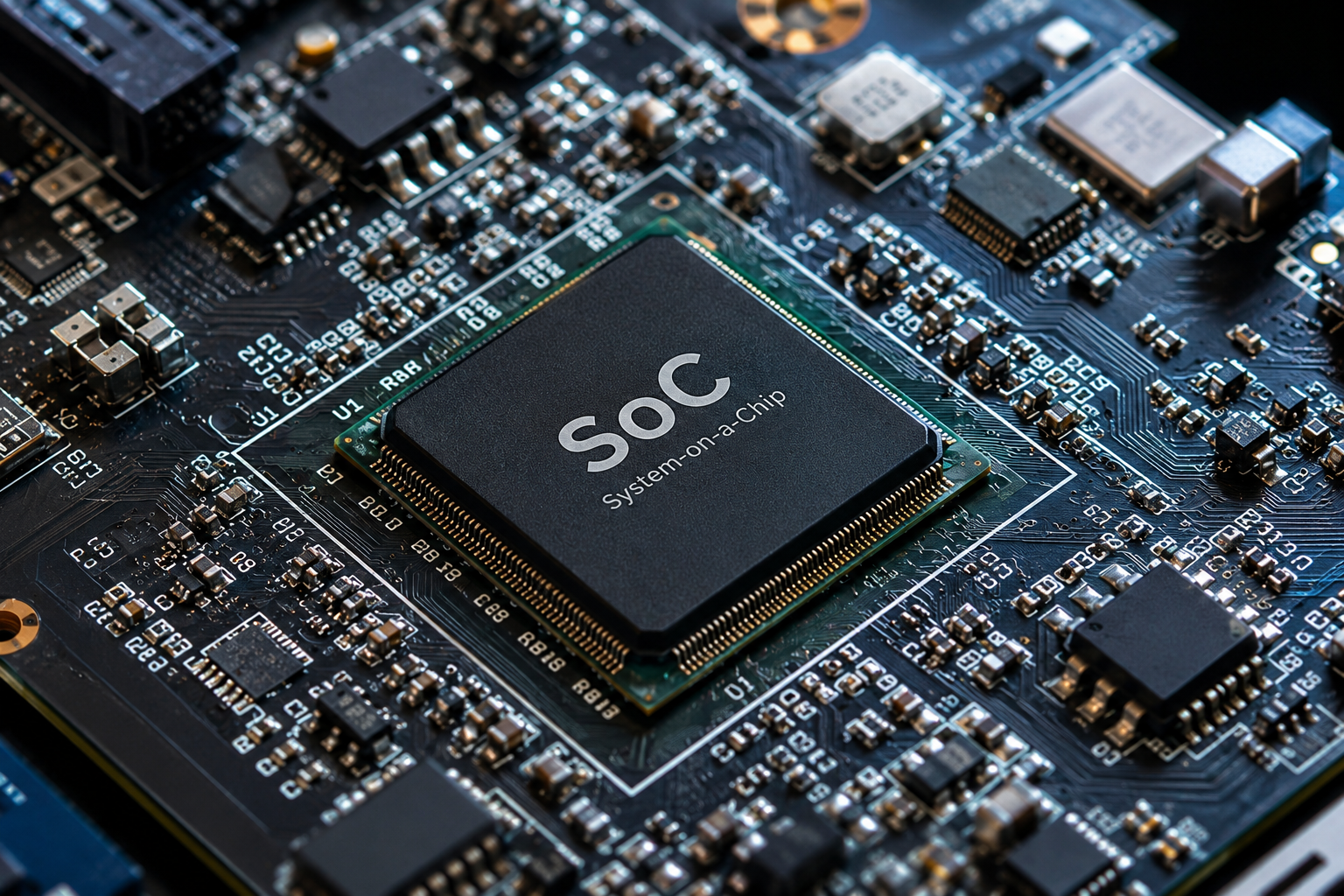
A System-on-a-Chip (SoC) is an integrated circuit that combines nearly all of the major components of a complete computer system onto a single semiconductor chip.
Instead of placing separate chips on a circuit board for the processor, graphics, memory controller, wireless communication, image processing, and other functions, an SoC integrates these components into one compact package.
In simple terms, an SoC is like an entire computer condensed into a single chip.
This integration makes devices smaller, faster, more energy-efficient, and more affordable to manufacture.
While desktop computers often use several separate chips, smartphones and many portable devices rely on SoCs because they must balance performance with low power consumption.
Why Is It Called a “System-on-a-Chip”?
The name describes exactly what the technology does.
A traditional computer system contains multiple electronic components working together.
An SoC places most of those essential components onto one silicon chip.
Instead of connecting numerous separate integrated circuits across a motherboard, engineers design them to operate together inside a single piece of silicon.
The result is a complete computing system that occupies only a tiny amount of space.
How an SoC Works
An SoC functions much like a miniature city where different neighborhoods each perform specialized jobs while remaining closely connected.
The central processor performs calculations and executes software instructions.
The graphics processor renders images, animations, and video.
Artificial intelligence hardware accelerates machine learning tasks.
Communication modules connect the device to wireless networks.
Image processors enhance photographs captured by cameras.
Audio processors handle music and voice processing.
Security hardware protects sensitive information.
Because all of these components reside on the same chip, they communicate extremely quickly while consuming far less energy than if they were spread across multiple chips.
The short physical distances inside an SoC allow data to travel rapidly, reducing delays and improving overall efficiency.
The CPU: The Main Processor
At the heart of every SoC is the Central Processing Unit (CPU).
The CPU is responsible for carrying out instructions from software.
Every time you open an app, browse the internet, send a message, or edit a document, the CPU performs billions of calculations every second.
Modern smartphone CPUs usually contain multiple processing cores.
Instead of relying on a single core, today’s SoCs often include six, eight, ten, or even more CPU cores designed for different workloads.
Some cores focus on maximum performance for demanding tasks.
Others are optimized for energy efficiency during lighter activities such as reading emails or checking notifications.
This combination helps extend battery life without sacrificing speed.
The GPU: Creating Graphics
The Graphics Processing Unit (GPU) specializes in rendering images.
Every animation, game, user interface, photo, and video displayed on your screen relies on the GPU.
Although originally designed for graphics, GPUs now perform many other highly parallel computing tasks.
Artificial intelligence, scientific simulations, image editing, and video processing often benefit from GPU acceleration.
In gaming smartphones, the GPU plays an especially important role, delivering smooth frame rates and realistic visual effects.
Neural Processing Units and AI Engines
Artificial intelligence has become a major feature of modern electronics.
Many SoCs now include dedicated Neural Processing Units (NPUs) or AI accelerators.
Unlike traditional CPUs, these specialized processors are designed specifically for machine learning operations.
They enable features such as facial recognition, voice assistants, language translation, object detection in photos, background blur during video calls, and intelligent camera enhancements.
Because AI calculations occur directly on the device, users often experience faster performance while improving privacy since sensitive data may never leave the device.
Image Signal Processors
Smartphone cameras have improved dramatically over the past decade.
Much of this progress comes from the Image Signal Processor (ISP) inside the SoC.
The ISP processes raw data coming from the camera sensor.
It adjusts brightness, color balance, sharpness, exposure, noise reduction, and dynamic range before producing the final photograph.
When your phone captures multiple images and combines them into one high-quality photo, the ISP performs much of this complex work.
Modern computational photography depends heavily on these specialized processors.
Memory Controllers
Every processor needs fast access to memory.
The memory controller manages communication between the SoC and the device’s RAM.
Efficient memory management allows applications to launch quickly, games to load smoothly, and multitasking to feel responsive.
Because the memory controller is integrated into the SoC, communication becomes faster and more energy efficient compared to older computer architectures.
Wireless Connectivity
Most SoCs also include communication hardware.
These components support technologies such as:
Wi-Fi
Bluetooth
Cellular networks
GPS
Near Field Communication (NFC)
Depending on the design, some SoCs integrate 5G modems directly onto the chip, while others use separate modem chips.
Integrated wireless hardware reduces power consumption and saves valuable internal space inside mobile devices.
Security Processors
Modern electronic devices store enormous amounts of personal information.
Passwords, banking data, biometric information, photos, and private documents all require protection.
Many SoCs include dedicated security processors that encrypt sensitive data and isolate secure operations from the rest of the system.
These secure environments help protect fingerprint recognition, facial authentication, digital payments, and encrypted communications.
Even if malware attacks other parts of the device, the secure processor remains isolated to safeguard critical information.
Why SoCs Are More Efficient
One of the biggest advantages of an SoC is efficiency.
When separate chips communicate across a circuit board, electrical signals travel relatively long distances.
This consumes additional power and increases communication delays.
Inside an SoC, components are located extremely close together.
Signals travel only tiny distances through microscopic wiring.
This allows information to move much faster while using less electricity.
The result is better battery life, lower heat generation, and improved performance.
The Difference Between an SoC and a CPU
Many people mistakenly believe that an SoC and a CPU are the same thing.
They are not.
The CPU is only one component inside an SoC.
An SoC includes the CPU along with many additional processors and controllers.
You can think of the CPU as the driver of a vehicle.
The SoC represents the entire vehicle, including the engine, transmission, steering system, electronics, brakes, navigation, and safety systems working together.
SoC vs Traditional Computer Architecture
Desktop computers usually contain multiple separate components.
The CPU occupies one socket.
The graphics card is often installed separately.
Memory resides in dedicated modules.
Networking functions may use additional chips.
Storage controllers operate independently.
This modular approach offers flexibility and easier upgrades.
However, it also requires more physical space and generally consumes more electricity.
An SoC sacrifices some upgradeability in exchange for compact size, efficiency, and lower power consumption.
This makes SoCs ideal for portable devices.
Why Smartphones Depend on SoCs
Smartphones have very limited internal space.
Every millimeter matters.
Manufacturers must fit batteries, cameras, speakers, antennas, cooling systems, sensors, and displays into remarkably thin designs.
Using many separate chips would require more space, consume more energy, and generate additional heat.
An SoC solves these challenges by integrating numerous functions into a single compact component.
Without SoCs, modern smartphones would likely be much larger, heavier, and less capable.
SoCs in Tablets
Tablets benefit from the same advantages.
Long battery life, thin designs, and powerful multimedia performance all depend on efficient SoC architectures.
Whether reading books, editing photos, attending online classes, or watching movies, tablets rely on integrated processors to balance performance with energy efficiency.
SoCs in Laptops
The role of SoCs has expanded beyond smartphones.
Several modern laptops now use SoC designs instead of traditional PC architectures.
By integrating the CPU, GPU, AI processors, memory controllers, and media engines, these chips deliver excellent battery life while maintaining impressive performance.
Many thin and lightweight laptops can now operate for an entire workday without recharging largely because of efficient SoC designs.
SoCs in Smartwatches
A smartwatch has even less available space than a smartphone.
Despite their tiny size, smartwatches monitor heart rate, track sleep, record workouts, receive notifications, answer phone calls, and run applications.
These capabilities are possible because miniature SoCs integrate numerous processing functions into an incredibly compact package while minimizing battery consumption.
SoCs in Smart TVs
Smart televisions have evolved into powerful multimedia computers.
Their SoCs decode high-resolution video, process streaming content, improve picture quality, run operating systems, and support voice assistants.
Advanced video processors inside television SoCs handle technologies such as HDR, 4K, and increasingly, 8K video playback.
SoCs in Cars
Modern vehicles contain dozens of computers.
Increasingly, advanced SoCs manage infotainment systems, navigation, digital dashboards, driver-assistance features, and artificial intelligence.
Electric vehicles especially rely on powerful SoCs to process information from cameras, radar, ultrasonic sensors, and other systems in real time.
Future autonomous vehicles will depend even more heavily on specialized automotive SoCs.
SoCs in Gaming Devices
Portable gaming systems require tremendous graphics performance while maintaining long battery life.
Gaming-focused SoCs combine powerful CPUs and GPUs with optimized memory systems to deliver console-quality graphics in handheld devices.
As semiconductor technology advances, gaming SoCs continue approaching the capabilities of traditional desktop hardware.
The Manufacturing of SoCs
Creating an SoC is among the most challenging engineering tasks in the world.
Engineers first design billions of microscopic electronic components using specialized software.
These designs are then manufactured on silicon wafers using advanced semiconductor fabrication processes.
Modern SoCs contain billions—and sometimes tens of billions—of transistors.
Each transistor acts as a tiny electronic switch.
Collectively, these switches perform the calculations that power modern computing.
Manufacturing requires astonishing precision.
Features inside today’s chips measure only a few nanometers across—thousands of times thinner than a human hair.
Even microscopic contamination can ruin an entire chip.
Power Efficiency: One of the Greatest Strengths of SoCs
Battery life has become one of the most important considerations in portable electronics.
An SoC is carefully designed to minimize unnecessary energy consumption.
Many components automatically power down when not in use.
Different CPU cores activate depending on workload.
Specialized processors perform tasks more efficiently than general-purpose CPUs.
These optimizations allow smartphones to stream videos, play games, browse the internet, and run AI applications for hours on a single charge.
Heat Management
Electronic devices generate heat while operating.
Too much heat can reduce performance and shorten component lifespan.
Efficient SoC designs reduce heat production by minimizing energy waste.
Many SoCs also include intelligent thermal management systems that adjust processing speeds when necessary to maintain safe operating temperatures.
This allows devices to remain comfortable to hold while protecting internal components.
The Future of System-on-a-Chip Technology
SoCs continue evolving rapidly.
Each new generation integrates more capabilities while becoming faster and more energy efficient.
Artificial intelligence hardware is becoming increasingly powerful.
Advanced graphics processors support realistic gaming and professional creative applications.
Wireless technologies continue improving with faster 5G and future 6G networks.
Researchers are also exploring new chip packaging methods, three-dimensional chip stacking, advanced memory integration, and specialized processors for emerging technologies.
Future SoCs may power wearable medical devices, augmented reality glasses, intelligent robots, autonomous transportation, and technologies that have yet to be imagined.
Why System-on-a-Chips Are So Important
The System-on-a-Chip represents one of the greatest achievements in modern semiconductor engineering. By integrating the essential components of an entire computer onto a single piece of silicon, SoCs have transformed the way electronic devices are designed and used.
They make smartphones slim enough to fit in a pocket, smartwatches small enough to wear comfortably, tablets powerful enough for creative work, and laptops capable of delivering all-day battery life. They also enable advanced features such as artificial intelligence, high-quality photography, secure digital payments, and lightning-fast wireless communication.
As semiconductor technology continues to advance, the SoC will remain at the heart of modern computing. Though hidden beneath sleek device designs, this tiny chip quietly performs billions of calculations every second, making the connected, intelligent world we rely on every day possible.