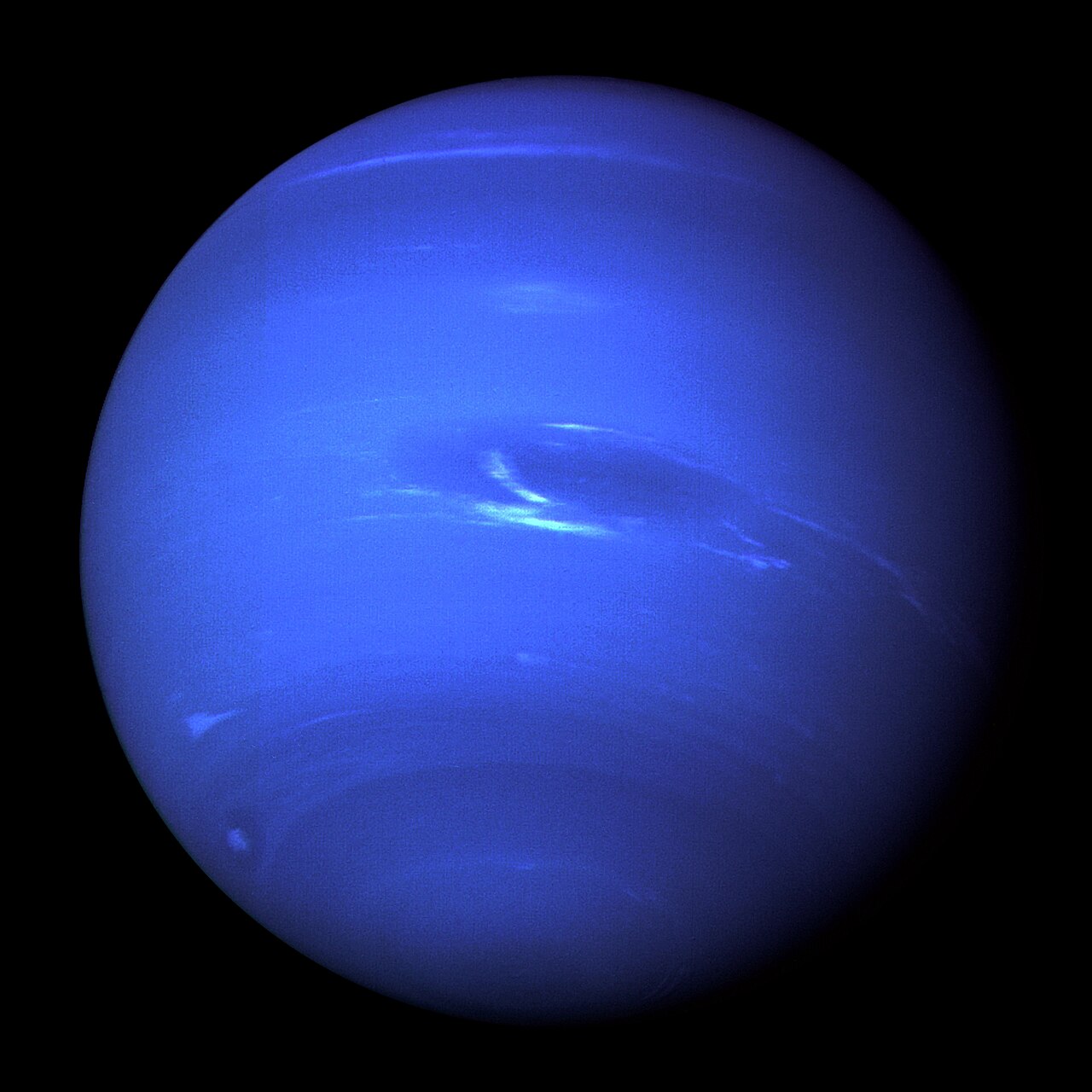
If you could somehow travel to Neptune, the eighth and most distant major planet from the Sun, you would discover a world unlike anything on Earth. There are no solid landscapes waiting beneath its clouds, no oceans where you could sail, and no mountains rising into the sky. Instead, Neptune is a giant planet wrapped in powerful winds, hidden beneath layers of exotic materials, and surrounded by mysteries that scientists are still working to understand.
From millions of kilometers away, Neptune appears as a brilliant blue jewel floating in the darkness of space. That beautiful color makes it one of the most recognizable planets in our Solar System. But beneath those striking blue clouds lies an incredibly complex interior made of gases, fluids, and an unusual mixture of substances that behave in ways we can barely imagine on Earth.
So, what exactly is Neptune made of? The answer takes us deep inside one of the Solar System’s most fascinating planets.
Neptune Is Not a Rocky Planet
The first thing to understand is that Neptune is not like Earth.
Earth is a rocky planet with a solid surface made mostly of silicate rocks and metals. You can stand on its ground because it has a solid crust.
Neptune is completely different.
Astronomers classify Neptune as an ice giant, a special type of giant planet that differs from the larger gas giants, Jupiter and Saturn.
Although Neptune contains large amounts of gas, much of its interior is made of materials that planetary scientists call “ices.” These are not necessarily frozen like the ice cubes in your freezer. Instead, they are compounds such as water, ammonia, and methane that exist under enormous pressures and extremely high temperatures deep inside the planet.
Neptune has no well-defined solid surface where a spacecraft or astronaut could land.
A Planet Built in Layers
Like Earth, Neptune has different internal layers. But instead of rock, soil, and oceans, its layers are made of gases and dense fluids that gradually change as you travel deeper.
The outermost layer is the atmosphere. Beneath that lies a thick mantle composed mainly of water, ammonia, and methane in extremely hot, compressed forms. At the very center sits a rocky core that contains heavy elements.
Each layer experiences dramatically increasing pressure and temperature.
The Atmosphere: Mostly Hydrogen and Helium
Neptune’s visible atmosphere is the part we see through telescopes and spacecraft images.
Although the planet is famous for its deep blue color, most of its atmosphere is actually made of two very common elements.
Hydrogen is the most abundant gas.
Helium is the second most abundant.
Together, these two elements make up the overwhelming majority of Neptune’s atmosphere.
Hydrogen is also the most abundant element in the universe. It powers stars, fills giant planets, and was one of the first elements formed after the Big Bang.
Helium, famous for filling party balloons on Earth, is another major ingredient throughout the cosmos.
On Neptune, however, these gases exist under conditions far more extreme than anything found naturally on our planet.
Methane Gives Neptune Its Beautiful Blue Color
If Neptune’s atmosphere is mostly hydrogen and helium, why does the planet look blue?
The answer is methane.
Although methane makes up only a small percentage of Neptune’s atmosphere, it has an enormous effect on the planet’s appearance.
Methane absorbs much of the red portion of sunlight while allowing blue wavelengths to be scattered and reflected back into space.
As a result, Neptune appears rich blue when viewed from space.
Interestingly, Neptune is even a deeper blue than Uranus, another ice giant with methane in its atmosphere. Scientists think additional atmospheric processes or particles may contribute to Neptune’s richer color, although the exact explanation is still an active area of research.
Clouds Floating High Above the Planet
Neptune’s atmosphere is far from calm.
High above the deeper layers, clouds constantly form and disappear.
Some clouds are made of frozen methane crystals.
Scientists also think that deeper layers contain clouds made from other compounds, including hydrogen sulfide, ammonia, and water, depending on the pressure and temperature.
Unlike Earth’s gentle cloud movements, Neptune’s clouds race through an atmosphere with some of the fastest winds anywhere in the Solar System.
The Mantle: A World of Hot, Dense Fluids
Beneath Neptune’s atmosphere lies its enormous mantle.
This region contains most of the planet’s mass.
Rather than being filled with ordinary liquid water or solid ice, the mantle is believed to consist largely of water, ammonia, and methane compressed into extremely dense, hot fluids.
Temperatures here rise to thousands of degrees Celsius.
The pressure is so immense that these substances behave very differently from anything we experience on Earth.
Scientists often describe this layer as a hot, slushy, electrically conducting fluid rather than a familiar liquid or solid.
Because no spacecraft has ever entered Neptune’s deep interior, researchers rely on computer models, laboratory experiments, and measurements of the planet’s gravity and magnetic field to understand what lies inside.
Water Makes Up Much of Neptune’s Interior
When people hear the word “water,” they often imagine oceans, lakes, or ice.
Inside Neptune, water exists in a completely different form.
The tremendous pressure prevents it from behaving like ordinary water.
Instead, it becomes a superheated, dense fluid that remains under enormous compression.
Water is thought to be one of the most abundant substances inside Neptune, making it one of the defining characteristics of an ice giant.
Ammonia Plays an Important Role
Another major ingredient inside Neptune is ammonia.
Ammonia is a compound made from nitrogen and hydrogen.
On Earth, it is commonly used in fertilizers and cleaning products.
Inside Neptune, however, ammonia exists under pressures millions of times greater than Earth’s atmospheric pressure.
Scientists believe ammonia mixes with water throughout much of Neptune’s mantle, helping create a complex interior where heat and electricity are transported in unusual ways.
Methane Exists Deep Inside Neptune
Methane is not limited to Neptune’s atmosphere.
Large amounts are also believed to exist deeper inside the planet.
Under the immense pressure found in Neptune’s interior, methane molecules may break apart.
When this happens, carbon atoms can separate from hydrogen.
Laboratory experiments and theoretical models suggest these carbon atoms may become compressed into diamond.
Some scientists think countless tiny diamonds could form deep within Neptune before sinking toward the planet’s center.
This fascinating idea has become known as diamond rain.
Although scientists have produced similar conditions in laboratory experiments, exactly how much diamond formation occurs inside Neptune remains an active area of research.
The Rocky Core
At the center of Neptune lies a dense core.
Unlike Earth’s metallic core, Neptune’s core is believed to consist mainly of rock and metals rich in heavier elements such as iron, nickel, and silicates.
The core contains a significant fraction of Neptune’s total mass despite occupying only a small portion of the planet’s overall size.
Temperatures in the core may reach several thousand degrees Celsius.
Pressures are millions of times greater than those at Earth’s surface.
Under these extraordinary conditions, matter behaves in ways impossible to reproduce completely in laboratories.
There Is No Place to Stand
People often ask what would happen if someone tried to land on Neptune.
The simple answer is that there is nowhere to land.
Unlike Earth or Mars, Neptune has no solid surface separating the atmosphere from the planet below.
As you descended, the atmosphere would gradually become thicker and denser.
The pressure would rapidly increase.
Temperatures would rise.
Eventually, the gases would transition into hot compressed fluids without ever reaching a traditional ground.
Long before reaching the deeper interior, the crushing pressure would destroy any ordinary spacecraft.
Why Scientists Call Neptune an Ice Giant
The name “ice giant” can be confusing.
It does not mean Neptune is covered with frozen ice like Antarctica.
Instead, planetary scientists use the word “ices” to describe chemical compounds such as water, ammonia, and methane because these substances were frozen when the Solar System formed billions of years ago in its cold outer regions.
Today, inside Neptune, these same materials exist under such intense heat and pressure that they are neither ordinary ice nor ordinary liquid.
The term reflects their chemical composition rather than their physical state.
Neptune Is Surprisingly Warm Inside
Although Neptune receives very little sunlight because it is so far from the Sun, its interior remains surprisingly warm.
In fact, Neptune radiates more than twice as much energy into space as it receives from sunlight.
Scientists believe this internal heat comes from leftover energy from the planet’s formation along with the slow contraction of its interior over billions of years.
This internal energy helps power Neptune’s dynamic atmosphere and contributes to its extraordinarily powerful weather.
A Planet of Powerful Storms
The materials that make up Neptune do more than simply fill the planet—they create one of the most active weather systems in the Solar System.
Neptune experiences enormous storms larger than Earth.
Its atmosphere contains bright clouds that constantly change.
Powerful convection carries heat upward from the interior.
This energy drives winds that can exceed 2,000 kilometers (about 1,200 miles) per hour, making them the fastest sustained planetary winds known in the Solar System.
The movement of gases, fluids, and heat is closely connected to Neptune’s internal composition.
How Scientists Know What Neptune Is Made Of
No spacecraft has drilled into Neptune or directly sampled its interior.
Instead, scientists combine several sources of evidence.
Spacecraft such as NASA’s Voyager 2, which flew past Neptune in 1989, measured the planet’s atmosphere, gravity, magnetic field, temperature, and overall structure.
Powerful telescopes on Earth and in space analyze the light reflected from Neptune’s atmosphere.
Laboratory experiments recreate some of the extreme pressures expected inside the planet.
Computer simulations use the laws of physics to predict how different materials behave deep within Neptune.
Together, these methods provide the best picture currently available of Neptune’s composition.
Could Neptune Contain Exotic Forms of Matter?
Deep inside Neptune, pressures become so extreme that familiar materials may transform into unusual states.
Water can become a superionic form in which oxygen atoms remain arranged in a crystal-like structure while hydrogen ions move freely through it. This exotic phase is predicted to conduct electricity efficiently and may help explain Neptune’s unusual magnetic field.
Researchers continue studying how matter behaves under these extraordinary conditions.
Understanding Neptune helps scientists better understand not only our own Solar System but also the many ice giant exoplanets discovered around distant stars.
Why Neptune’s Composition Matters
Learning what Neptune is made of tells us more than the story of one distant planet.
It helps scientists understand how planets form from disks of gas and dust around young stars.
It reveals how giant planets evolve over billions of years.
It offers clues about the formation of Uranus, Jupiter, Saturn, and countless exoplanets throughout the Milky Way.
Every new discovery about Neptune improves our understanding of planetary science as a whole.
The Lasting Mystery of Neptune
Neptune may look peaceful from billions of kilometers away, but beneath its beautiful blue clouds lies a world of extraordinary complexity. Its atmosphere is dominated by hydrogen and helium, with methane giving the planet its iconic blue color. Deep below, immense layers of water, ammonia, and methane exist under crushing pressures and extreme temperatures, surrounding a dense rocky core.
Although scientists have learned a great deal since Voyager 2’s historic flyby, Neptune still guards many secrets. Future space missions, more powerful telescopes, and advances in laboratory research may reveal even more about the strange materials hidden inside this distant ice giant.
For now, Neptune remains one of the Solar System’s most captivating worlds—a planet where familiar substances become exotic, ordinary chemistry transforms under unimaginable pressure, and the laws of physics create a world unlike any other we know.