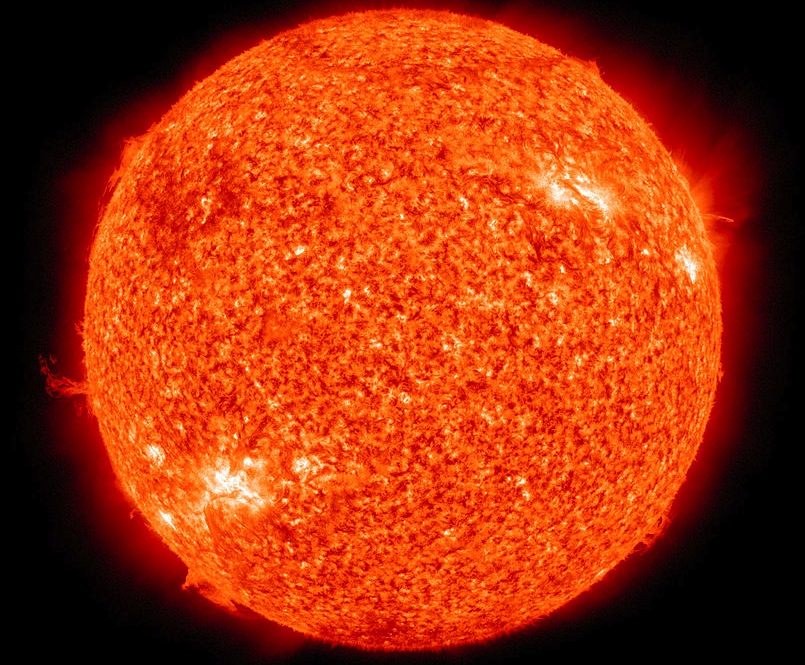
At first glance, the Sun seems easy to understand. It is a gigantic ball of glowing gas that produces light and heat, warming our planet from nearly 93 million miles (150 million kilometers) away. Most people naturally assume that the closer you get to the Sun’s center, the hotter it becomes, and the farther you move away, the cooler it should get.
That assumption is mostly correct—until you reach one extraordinary region.
Surrounding the Sun is a vast, ghostly outer atmosphere called the corona. Surprisingly, this thin layer is far hotter than the Sun’s visible surface. While the surface reaches about 5,500°C (9,900°F), the corona can soar to more than 1 million°C (1.8 million°F). In some places, temperatures may even exceed 10 million°C (18 million°F) during solar eruptions.
This astonishing fact has puzzled scientists for more than 80 years. How can an outer layer become hundreds of times hotter than the layer beneath it? It seems to defy common sense.
Yet this mystery is real, and solving it has become one of the greatest challenges in solar physics.
What Is the Sun’s Corona?
The corona is the Sun’s outermost atmosphere. It stretches millions of kilometers into space, gradually blending into the solar wind, the continuous stream of charged particles flowing away from the Sun in every direction.
Unlike the bright solar surface, the corona is incredibly thin. Its gas is so sparse that, despite its enormous temperature, it contains far less heat energy than the dense layers below. This is why astronauts far from Earth would not feel the corona as a scorching furnace, even though its temperature is measured in millions of degrees.
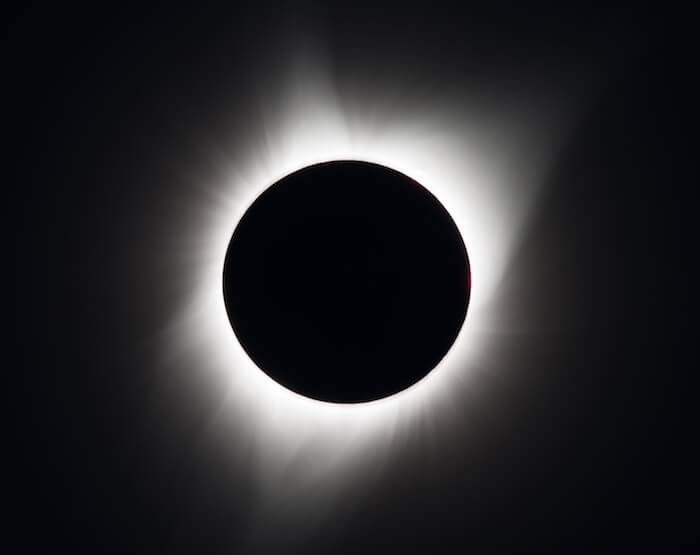
Normally, the brilliant light from the Sun’s surface overwhelms the faint corona, making it invisible to the naked eye.
However, during a total solar eclipse, when the Moon completely blocks the Sun’s bright disk, the corona suddenly appears as a beautiful white halo stretching far into space. It is one of nature’s most breathtaking sights.
Spacecraft equipped with special instruments called coronagraphs can also block the Sun’s bright light, allowing scientists to observe the corona every day.
Why the Corona Should Be Cooler
Heat usually flows from hotter places to cooler ones.
Imagine standing near a campfire. The closer you are to the flames, the warmer you feel. As you walk away, the heat gradually fades.
The Sun should behave similarly.
Its core reaches roughly 15 million°C (27 million°F), where nuclear fusion generates enormous amounts of energy. Moving outward, the temperature steadily decreases through several layers until it reaches about 5,500°C at the visible surface, known as the photosphere.
Based on this pattern, scientists expected the atmosphere above the surface to continue cooling.
Instead, something astonishing happens.
Just above the photosphere lies a thin region called the chromosphere, where temperatures begin rising again.
Farther outward, in the corona, temperatures suddenly leap into the millions of degrees.
It is as though you walked away from a fire only to find the surrounding air becoming much hotter than the flames themselves.
This unexpected temperature increase is known as the coronal heating problem.
The Sun Is Filled With Powerful Magnetic Fields
To understand the corona, it is impossible to ignore one invisible force: magnetism.
The Sun is not a solid object. It is made almost entirely of hot, electrically charged gas known as plasma.
Plasma behaves differently from ordinary gases because its charged particles respond strongly to magnetic fields.
Inside the Sun, hot plasma constantly rises, cools, and sinks again in giant convective motions. These movements twist, stretch, and tangle magnetic field lines into incredibly complex shapes.
If we could somehow see the Sun’s magnetic field, it would resemble an enormous web of glowing loops, arches, and tangled strands reaching high into the corona.
These magnetic fields contain tremendous amounts of stored energy.
Scientists now believe this magnetic energy is the key to explaining why the corona becomes so extraordinarily hot.
Tiny Explosions Called Nanoflares
One of the leading explanations involves countless miniature explosions known as nanoflares.
The idea was first proposed by astrophysicist Eugene Parker in the late twentieth century.
These are not ordinary solar flares.
Instead, they are extremely small bursts of energy produced when magnetic field lines become twisted and suddenly reconnect.
Imagine stretching a rubber band until it snaps into a new shape.
A similar process happens when magnetic field lines in the Sun suddenly rearrange themselves.
This process, called magnetic reconnection, releases stored magnetic energy almost instantly.
Each individual nanoflare is tiny compared with the enormous solar flares sometimes seen erupting from the Sun.
However, scientists think millions of nanoflares may occur every second across the Sun.
Together, these countless tiny energy releases could continually heat the corona to millions of degrees.
Although detecting individual nanoflares remains challenging because they are so small and short-lived, observations increasingly suggest they occur throughout the corona.
Waves That Carry Energy
Another major explanation involves powerful waves traveling through the Sun’s magnetic fields.
Just as earthquakes produce seismic waves inside Earth, the Sun constantly vibrates.
These vibrations generate waves that travel upward from the surface into the corona.
Among the most important are Alfvén waves, named after Nobel Prize-winning physicist Hannes Alfvén.
These waves travel along magnetic field lines, carrying energy from the Sun’s lower atmosphere into the corona.
If enough of this wave energy is absorbed by the surrounding plasma, it can heat the gas dramatically.
Space missions have directly observed Alfvén waves moving through the Sun’s atmosphere, showing they transport enormous amounts of energy.
Scientists continue studying exactly how efficiently that energy converts into heat.
Magnetic Reconnection Releases Hidden Energy
Magnetic reconnection may play an even broader role than nanoflares alone.
The Sun’s magnetic field is constantly changing.
Loops collide.
Field lines twist together.
Oppositely directed magnetic fields meet.
When conditions become right, these tangled magnetic fields suddenly break apart and reconnect in new arrangements.
The process releases huge amounts of stored magnetic energy.
Large reconnection events create spectacular solar flares and coronal mass ejections, in which billions of tons of solar plasma are hurled into space.
Smaller reconnection events occur far more frequently.
Scientists believe these repeated magnetic rearrangements provide a steady source of heating throughout the corona.
The Corona Is Thin but Extremely Hot
The word “hot” can sometimes be misleading.
Temperature measures the average energy of individual particles.
The corona contains particles moving at tremendous speeds, giving it an extremely high temperature.
However, because the corona is incredibly thin, there are relatively few particles.
This means its total heat content is much lower than that of denser regions beneath it.
An everyday comparison helps.
The air inside an oven may be hundreds of degrees, but touching the metal rack hurts much more because the metal contains far more heat energy.
Likewise, the corona’s particles are extraordinarily energetic, but they are spread so far apart that the corona is not like a dense wall of fire.
How Scientists Study the Corona
Understanding the corona requires observing the Sun with specialized instruments.
Ground-based telescopes provide valuable observations, but Earth’s atmosphere blocks many wavelengths of light.
Spacecraft overcome this limitation.
NASA’s Solar Dynamics Observatory continuously watches the Sun in ultraviolet light, revealing the constantly changing corona in remarkable detail.
The Parker Solar Probe, launched in 2018, became the first spacecraft to fly directly through the Sun’s outer atmosphere. By repeatedly approaching closer than any previous spacecraft, it measures magnetic fields, plasma, and solar particles from inside the corona itself.
Meanwhile, the Solar Orbiter, a joint mission of the European Space Agency and NASA, studies the Sun from unique viewing angles while combining close-up measurements with high-resolution images.
Together, these missions are providing the most detailed understanding of the corona ever achieved.
The Parker Solar Probe Changed Everything
For decades, scientists dreamed of sending a spacecraft into the Sun’s atmosphere.
That dream became reality with the Parker Solar Probe.
Protected by an advanced carbon-composite heat shield, the spacecraft survives temperatures that would destroy ordinary spacecraft while keeping its instruments at safe operating temperatures.
During close flybys, Parker has crossed the Alfvén critical surface, a boundary where the solar wind transitions from being controlled by the Sun’s magnetic field to flowing freely into space.
The spacecraft has observed unexpected magnetic “switchbacks,” measured plasma flows, and gathered direct evidence about the environment where the solar wind forms.
These measurements are helping scientists determine how energy moves through the corona and how it becomes so intensely heated.
Why the Corona Matters to Earth
The corona is not just an interesting scientific puzzle.
It directly affects life on Earth.
The corona is the source of the solar wind and many forms of space weather.
Powerful eruptions from the corona can send enormous clouds of charged particles racing toward Earth.
When these particles interact with Earth’s magnetic field, they create beautiful auroras near the poles.
However, strong solar storms can also disrupt satellites, interfere with radio communications, affect GPS signals, damage power grids, and pose radiation risks for astronauts.
Understanding how the corona behaves improves scientists’ ability to forecast space weather, helping protect modern technology.
Is the Mystery Solved?
The answer is both yes and no.
Scientists now agree that magnetic fields are central to the heating of the corona.
There is strong evidence that magnetic reconnection, nanoflares, wave heating, and other magnetic processes all contribute.
However, researchers are still determining which mechanisms dominate under different conditions and how they work together.
Rather than searching for one single explanation, many scientists now think the corona is heated by several interacting processes occurring simultaneously across different regions of the Sun.
Each new observation brings researchers closer to solving this remarkable puzzle.
The Sun Continues to Surprise Us
The Sun is the best-studied star in the universe, yet it still holds profound mysteries.
The fact that its outer atmosphere is hundreds of times hotter than its visible surface challenges our everyday intuition and reminds us that nature often behaves in surprising ways.
Thanks to powerful telescopes, sophisticated computer simulations, and daring spacecraft that fly through the Sun’s outer atmosphere, scientists are steadily uncovering the hidden processes that energize the corona.
Every new discovery reveals that our nearest star is not a simple glowing sphere but a dynamic, magnetic, ever-changing world filled with invisible forces of extraordinary power.
The mystery of the Sun’s hot corona is more than a question about one star. It is a window into the physics of stars across the universe, the behavior of plasma in extreme environments, and the invisible magnetic forces that shape the cosmos. As research continues, the corona remains one of the brightest examples of how even the most familiar object in our sky can still inspire wonder and challenge our understanding of nature.