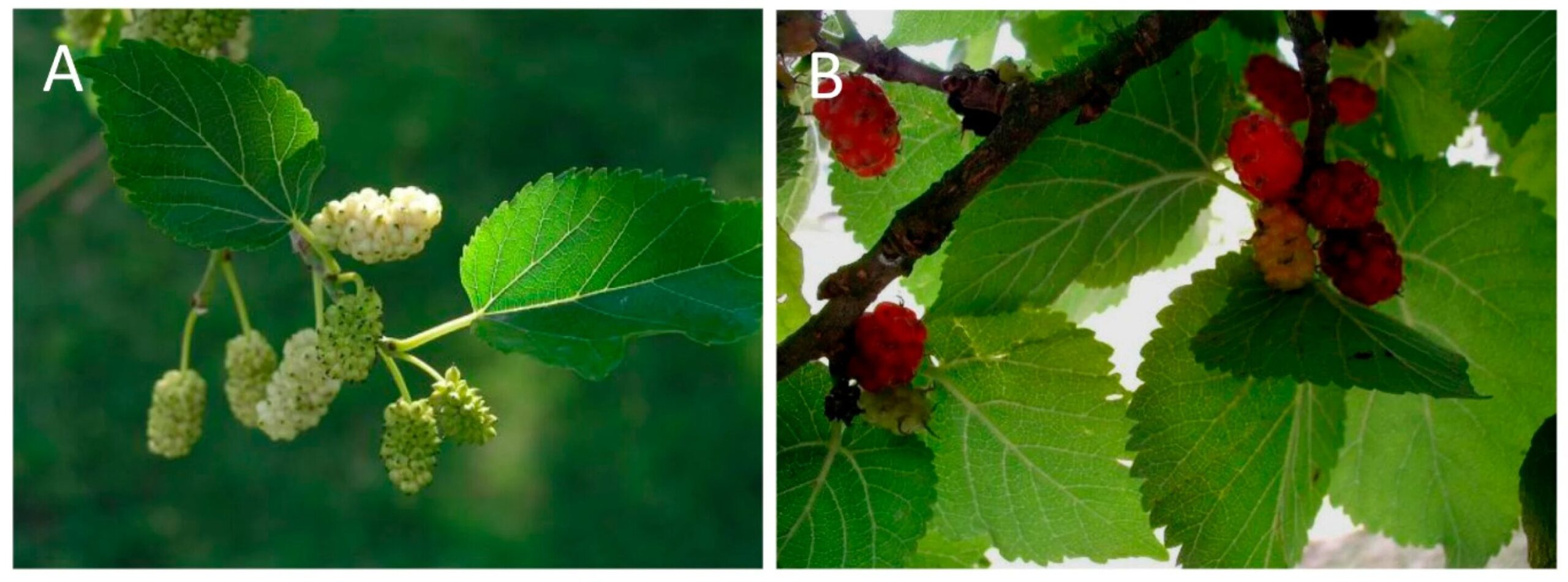
Mulberry preparations may influence the gut microbiota and some measures of metabolism, but a review of the evidence suggests that the effects can change substantially depending on the mulberry species, the plant part used and how the material is processed. Most of the evidence so far comes from laboratory and animal studies, leaving their effects in humans unresolved.
Scientists have been studying mulberry because it contains several bioactive compounds, including polyphenols and polysaccharides that may interact with microorganisms living in the gut.
Most research has examined white mulberry (Morus alba), although black mulberry (Morus nigra), especially its fruit, has also produced interesting results.
The leaves contain 1-deoxynojirimycin, or DNJ, a compound known for effects on carbohydrate metabolism. They also contain polyphenols and polysaccharides. Black mulberry fruit is rich in anthocyanins and other phenolic compounds and also contains polysaccharides.
But the plant itself is only part of the equation. Processing can change what ends up in a preparation. Drying, fermentation and different extraction methods can alter the amount and proportions of bioactive compounds. As a result, two preparations made from the same plant material can have different compositions and biological effects.
Changes in gut bacteria have been reported
The review found evidence that preparations made from mulberry leaves and fruit can affect both the composition and activity of the gut microbiota.
Some studies reported changes in the abundance of beneficial bacteria along with greater production of short-chain fatty acids, including acetate, propionate and butyrate. These compounds are produced by gut bacteria when they ferment dietary components and play an important role in intestinal function.
Other studies connected changes in the microbiota with improvements in some measures related to glucose and lipid metabolism.
The results, however, were not uniform. The effects depended on both the material being studied and the way it was prepared.
Extraction changed how mulberry polysaccharides behaved
Polysaccharides from black mulberry fruit illustrate the importance of processing.
Different extraction techniques produced polysaccharide fractions with different structures and different levels of use by gut microorganisms. Fractions produced through water extraction and with pectate lyase had the highest prebiotic potential among those examined.
Research on leaf polysaccharides also found that their structure may influence which bacteria use them as a food source and which short-chain fatty acids are produced. Factors including molecular weight and the types of monosaccharides in the polysaccharides were associated with these differences.
These findings make it difficult to treat all mulberry preparations as if they were chemically and biologically equivalent.
A combination of compounds produced stronger effects in mice
Some of the most notable evidence came from experiments using a more complex preparation rather than an isolated group of compounds.
In mice fed a high-fat diet, researchers tested a fraction from white mulberry fruit that contained both polyphenols and polysaccharides. The combined fraction produced greater beneficial changes in the gut microbiota than either fraction given separately.
The treatment was also accompanied by improvements in some parameters associated with metabolic syndrome and intestinal health.
Researchers then carried out a microbiota transplantation experiment using the same model. Microbiota from mice that had received the combined fraction were transferred to other animals. The recipient mice also experienced improvements in some metabolic disturbances.
The results provided further evidence that the microbiota may mediate some of the effects of the preparation.
Taken together, the findings point to the composition of the entire preparation as an important factor. The presence of one particular compound may not fully explain the biological effects. The proportions of different compounds and their interactions may also matter.
That means the researchers argue that future work should identify which combinations of mulberry species, plant parts, chemical composition and processing methods produce particular biological effects rather than looking for one universal mulberry preparation.
The evidence still comes mainly from experiments
There is an important gap in the current research: direct human studies examining how mulberry preparations affect the gut microbiota are lacking.
Most of the available evidence comes from animal models and experiments conducted outside living organisms. Comparing the studies is also difficult because relatively few connect the observed effects with a detailed analysis of the preparation’s composition.
For that reason, the existing findings cannot establish whether the relationships observed between mulberry preparations, gut microorganisms and metabolism in experimental models also occur in humans.
Clinical studies using well-characterized, standardized mulberry preparations are needed to determine how different products affect the human gut microbiota, how large those effects are and whether they produce measurable health benefits.
The study was published in Biomolecules.