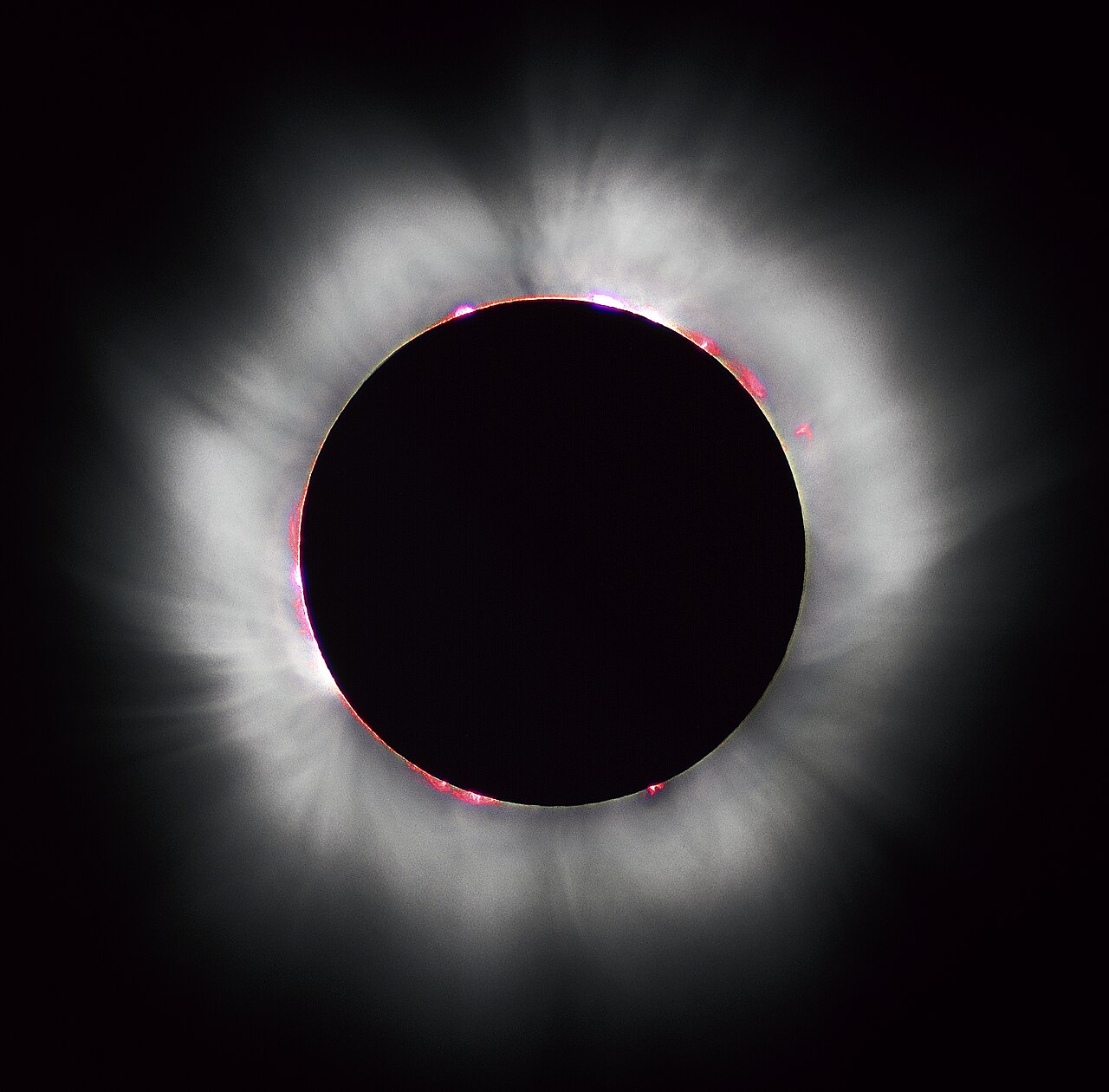
Every time the Moon completely covers the Sun during a total solar eclipse, something extraordinary appears in the sky. Around the dark silhouette of the Moon, a glowing crown of delicate white light stretches millions of kilometers into space. For a few breathtaking minutes, people witness one of nature’s most spectacular sights—the solar corona.
The solar corona is the Sun’s outermost atmosphere. It is a vast region of incredibly hot, thin plasma that extends far beyond the visible surface of the Sun. Although it is much less dense than the air we breathe, the corona plays a crucial role in shaping the entire solar system. It is the birthplace of the solar wind, the source of powerful space weather, and one of the greatest mysteries in modern solar physics.
Understanding the corona helps scientists understand not only our own star but also how stars throughout the universe behave.
The Sun Has More Than One Layer
When most people picture the Sun, they imagine a brilliant glowing sphere. What we actually see from Earth, however, is only one layer of a much larger and more complex star.
The visible surface of the Sun is called the photosphere. It is the layer that emits most of the sunlight reaching Earth. Above the photosphere lies the chromosphere, a relatively thin layer that becomes visible as a reddish glow during a total solar eclipse.
Beyond the chromosphere lies the corona, the Sun’s enormous outer atmosphere. Unlike the lower layers, the corona stretches outward for millions of kilometers and gradually blends into interplanetary space.
Rather than ending abruptly, the corona fades into the solar wind, a continuous stream of charged particles flowing throughout the solar system.
Why Is It Called the Corona?
The word corona comes from the Latin word for “crown.”
The name perfectly describes its appearance during a total solar eclipse. As the Moon blocks the brilliant photosphere, the faint outer atmosphere suddenly becomes visible as an elegant crown of glowing white streamers surrounding the hidden Sun.
Without an eclipse, the corona is almost impossible to see with the naked eye because the photosphere is about a million times brighter. Its intense light overwhelms the faint glow of the corona.
Scientists can also observe the corona using special instruments called coronagraphs, which artificially block the bright disk of the Sun to reveal the surrounding atmosphere.
What Is the Corona Made Of?
The solar corona is not made of ordinary gas.
Instead, it consists of plasma, often called the fourth state of matter. Plasma forms when temperatures become so high that atoms lose some or all of their electrons. Instead of neutral atoms, plasma contains freely moving electrons and positively charged ions.
The Sun itself is almost entirely made of plasma.
Although the corona is extremely hot, it is also incredibly thin. Near Earth’s surface, a single cubic centimeter of air contains trillions upon trillions of molecules. In the corona, the same volume contains only a tiny fraction of that number of particles.
Because the plasma is so sparse, it does not feel hot in the same way that a hot oven does. Heat depends not only on temperature but also on the number of particles available to transfer energy.
The Corona Is Surprisingly Hot
One of the greatest mysteries in solar physics is known as the coronal heating problem.
You might expect the atmosphere around the Sun to become cooler as it moves farther away from the solar surface. After all, stepping away from a campfire makes you cooler, not hotter.
Surprisingly, the opposite happens.
The photosphere has a temperature of about 5,500 degrees Celsius (9,900 degrees Fahrenheit).
The corona, however, reaches temperatures of one to several million degrees Celsius.
This astonishing difference puzzled scientists for decades and remains an active area of research.
Although researchers have made significant progress, the exact processes responsible for heating the corona are still being investigated.
Why Is the Corona So Hot?
Scientists have proposed several explanations for the corona’s extreme temperature.
One leading idea involves the Sun’s powerful magnetic fields.
The Sun is filled with magnetic field lines that twist, stretch, and reconnect as the star constantly churns beneath its surface. When magnetic field lines suddenly rearrange themselves—a process called magnetic reconnection—they release enormous amounts of energy.
This released energy may heat the surrounding plasma to millions of degrees.
Another leading explanation involves tiny waves traveling along magnetic field lines. These waves, known as Alfvén waves, may transport energy from the lower layers of the Sun into the corona, where that energy is eventually converted into heat.
Many scientists believe both processes likely contribute to the corona’s high temperature.
The Corona Is Always Changing
The corona is anything but calm.
Powerful magnetic fields constantly reshape it.
Loops of glowing plasma rise high above the solar surface before curving back down.
Bright streamers stretch millions of kilometers into space.
Dark regions called coronal holes appear where magnetic field lines open outward, allowing charged particles to escape more easily.
Massive eruptions suddenly burst into space.
The corona is a dynamic environment that changes from minute to minute and throughout the Sun’s approximately 11-year activity cycle.
Solar Magnetic Fields Shape the Corona
Magnetic fields are the invisible architects of the corona.
Unlike Earth, where gravity dominates many everyday processes, the behavior of the coronal plasma is largely controlled by magnetic forces.
Charged particles naturally move along magnetic field lines.
This is why many coronal structures appear as graceful loops, arches, and streamers.
Where magnetic fields are especially strong, the plasma follows intricate paths that create the beautiful shapes seen in spacecraft images.
As the Sun rotates and its magnetic field evolves, the entire corona changes with it.
Coronal Loops
One of the most recognizable features of the corona is the coronal loop.
These enormous arches of glowing plasma follow magnetic field lines extending above active regions on the Sun.
Some loops reach heights many times larger than Earth itself.
Within these loops, hot plasma flows continuously while magnetic forces keep it suspended above the solar surface.
Modern solar observatories capture thousands of these loops in ultraviolet and X-ray wavelengths, revealing a remarkably active atmosphere.
Coronal Holes
Not every part of the corona shines equally brightly.
Some regions appear darker because they contain less dense, cooler plasma.
These areas are called coronal holes.
In coronal holes, magnetic field lines remain open instead of looping back toward the Sun.
These open magnetic pathways allow high-speed streams of charged particles to escape into space, contributing to the solar wind.
When fast solar wind from coronal holes reaches Earth, it can interact with our planet’s magnetic field and sometimes enhance auroras near the polar regions.
The Solar Wind Begins in the Corona
The corona is the birthplace of the solar wind.
The solar wind is a continuous flow of charged particles, mainly electrons and protons, streaming away from the Sun in all directions.
This flow never stops.
It fills the entire solar system, creating a giant bubble around the Sun called the heliosphere.
The solar wind shapes the magnetic environments of planets, influences comet tails, affects spacecraft, and interacts with Earth’s magnetic field.
Without the corona, there would be no solar wind.
Coronal Mass Ejections
Sometimes the corona releases truly enormous explosions.
These events are called coronal mass ejections, often abbreviated as CMEs.
During a CME, billions of tons of plasma and magnetic field are launched into space at tremendous speeds.
Some CMEs travel at several million kilometers per hour.
If one is directed toward Earth, it can produce major space weather events.
These storms may disrupt satellite communications, interfere with GPS signals, affect radio communications, increase radiation exposure for astronauts, and in extreme cases induce electrical currents in power grids.
Fortunately, Earth’s magnetic field provides substantial protection against most solar activity.
Solar Flares and the Corona
Solar flares and coronal mass ejections often occur together, although either can happen independently.
A solar flare is a sudden burst of electromagnetic radiation caused by rapid magnetic energy release.
The flare itself produces intense radiation across the electromagnetic spectrum, from radio waves to X-rays and gamma rays.
The corona is the region where much of this energy is released.
Studying the corona helps scientists better understand how these powerful events begin.
Seeing the Corona During a Total Solar Eclipse
For most of history, total solar eclipses provided humanity’s only opportunity to observe the corona directly.
As the Moon completely covers the Sun’s bright photosphere, the hidden corona suddenly becomes visible.
Observers see delicate streamers extending outward in multiple directions.
The exact appearance depends on the Sun’s magnetic activity.
During periods of low solar activity, the corona often appears more symmetrical.
During times of high activity, it becomes more complex, with long streamers reaching far into space.
These breathtaking views inspired astronomers long before modern telescopes existed.
Studying the Corona From Space
Today, scientists no longer have to wait for eclipses.
Spacecraft equipped with advanced instruments continuously monitor the corona.
Observatories such as NASA’s Solar Dynamics Observatory (SDO) capture detailed images in ultraviolet wavelengths that reveal structures invisible to human eyes.
The joint ESA/NASA Solar and Heliospheric Observatory (SOHO) has studied the corona for decades using powerful coronagraphs.
NASA’s Parker Solar Probe has revolutionized solar research by flying closer to the Sun than any spacecraft in history. It travels directly through the Sun’s outer atmosphere, measuring particles, magnetic fields, and plasma under conditions never before explored.
Meanwhile, ESA’s Solar Orbiter provides detailed observations from unique viewing angles, helping scientists better understand how the corona changes over time.
Together, these missions continue to answer questions that puzzled astronomers for generations.
The Corona and Space Weather
The corona directly influences what scientists call space weather.
Unlike weather on Earth, space weather refers to changing conditions in space caused by activity from the Sun.
Most of the events responsible for space weather begin in the corona.
Solar flares.
Coronal mass ejections.
Fast solar wind.
Magnetic disturbances.
These phenomena can affect satellites, astronauts, spacecraft, navigation systems, aviation, communications, and even electrical infrastructure on Earth.
As our dependence on space-based technology grows, understanding the corona becomes increasingly important.
Why the Corona Looks Different in Various Images
Images of the corona often appear in brilliant shades of blue, green, orange, purple, or gold.
These colors are usually false-color images.
Different instruments observe ultraviolet, extreme ultraviolet, or X-ray wavelengths that human eyes cannot detect.
Scientists assign visible colors to these wavelengths to highlight different temperatures and chemical elements.
These color choices help researchers study the complex behavior of the Sun’s atmosphere more effectively.
The corona itself would generally appear as a faint white glow during a total solar eclipse.
The Corona Beyond Our Solar System
The Sun is not unique.
Many stars possess hot outer atmospheres similar to the solar corona.
Astronomers study stellar coronas using space telescopes that detect X-rays and ultraviolet radiation.
Some stars have coronas far more active than the Sun’s, producing enormous flares that dwarf anything seen in our own solar system.
Comparing the Sun’s corona with those of other stars helps scientists understand how stellar magnetic fields evolve across the universe.
Mysteries That Still Remain
Although scientists have learned an enormous amount about the corona, many questions remain unanswered.
Exactly how the corona reaches its extraordinary temperatures is still being investigated.
Researchers continue studying how magnetic energy converts into heat.
They seek to understand how solar eruptions begin, how the solar wind is accelerated, and how magnetic fields evolve throughout the Sun’s atmosphere.
Each new spacecraft observation provides fresh clues, but the corona still holds many secrets waiting to be uncovered.
Why the Solar Corona Matters
The solar corona is far more than a beautiful halo surrounding the Sun during a rare eclipse. It is a dynamic, powerful, and ever-changing region where intense magnetic fields shape hot plasma, launch the solar wind, and generate the space weather that influences the entire solar system.
Its behavior affects satellites orbiting Earth, astronauts traveling through space, communication systems, navigation technology, and even the shimmering auroras dancing across polar skies. By understanding the corona, scientists gain a deeper understanding of our nearest star and the forces that make life on Earth possible.
The glowing crown that appears so briefly during a total solar eclipse is not merely a stunning celestial spectacle. It is the visible edge of an immense and energetic atmosphere that connects the Sun to every planet, every spacecraft, and ultimately every corner of the solar system.