Every time we look up at the night sky, we instinctively feel that “space” is somewhere far above us. The Moon, planets, stars, and galaxies all seem to exist in a vast, silent realm completely separate from Earth. But have you ever wondered where that journey actually begins? At what exact height does Earth’s atmosphere end and outer space start?
It might seem like a question with a simple answer, yet it has puzzled scientists, engineers, pilots, and lawmakers for decades. Surprisingly, there is no universally accepted physical boundary that marks the beginning of space. Instead, Earth’s atmosphere gradually becomes thinner until it eventually blends into the near vacuum surrounding our planet.
Understanding where space begins requires exploring Earth’s atmosphere, the invisible layers surrounding our world, the challenges of defining a boundary, and the scientific reasons why the answer is more fascinating than many people imagine.
Why It Is Difficult to Define the Beginning of Space
Unlike the shoreline where land meets the sea, there is no sharp border separating Earth’s atmosphere from outer space.
If you were able to travel upward from sea level, you would not suddenly cross an invisible line and find yourself in space. Instead, the air would gradually become thinner. Oxygen molecules would become increasingly scarce, air pressure would continue to fall, and eventually the atmosphere would become so thin that it would no longer support conventional flight or human survival without specialized equipment.
The atmosphere does not simply stop. Its gases extend hundreds and even thousands of kilometers above Earth’s surface, becoming more and more diffuse until they merge with the flow of particles streaming from the Sun.
This gradual transition is the main reason scientists cannot point to one perfectly natural location where space officially begins.
Earth’s Atmosphere Does Not End Suddenly
Earth is surrounded by a protective envelope of gases known as the atmosphere. It contains roughly 78% nitrogen, 21% oxygen, and small amounts of argon, carbon dioxide, water vapor, and other gases.
Nearly all weather, clouds, and breathable air exist close to Earth’s surface. As altitude increases, atmospheric density decreases dramatically.
Although people often imagine the atmosphere ending a short distance above Earth, it actually extends far higher than most realize. Even hundreds of kilometers above the surface, enough air remains to create measurable effects on satellites orbiting the planet.
The atmosphere simply becomes thinner and thinner with increasing altitude rather than ending at a precise location.
The Layers of Earth’s Atmosphere
Scientists divide Earth’s atmosphere into several layers based on changes in temperature and physical properties.
The troposphere is the lowest layer and contains nearly all weather systems. Most commercial aircraft fly near its upper boundary.
Above it lies the stratosphere, where the ozone layer absorbs much of the Sun’s harmful ultraviolet radiation.
Higher still is the mesosphere, where many meteoroids burn up as they enter Earth’s atmosphere, producing the streaks of light commonly called shooting stars.
The thermosphere extends hundreds of kilometers above Earth. Temperatures here can become extremely high because sparse gas molecules absorb energetic solar radiation. The International Space Station orbits within this layer, even though astronauts often describe themselves as being “in space.”
Beyond the thermosphere lies the exosphere, the outermost atmospheric layer. Here, gas molecules are so widely separated that they may travel hundreds of kilometers before colliding with another particle. Eventually these particles escape Earth’s gravity or become part of interplanetary space.
Rather than ending abruptly, the atmosphere gradually fades into space through this immense transition region.
The Kármán Line: The Most Widely Used Boundary
Although nature provides no sharp boundary, scientists and aerospace organizations often need a practical definition.
The most widely recognized boundary is called the Kármán line, located about 100 kilometers (62 miles) above Earth’s mean sea level.
This boundary was proposed by Hungarian-American engineer and physicist Theodore von Kármán.
Von Kármán realized that above approximately 100 kilometers, the atmosphere becomes so thin that an aircraft would need to travel faster than orbital velocity to generate enough aerodynamic lift for flight. At that point, ordinary airplanes can no longer remain airborne because there simply is not enough air beneath their wings.
Above this altitude, vehicles must rely on rocket propulsion rather than aerodynamic flight.
Because of this physical reasoning, many international organizations and aerospace communities recognize the Kármán line as the beginning of outer space.
Why 100 Kilometers?
The choice of 100 kilometers is not arbitrary.
As altitude increases, air density decreases exponentially. Lift generated by aircraft wings depends on air density, wing shape, and speed.
Eventually the atmosphere becomes so thin that even extremely fast aircraft cannot produce sufficient lift without essentially traveling at orbital speeds.
Beyond this point, the distinction between aviation and astronautics becomes clear.
Aircraft depend on air.
Spacecraft depend on momentum and gravity.
Although the precise transition varies slightly depending on atmospheric conditions and vehicle design, 100 kilometers provides a practical and scientifically meaningful boundary.
The United States Uses a Different Definition
Interestingly, not every country defines space in exactly the same way.
In the United States, some government agencies historically awarded astronaut status to people who flew above 50 miles, or approximately 80 kilometers, above Earth’s surface.
This lower boundary recognizes that above about 80 kilometers, atmospheric effects become extremely small, allowing vehicles to experience conditions similar to those encountered in space.
As a result, some astronauts have officially received astronaut wings despite never crossing the internationally recognized Kármán line.
Both definitions are used for practical purposes, illustrating that the beginning of space depends partly on scientific reasoning and partly on historical convention.
Can Satellites Orbit Below the Kármán Line?
In general, no.
The atmosphere below about 100 kilometers is still too dense for stable long-term orbital motion.
A satellite traveling at orbital speed encounters atmospheric drag. Friction with air molecules gradually slows it down, causing it to lose altitude and eventually re-enter the atmosphere.
Most operational satellites orbit several hundred kilometers above Earth, where the atmosphere is thin enough to allow long-lasting orbits.
Even then, tiny amounts of atmospheric drag slowly reduce orbital altitude over time.
This is why spacecraft like the International Space Station occasionally perform orbital boosts to maintain their altitude.
Is the International Space Station Really in Space?
Yes.
The International Space Station typically orbits around 400 kilometers (250 miles) above Earth.
Although it remains inside the thermosphere, the surrounding atmosphere is extraordinarily thin.
Astronauts experience continuous free fall as the station circles Earth at approximately 28,000 kilometers per hour (17,500 miles per hour).
This constant free fall creates the sensation of weightlessness often described as microgravity.
Even though traces of Earth’s atmosphere still exist at that altitude, the environment clearly qualifies as outer space.
Where Does Earth’s Atmosphere Finally End?
This question has no single answer.
If “ending” means where breathable air disappears, that occurs relatively close to Earth’s surface.
If it means where aircraft can no longer fly, the answer is much higher.
If it means where atmospheric molecules become extremely rare, that occurs even farther away.
The outermost atmospheric layer, the exosphere, extends thousands of kilometers into space. Some hydrogen atoms may travel enormous distances before escaping Earth’s gravity altogether.
Scientists sometimes estimate the exosphere reaches nearly 10,000 kilometers (6,200 miles) above Earth before gradually blending into the solar wind.
Rather than ending like a wall, Earth’s atmosphere slowly fades into the surrounding vacuum.
What Is Space Actually Like?
Outer space is often described as a vacuum, but it is not completely empty.
Tiny numbers of atoms, molecules, dust particles, magnetic fields, cosmic rays, and streams of charged particles move throughout space.
Compared with Earth’s atmosphere, however, space is astonishingly empty.
Without atmospheric pressure, humans cannot survive without specially designed spacecraft or spacesuits.
Sound cannot travel because there are too few particles to carry sound waves.
Temperatures vary dramatically depending on sunlight and shadow.
Radiation from the Sun and distant cosmic sources becomes much more intense because there is little atmospheric protection.
These conditions make space one of the harshest environments known.
Why the Atmosphere Is So Important
Earth’s atmosphere is far more than simply air.
It protects life from harmful ultraviolet radiation through the ozone layer.
It burns up countless meteoroids before they can strike Earth’s surface.
It regulates temperature by trapping some of the Sun’s heat through the natural greenhouse effect.
It provides oxygen for respiration and carbon dioxide for photosynthesis.
It also makes weather, clouds, rainfall, and the water cycle possible.
Without this protective envelope, life as we know it could not exist.
The gradual transition from atmosphere to space reminds us just how remarkable Earth’s environment truly is.
How Rockets Reach Space
Unlike airplanes, rockets do not rely on atmospheric oxygen or aerodynamic lift.
A rocket carries both fuel and an oxidizer, allowing its engines to operate even in the vacuum of space.
As the rocket climbs higher, the atmosphere becomes thinner, reducing air resistance.
Once it reaches sufficient speed and altitude, it can enter orbit around Earth or continue toward the Moon, planets, or beyond.
Crossing the Kármán line is an important milestone, but reaching orbit requires much more than simply passing 100 kilometers in altitude. A spacecraft must also achieve the tremendous horizontal speed needed to continuously fall around Earth instead of back toward it.
Space Tourism and Crossing the Boundary
The growing field of commercial spaceflight has brought renewed attention to the question of where space begins.
Companies developing suborbital space tourism typically fly passengers above either the 80-kilometer or 100-kilometer boundary, depending on the mission profile.
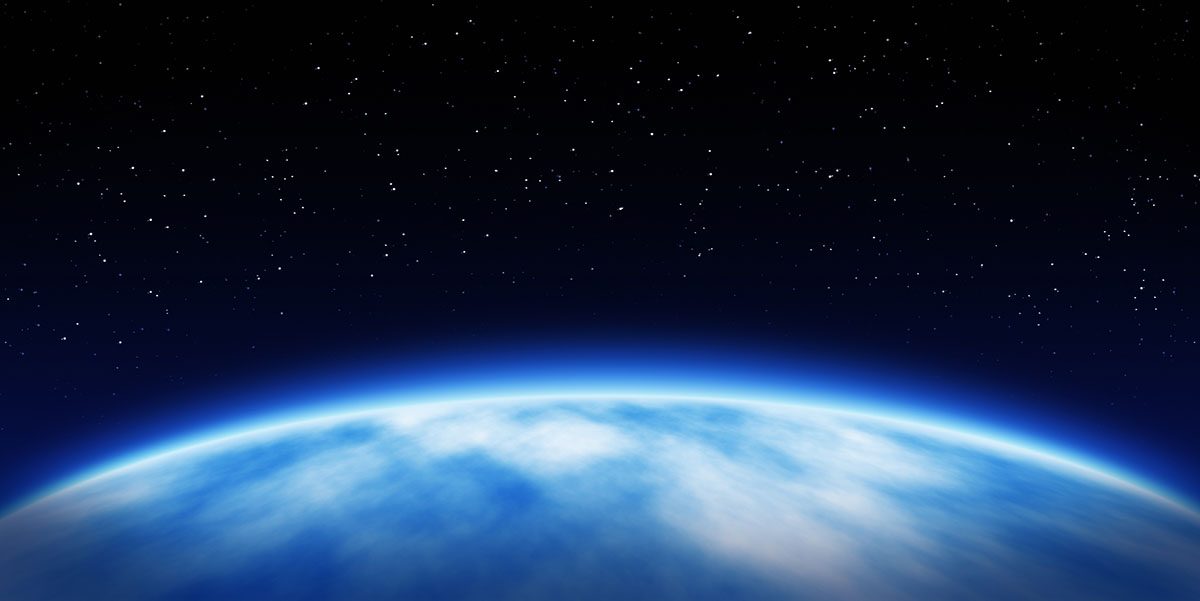
For a few breathtaking minutes, passengers experience microgravity, witness Earth’s curved horizon, and see the sky become completely black even though the Sun shines brightly.
These journeys highlight how quickly Earth’s atmosphere gives way to the extraordinary environment of space.
Why Scientists Continue to Study the Edge of Space
The region between Earth’s atmosphere and outer space is scientifically important.
Researchers study this transition to better understand atmospheric escape, satellite drag, space weather, auroras, and the interactions between Earth’s magnetic field and charged particles from the Sun.
Understanding this region also helps improve spacecraft design, satellite operations, GPS accuracy, climate research, and predictions of how solar activity affects modern technology.
Far from being an empty boundary, the edge of space is an active and dynamic environment.
The Expanding Human Presence Beyond Earth
Humanity has traveled far beyond the point where space begins.
Astronauts have walked on the Moon.
Robotic spacecraft have explored every major planet in the Solar System.
Space telescopes observe galaxies billions of light-years away.
Probes have even entered interstellar space after leaving the influence of the Sun’s solar wind.
Yet every one of these extraordinary journeys starts the same way—by leaving behind the gradually thinning blanket of air surrounding our home planet.
The edge of space is not merely a scientific boundary. It represents the threshold between our familiar world and the vast cosmic ocean waiting beyond.
Conclusion
So, where does space begin? The most widely accepted answer is 100 kilometers (62 miles) above Earth’s surface at the Kármán line, where the atmosphere becomes too thin to support conventional flight and spacecraft must rely on orbital mechanics rather than aerodynamic lift. However, this boundary is a practical definition rather than a sharp natural divide. Earth’s atmosphere gradually thins through multiple layers, extending thousands of kilometers into space before blending almost imperceptibly with the surrounding vacuum.
This subtle transition reminds us that our planet is not isolated from the universe but connected to it by an invisible, ever-thinning veil of gas. Every rocket launch, every satellite, every space station, and every voyage into the cosmos begins by passing through this remarkable boundary—a gateway between the world we know and the endless universe beyond.