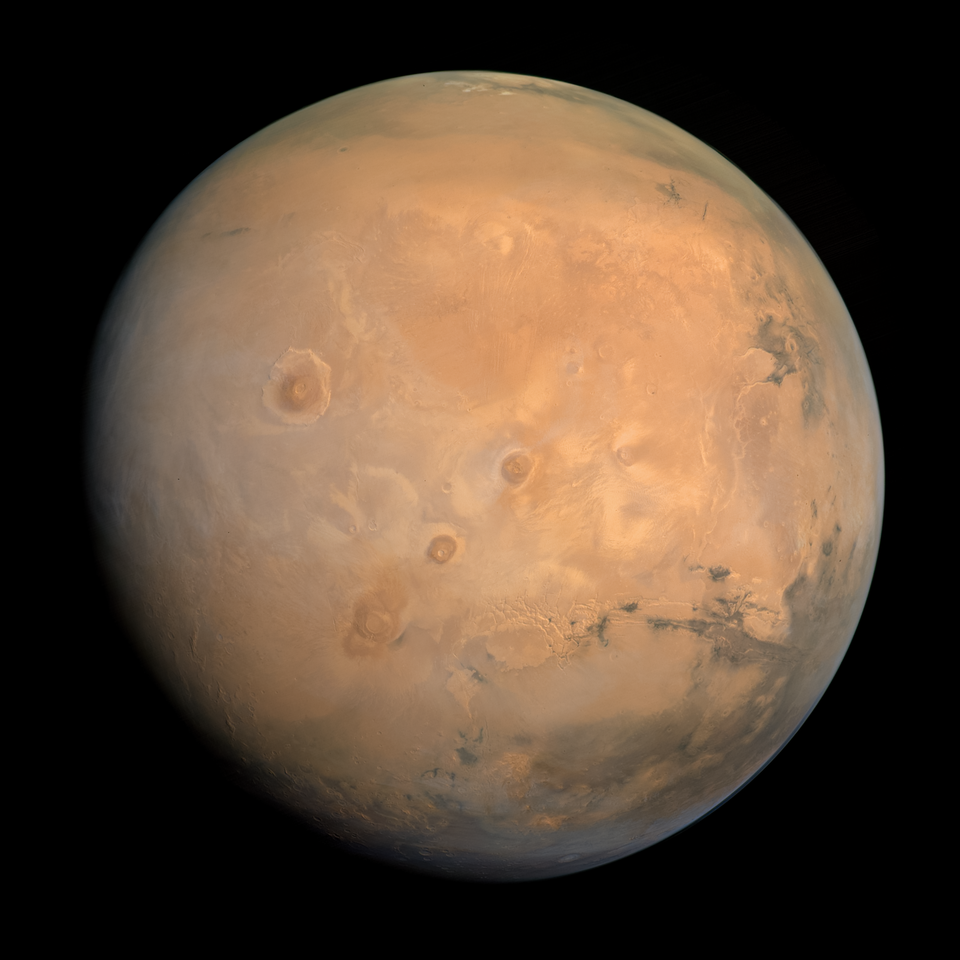
For generations, Mars has captured the human imagination like no other planet. Its reddish appearance in the night sky has inspired myths, stories, and scientific curiosity for thousands of years. But among all the questions people have asked about the Red Planet, one stands above the rest: Does Mars have water?
The answer is yes—but it is more complicated than many people expect.
Today, Mars is a cold, dry desert where liquid water cannot normally survive on the surface for long. Yet scientists have found overwhelming evidence that water shaped the planet in the distant past. They have also discovered enormous amounts of water frozen beneath the surface and locked inside the polar ice caps. Even more intriguingly, researchers continue to search for places where small amounts of liquid water might exist deep underground.
Water is much more than something that could quench an astronaut’s thirst. It is one of the essential ingredients for life as we know it. That is why every new discovery about water on Mars brings scientists one step closer to answering one of humanity’s greatest questions: Could life have once existed on the Red Planet—or could it still exist today?
Why Water Is So Important
Water plays an extraordinary role in shaping planets. It carves valleys, forms rivers and lakes, transports minerals, influences weather, and supports countless chemical reactions.
On Earth, every known living organism depends on liquid water. Although scientists cannot rule out the possibility of life based on other chemistries elsewhere in the universe, liquid water remains one of the strongest indicators that a planet or moon could be habitable.
Whenever astronomers search for potentially life-supporting worlds, one of the first questions they ask is whether water is present.
That is exactly why Mars has become one of the most intensely studied planets in the Solar System.
What Mars Looks Like Today
If you could stand on the surface of Mars today, you would immediately notice how different it is from Earth.
The sky would appear butterscotch or pinkish because of fine dust suspended in the atmosphere. The ground would stretch into rocky plains, towering volcanoes, giant canyons, and dusty deserts.
The air would be incredibly thin—less than 1% of Earth’s atmospheric pressure at the surface—and made up mostly of carbon dioxide.
Temperatures vary widely but are generally very cold. Near the equator during a summer afternoon, temperatures may briefly climb above the freezing point of water. However, nights quickly become much colder, often dropping far below freezing.
Because the atmosphere is so thin, liquid water exposed on the surface would generally be unstable. Instead of remaining as a liquid, it would either freeze or evaporate, with some ice capable of changing directly into water vapor through sublimation.
This harsh environment makes Mars appear lifeless and bone dry.
But appearances can be deceiving.
The First Clues That Mars Once Had Water
Long before spacecraft ever reached Mars, astronomers noticed bright polar caps that changed size with the seasons.
Some believed they were made entirely of water ice.
Others imagined canals carrying water across the planet, although those “canals” later turned out to be optical illusions caused by limitations in early telescopes.
The real breakthrough came when spacecraft began orbiting and landing on Mars.
Images revealed something astonishing.
Across the planet’s surface were enormous valleys, winding channels, fan-shaped deltas, dried lake basins, and sedimentary rock layers that looked remarkably similar to landscapes formed by flowing water on Earth.
These discoveries changed our understanding of Mars forever.
Ancient Rivers That Once Flowed
Some of the strongest evidence for ancient water comes from dried river valleys.
These valleys branch into networks much like river systems on Earth.
Their shapes suggest that water once flowed downhill across the Martian landscape, gradually eroding the ground over long periods.
Some channels stretch for hundreds or even thousands of kilometers.
Their enormous size indicates that Mars once experienced major episodes of flowing water.
Scientists believe some rivers may have existed billions of years ago when Mars had a warmer climate and a thicker atmosphere.
Lakes That Existed Billions of Years Ago
Ancient Mars was not only home to rivers.
Scientists have discovered convincing evidence that large lakes once filled many impact craters.
These ancient lakes collected sediments carried by rivers, just as lakes do on Earth today.
Some craters contain beautifully preserved deltas—fan-shaped deposits created where rivers slow down as they enter standing water.
These deltas are especially exciting because they can preserve organic molecules and microscopic evidence of ancient life if it ever existed.
NASA’s Perseverance rover is currently exploring Jezero Crater because scientists believe it once contained a long-lived lake and river delta.
Oceans on Ancient Mars?
One of the biggest scientific debates is whether Mars once had an ocean.
Several lines of evidence suggest that billions of years ago, a vast body of water may have covered much of the planet’s northern lowlands.
The northern hemisphere of Mars lies much lower than the southern hemisphere, making it a natural location where water could have collected.
Researchers have identified possible ancient shorelines, coastal landforms, and sediment deposits consistent with an ocean.
However, the evidence is not yet conclusive.
If such an ocean existed, it may have contained a volume of water comparable to Earth’s Arctic Ocean.
Whether Mars truly hosted a global ocean remains one of planetary science’s most fascinating unanswered questions.
Where Did All the Water Go?
If Mars once had rivers, lakes, and perhaps even oceans, what happened to them?
The answer lies in the planet’s evolution.
Billions of years ago, Mars gradually lost much of its atmosphere.
Without a thick atmosphere, air pressure dropped dramatically.
At the same time, the planet lost its global magnetic field, leaving its atmosphere vulnerable to being stripped away by the solar wind—a continuous stream of charged particles flowing outward from the Sun.
As the atmosphere became thinner, surface temperatures generally fell, and liquid water became increasingly difficult to maintain.
Much of the water escaped into space as hydrogen atoms produced by the breakdown of water molecules. Some water became trapped underground as ice, while large amounts froze at the poles.
The result is the cold, dry Mars we see today.
Water Ice at the Polar Caps
One of the easiest places to find water on Mars is at its poles.
The polar caps contain enormous amounts of frozen water ice.
During winter, additional layers of frozen carbon dioxide, commonly called dry ice, accumulate on top of the water ice.
As spring returns, much of the carbon dioxide ice sublimates back into the atmosphere, revealing the underlying water ice.
Radar measurements from orbit show that these polar ice deposits are several kilometers thick in some places.
If all the water ice in the polar caps melted, it would cover the entire planet with a global ocean several tens of meters deep.
Hidden Ice Beneath the Surface
The polar caps are only part of the story.
Orbiters equipped with radar instruments have discovered vast amounts of buried ice beneath the Martian surface.
In many regions, just a thin layer of soil covers thick deposits of nearly pure water ice.
Some of these underground ice sheets extend for hundreds of kilometers.
Scientists believe they formed during past climate changes, when ice accumulated in different parts of the planet.
This hidden ice represents an important resource for future human explorers, who could potentially use it for drinking water, producing oxygen, and making rocket fuel through the electrolysis of water into hydrogen and oxygen.
Water Locked Inside Rocks
Not all of Mars’ water exists as visible ice.
Many Martian minerals formed through interactions with water billions of years ago.
Clay minerals, sulfates, and hydrated salts contain water molecules locked within their crystal structures.
Orbiting spacecraft have mapped these minerals across large portions of the planet.
Their presence confirms that liquid water once altered the rocks over extended periods.
These minerals also help scientists reconstruct the environmental conditions that existed when Mars was wetter.
Frost on the Martian Surface
Although Mars is generally dry, thin layers of frost regularly appear in many regions.
During cold nights, water vapor in the atmosphere can freeze directly onto the ground, rocks, and sand.
As sunlight warms the surface after sunrise, much of this frost disappears.
This seasonal cycle shows that water still moves between the atmosphere and the surface, even though the total amount is relatively small.
Water Vapor in the Atmosphere
Mars contains only a tiny amount of water vapor compared with Earth.
Even so, this small quantity plays an important role in the planet’s weather.
Water vapor forms thin clouds made of ice crystals.
It contributes to frost formation and participates in seasonal cycles between the atmosphere, the surface, and the polar ice caps.
Scientists carefully monitor these changes to better understand the Martian climate.
Could Liquid Water Exist Today?
This is one of the most exciting questions in planetary science.
Under normal surface conditions, stable liquid water is extremely unlikely because of the low atmospheric pressure and cold temperatures.
However, scientists have explored several possibilities.
One idea is that salty water, known as brine, might occasionally remain liquid for short periods because dissolved salts lower water’s freezing point.
Certain dark streaks once observed on Martian slopes were initially thought to result from flowing brines. Later research suggested many of these features are more likely caused by dry movements of dust and sand rather than liquid water.
Another possibility is that liquid water could exist deep underground, where pressure is higher and temperatures may be warmer than at the surface.
Although this idea remains under investigation, no underground liquid reservoirs have yet been directly confirmed.
The Search for Underground Water
Radar instruments aboard orbiting spacecraft have searched beneath the Martian surface for signs of buried liquid water.
Some radar observations have been interpreted as possible evidence for liquid water beneath the south polar ice cap.
However, other scientists argue that the signals could instead be produced by unusual minerals or other geological materials.
As a result, the existence of present-day underground lakes remains uncertain.
Future missions with more advanced instruments may eventually resolve this mystery.
Mars Rovers and the Story of Water
Several robotic explorers have transformed our understanding of Martian water.
NASA’s Spirit and Opportunity rovers found minerals that form in the presence of water.
Opportunity explored rocks that clearly showed evidence of ancient groundwater.
Curiosity discovered that Gale Crater once hosted lakes that persisted for long periods. The sediments indicate that these lakes contained water with conditions that may have been suitable for microbial life.
Perseverance is studying rocks within Jezero Crater, collecting carefully selected samples that may one day be returned to Earth for detailed laboratory analysis.
Each mission has strengthened the conclusion that ancient Mars was once much wetter than it is today.
Could There Have Been Life?
Water alone does not guarantee life.
Life also requires suitable chemistry and a source of energy.
Even so, ancient Mars appears to have possessed many of the ingredients considered important for habitability.
It had liquid water.
It had energy from volcanic activity and sunlight.
It contained essential chemical elements found in rocks and minerals.
Scientists therefore consider ancient Mars to have been potentially habitable, especially for microscopic organisms similar to some bacteria that thrive in extreme environments on Earth.
So far, however, no confirmed evidence of past or present life has been found.
The search continues.
Water and Future Human Exploration
Water will be one of the most valuable resources for future astronauts.
Transporting large quantities of water from Earth would be expensive and impractical.
Fortunately, the ice already present on Mars could provide drinking water, oxygen for breathing, and hydrogen for rocket fuel.
Using local resources rather than carrying everything from Earth is known as in-situ resource utilization, and it will likely play a key role in future human missions.
Engineers are already developing technologies that could extract water from Martian ice and use it to support long-term exploration.
How Scientists Detect Water on Mars
Finding water on another planet requires sophisticated technology.
Orbiters use cameras, spectrometers, and radar instruments to identify ice, map minerals formed in water, and probe beneath the surface.
Landers and rovers analyze rocks with drills, lasers, and chemical laboratories.
Scientists combine information from multiple instruments to determine where water once flowed, where ice remains today, and where future missions should investigate.
Each new mission adds another piece to the puzzle.
How Much Water Does Mars Still Have?
Although Mars appears dry, scientists estimate that the planet still holds an enormous amount of water.
Most of it exists as ice within the polar caps, underground deposits, and permanently frozen ground known as permafrost.
Smaller amounts remain trapped inside minerals and circulate through the atmosphere as water vapor.
Compared with Earth’s oceans, Mars contains far less accessible water today, but the remaining reserves are still substantial.
Why Studying Martian Water Matters
Understanding water on Mars helps scientists answer much bigger questions.
How do planets change over billions of years?
Why did Earth remain habitable while Mars became cold and dry?
Could similar changes happen on other rocky planets?
The answers improve our understanding not only of Mars but also of Earth’s history and the countless planets being discovered around other stars.
Every discovery about Martian water teaches us something about the processes that shape worlds throughout the universe.
Conclusion
Mars does have water—but not in the way people once imagined. Instead of flowing rivers and vast blue seas, today’s Red Planet stores most of its water as ice beneath the surface and within its polar caps. Thin layers of frost appear with the changing seasons, and tiny amounts of water vapor drift through the atmosphere. Scientists have also uncovered compelling evidence that billions of years ago, Mars was a much wetter world, with rivers, lakes, groundwater, and perhaps even an ocean.
The story of water on Mars is ultimately the story of a planet that changed dramatically over time. By studying its frozen landscapes and ancient riverbeds, researchers are uncovering clues about the planet’s past, the possibility of ancient life, and the future of human exploration. Every new mission brings us closer to understanding whether Mars was once a living world—and whether some traces of that watery past may still survive beneath its dusty, crimson surface.