Mercury is the closest planet to the Sun, a mysterious world of blazing heat, freezing darkness, and endless craters. At first glance, it might seem like one of the last places where humans could ever survive. Standing on its surface would be unlike anything we have ever experienced. One side of the planet can become hot enough to melt lead, while another can plunge to temperatures colder than Antarctica.
Yet Mercury continues to fascinate scientists. Despite its harsh environment, this tiny rocky planet has surprised researchers with discoveries that challenge our expectations. It has water ice hidden in permanently shadowed craters, a surprisingly large iron core, and even a thin atmosphere called an exosphere.
So, could humans ever live on Mercury?
The short answer is that humans cannot live on Mercury today, and creating a permanent settlement there would be extraordinarily difficult. However, the idea is not entirely impossible. With future technology, carefully designed habitats, and decades of scientific progress, some experts believe humans might one day establish small research stations in certain parts of the planet.
Understanding why requires a closer look at one of the Solar System’s most extreme worlds.
Getting to Know Mercury
Mercury is the smallest planet in our Solar System and the closest one to the Sun. It has a diameter of about 4,880 kilometers (3,032 miles), making it only slightly larger than Earth’s Moon.
Despite being so close to the Sun, Mercury is not the hottest planet. That title belongs to Venus because its thick atmosphere traps heat through an intense greenhouse effect. Mercury has almost no atmosphere to hold in warmth, causing its temperatures to swing dramatically between day and night.
A year on Mercury lasts only 88 Earth days, meaning it completes one trip around the Sun very quickly. However, the planet rotates slowly, taking about 59 Earth days to spin once on its axis. As a result, one solar day—from one sunrise to the next—lasts about 176 Earth days.
Imagine waiting nearly six months for the Sun to rise again. That is everyday life on Mercury.
What Would Mercury Look Like?
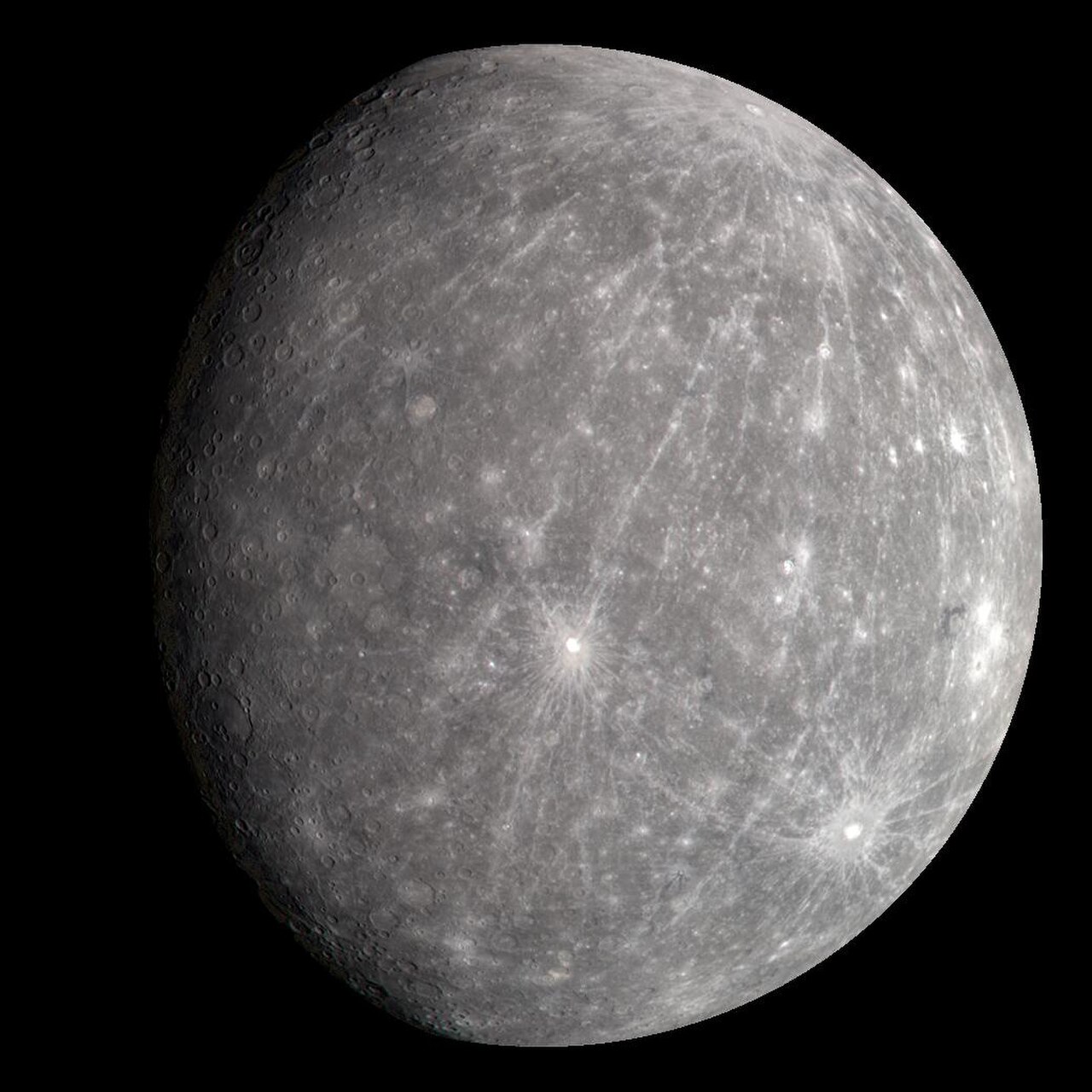
If you stood safely above Mercury’s surface in a protective spacecraft, you would see a landscape that resembles Earth’s Moon.
The ground is covered with countless impact craters formed by billions of years of asteroid collisions. Massive cliffs stretch across the landscape, created as the planet slowly shrank while cooling over billions of years.
The sky would appear completely black, even during daytime, because Mercury has almost no atmosphere to scatter sunlight. The Sun itself would look enormous—about three times wider than it appears from Earth—and shine with dazzling brightness.
It would be both beautiful and intimidating.
Why Mercury Is So Difficult for Humans
Mercury presents nearly every challenge that humans could face on another planet.
The first obstacle is temperature.
During the day, surface temperatures can reach about 430°C (800°F). This is hot enough to melt metals like tin and lead. No human could survive these conditions without advanced cooling systems.
When night falls, temperatures can drop to around −180°C (−290°F) because there is almost no atmosphere to keep the heat from escaping into space.
Very few places in the Solar System experience such dramatic temperature differences.
Any habitat on Mercury would need to withstand both intense heat and extreme cold.
There Is Almost No Air
Humans need oxygen to breathe, but Mercury has essentially no breathable atmosphere.
Instead, it has an extremely thin exosphere made of tiny amounts of atoms such as oxygen, sodium, hydrogen, helium, and potassium. These particles are so widely spread that they rarely collide with one another.
For practical purposes, Mercury is almost a vacuum.
Without a proper atmosphere, humans would need fully sealed habitats and pressurized spacesuits every time they stepped outside.
Dangerous Solar Radiation
Living close to the Sun comes with another major problem.
Mercury receives about 6.5 times more sunlight than Earth.
That means much stronger ultraviolet radiation, intense solar wind, and a greater risk from solar flares and energetic particles.
Without Earth’s thick atmosphere and magnetic protection, these forms of radiation can damage living cells, increase cancer risk, and harm electronic equipment.
Interestingly, Mercury does have a magnetic field, but it is much weaker than Earth’s and provides only limited protection.
Any human settlement would require heavy radiation shielding, possibly using thick layers of rock or specially designed materials.
No Liquid Water
Water is essential for life.
Mercury has no rivers, lakes, oceans, or rainfall.
However, scientists have discovered something remarkable.
Deep inside permanently shadowed craters near the planet’s north and south poles, temperatures remain so cold that water ice has survived for billions of years.
These craters never receive direct sunlight because the Sun always stays low on Mercury’s horizon.
Radar observations from Earth, followed by data from NASA’s MESSENGER spacecraft, confirmed large deposits of water ice hidden within these dark regions.
This ice could become an incredibly valuable resource for future explorers.
Water can provide drinking supplies, produce oxygen for breathing, and be separated into hydrogen and oxygen for rocket fuel.
Could Humans Build Cities on Mercury?
Building a large city on Mercury would be one of the greatest engineering challenges in history.
Ordinary buildings would quickly become uninhabitable because of the extreme temperatures and radiation.
Instead, future settlements would probably look very different.
Habitats might be built underground, where rock naturally blocks radiation and helps maintain stable temperatures.
Another possibility is constructing bases inside crater walls or beneath protective domes made from local materials.
Robotic machines would likely perform most outdoor construction long before humans arrived.
The Best Place to Live on Mercury
If humans ever settle on Mercury, they probably would not choose the hottest regions near the equator.
Scientists believe the areas near the poles offer much better conditions.
Some mountain peaks near Mercury’s poles receive sunlight almost continuously while nearby craters remain permanently dark.
This creates an interesting opportunity.
Solar panels could generate abundant electricity from the constantly shining Sun, while nearby ice deposits could provide water.
The temperatures in these polar regions are also less extreme than those experienced elsewhere on the planet.
Although still harsh, these locations could become the most practical places for future research stations.
What Would Daily Life Be Like?
Life on Mercury would be unlike life anywhere on Earth.
People would spend nearly all of their time inside protected habitats.
Outdoor trips would require advanced spacesuits capable of resisting extreme temperatures and radiation.
Windows might be small or heavily shielded to reduce exposure to sunlight.
Artificial lighting could simulate Earth’s normal day-night cycle since Mercury’s natural days last far too long for human biological rhythms.
Most food would probably be grown indoors using hydroponic or aeroponic farming systems.
Water would be carefully recycled, just as astronauts recycle water aboard the International Space Station today.
Every resource would be precious.
Gravity on Mercury
Mercury’s gravity is much weaker than Earth’s.
It is about 38% as strong as Earth’s gravity, almost the same as the gravity on Mars.
A person weighing 75 kilograms (165 pounds) on Earth would weigh the equivalent of about 28 kilograms (63 pounds) on Mercury.
Walking would feel much lighter, and jumping would be easier.
However, scientists are still studying how living in lower gravity for long periods affects muscles, bones, and overall health.
Future settlers would likely need regular exercise to stay healthy.
Can Plants Grow on Mercury?
Plants cannot grow naturally on Mercury.
There is no breathable atmosphere, no rain, no fertile soil, and almost no protection from radiation.
However, plants could grow inside carefully controlled habitats.
Greenhouses would provide oxygen, water, nutrients, and artificial climate control.
Similar systems are already being tested aboard the International Space Station and in research laboratories on Earth.
Growing crops would reduce the need to transport food across millions of kilometers of space.
How Long Would It Take to Reach Mercury?
Traveling to Mercury is surprisingly difficult.
Although it is the closest planet to the Sun, reaching it requires spacecraft to lose a tremendous amount of orbital energy.
Instead of simply flying toward the Sun, spacecraft often perform multiple gravity-assist flybys around Earth, Venus, or Mercury itself.
NASA’s MESSENGER mission took more than six years to reach Mercury.
Future crewed missions would likely use faster propulsion systems, but the journey would still be challenging.
Why Would Humans Want to Go There?
If Mercury is so dangerous, why consider going at all?
One reason is science.
Mercury preserves clues about how the Solar System formed over 4.5 billion years ago.
Because the planet has changed relatively little compared with Earth, its rocks contain valuable information about the early history of the inner planets.
Mercury is also unusual because its enormous iron core occupies about 85% of the planet’s radius, making it proportionally much larger than Earth’s core.
Studying Mercury could help scientists better understand how rocky planets form throughout the universe.
There may also be economic reasons in the distant future.
Mercury receives enormous amounts of solar energy, making it an attractive location for solar-powered technology.
Its metal-rich composition could one day become valuable if advanced space industries develop.
Could Technology Make Living There Possible?
Technology has already allowed humans to survive in places that once seemed impossible.
People now live year-round in Antarctica, aboard submarines, and continuously on the International Space Station.
Future advances could make Mercury less intimidating.
Improved radiation shielding, efficient cooling systems, autonomous robots, advanced recycling technologies, nuclear or solar power systems, and artificial intelligence could all play important roles.
Scientists are also developing better life-support systems capable of recycling nearly everything needed for survival.
Although today’s technology is not sufficient for a permanent settlement, future generations may achieve what currently seems impossible.
What Are the Biggest Challenges?
The greatest obstacles remain enormous.
Extreme temperatures would place constant stress on equipment.
Radiation would threaten both people and electronics.
The lack of atmosphere means every habitat must remain perfectly sealed.
Transporting supplies across space would be extremely expensive.
Medical emergencies would be difficult to manage because Earth would be millions of kilometers away.
Even simple maintenance tasks outside the habitat would require careful planning.
Living on Mercury would demand constant preparation and advanced engineering.
Is Mercury Better Than Mars?
When people think about human settlements beyond Earth, Mars usually comes first.
Compared with Mercury, Mars offers several important advantages.
Its temperatures are generally less extreme.
Its atmosphere, although very thin, provides some protection from radiation and allows technologies that use atmospheric gases.
Its day lasts about 24.6 hours, very similar to Earth’s, making it easier for humans to maintain normal biological rhythms.
For these reasons, Mars is widely considered a much more practical destination for long-term human settlement.
Mercury remains primarily a target for scientific exploration rather than colonization.
The Future of Human Exploration
Mercury continues to surprise scientists with every new mission.
The European Space Agency and the Japan Aerospace Exploration Agency launched the BepiColombo mission to study the planet in unprecedented detail. As it continues its journey and begins exploring Mercury, scientists expect to learn much more about its magnetic field, interior, surface, and history.
These discoveries will improve our understanding of the smallest planet and help future generations evaluate whether humans could someday establish robotic or even crewed outposts there.
Conclusion
Mercury is one of the most hostile places in the Solar System. Its scorching days, freezing nights, powerful solar radiation, almost nonexistent atmosphere, and barren landscape make it an incredibly difficult world for humans to inhabit.
Today, humans cannot live on Mercury. Our current technology is not capable of supporting permanent communities in such an unforgiving environment.
Yet Mercury is not entirely beyond imagination. Hidden water ice, abundant sunlight, and decades of advancing space technology suggest that small scientific bases could someday become possible, especially near the planet’s poles.
For now, Mercury remains a place for robotic explorers and scientific discovery. But throughout history, humanity has repeatedly turned impossible dreams into reality. Whether people will one day stand safely on Mercury for months or even years remains uncertain—but exploring that possibility continues to inspire scientists, engineers, and dreamers around the world.