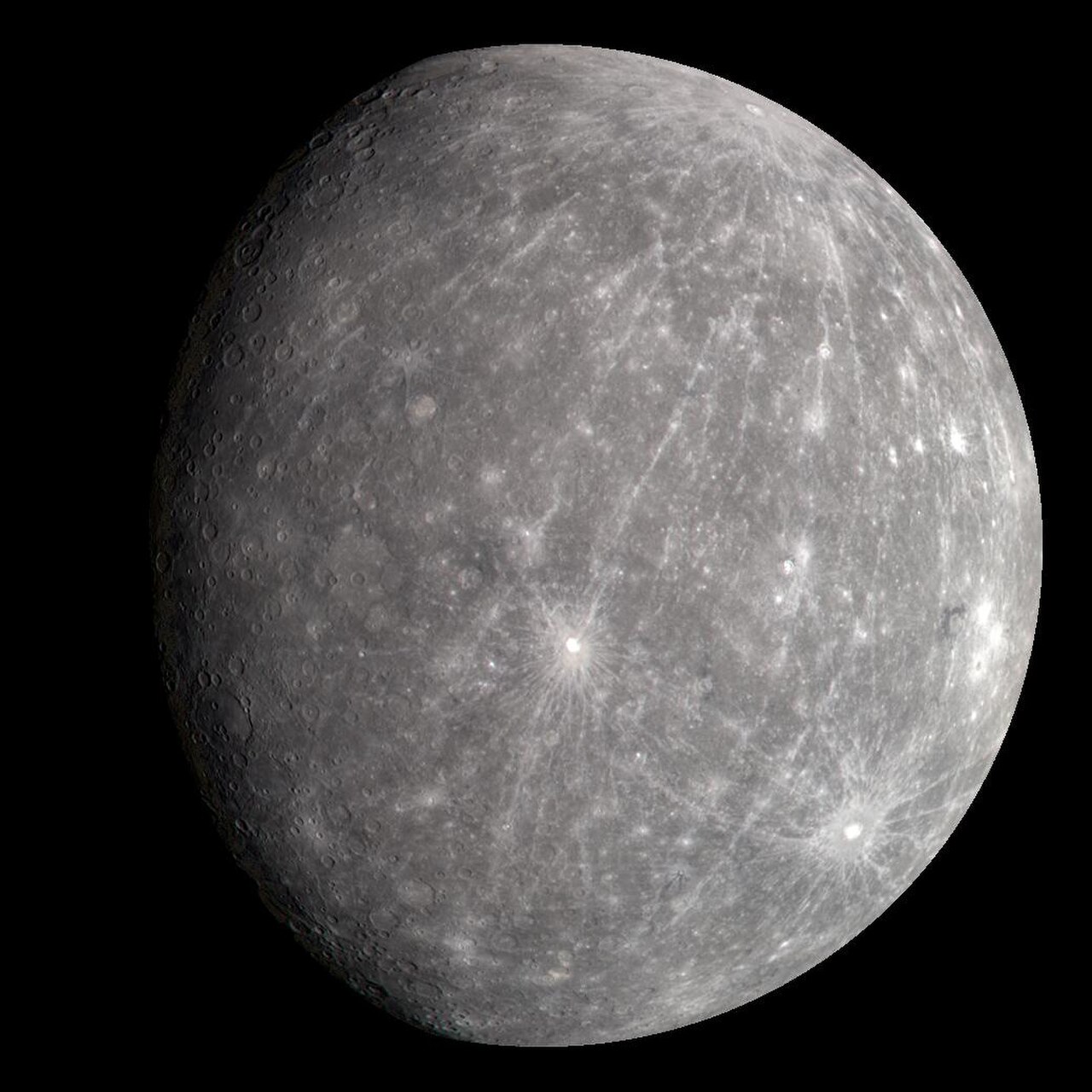
Mercury is the closest planet to the Sun, a small rocky world that has fascinated astronomers for centuries. At first glance, it might seem like a simple planet. It has no thick atmosphere, no moons, and no rings. But hidden beneath its seemingly quiet appearance is one of the strangest timekeeping systems in the Solar System.
If someone asked you how long a day on Mercury is, you might expect a simple answer. On Earth, a day lasts 24 hours. On Mars, it’s about 24.6 hours. But on Mercury, the answer depends on what you mean by the word “day.”
Do you mean the time it takes the planet to spin once on its axis? Or do you mean the time from one sunrise to the next? Surprisingly, these are two very different lengths on Mercury.
Understanding why reveals an incredible story about gravity, motion, and one of the most unusual planetary rotations in our Solar System.
What Is a Day?
Before exploring Mercury, it’s important to understand what astronomers mean by a “day.”
There are actually two different ways to measure a day.
A sidereal day is the time it takes a planet to complete one full rotation relative to distant stars.
A solar day is the time between one sunrise and the next, or the time it takes for the Sun to return to the same position in the sky.
On Earth, these two measurements are almost the same. A sidereal day lasts about 23 hours and 56 minutes, while a solar day is exactly 24 hours. Because the difference is so small, most people never notice it.
On Mercury, however, these two kinds of days are dramatically different.
Mercury’s Rotation Is Surprisingly Slow
Mercury rotates very slowly compared to Earth.
One complete rotation on its axis takes about 58.6 Earth days.
That means if you were standing on Mercury and somehow survived its extreme environment, it would take nearly two months for the planet to turn around once relative to the distant stars.
This is Mercury’s sidereal day.
Although that sounds incredibly long, it is only part of the story.
A Solar Day on Mercury Lasts 176 Earth Days
The answer most people are looking for is Mercury’s solar day—the time from one sunrise to the next.
A solar day on Mercury lasts about 176 Earth days.
That means one full cycle of daylight, sunset, nighttime, and sunrise takes almost six Earth months.
Imagine watching the Sun slowly climb into the sky, travel overhead, set, and then waiting nearly half a year before seeing the next sunrise.
On Mercury, that is completely normal.
Why Is Mercury’s Day So Long?
The reason lies in Mercury’s unique combination of rotation and orbit.
Mercury circles the Sun faster than any other planet.
It completes one orbit in only 88 Earth days.
At the same time, it rotates very slowly.
Because Mercury moves around the Sun so quickly while rotating slowly, the Sun appears to move across its sky much more slowly than you might expect.
As Mercury spins, it is also racing around the Sun. These two motions work together to stretch the length of the solar day.
The result is remarkable.
By the time Mercury completes two full rotations, it has traveled around the Sun exactly three times.
This creates a solar day that lasts 176 Earth days.
The Amazing 3:2 Spin-Orbit Resonance
Mercury is locked into a rare phenomenon called a 3:2 spin-orbit resonance.
This means Mercury rotates three times for every two trips it makes around the Sun.
No other major planet in the Solar System behaves this way.
Scientists believe this unusual rotation developed billions of years ago because of the Sun’s powerful gravitational pull.
Over millions of years, gravity gradually slowed Mercury’s rotation until it settled into this stable pattern.
Today, the planet continues rotating in this precise rhythm.
Sunrise on Mercury Is Unlike Anywhere Else
If you could stand safely on Mercury’s surface, you would witness one of the strangest sunrises imaginable.
Because Mercury follows a highly elliptical orbit, its speed changes as it travels around the Sun.
Near the closest point in its orbit, called perihelion, Mercury moves especially fast.
At certain locations on the planet, this causes something extraordinary.
The Sun appears to rise above the horizon, slow down, stop, move backward for a while, and then reverse direction again before continuing across the sky.
In other words, the Sun can appear to rise twice.
This bizarre effect happens because Mercury’s orbital speed temporarily competes with its slow rotation.
No other planet in the Solar System experiences this exact phenomenon.
Daytime on Mercury Is Extremely Hot
Mercury has almost no atmosphere to spread heat around the planet.
As a result, temperatures change dramatically between day and night.
During the long daytime, the surface can reach about 430°C (800°F).
That is hot enough to melt metals such as lead and damage most spacecraft materials.
Because the Sun shines on the same location for such a long time, the ground absorbs enormous amounts of solar energy.
Without an atmosphere to provide shade or circulate air, the heat becomes intense.
Nighttime Is Incredibly Cold
After the Sun finally sets, the opposite happens.
Mercury quickly loses heat into space.
Nighttime temperatures can fall to around –180°C (–290°F).
That is colder than many places on Mars and cold enough to freeze gases that remain liquid on Earth.
This enormous temperature swing is one of the largest experienced by any planet in the Solar System.
It happens because Mercury lacks the thick atmosphere that helps Earth retain warmth after sunset.
Does Mercury Have Seasons?
Mercury does not experience seasons like Earth.
Earth has seasons because its rotational axis is tilted by about 23.5 degrees.
Mercury’s axis, however, is tilted by only about 0.03 degrees, making it almost perfectly upright.
As a result, sunlight reaches the planet in nearly the same way throughout its year.
Instead of seasons, Mercury mainly experiences extremely long periods of daylight and darkness.
What Would Life Be Like on Mercury?
Living on Mercury would be unlike anything humans have ever experienced.
A single sunrise-to-sunrise cycle would last 176 Earth days.
You would spend months under continuous sunlight followed by months of darkness.
The daytime heat would be intense enough to destroy ordinary equipment, while the nighttime cold would be equally dangerous.
Without a substantial atmosphere, there would also be no breathable air, almost no protection from harmful solar radiation, and no weather as we know it.
The sky would appear black even during the day because there is virtually no atmosphere to scatter sunlight.
The Sun itself would look more than three times wider in the sky than it does from Earth, creating a breathtaking but hostile landscape.
How Scientists Measured Mercury’s Day
For centuries, astronomers struggled to determine how fast Mercury rotated.
Because the planet stays close to the Sun in our sky, it is difficult to observe from Earth.
Early estimates were incorrect.
The mystery was finally solved in the 1960s using powerful radar observations.
Scientists bounced radio waves off Mercury and carefully measured how the reflected signals changed as the planet rotated.
These observations revealed Mercury’s true rotation period and confirmed its unusual 3:2 spin-orbit resonance.
Later spacecraft, including Mariner 10, MESSENGER, and the ongoing BepiColombo mission, greatly expanded our understanding of Mercury’s rotation, geology, magnetic field, and interior.
Mercury’s Long Day Shapes the Planet
The length of Mercury’s day affects nearly everything about the planet.
The extreme heating and cooling gradually break down rocks on the surface.
The long periods of sunlight influence how temperatures change across the landscape.
Even permanently shadowed craters near the poles are affected.
Because sunlight never reaches the deepest parts of some polar craters, water ice has survived there for billions of years despite Mercury’s closeness to the Sun.
This discovery surprised scientists and showed that even the hottest planet during the day can hide frozen water in places where sunlight never shines.
Comparing Mercury’s Day with Earth’s
Earth completes one rotation every 24 hours, giving us a familiar rhythm of day and night.
Mercury rotates much more slowly, taking about 58.6 Earth days to spin once.
More importantly, because of its fast orbit around the Sun, one solar day stretches to 176 Earth days.
In fact, a day on Mercury is twice as long as its year.
Mercury completes an entire trip around the Sun in only 88 Earth days, yet it takes 176 Earth days for the Sun to return to the same place in its sky.
This remarkable fact makes Mercury unique among the planets.
Why Mercury’s Strange Day Matters
Mercury’s unusual day is more than an astronomical curiosity.
It helps scientists understand how gravity shapes planetary motion over billions of years.
Its rotation offers clues about the planet’s interior, its history, and the powerful tidal forces exerted by the Sun.
Studying Mercury also helps researchers better understand rocky planets orbiting other stars. Many exoplanets are located very close to their stars, where strong gravitational interactions may create rotation patterns similar to Mercury’s.
In this way, Mercury serves as a natural laboratory for exploring planetary evolution across the universe.
Conclusion
Mercury may be the smallest planet in the Solar System, but it has one of the most extraordinary clocks in the cosmos. While it spins once every 58.6 Earth days, the time from one sunrise to the next lasts an astonishing 176 Earth days. This happens because Mercury rotates slowly while racing around the Sun in a rare 3:2 spin-orbit resonance.
The result is a world where daylight lasts for months, the Sun can appear to reverse direction in the sky, daytime temperatures soar to hundreds of degrees above zero, and nights become bitterly cold. These unusual characteristics make Mercury unlike any other planet we know.
Its strange day reminds us that the universe does not always follow our everyday expectations. Even a planet that appears small and quiet can reveal extraordinary secrets about how the Solar System works, inviting us to look beyond the familiar and appreciate the remarkable diversity of worlds that orbit our Sun.