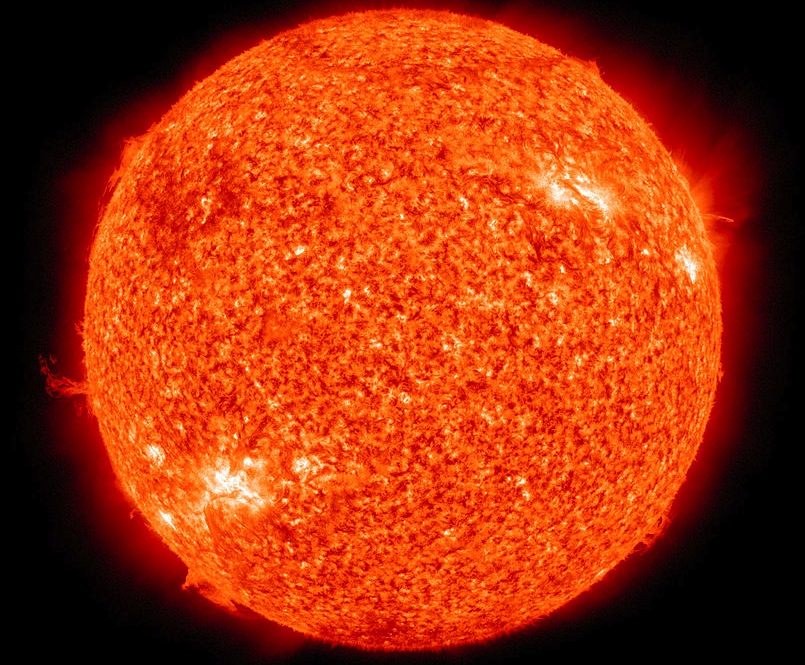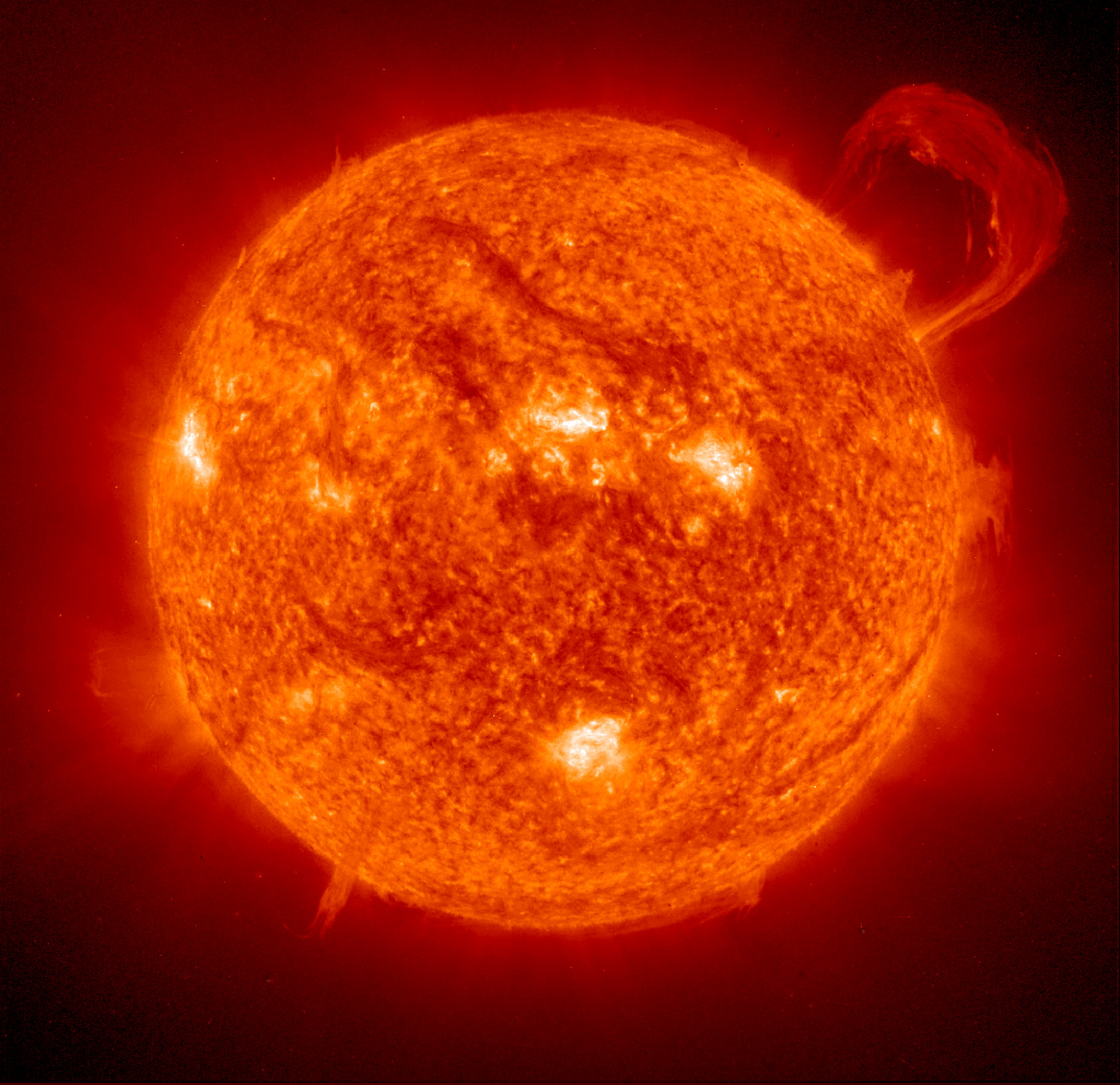
Every morning, the Sun rises above the horizon, filling our world with light and warmth. It feels so familiar that we rarely stop to think about what it truly is. Yet the glowing star that makes life possible on Earth is an enormous sphere of superheated plasma, more than 1.39 million kilometers (864,000 miles) across and containing about 99.8% of all the mass in our Solar System.
Although the Sun appears as a bright, featureless disk from Earth, it is anything but simple. Beneath its brilliant surface lies a fascinating internal structure where unimaginable temperatures, powerful magnetic fields, and constant streams of energy shape everything we see. Scientists divide the Sun into several distinct layers, each with unique properties and each playing a vital role in keeping our star shining.
Understanding these layers helps us answer some of astronomy’s biggest questions. How does the Sun produce its energy? Why do sunspots appear? What causes solar flares? And why is the Sun’s outer atmosphere far hotter than its visible surface? The journey through the Sun’s layers reveals one of the most extraordinary natural systems in the universe.
The Sun Is Not Solid
Before exploring its layers, it is important to understand what the Sun actually is.
Unlike Earth, the Sun has no solid surface. It is made almost entirely of hydrogen and helium in an extremely hot state called plasma. Plasma is often described as the fourth state of matter. In plasma, atoms become so energetic that their electrons separate from their nuclei, creating a mixture of charged particles.
Because the Sun is plasma rather than solid rock, its different layers gradually transition into one another instead of having sharp boundaries. Each layer has its own temperature, density, and physical processes, creating an incredibly dynamic star.
The Core: The Sun’s Powerful Heart
At the very center of the Sun lies its core, the region where all of the Sun’s energy is produced.
The core extends from the center to about 20–25% of the Sun’s radius. This may seem relatively small, but it contains an enormous amount of the Sun’s mass because the material here is compressed under the immense weight of the layers above it.
Conditions inside the core are almost beyond imagination. Temperatures reach approximately 15 million degrees Celsius (27 million degrees Fahrenheit), while pressures are hundreds of billions of times greater than Earth’s atmospheric pressure.
Under these extraordinary conditions, hydrogen nuclei move so rapidly that they overcome their natural electrical repulsion and fuse together through nuclear fusion.
This fusion process converts hydrogen into helium.
A tiny amount of mass disappears during each fusion reaction and is transformed directly into energy according to Albert Einstein’s famous equation:
E = mc²
Every second, the Sun converts roughly 600 million metric tons of hydrogen into helium. Around 4 million metric tons of mass become pure energy every second.
This continuous fusion has powered the Sun for about 4.6 billion years and is expected to continue for roughly another 5 billion years.
How Energy Begins Its Long Journey
The energy created in the core does not immediately escape into space.
Instead, it begins an incredibly slow journey outward.
The energy is initially produced as high-energy gamma-ray photons. However, these photons cannot travel freely because the Sun’s interior is extremely dense.
They are constantly absorbed and re-emitted by particles inside the Sun.
A single photon may travel only a tiny distance before colliding with another particle.
As a result, the energy performs a random, zigzag path.
Scientists estimate that it can take anywhere from tens of thousands to several hundred thousand years for energy created in the core to finally reach the Sun’s visible surface.
By the time it emerges, the original gamma rays have been transformed into lower-energy visible light and other forms of electromagnetic radiation.
The Radiative Zone: A Slow Escape
Surrounding the core is the radiative zone.
This region extends from about 25% of the Sun’s radius to roughly 70% of its radius.
The radiative zone is named because energy moves primarily through radiation.
Here, photons slowly transfer energy outward through countless interactions with charged particles.
Although the temperature gradually decreases as distance from the center increases, it remains astonishingly hot.
Near the inner edge of the radiative zone, temperatures are still several million degrees.
Closer to its outer boundary, temperatures fall to around 2 million degrees Celsius.
Despite these immense temperatures, the plasma remains extremely dense compared with the Sun’s outer layers.
The radiative zone acts like a gigantic energy highway, although it is one of the slowest highways imaginable.
The Tachocline: A Remarkable Transition Region
Between the radiative zone and the convection zone lies a relatively thin transition layer known as the tachocline.
Although only a small part of the Sun, it is considered one of the most important regions in solar physics.
In the radiative zone, the Sun rotates almost like a solid object.
Above it, the convection zone rotates differently depending on latitude. The equator rotates faster than the poles, a phenomenon called differential rotation.
The tachocline marks the boundary where this dramatic change occurs.
Scientists believe that this region plays a major role in generating the Sun’s powerful magnetic field through processes collectively known as the solar dynamo.
The Sun’s magnetic field drives many spectacular events, including sunspots, solar flares, and coronal mass ejections.
The Convection Zone: A Sea of Boiling Plasma
Above the radiative zone lies the convection zone.
This layer extends from about 70% of the Sun’s radius to the visible surface.
Unlike the radiative zone, energy here moves mainly through convection.
The process is similar to boiling water in a pot.
Hot plasma rises toward the surface because it is less dense.
As it reaches the cooler upper layers, it loses heat, becomes denser, and sinks again.
These enormous circulating currents continuously transport energy upward.
The convection cells vary greatly in size.
Some are comparable to entire continents, while others can be larger than Earth itself.
This constant churning creates the grainy appearance of the Sun’s surface, known as granulation.
Each bright granule represents hot plasma rising upward, while darker edges mark cooler plasma sinking back down.
Although individual granules usually last only several minutes, the process never stops.
The Sun is continually boiling on a colossal scale.
The Photosphere: The Sun’s Visible Surface
The photosphere is the layer we normally think of as the Sun’s surface.
In reality, it is simply the level from which most visible light escapes into space.
The photosphere is approximately 500 kilometers (310 miles) thick.
Compared with the Sun’s enormous diameter, this layer is remarkably thin.
Its average temperature is about 5,500 degrees Celsius (9,900 degrees Fahrenheit).
This is the light that eventually reaches Earth after traveling about 150 million kilometers (93 million miles) through space in approximately 8 minutes and 20 seconds.
Although the photosphere appears smooth to the naked eye, high-resolution telescopes reveal an ever-changing landscape of granules, magnetic structures, and dark sunspots.
Sunspots: Dark Windows into Magnetic Activity
One of the most striking features of the photosphere is the appearance of sunspots.
Sunspots look dark only because they are cooler than their surroundings.
While the surrounding photosphere has a temperature near 5,500°C, sunspots are typically around 3,500 to 4,500°C.
Even at these temperatures, they would glow brightly if seen alone.
Sunspots form where powerful magnetic fields suppress convection.
With less hot plasma rising from below, these regions become cooler than the surrounding surface.
Sunspots often occur in groups and can be larger than Earth.
Their numbers increase and decrease in an approximately 11-year solar cycle.
The Chromosphere: A Colorful Hidden Layer
Above the photosphere lies the chromosphere.
Its name comes from the Greek word for “color.”
Normally, the chromosphere is hidden by the intense brightness of the photosphere.
However, during a total solar eclipse, when the Moon completely blocks the photosphere, the chromosphere becomes visible as a thin reddish rim around the Sun.
This red glow comes primarily from excited hydrogen atoms emitting a specific wavelength of light.
The chromosphere extends several thousand kilometers above the photosphere.
Temperatures begin around 4,500°C near its lower boundary but increase dramatically with height, eventually reaching tens of thousands of degrees.
This unexpected temperature rise puzzled scientists for decades.
Spicules: Jets of Solar Plasma
The chromosphere is filled with countless narrow jets called spicules.
These towering structures shoot hot plasma upward at astonishing speeds.
Individual spicules may rise thousands of kilometers above the Sun’s surface before collapsing within only a few minutes.
Millions of spicules exist across the Sun at any given time.
Although each one is relatively short-lived, together they transport enormous amounts of energy and material into the Sun’s upper atmosphere.
Researchers continue studying their exact role in heating the Sun’s outer layers.
The Transition Region
Above the chromosphere lies an extremely thin layer known as the transition region.
Despite being only a few hundred kilometers thick, this region experiences one of the sharpest temperature increases anywhere in the Solar System.
Within a very short distance, temperatures climb from tens of thousands of degrees to more than one million degrees Celsius.
Scientists are still investigating the precise physical processes responsible for this dramatic change.
Magnetic fields are believed to play a central role.
The Corona: The Sun’s Mysterious Outer Atmosphere
The outermost layer of the Sun is called the corona.
This is the Sun’s extended atmosphere, stretching millions of kilometers into space.
During a total solar eclipse, the corona appears as a beautiful white halo surrounding the darkened Sun.
Its delicate streamers and loops create one of nature’s most breathtaking sights.
The corona presents one of astronomy’s greatest mysteries.
Despite being farther from the Sun’s energy-producing core, it is vastly hotter than the visible surface.
While the photosphere has a temperature of about 5,500°C, the corona reaches temperatures of 1 to 3 million degrees Celsius, with some regions becoming even hotter.
This surprising phenomenon is known as the coronal heating problem.
Scientists think that magnetic reconnection and the dissipation of magnetic waves likely provide much of the energy responsible for heating the corona, though research continues.
Solar Wind Begins Here
The corona is also the birthplace of the solar wind.
The solar wind is a continuous stream of charged particles flowing outward from the Sun in every direction.
These particles travel through the Solar System at hundreds of kilometers per second.
When the solar wind reaches Earth, our planet’s magnetic field deflects most of it.
Some particles, however, become trapped near the poles, where they collide with atoms in Earth’s atmosphere.
These collisions create the beautiful auroras, known as the Northern and Southern Lights.
The solar wind also shapes planetary magnetospheres, influences spacecraft, and affects space weather throughout the Solar System.
Solar Flares and Coronal Mass Ejections
The Sun’s outer layers are highly active.
Sometimes magnetic fields become twisted and unstable.
When they suddenly reconnect, enormous amounts of energy are released.
These explosive events produce solar flares.
Solar flares emit intense bursts of electromagnetic radiation across the spectrum, from radio waves to X-rays and gamma rays.
Even larger eruptions, known as coronal mass ejections, hurl billions of tons of plasma into space.
If directed toward Earth, these events can disrupt satellites, radio communications, GPS systems, and electrical power grids while also increasing radiation hazards for astronauts.
How Scientists Study the Sun’s Layers
The Sun’s layers cannot be visited directly, but scientists have developed remarkable methods to study them.
Space telescopes observe the Sun in visible light, ultraviolet light, X-rays, and many other wavelengths, revealing different layers and physical processes.
Solar observatories monitor magnetic fields, plasma motion, and solar activity around the clock.
Scientists also study vibrations traveling through the Sun in a technique known as helioseismology.
Just as earthquakes reveal Earth’s interior, these solar vibrations help researchers map the Sun’s internal structure.
Computer simulations based on physics further improve our understanding of the complex interactions occurring deep inside our star.
How the Layers Work Together
Although scientists describe the Sun in separate layers, these regions are closely connected.
Nuclear fusion in the core generates energy.
That energy slowly travels through the radiative zone.
The convection zone carries it upward through giant currents of plasma.
The photosphere releases visible sunlight into space.
The chromosphere and corona respond to powerful magnetic fields generated deep within the Sun.
Together, these interconnected layers create the stable yet dynamic star that has illuminated our Solar System for billions of years.
Every beam of sunlight warming your skin, every colorful sunset, every growing forest, and every breath of oxygen produced by plants ultimately depends on the remarkable processes occurring within these layers.
Conclusion
The Sun may appear as a simple golden circle in the sky, but beneath its glowing surface lies an incredibly complex world. From the blazing core where nuclear fusion creates immense amounts of energy to the mysterious corona that extends far into space, each layer has its own unique role in sustaining our star.
These layers work together in an intricate balance, transporting energy outward, generating magnetic fields, driving solar storms, and producing the light and heat that make life on Earth possible. Even after centuries of scientific study, the Sun continues to surprise researchers with new discoveries and unsolved mysteries.
By understanding the layers of the Sun, we gain more than knowledge about a single star. We gain insight into the physics that powers countless stars throughout the universe and a deeper appreciation for the extraordinary cosmic engine that has quietly sustained life on our planet for billions of years.