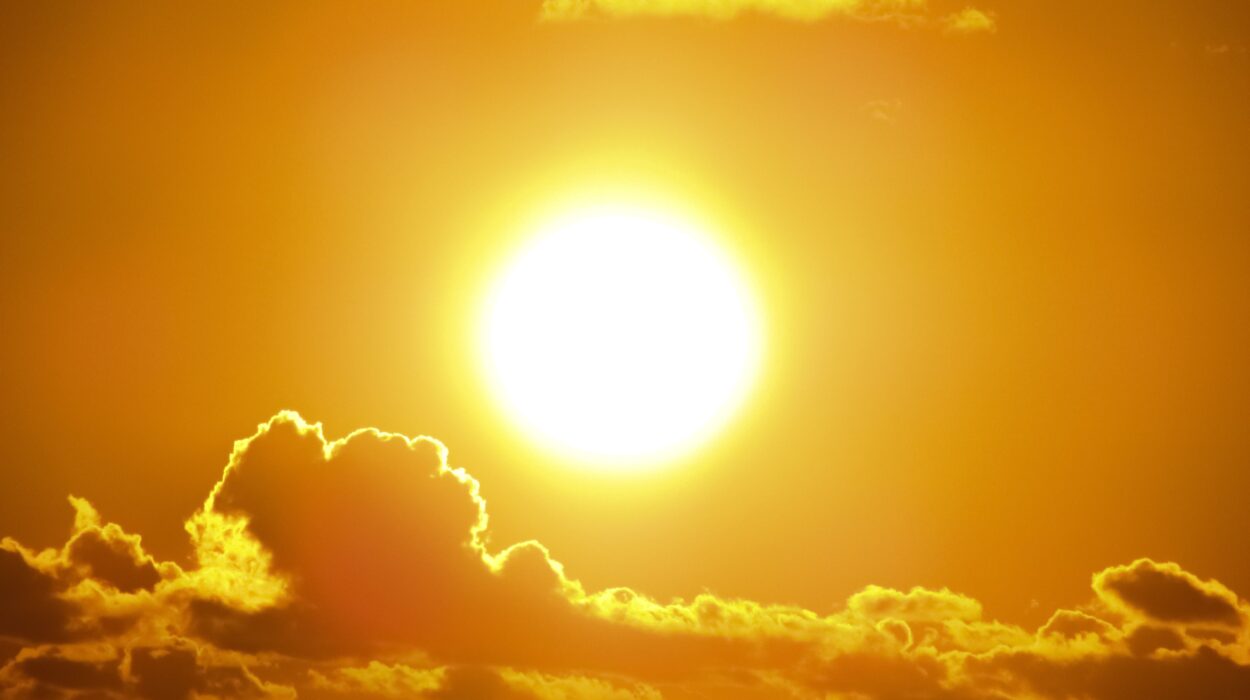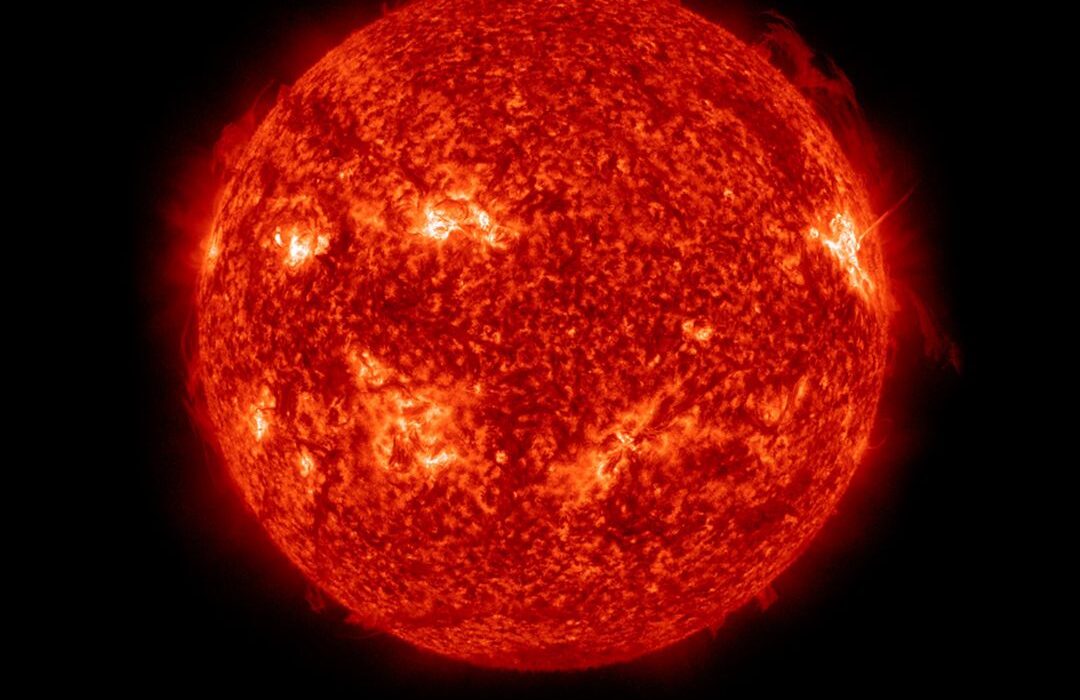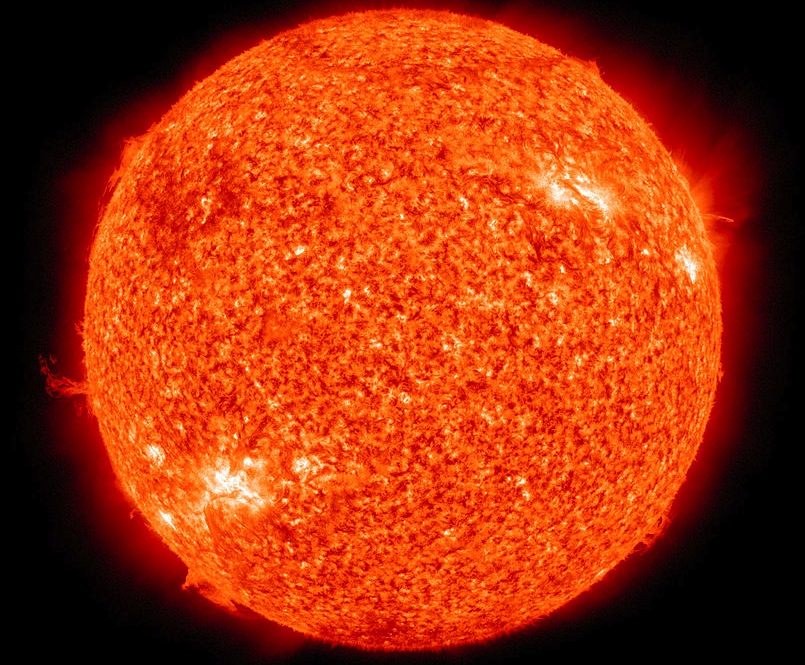
Every morning, the Sun rises above the horizon, bathing Earth in warmth and light. It looks like a bright golden disk, not much larger than the Moon appears in the sky. Because of this familiar sight, it is easy to forget that the Sun is an unimaginably enormous star. In reality, it is so vast that our entire planet is little more than a tiny speck beside it.
The Sun is the heart of our Solar System. Every planet, moon, asteroid, and comet travels under its powerful gravitational influence. It contains nearly all the mass in the Solar System and produces the energy that makes life on Earth possible.
So, just how big is the Sun? The answer is almost beyond imagination. To truly appreciate its size, we need to compare it with Earth, other planets, and even other stars across the universe.
The Sun at a Glance
The Sun is a medium-sized star located about 150 million kilometers (93 million miles) from Earth. Astronomers classify it as a G-type main-sequence star, often called a yellow dwarf, although its light is actually nearly white when viewed from space.
Despite being considered only an average-sized star, the Sun is incredibly large by human standards. It has a diameter of about 1.39 million kilometers (864,000 miles).
That means if you could somehow drive a car around the Sun’s equator at highway speed, the journey would take centuries.
Its radius—the distance from its center to its surface—is about 696,000 kilometers (432,000 miles).
These numbers are so enormous that they are difficult to picture. Comparing the Sun with Earth makes its true scale much easier to understand.
How Big Is the Sun Compared to Earth?
Earth feels enormous to us. Mountains stretch across continents, oceans cover most of the planet, and flying around the world takes many hours.
Yet compared with the Sun, Earth is astonishingly tiny.
The Sun’s diameter is about 109 times wider than Earth’s.
If Earth were the size of a marble, the Sun would be about as large as a giant beach ball.
Imagine placing 109 Earths side by side in a straight line. Together, they would just span the width of the Sun.
The difference becomes even more dramatic when comparing volume.
Because volume increases much faster than diameter, the Sun could hold approximately 1.3 million Earths inside it.
If those Earths could somehow be packed together without empty space, more than a million of them would fit inside the Sun.
Even this comparison is difficult to imagine because the numbers are so immense.
How Much Does the Sun Weigh?
Being huge also means being incredibly massive.
The Sun has a mass of about 1.99 × 10³⁰ kilograms.
Written out, that is:
1,990,000,000,000,000,000,000,000,000,000 kilograms.
This is approximately 333,000 times the mass of Earth.
In fact, the Sun contains about 99.86% of all the mass in the Solar System.
Everything else combined—including all the planets, moons, asteroids, comets, and dust—accounts for only about 0.14%.
Jupiter, the largest planet, is massive by planetary standards, but it is still only about one-thousandth the mass of the Sun.
How Much Space Does the Sun Take Up?
The Sun’s volume is truly staggering.
Its volume is approximately 1.41 × 10¹⁸ cubic kilometers.
To picture this, imagine filling the Sun completely with Earth-sized planets.
About 1.3 million Earths could fit inside.
If the Earth-sized spheres were compressed into every available space rather than packed as solid spheres, even more material could fit.
This enormous volume allows the Sun to contain the tremendous amounts of hydrogen fuel needed to shine for billions of years.
How Far Around Is the Sun?
The Sun’s circumference—the distance around its equator—is approximately 4.37 million kilometers (2.72 million miles).
Even modern aircraft traveling around 900 kilometers per hour would need more than 200 days of nonstop flight to circle the Sun once, assuming such a journey were somehow possible.
Of course, the Sun is not a solid object, making such a trip impossible in reality.
Is the Sun Solid?
Although the Sun appears to have a visible surface, it is not solid like Earth.
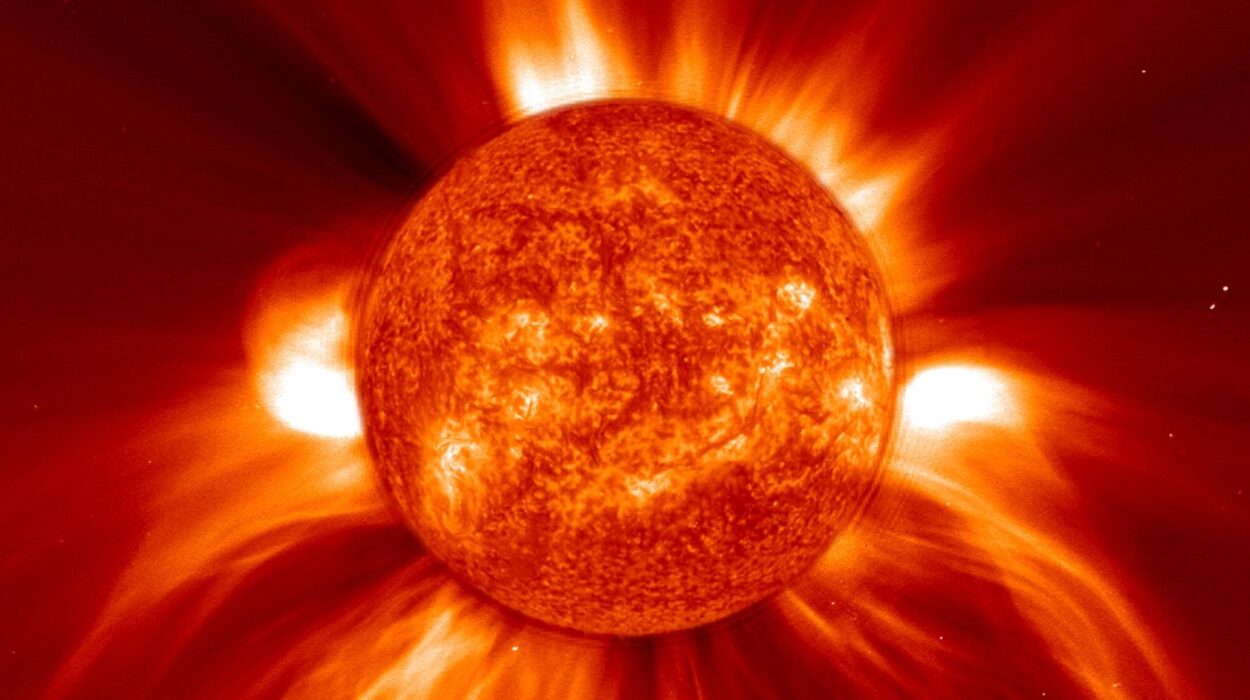
The Sun is an enormous sphere of extremely hot plasma.
Plasma is often called the fourth state of matter. It consists of atoms stripped of many of their electrons, creating a mixture of charged particles.
The visible surface is known as the photosphere.
This layer is only a few hundred kilometers thick and has a temperature of about 5,500 degrees Celsius (9,900 degrees Fahrenheit).
Below the photosphere, temperatures rise dramatically as one moves toward the Sun’s center.
What Is Inside the Sun?
The Sun has several distinct layers.
At its center lies the core, where temperatures reach about 15 million degrees Celsius (27 million degrees Fahrenheit).
This is where nuclear fusion occurs.
Hydrogen atoms collide under enormous pressure and fuse into helium.
During this process, a tiny amount of mass is converted directly into energy according to Einstein’s famous equation:
E = mc²
This energy slowly moves outward through the Sun’s interior before eventually escaping into space as sunlight.
Above the core lies the radiative zone, where energy travels mainly through radiation.
Above that is the convective zone, where hot plasma rises while cooler plasma sinks, creating giant convection currents.
The visible photosphere sits above these layers.
Beyond it lie the chromosphere and the incredibly hot corona, the Sun’s outer atmosphere, which extends millions of kilometers into space.
How Big Is the Sun Compared to the Moon?
The Sun and the Moon appear almost exactly the same size in Earth’s sky.
This surprising coincidence makes total solar eclipses possible.
However, this has nothing to do with their actual sizes.
The Sun is about 400 times wider than the Moon.
It only appears similar in size because it is also roughly 400 times farther away.
This remarkable coincidence is unique in our Solar System and has fascinated astronomers for centuries.
How Big Is the Sun Compared to Jupiter?
Jupiter is the largest planet in the Solar System.
Its diameter is about 143,000 kilometers (89,000 miles).
Even so, the Sun is nearly 10 times wider than Jupiter.
More impressively, the Sun could hold roughly 1,000 Jupiters inside its volume.
If Jupiter seems enormous in pictures from spacecraft, imagine something one thousand times larger.
That is the scale of the Sun.
Is the Sun the Biggest Star?
Surprisingly, no.
Although the Sun is enormous compared with Earth and the other planets, it is only an average-sized star.
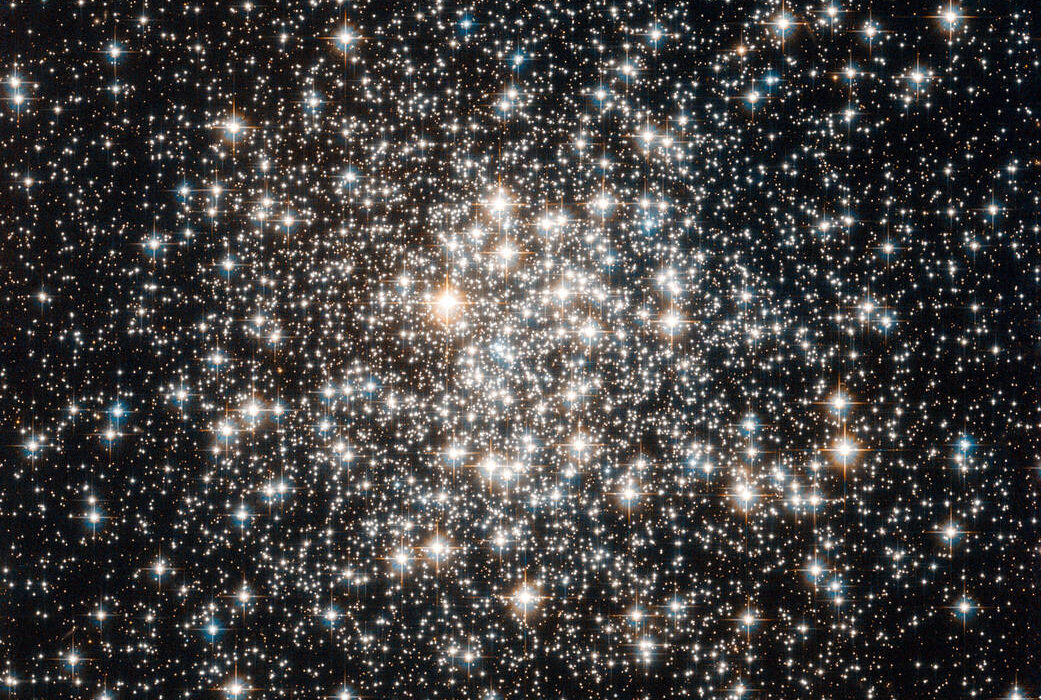
The universe contains stars both much smaller and much larger.
Some red dwarf stars are less than one-fifth the Sun’s diameter.
On the opposite end of the scale are giant and supergiant stars.
For example, Betelgeuse, the famous red supergiant in the constellation Orion, is hundreds of times wider than the Sun.
Even larger is UY Scuti, one of the largest known stars.
If UY Scuti replaced the Sun, its outer layers would extend far beyond the orbit of Jupiter and possibly approach the orbit of Saturn, depending on its exact size.
Compared with these cosmic giants, the Sun appears surprisingly modest.
How Big Is the Sun Compared to Other Types of Stars?
Stars come in many sizes because they form with different masses and evolve differently over time.
Small red dwarfs burn fuel slowly and can survive for trillions of years.
Stars like the Sun live for around 10 billion years.
Massive stars burn their fuel much more rapidly.
Some giant stars can be hundreds or even more than a thousand times wider than the Sun.
Despite these differences, every star shines because of nuclear fusion occurring deep within its core.
The Sun belongs comfortably in the middle of the stellar size range.
Why Doesn’t the Sun Collapse?
Considering its enormous mass, one might wonder why the Sun does not collapse under its own gravity.
The answer lies in a delicate balance.
Gravity constantly pulls the Sun inward.
At the same time, nuclear fusion in the core produces immense pressure pushing outward.
These opposing forces remain nearly balanced.
This state is known as hydrostatic equilibrium.
As long as hydrogen fusion continues, the Sun maintains nearly the same size.
Will the Sun Stay This Size Forever?
No.
Like every star, the Sun is evolving.
It is about 4.6 billion years old and is roughly halfway through its main life.
As hydrogen in its core gradually becomes depleted, the Sun will slowly grow brighter over billions of years.
Eventually, around 5 billion years from now, it will expand into a red giant.
During this phase, the Sun will become dramatically larger than it is today.
Its outer layers are expected to extend close to Earth’s current orbit.
Whether Earth survives this expansion remains uncertain, but its surface would certainly become completely uninhabitable long before then.
After shedding its outer layers, the Sun will leave behind a dense white dwarf approximately the size of Earth.
Although much smaller, that white dwarf will still contain about half the Sun’s present mass.
How Do Scientists Measure the Sun?
Astronomers measure the Sun using several independent techniques.
Powerful telescopes observe its apparent size from Earth and from space.
Radar measurements and spacecraft tracking help determine the distance between Earth and the Sun with remarkable precision.
Knowing both the distance and the apparent angular size allows scientists to calculate the Sun’s actual diameter using geometry.
Modern observations from solar observatories continuously improve these measurements.
The uncertainty in the Sun’s size is now only a few kilometers—an extraordinary achievement considering the Sun is nearly 150 million kilometers away.
Why Does the Sun Look Small in the Sky?
The Sun appears small simply because it is so far away.
Although it is nearly 1.4 million kilometers across, the enormous distance between Earth and the Sun reduces its apparent size.
If the Sun were much closer, it would dominate the sky.
Fortunately, Earth’s current distance places it within the habitable zone, where temperatures allow liquid water to exist on the planet’s surface.
This distance has been one of the key factors enabling life to develop and thrive.
Can Humans Truly Imagine the Sun’s Size?
The human brain evolved to understand everyday objects, not stars.
Numbers like one million kilometers or one million Earths are difficult to visualize.
That is why comparisons help.
Imagine Earth as a grape.
The Sun would be about the size of a large exercise ball.
Imagine Earth as a coin.
The Sun would be about the size of a large room.
No matter which comparison we choose, the Sun remains overwhelmingly larger than anything we experience in daily life.
Yet across the Milky Way, there are billions of stars, many even larger.
And beyond our galaxy lie hundreds of billions of other galaxies.
The Sun, enormous as it seems to us, is only one ordinary star in an unimaginably vast universe.
The Sun’s Size Makes Life Possible
The Sun’s immense size is not merely an interesting fact—it is the reason life exists on Earth.
Its enormous mass creates the pressure needed for nuclear fusion.
Fusion releases the energy that warms our planet, powers Earth’s climate, drives photosynthesis, and ultimately supports nearly every ecosystem.
If the Sun were much smaller, it would produce far less energy.
If it were much larger, it would burn its fuel much faster and have a much shorter lifespan.
Instead, the Sun’s size is just right to provide a stable source of light and heat for billions of years, giving life enough time to emerge, evolve, and flourish.
Conclusion
The Sun is far larger than our everyday experience can easily comprehend. With a diameter of about 1.39 million kilometers, a mass 333,000 times greater than Earth’s, and enough volume to hold approximately 1.3 million Earths, it is the overwhelmingly dominant object in our Solar System. It contains 99.86% of the Solar System’s total mass, shaping the motions of every planet and fueling life with the energy produced deep within its core.
Yet in the grand scale of the universe, the Sun is not an extraordinary giant but an average star among hundreds of billions in the Milky Way alone. Its immense size reminds us both of nature’s incredible power and of our place in a cosmos filled with wonders far beyond our imagination.