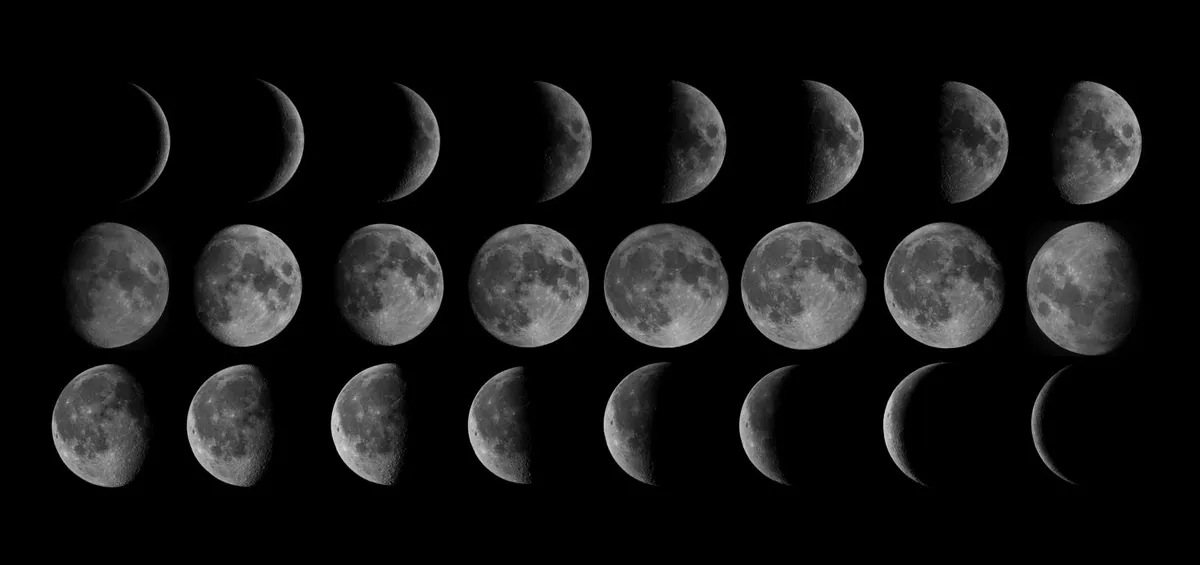
On some nights, the Moon appears as a thin silver crescent hanging low in the sky. A week later, it grows into a bright half Moon. Soon it becomes a magnificent full Moon, lighting up the night with its pale glow. Then, almost as quietly as it grew, it begins to shrink again until it disappears from view, only to start the cycle all over.
For thousands of years, people have watched this beautiful transformation with wonder. Ancient civilizations created myths and legends to explain why the Moon seemed to change its shape. Some believed the Moon was being eaten by mythical creatures, while others imagined it was a magical object that grew and faded with time.
Today, science has revealed the true reason behind this familiar yet fascinating sight. Surprisingly, the Moon is not actually changing its shape at all. Instead, what changes is the amount of its sunlit surface that we can see from Earth.
Understanding why the Moon appears to change shape takes us on an incredible journey through space, where sunlight, gravity, and orbital motion work together to create one of nature’s most beautiful monthly spectacles.
Does the Moon Really Change Shape?
The first thing to know is that the Moon itself does not physically change shape.
The Moon is a nearly spherical world about 3,474 kilometers (2,159 miles) in diameter. Whether it appears full, half, or crescent from Earth, its actual shape remains almost exactly the same.
Imagine holding a white ball under a lamp in a dark room. The lamp lights up one half of the ball all the time. As you walk around the ball, you see different portions of the illuminated side. Sometimes you see almost all of it. Sometimes only half. Sometimes just a thin sliver.
The Moon behaves in exactly the same way.
The Sun always illuminates one half of the Moon. As the Moon moves around Earth, our viewing angle changes, making different amounts of the illuminated half visible. This changing view creates the familiar phases of the Moon.
The Moon Does Not Produce Its Own Light
Many people assume the Moon shines by itself, but it does not.
The Moon is a giant rocky object with no internal light source. It glows because it reflects sunlight.
Its surface is covered with fine dust and rocky material that bounce a portion of the Sun’s light back into space. Although the Moon looks brilliantly bright against the dark night sky, it actually reflects only about 12 percent of the sunlight that reaches it. In other words, the Moon is much darker than many people imagine—its reflectivity is surprisingly similar to worn asphalt.
Yet because it is so close to Earth and illuminated by the incredibly powerful Sun, it appears bright enough to dominate the night.
Without the Sun, the Moon would be almost completely invisible.
The Moon Orbits Earth
The key to understanding the Moon’s changing appearance is its orbit around Earth.
The Moon travels around our planet once every 27.3 days relative to the distant stars. However, because Earth is also moving around the Sun, it takes about 29.5 days for the Moon to complete one full cycle of phases, known as a synodic month or lunar month.
As the Moon moves along its orbit, the angle between the Sun, Earth, and Moon constantly changes.
This changing geometry determines how much of the Moon’s illuminated side is visible from Earth.
Every phase is simply the result of viewing the same illuminated Moon from a different angle.
The Journey Begins with the New Moon
The lunar cycle starts with the New Moon.
During this phase, the Moon lies roughly between Earth and the Sun. The side facing the Sun is brightly illuminated, while the side facing Earth is mostly dark.
Because the illuminated side points away from us, the Moon becomes extremely difficult to see.
The New Moon is not invisible because it has disappeared—it is simply positioned so that the sunlit half faces away from Earth.
This marks the beginning of a new lunar cycle.
The Crescent Moon Appears
As the Moon continues its journey around Earth, it moves away from the Sun’s direction in the sky.
Now, a small portion of the illuminated side becomes visible.
This creates the beautiful crescent Moon.
The thin glowing arc often appears shortly after sunset or just before sunrise, depending on whether it is waxing or waning.
Many people find the crescent Moon especially beautiful because the sharp curve contrasts dramatically with the dark sky.
Sometimes, the darker portion of the Moon can faintly be seen as well. This phenomenon is called Earthshine.
Earthshine occurs because sunlight reflects off Earth and softly illuminates the Moon’s night side, giving it a ghostly appearance.
The First Quarter Moon
About one week after the New Moon, the Moon reaches the First Quarter.
Despite its name, only half of the Moon appears illuminated.
The term “quarter” refers not to the visible portion but to the Moon’s position in its orbit—it has completed about one-quarter of its journey around Earth.
At this stage, the line dividing day and night on the Moon, known as the terminator, runs straight down the middle of the visible disk.
The rugged mountains and craters near the terminator cast long shadows, making them particularly striking through binoculars or telescopes.
The Waxing Gibbous Moon
As the Moon continues moving around Earth, more than half of its sunlit side becomes visible.
This phase is called the Waxing Gibbous Moon.
The word “waxing” means growing, while “gibbous” refers to a shape that is more than half illuminated but not yet full.
Night after night, the Moon appears larger and brighter.
This gradual increase builds anticipation for the arrival of the Full Moon.
The Full Moon
The Full Moon is perhaps the most celebrated phase of the lunar cycle.
At this point, Earth lies approximately between the Sun and the Moon.
The entire side of the Moon facing Earth is illuminated by sunlight.
As a result, the Moon appears as a brilliant, nearly perfect circle.
Contrary to popular belief, the Full Moon lasts only a brief moment when the Sun, Earth, and Moon reach their precise alignment. To our eyes, however, it appears full for a day or two.
A Full Moon rises around sunset, remains visible throughout the night, and sets near sunrise.
Its bright light has inspired poetry, folklore, religious traditions, calendars, festivals, and scientific exploration throughout human history.
The Moon Begins to Shrink
After the Full Moon, the illuminated portion begins to decrease.
The Moon has not actually started shrinking.
Instead, as it continues along its orbit, we begin seeing less of its sunlit half.
This stage is known as the Waning Gibbous Moon.
The word “waning” simply means becoming smaller in appearance.
Each night, the Moon rises later and later while gradually losing its bright circular form.
The Last Quarter Moon
About three weeks into the lunar cycle, the Moon reaches the Last Quarter.
Once again, half of the Moon appears illuminated.
Like the First Quarter, this name refers to the Moon’s position in its orbit rather than the visible illuminated area.
Now the opposite half of the Moon is lit compared to the First Quarter.
The Last Quarter Moon often rises around midnight and remains visible during the morning hours.
The Waning Crescent
As the cycle nears its end, only a thin crescent remains visible.
This Waning Crescent often appears before sunrise.
Eventually, the illuminated portion becomes so small that it disappears from view as the Moon returns to the New Moon position.
The entire cycle then begins again.
This endless rhythm has continued for billions of years and will continue long into the future.
Why We Always See the Same Side of the Moon
Many people notice that the Moon always seems to have the same familiar patterns.
This is because the Moon is tidally locked to Earth.
The Moon rotates once on its axis in almost exactly the same amount of time it takes to orbit Earth.
As a result, the same hemisphere always faces our planet.
This does not mean the Moon never rotates.
In fact, it rotates continuously.
If it did not rotate at all, we would eventually see every side of it during its orbit.
Instead, its rotation perfectly matches its orbital motion, keeping one face turned toward Earth.
Because of slight variations in its orbit, known as libration, we can actually observe about 59 percent of the Moon’s surface over time rather than exactly half.
Why Doesn’t Earth Block the Sun Every Month?
A common question arises when learning about Moon phases.
If the Moon passes between Earth and the Sun during every New Moon, why don’t we experience a solar eclipse every month?
Likewise, if Earth lies between the Sun and the Moon during every Full Moon, why isn’t there a lunar eclipse every month?
The answer lies in the Moon’s orbit.
The Moon’s orbital plane is tilted by about five degrees relative to Earth’s orbit around the Sun.
Most months, the Moon passes slightly above or below the direct line connecting Earth and the Sun.
Only when the alignment is nearly perfect do eclipses occur.
This slight tilt prevents monthly eclipses while still allowing the regular cycle of lunar phases.
The Moon’s Phases Are the Same Everywhere
No matter where you live on Earth, the Moon is always in the same phase at the same time.
If people in North America see a Full Moon, people in Asia, Africa, Europe, Australia, and South America are also seeing a Full Moon.
However, observers in different hemispheres view the Moon from different orientations.
Someone in the Southern Hemisphere may see the crescent appear upside down compared with how it appears to someone in the Northern Hemisphere.
Although the orientation changes, the phase itself remains identical worldwide.
How the Moon Affects Earth
The Moon does far more than decorate the night sky.
Its gravity creates Earth’s ocean tides by pulling on our planet’s water.
These tides influence marine ecosystems, coastal environments, navigation, and even some aspects of Earth’s rotation.
The Moon also helps stabilize Earth’s axial tilt.
Without the Moon, Earth’s climate could have varied much more dramatically over millions of years, potentially affecting the evolution of life.
Its steady gravitational influence has contributed to the long-term stability of our planet.
The Moon in Human History
Long before clocks and calendars existed, people watched the Moon to measure time.
Many ancient calendars were based on lunar cycles.
Farmers used the Moon to help plan agricultural activities.
Sailors navigated by moonlight.
Religious festivals were timed according to lunar phases.
The Moon also inspired myths, literature, music, paintings, and scientific curiosity across nearly every culture on Earth.
Even today, astronauts, scientists, and engineers continue studying the Moon to better understand both its history and Earth’s own past.
Can You Predict the Moon’s Shape?
One remarkable feature of the Moon’s phases is their predictability.
Because the Moon’s orbit follows well-understood physical laws, astronomers can calculate lunar phases years, decades, or even centuries into the future.
This precision allows calendars, eclipse predictions, space missions, and scientific observations to be planned with extraordinary accuracy.
Every Full Moon, Crescent Moon, and New Moon follows the same reliable rhythm established by gravity and orbital motion.
Watching the Moon Is Watching the Solar System in Motion
Every evening, the Moon offers a quiet reminder that our Solar System is constantly moving.
Its changing appearance is not magic, nor is it the result of the Moon growing or shrinking. Instead, it is a beautiful consequence of sunlight illuminating one half of the Moon while the Moon steadily orbits Earth. As our perspective changes, different portions of that illuminated half come into view, creating the familiar sequence of phases that has fascinated humanity for countless generations.
The next time you look up and notice a delicate crescent or a brilliant Full Moon, remember that you are witnessing an elegant dance between the Sun, Earth, and Moon—a dance choreographed by gravity and motion, repeated every month with remarkable precision. It is one of the simplest yet most captivating demonstrations of the laws of physics, visible to anyone who pauses to look at the night sky.