The James Webb Space Telescope is one of the most advanced scientific instruments ever built. Designed to look deeper into the universe than any previous space telescope, it allows humanity to observe galaxies that formed shortly after the Big Bang, peer through clouds of cosmic dust where new stars are born, analyze the atmospheres of distant exoplanets, and study some of the coldest and faintest objects in the cosmos.
Unlike ordinary telescopes that simply magnify distant objects, the James Webb Space Telescope acts like a giant time machine. Because light takes time to travel through space, looking farther into the universe means looking farther back in time. Every image captured by Webb reveals a chapter from the universe’s long history, helping scientists answer some of the biggest questions in astronomy.
Understanding how the James Webb Space Telescope works reveals not only an extraordinary feat of engineering but also how modern science explores the universe in ways that were once impossible.
What Is the James Webb Space Telescope?
The James Webb Space Telescope, often abbreviated as JWST or simply Webb, is a large infrared space telescope developed through an international collaboration led by NASA with major contributions from the European Space Agency (ESA) and the Canadian Space Agency (CSA).
Launched on December 25, 2021, aboard an Ariane 5 rocket, Webb was built to succeed—not replace—the Hubble Space Telescope. While Hubble continues to observe the universe mainly in visible and ultraviolet light, Webb specializes in infrared light, allowing it to see objects that are too cold, too distant, or hidden behind clouds of dust for Hubble to observe clearly.
Webb represents decades of scientific planning, engineering innovation, and international cooperation, making it one of the most ambitious astronomy missions ever undertaken.
Why the Telescope Observes Infrared Light
The most important feature of the James Webb Space Telescope is its ability to detect infrared light.
Human eyes can only see visible light, which represents a tiny part of the electromagnetic spectrum. Infrared light has longer wavelengths than visible light and is often associated with heat. Many objects in the universe naturally emit infrared radiation, especially cool stars, planets, dust clouds, and distant galaxies.
Infrared light offers several important advantages.
First, it can pass through clouds of dust that block visible light. Star-forming regions are often hidden inside dense clouds of gas and dust. Visible-light telescopes may see only dark patches, but Webb can look through these clouds and observe newborn stars and forming planetary systems.
Second, the expansion of the universe stretches light traveling across billions of years. Light that originally left distant galaxies as visible or ultraviolet light has been stretched into infrared wavelengths by the time it reaches Earth. By observing infrared light, Webb can detect some of the earliest galaxies that formed after the Big Bang.
This makes infrared astronomy essential for studying both the distant past and hidden regions of the universe.
The Giant Golden Mirror
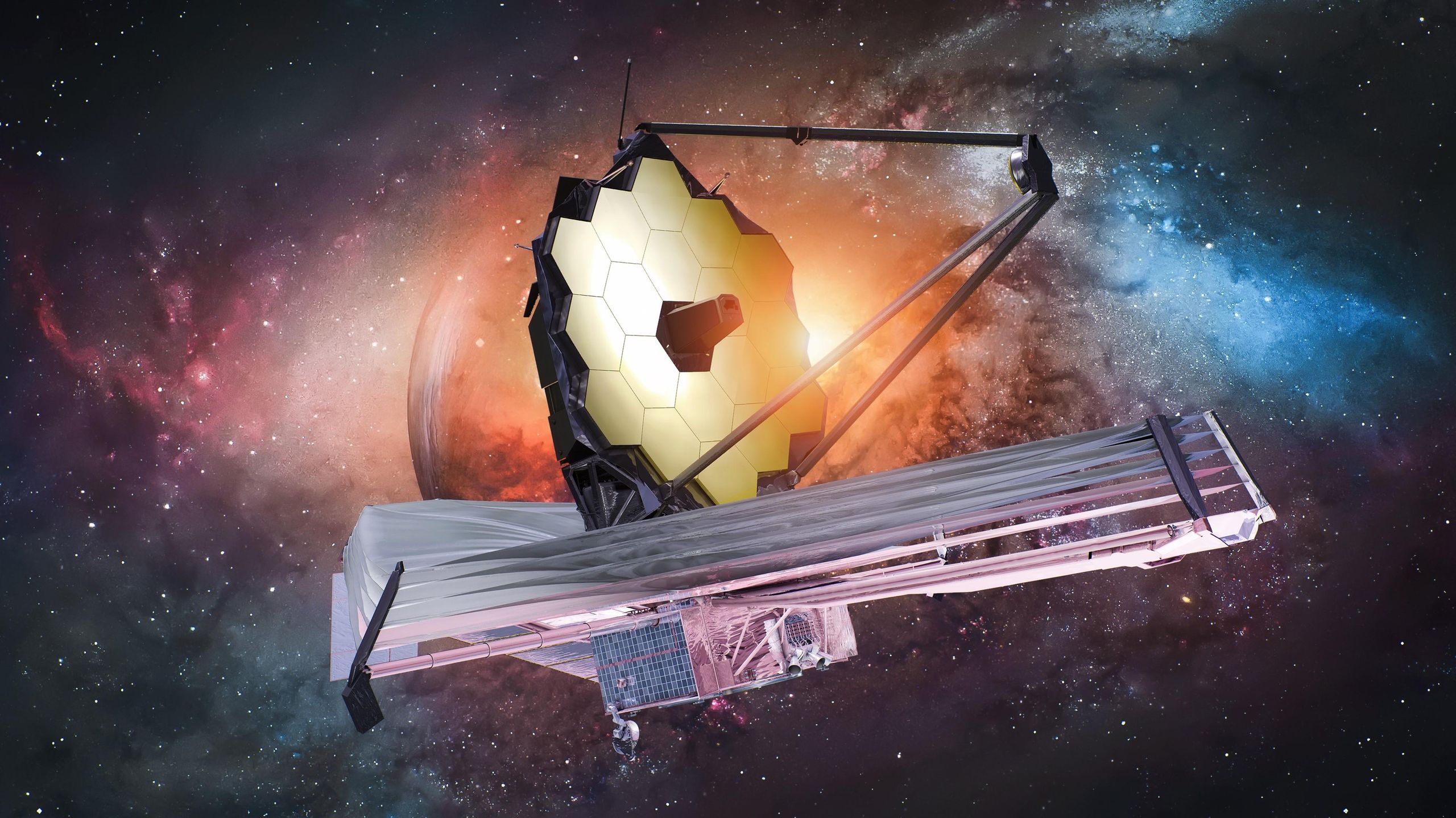
One of Webb’s most recognizable features is its enormous golden primary mirror.
The mirror measures 6.5 meters (21.3 feet) across, making it much larger than the Hubble Space Telescope’s 2.4-meter mirror. The larger the mirror, the more light a telescope can collect.
Collecting more light allows Webb to observe objects that are extremely faint and incredibly distant. Even tiny amounts of light that have traveled across billions of light-years can be gathered and focused into sharp images.
The primary mirror is made of 18 hexagonal segments that work together as a single mirror. Each segment is carefully aligned using tiny motors capable of adjusting their positions with astonishing precision. These adjustments ensure that all eighteen segments focus light perfectly onto the telescope’s scientific instruments.
The mirror is coated with an extremely thin layer of gold. Gold reflects infrared light exceptionally well, making it an ideal material for an infrared telescope. Although the mirror appears solid gold in photographs, the coating is only a microscopic layer and contributes very little to the telescope’s overall weight.
Why the Mirror Is Segmented
Building a single mirror 6.5 meters wide would have made the telescope far too large to fit inside a rocket.
Engineers solved this challenge by designing Webb with a folding mirror. Before launch, the mirror was folded into a compact configuration. After reaching space, it unfolded automatically through one of the most complex deployment sequences ever attempted.
Once fully deployed, the mirror segments had to be aligned with extraordinary accuracy. Even tiny errors measured in fractions of the width of a human hair could reduce image quality.
Using sophisticated wavefront sensing techniques, engineers adjusted every mirror segment until they functioned together as one enormous, perfectly shaped mirror.
This remarkable achievement transformed eighteen separate mirrors into one of the most precise optical systems ever created.
The Five-Layer Sunshield
Perhaps the telescope’s most unusual feature is its enormous sunshield.
The sunshield looks almost like five giant silver kites stacked together. Each layer is made from a special material called Kapton, coated with aluminum and silicon to reflect sunlight and release heat.
The sunshield serves a critical purpose: keeping the telescope extremely cold.
Infrared instruments detect heat. If Webb itself became warm, its own heat would overwhelm the faint infrared signals arriving from distant objects.
The side facing the Sun can become hotter than 100°C (212°F), while the telescope on the shaded side remains colder than about -223°C (-369°F). This dramatic temperature difference allows Webb to observe faint infrared light with remarkable sensitivity.
Without the sunshield, the telescope simply could not perform its scientific mission.
Why the Telescope Must Stay Cold
Everything with a temperature above absolute zero emits infrared radiation.
People emit infrared radiation.
Earth emits infrared radiation.
The telescope itself emits infrared radiation if it becomes warm.
Since Webb is designed to detect extremely weak infrared signals from the distant universe, it must remain colder than most objects around it.
Its passive cooling system, provided mainly by the massive sunshield, keeps most instruments cold enough for observations. One instrument, the Mid-Infrared Instrument (MIRI), requires even lower temperatures and uses an additional cryocooler that lowers its temperature to around 7 kelvin, just a few degrees above absolute zero.
These ultra-cold conditions make Webb one of the most sensitive infrared observatories ever built.
Where the James Webb Space Telescope Is Located
Unlike Hubble, which orbits Earth, Webb operates much farther away.
It is positioned near the Sun-Earth second Lagrange point, commonly called L2.
This location lies approximately 1.5 million kilometers (about 930,000 miles) from Earth.
At L2, the Sun, Earth, and Moon remain on the same side of the telescope. This arrangement allows the sunshield to block light and heat from all three objects simultaneously.
The stable thermal environment helps Webb maintain the low temperatures needed for infrared observations while providing an uninterrupted view of deep space.
Although Webb orbits the Sun, it stays near Earth by following a carefully controlled orbit around the L2 region.
How Light Travels Through the Telescope
The journey of light inside Webb begins when distant infrared light strikes the large primary mirror.
The primary mirror reflects this light toward a smaller secondary mirror suspended above it.
The secondary mirror redirects the light through an opening in the center of the primary mirror.
From there, the light enters the telescope’s scientific instruments, where it is analyzed in different ways depending on the observation.
Some instruments produce detailed images.
Others separate light into its individual wavelengths, creating spectra that reveal the chemical composition, temperature, motion, and physical properties of distant objects.
Every observation begins with this carefully controlled path of light through the telescope’s optical system.
The Scientific Instruments
The James Webb Space Telescope carries four highly sophisticated scientific instruments, each designed for specific types of observations.
Near-Infrared Camera, or NIRCam, serves as Webb’s primary imaging instrument. It captures extraordinarily detailed infrared images and also helps align the telescope’s mirror segments.
Near-Infrared Spectrograph, or NIRSpec, analyzes the light from stars, galaxies, and exoplanets. It can study the spectra of hundreds of objects simultaneously, greatly increasing Webb’s scientific efficiency.
Mid-Infrared Instrument, known as MIRI, observes longer infrared wavelengths. It reveals colder objects such as dusty galaxies, forming stars, and distant planetary systems while also providing both imaging and spectroscopy.
Fine Guidance Sensor and Near-Infrared Imager and Slitless Spectrograph, developed with contributions from the Canadian Space Agency, keeps the telescope pointed with extraordinary precision while also conducting specialized scientific observations.
Together, these instruments allow Webb to investigate an enormous range of astronomical phenomena.
How Webb Produces Images
Unlike ordinary cameras, Webb collects light over extended periods.
Some observations require exposures lasting several minutes, while others continue for many hours.
The telescope’s detectors record incoming infrared photons as electronic signals.
These signals are transmitted to Earth through NASA’s Deep Space Network.
Scientists process the raw data by correcting detector effects, removing background noise, and combining multiple exposures into highly detailed scientific images.
The colors seen in Webb’s published photographs are carefully assigned to represent different infrared wavelengths. Since human eyes cannot see infrared light directly, scientists translate invisible wavelengths into visible colors that highlight structures, temperatures, and chemical compositions.
These stunning images are scientifically meaningful while also making the invisible universe accessible to everyone.
How Webb Studies Exoplanets
One of Webb’s most exciting capabilities is studying planets orbiting distant stars.
When an exoplanet passes in front of its star, a tiny fraction of the starlight passes through the planet’s atmosphere before reaching the telescope.
Different gases absorb different wavelengths of light.
By carefully analyzing these subtle absorption patterns, Webb can identify molecules present in the atmosphere.
Scientists have already detected substances such as water vapor, carbon dioxide, methane, sulfur dioxide, and other molecules in the atmospheres of several exoplanets.
These observations help researchers understand planetary climates, atmospheric chemistry, and the diversity of worlds beyond our Solar System.
Looking Back in Time
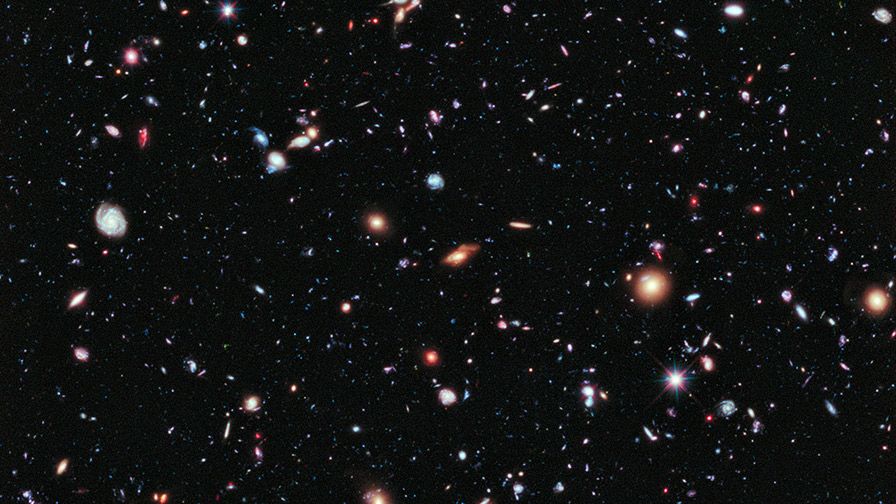
One of Webb’s greatest strengths is its ability to observe extremely distant galaxies.
Because light travels at a finite speed, observing galaxies billions of light-years away means seeing them as they existed billions of years ago.
Some of Webb’s observations capture light that began its journey more than 13 billion years ago.
This allows astronomers to investigate how the earliest stars formed, how galaxies assembled, and how the young universe evolved after the Big Bang.
In this sense, Webb is not merely observing distant objects—it is observing ancient history preserved in light.
Seeing Through Cosmic Dust
Many fascinating regions of the universe remain hidden behind dense clouds of gas and dust.
Visible light is scattered or absorbed by these clouds, preventing ordinary telescopes from seeing inside them.
Infrared light passes through much of this dust.
As a result, Webb can reveal newborn stars, growing planetary systems, and structures hidden deep within giant molecular clouds.
These observations provide valuable insights into how stars and planets form throughout the universe.
Extraordinary Precision
Operating the James Webb Space Telescope requires astonishing precision.
The telescope must point at distant objects with incredible accuracy despite being over one million kilometers from Earth.
Its fine guidance system locks onto guide stars and maintains stable pointing throughout long observations.
The mirror segments remain aligned to within tiny fractions of a wavelength of light.
Its detectors measure incredibly faint signals arriving after journeys lasting billions of years.
Every part of the observatory works together with remarkable coordination, allowing Webb to achieve image quality beyond what was once thought possible.
Communicating with Earth
Although Webb operates far from Earth, it remains in constant communication with mission controllers.
Scientific observations are stored onboard before being transmitted through high-frequency radio signals.
NASA’s Deep Space Network receives the data, which are then processed and distributed to scientists around the world.
Engineers also send commands that update observation schedules, adjust telescope orientation, and maintain the spacecraft’s orbit around the L2 region.
This continuous communication keeps the observatory operating smoothly throughout its mission.
Why the James Webb Space Telescope Is So Important
The James Webb Space Telescope is much more than a powerful camera in space. It is a scientific observatory designed to answer some of humanity’s oldest questions.
How did the first galaxies form?
How are stars and planets born?
What are the atmospheres of distant worlds made of?
How have galaxies changed over billions of years?
Could some exoplanets possess conditions suitable for life?
Every observation made by Webb brings scientists closer to answering these profound questions while often revealing entirely new mysteries.
The Future of Discovery
The James Webb Space Telescope was designed to operate for many years, and its scientific journey has only begun. As it continues exploring the cosmos, it is expected to make discoveries that scientists cannot yet predict. History has shown that every major telescope has revealed surprises, and Webb is already continuing that tradition by uncovering galaxies, stars, and planetary systems in greater detail than ever before.
Future observations will deepen our understanding of the early universe, the life cycles of stars, the diversity of exoplanets, the chemistry of distant worlds, and the evolution of cosmic structures across billions of years.
Conclusion
The James Webb Space Telescope works by collecting faint infrared light with its giant gold-coated mirror, keeping its instruments extraordinarily cold using a massive five-layer sunshield, and analyzing that light with highly advanced scientific instruments. Positioned nearly 1.5 million kilometers from Earth near the Sun-Earth L2 point, it observes the universe with unprecedented sensitivity and precision.
By seeing infrared light invisible to human eyes, Webb can peer through cosmic dust, study the atmospheres of distant exoplanets, observe the birth of stars, and detect galaxies whose light has traveled for more than 13 billion years. Every image and every spectrum it returns expands our understanding of the cosmos, making the James Webb Space Telescope one of the greatest scientific achievements in human history and one of our most powerful tools for exploring the universe.