Have you ever looked up on a clear day and wondered why Earth’s sky is such a brilliant blue? Or watched a sunset turn shades of orange, pink, and red before darkness slowly covered the world? Our sky is so familiar that we rarely stop to think about what makes it possible. Yet if you could stand on the surface of Mercury—the smallest and innermost planet in the Solar System—you would immediately notice something astonishing.
There would be no blue sky stretching overhead.
There would be no fluffy clouds drifting across the horizon.
There would be no colorful sunrise or glowing sunset.
Instead, you would find yourself beneath an endless black sky, even in the middle of the brightest daytime. The Sun would blaze with incredible intensity, but the sky around it would remain dark, almost as if you were standing on the Moon.
This strange view raises an intriguing question: Why doesn’t Mercury have a real sky? The answer lies in the planet’s unique environment, its almost complete lack of atmosphere, and the fascinating physics of light.
What Makes a Sky?
To understand why Mercury lacks a true sky, we first need to understand what creates a sky in the first place.
A sky is not simply empty space above our heads. It is the visible effect of sunlight interacting with a planet’s atmosphere.
When sunlight enters Earth’s atmosphere, it collides with countless tiny molecules of nitrogen and oxygen. These molecules scatter the sunlight in every direction.
Blue light has a shorter wavelength than red light, so it scatters much more efficiently. This process, known as Rayleigh scattering, causes blue light to spread across the entire sky, making it appear blue from almost every direction.
Without an atmosphere to scatter sunlight, the sky would not glow at all.
Instead, space would remain black.
This is exactly what happens on Mercury.
Mercury Has Almost No Atmosphere
Mercury is often described as having no atmosphere, but this is a slight simplification.
The planet actually possesses an incredibly thin layer of gas called an exosphere.
Unlike Earth’s atmosphere, Mercury’s exosphere is so sparse that its atoms rarely collide with one another. In fact, the gas is closer to the vacuum of space than to what we normally think of as an atmosphere.
The exosphere contains tiny amounts of oxygen, sodium, hydrogen, helium, potassium, and calcium.
These atoms originate from several sources.
Some are blasted off Mercury’s rocky surface by the solar wind.
Others are released when tiny meteoroids strike the planet.
Some escape from the planet’s interior through geological processes.
Because Mercury’s gravity is relatively weak and the Sun’s heat is extremely intense, these atoms cannot remain around the planet for very long. Many escape into space altogether.
The result is an exosphere that is trillions of times thinner than Earth’s atmosphere.
Why Thin Gas Doesn’t Create a Sky
Even though Mercury has a few atoms floating above its surface, they are far too few to scatter sunlight effectively.
Imagine walking into a dense forest. Sunlight filters through countless leaves, branches, and trunks, creating beautiful patterns of light.
Now imagine standing in a vast desert with only a few scattered trees. Almost nothing interrupts the sunlight.
Mercury’s exosphere is like that nearly empty desert.
There simply are not enough particles to spread sunlight across the sky.
Instead of filling the heavens with blue light, sunlight travels almost completely undisturbed.
As a result, anyone standing on Mercury would look upward and see black space.
A Black Sky During the Day
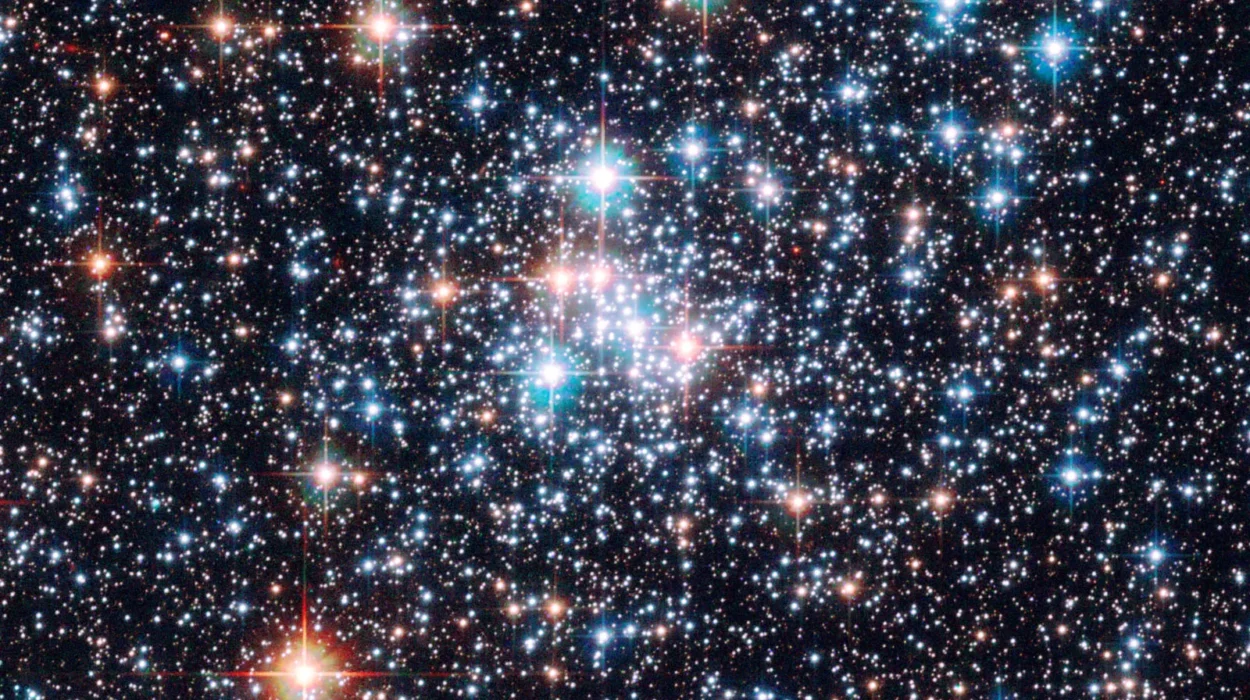
One of the strangest experiences on Mercury would be seeing stars during the daytime.
On Earth, sunlight scattered by our atmosphere makes the daytime sky so bright that stars become invisible.
On Mercury, there is almost no scattered light.
The sky remains black whether the Sun is overhead or below the horizon.
This is similar to the view experienced by astronauts on the Moon.
Although the Sun shines brilliantly, the surrounding sky remains dark because there is essentially no atmosphere to illuminate it.
If your eyes could safely adjust to the brightness, many stars would still be visible while the Sun was above the horizon.
The Sun Looks Enormous
Mercury’s lack of a sky makes the Sun appear even more dramatic.
The planet orbits at an average distance of only about 58 million kilometers (36 million miles) from the Sun.
Earth, by comparison, orbits roughly 150 million kilometers (93 million miles) away.
Because Mercury is much closer, the Sun appears far larger in the sky.
Depending on where Mercury is in its elliptical orbit, the Sun can appear more than three times larger in diameter than it does from Earth.
Since apparent size depends on area as well as diameter, the Sun can look several times brighter than it appears from our planet.
With no atmosphere to soften or diffuse its light, sunlight strikes Mercury’s surface directly.
The result is an intensely bright Sun against an otherwise pitch-black sky.
No Blue Sky, No Red Sunsets
Earth’s spectacular sunsets occur because sunlight travels through a thicker layer of atmosphere when the Sun is near the horizon.
Blue wavelengths scatter away before reaching your eyes, allowing red and orange colors to dominate.
Mercury has no atmosphere thick enough to produce this effect.
As the Sun approaches the horizon, its appearance changes very little.
There are no glowing orange skies.
There are no purple twilight colors.
There is no gradual fading of daylight.
Instead, daylight ends with remarkable abruptness compared with Earth.
The horizon simply grows darker as the Sun disappears.
No Clouds Above Mercury
Clouds require an atmosphere containing gases and usually water vapor.
On Earth, warm moist air rises, cools, and condenses into tiny water droplets or ice crystals.
Mercury has essentially none of these ingredients.
There is almost no atmospheric pressure.
There is virtually no water vapor in the air.
There are no weather systems.
Without a substantial atmosphere, clouds simply cannot form.
The sky remains permanently clear—but completely black.
No Weather at All
Weather is driven by atmospheric motion.
Wind, rain, snow, storms, hurricanes, and fog all depend upon air moving around a planet.
Mercury lacks enough atmosphere for any of these processes.
There are no breezes.
There are no thunderstorms.
There are no clouds casting shadows across the landscape.
Nothing rustles.
Nothing blows.
The planet is astonishingly still.
Its surface changes mainly through meteorite impacts and the extreme expansion and contraction caused by huge temperature differences.
Mercury’s Extreme Temperatures
Because Mercury has almost no atmosphere, it cannot effectively trap or redistribute heat.
During the long daytime, temperatures near the equator can reach approximately 430°C (800°F).
When night falls, heat escapes rapidly into space.
Temperatures can plunge to around −180°C (−290°F).
This enormous temperature difference is one of the greatest in the Solar System.
Earth’s atmosphere acts like a blanket, helping moderate temperatures between day and night.
Mercury has almost no such protection.
The Role of Gravity
One reason Mercury lacks a thick atmosphere is its relatively low gravity.
Although Mercury is dense, it is also small.
Its gravitational pull is only about 38% as strong as Earth’s.
This weaker gravity makes it easier for gas particles to escape into space.
Light gases such as hydrogen and helium escape especially easily.
Over billions of years, Mercury gradually lost much of the atmosphere it may once have possessed.
The Sun Constantly Strips Mercury’s Gases
Mercury’s close proximity to the Sun creates another challenge.
The Sun constantly emits a stream of charged particles called the solar wind.
Earth’s magnetic field and thick atmosphere shield us from much of this solar wind.
Mercury has a magnetic field, but it is much weaker than Earth’s.
As a result, energetic solar particles frequently interact with Mercury’s surface.
These particles knock atoms into space through a process called sputtering.
Some of these atoms briefly become part of Mercury’s exosphere before escaping entirely.
This continuous cycle prevents the planet from building a stable atmosphere.
A Sky That Changes in Unexpected Ways
Although Mercury lacks a traditional sky, its exosphere is not completely invisible.
Sensitive scientific instruments have detected enormous clouds of sodium extending far from the planet.
These sodium atoms glow faintly when illuminated by sunlight.
The sodium tail can stretch millions of kilometers into space, resembling a giant comet tail.
This feature cannot be seen easily with the naked eye from Mercury’s surface, but it demonstrates that the planet’s exosphere is surprisingly dynamic despite being extremely thin.
Sunrises Are Unlike Anywhere Else
Mercury has one of the strangest rotations in the Solar System.
It rotates slowly while orbiting rapidly around the Sun.
One solar day—from one noon to the next—lasts about 176 Earth days.
Even more remarkable, the Sun’s apparent motion across Mercury’s sky is unusual.
Near certain regions of the planet, the Sun appears to rise, stop, move backward briefly, then continue its journey.
This strange behavior occurs because Mercury’s orbital speed changes dramatically during its highly elliptical orbit.
It is one of the most unusual sunrise experiences anywhere in the Solar System.
Standing on Mercury
Imagine standing on Mercury wearing a protective spacesuit.
Above you stretches an endless black sky filled with stars.
The Sun shines with incredible brilliance, appearing much larger than it does from Earth.
There are no clouds.
No blue sky.
No wind.
No birds.
No aircraft.
No weather.
The rocky landscape remains silent beneath the intense sunlight.
The horizon appears sharp because there is no atmosphere to blur distant objects.
Every shadow is dark and crisp.
The scene would feel both breathtaking and strangely lonely.
Comparing Mercury’s Sky with Earth’s
Earth’s atmosphere transforms our experience of the sky.
It scatters sunlight into brilliant shades of blue.
It creates colorful sunsets.
It produces clouds, rainbows, storms, and weather.
It protects life from harmful solar radiation and helps maintain stable temperatures.
Mercury lacks nearly all of these features.
Its exosphere is simply too thin to create the beautiful atmospheric effects we take for granted.
The contrast reminds us how extraordinary Earth’s atmosphere truly is.
What Scientists Have Learned
Spacecraft have dramatically improved our understanding of Mercury.
NASA’s Mariner 10 became the first spacecraft to visit Mercury during the 1970s.
Decades later, NASA’s MESSENGER mission spent more than four years orbiting the planet, mapping its surface and studying its exosphere in remarkable detail.
Today, the joint European Space Agency and Japan Aerospace Exploration Agency mission BepiColombo is on its way to Mercury to investigate the planet even more thoroughly after orbital insertion.
These missions continue revealing how Mercury interacts with the Sun and why its environment is unlike that of any other rocky planet.
Why Mercury Doesn’t Have a Real Sky
Mercury does not have a real sky because it lacks the one essential ingredient required to create one: a thick atmosphere.
Its extremely thin exosphere contains far too few atoms to scatter sunlight. Without this scattering, space remains black even under the blazing midday Sun. The planet’s weak gravity, intense solar heating, and constant bombardment by the solar wind prevent it from holding onto a substantial atmosphere.
The result is a world where daylight arrives without a blue sky, where sunsets lack fiery colors, and where stars can remain visible even while the Sun dominates the horizon.
Mercury reminds us that a beautiful sky is not a universal feature of planets. It is a remarkable gift created by the delicate interaction between sunlight and atmosphere—a combination that Earth possesses in abundance, but Mercury almost entirely lacks.