The internet has become an essential part of everyday life. It helps us work from home, attend online classes, watch movies, play games, connect with loved ones, shop, and explore the world without leaving our homes. Yet behind every video call, every streaming service, and every website you visit lies an invisible network carrying enormous amounts of information in just fractions of a second.
Among all the internet technologies available today, fiber broadband stands out as the fastest, most reliable, and most future-ready. Unlike older internet connections that rely on electrical signals traveling through copper wires, fiber broadband uses pulses of light traveling through incredibly thin strands of glass or plastic. This remarkable technology allows data to move at nearly the speed of light, delivering internet speeds that were once unimaginable.
But what exactly is fiber broadband? How does it work? Why is it so much faster than traditional broadband? And why are countries around the world investing billions of dollars to expand fiber networks?
Let’s explore the fascinating science and technology behind fiber broadband.
What Is Fiber Broadband?
Fiber broadband, also called fiber-optic broadband or simply fiber internet, is a high-speed internet connection that uses fiber-optic cables to transmit digital information.
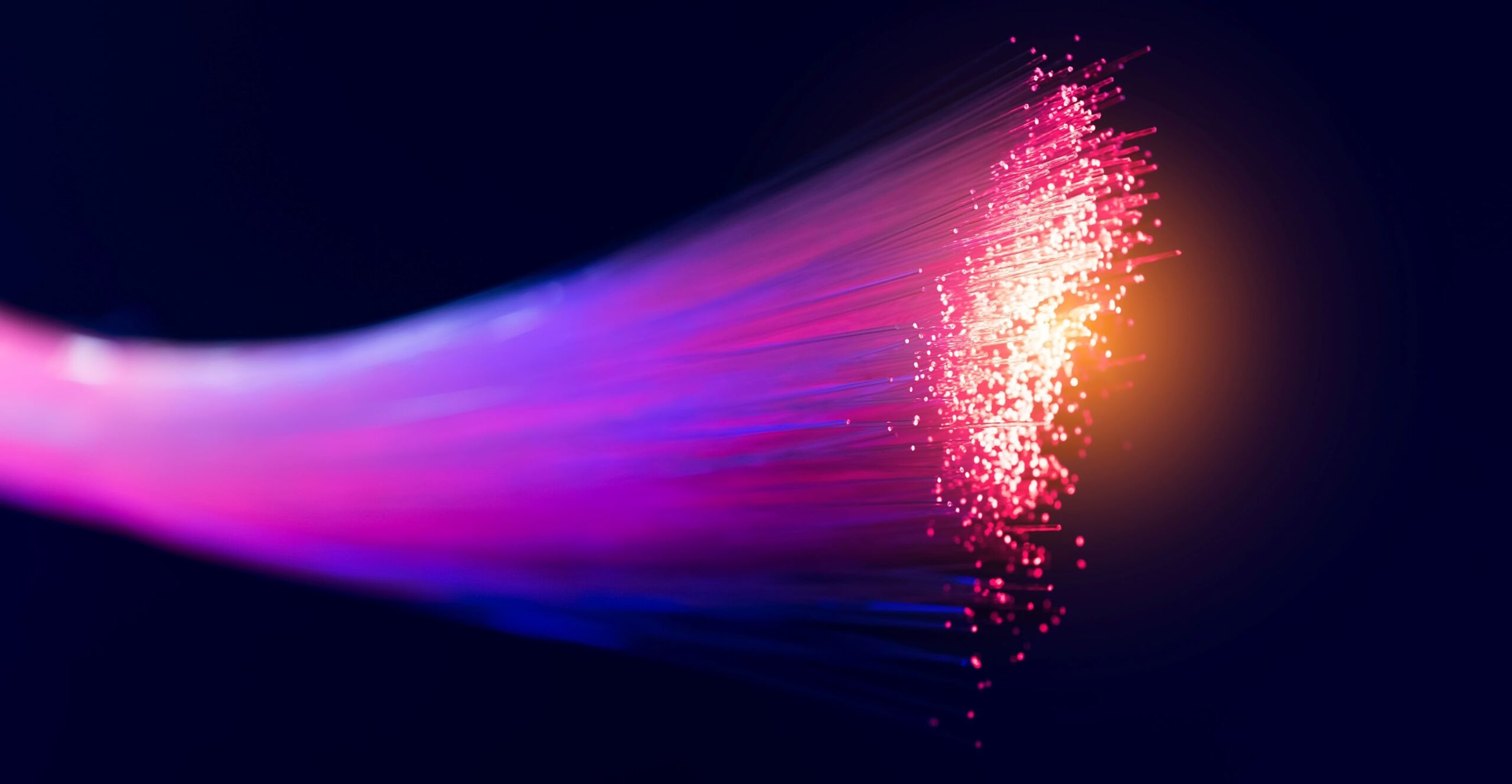
Instead of carrying electrical signals like traditional copper telephone lines, fiber-optic cables carry information as tiny pulses of light. These light signals travel through ultra-thin strands of glass or plastic known as optical fibers.
Because light can travel extremely quickly and with very little signal loss, fiber broadband provides exceptionally fast internet speeds, low latency, and highly reliable connections.
Today, fiber broadband supports everything from simple web browsing to cloud computing, ultra-high-definition video streaming, artificial intelligence applications, online gaming, virtual reality, and remote work.
Why Is It Called “Fiber”?
The word “fiber” refers to the incredibly thin optical fibers inside the cable.
Each fiber is roughly as thin as a human hair. Despite its tiny size, a single optical fiber can carry an enormous amount of digital information over very long distances.
These fibers are carefully manufactured from highly purified glass or specialized plastic. Their unique structure allows light to remain trapped inside the fiber as it travels, even when the cable bends around corners.
This ability to guide light efficiently is what makes fiber broadband possible.
How Fiber Broadband Works
Every photo you upload, every email you send, every movie you stream, and every website you visit is made up of digital data.
Digital data consists of binary information represented by ones and zeros.
In a fiber broadband network, this digital information is converted into rapid flashes of light using devices called lasers or light-emitting diodes (LEDs).
These tiny flashes travel through optical fibers at extraordinary speeds.
When the light reaches its destination, another device called an optical receiver detects the light pulses and converts them back into electrical signals that your computer, smartphone, television, or gaming console can understand.
This entire process happens so quickly that it feels almost instantaneous.
The Science Behind Optical Fibers
One of the most fascinating aspects of fiber broadband is the science that allows light to stay inside the cable.
Normally, light travels in straight lines. If it hits a surface, some of it may reflect while some passes through.
Optical fibers take advantage of a physical phenomenon called total internal reflection.
Each fiber has two main layers.
At the center is the core, where the light travels.
Surrounding the core is the cladding, which has a slightly lower refractive index than the core.
Whenever the light reaches the boundary between these two layers at the proper angle, it reflects back into the core instead of escaping.
As a result, the light continually bounces along the length of the fiber while remaining trapped inside.
Even when the cable curves gently, the light continues traveling efficiently with very little loss.
Why Light Is Better Than Electricity
Traditional broadband technologies such as DSL and many cable internet systems transmit electrical signals through copper wires.
Electricity works well, but it has several limitations.
Electrical signals gradually weaken over distance.
They can also be affected by electromagnetic interference from nearby power lines, electrical equipment, or lightning.
Fiber broadband avoids these problems because it uses light instead of electricity.
Light experiences extremely low signal loss inside optical fibers.
It is immune to electromagnetic interference.
It travels over much longer distances without significant degradation.
This is one of the main reasons why fiber broadband consistently delivers higher performance than older internet technologies.
The Journey of Your Internet Data
When you click on a website, your device sends a request through your home router.
The router forwards this request through your fiber connection.
The request then travels across local fiber networks, regional fiber links, and international undersea fiber-optic cables until it reaches the server hosting the website.
The server sends the requested information back through the same global fiber infrastructure.
This entire round trip often takes only a few milliseconds.
Although the data may travel hundreds or even thousands of kilometers, it reaches your screen almost instantly.
The Different Types of Fiber Broadband
Not every fiber connection reaches your home in exactly the same way.
Some networks use fiber for the entire connection from the internet provider directly to your building.
This is often called Fiber to the Home (FTTH) or Fiber to the Premises (FTTP).
These connections provide the highest speeds and the greatest reliability because the entire path uses optical fiber.
Other systems use fiber for most of the network but switch to existing copper cables for the final section leading into homes.
These hybrid systems generally offer faster speeds than older broadband technologies but may not match the full performance of an all-fiber connection.
As more countries upgrade their internet infrastructure, full-fiber deployments are becoming increasingly common.
Why Fiber Broadband Is So Fast
Fiber broadband offers impressive speeds because optical fibers can carry vast amounts of information simultaneously.
Modern fiber systems use a technique known as wavelength division multiplexing.
Instead of sending just one light signal through a fiber, multiple colors—or wavelengths—of light can travel through the same fiber at the same time.
Each wavelength carries its own stream of information.
This dramatically increases the cable’s total data capacity.
Combined with advanced networking equipment, this technology enables fiber networks to deliver internet speeds ranging from hundreds of megabits per second to multiple gigabits per second for residential users.
Research networks and data centers can achieve speeds many thousands of times higher.
Understanding Download and Upload Speeds
Internet speed is usually described using download speed and upload speed.
Download speed measures how quickly information moves from the internet to your device.
Upload speed measures how quickly information moves from your device to the internet.
Many older broadband technologies provide much faster downloads than uploads.
Fiber broadband often offers symmetrical speeds, meaning uploads and downloads can be equally fast.
This is especially valuable for cloud storage, video conferencing, remote work, online backups, content creation, and live streaming.
What Is Latency?
Speed is only one part of internet performance.
Another important measurement is latency.
Latency is the time it takes for information to travel between your device and another computer on the internet.
Lower latency means faster responses.
Fiber broadband generally offers significantly lower latency than many other broadband technologies because light travels efficiently through optical fibers with minimal delay.
Low latency is especially important for online gaming, video calls, virtual reality, financial trading, and interactive applications.
Reliability in All Weather
One reason many businesses prefer fiber broadband is its reliability.
Copper cables can be more vulnerable to electrical interference, corrosion, and environmental conditions.
Fiber-optic cables are not affected by electromagnetic interference because they carry light instead of electricity.
While physical damage can still interrupt service, fiber networks are generally more stable and maintain consistent performance under a wide range of conditions.
This reliability makes fiber an excellent choice for hospitals, schools, businesses, research institutions, and homes.
Fiber Broadband and Streaming
Watching 4K and even 8K videos requires a steady flow of data.
If your internet connection cannot keep up, videos may pause for buffering or reduce their quality automatically.
Fiber broadband provides enough bandwidth to support multiple high-resolution video streams simultaneously.
This means several family members can watch different movies, attend video meetings, and browse the internet at the same time without noticeably slowing one another down.
Online Gaming with Fiber
Modern online games exchange information with servers many times every second.
Even small delays can affect gameplay.
Because fiber broadband combines high speeds with low latency, it provides a smoother gaming experience.
Players experience faster downloads for game updates, quicker matchmaking, and more responsive online interactions.
Fiber Broadband for Remote Work
Remote work has become increasingly common across the world.
Video conferences, cloud applications, large file transfers, and collaborative online tools all require reliable internet.
Fiber broadband supports these activities with ease.
Large documents upload quickly.
Video meetings remain clearer.
Cloud services respond faster.
This allows professionals to work efficiently from almost anywhere with a fiber connection.
Supporting Smart Homes
Today’s homes often contain dozens of internet-connected devices.
Smart televisions, security cameras, voice assistants, thermostats, lighting systems, gaming consoles, smartphones, tablets, laptops, and household appliances may all share the same connection.
Fiber broadband provides sufficient bandwidth to support these devices simultaneously without major performance issues.
As smart homes become more advanced, fiber offers the capacity needed for future innovations.
Fiber and Cloud Computing
Cloud computing stores information and runs applications on remote servers instead of local computers.
People now regularly use cloud storage, online office software, artificial intelligence tools, and streaming platforms.
These services depend on fast, reliable internet.
Fiber broadband allows data to move quickly between users and cloud servers, making online applications feel almost as responsive as locally installed software.
The Global Network of Fiber-Optic Cables
Fiber broadband does not stop at city limits.
A vast worldwide network of fiber-optic cables connects countries and continents.
Thousands of kilometers of submarine fiber-optic cables lie across the ocean floor.
These underwater cables carry the overwhelming majority of international internet traffic.
Every day, they transmit emails, financial transactions, scientific research, video calls, streaming content, and countless other forms of digital communication between continents.
Without these global fiber networks, today’s internet simply could not exist.
Fiber Broadband and Future Technologies
As technology advances, internet demand continues to grow.
Artificial intelligence, autonomous vehicles, smart cities, virtual reality, augmented reality, cloud gaming, remote healthcare, and advanced scientific research all require fast and reliable data connections.
Fiber broadband provides the infrastructure capable of supporting these future technologies.
Its enormous capacity means today’s fiber networks can often be upgraded simply by replacing networking equipment rather than installing entirely new cables.
This makes fiber one of the most future-proof communication technologies ever developed.
Is Fiber Broadband More Secure?
No internet connection is completely immune to security threats.
However, fiber-optic communication has certain physical characteristics that make unauthorized interception more difficult than with traditional copper cables.
Because information travels as light inside sealed optical fibers, tapping into the signal without detection is generally more challenging.
Of course, cybersecurity also depends on encryption, secure software, strong passwords, and responsible online behavior.
Fiber alone cannot protect against hacking or malware, but it contributes to a secure communication infrastructure.
Does Fiber Broadband Have Any Limitations?
Although fiber broadband offers outstanding performance, building fiber networks can be expensive.
Installing underground cables, connecting homes, and deploying specialized equipment require significant investment.
Remote rural regions may take longer to receive fiber service because construction costs are often higher.
Despite these challenges, many governments and internet providers continue expanding fiber networks because of their long-term benefits.
As deployment grows, fiber broadband is becoming increasingly accessible around the world.
The Future of Internet Connectivity
The demand for faster internet continues to increase every year.
New technologies generate larger files, higher-quality video, more connected devices, and greater amounts of digital information.
Fiber broadband is well positioned to meet these growing demands.
Researchers continue developing faster optical transmission systems capable of carrying even more information through existing fibers.
Future improvements will likely focus on increasing capacity, reducing latency, improving energy efficiency, and expanding coverage to more communities.
As digital life becomes even more integrated into education, healthcare, business, entertainment, and scientific research, fiber broadband will remain at the heart of global communication.
Why Fiber Broadband Is Transforming the Digital World
Fiber broadband represents one of the greatest advances in communication technology since the invention of the internet itself. By replacing electrical signals with pulses of light traveling through ultra-thin optical fibers, it enables incredibly fast, reliable, and efficient data transmission.
From streaming movies without buffering to supporting life-saving medical technologies, connecting smart cities, powering cloud computing, and enabling the next generation of artificial intelligence, fiber broadband forms the invisible foundation of our connected world.
As societies continue to embrace digital innovation, the importance of fiber broadband will only continue to grow. It is more than just a faster internet connection—it is the infrastructure that makes the modern digital age possible and provides the foundation for the technologies of tomorrow.