Every time you unlock your smartphone, stream a movie, play a video game, ask an AI assistant a question, or send an email across the world, billions of tiny electronic components work together inside a computer chip. These chips power nearly every modern technology, from laptops and electric cars to satellites and supercomputers. Yet despite the incredible complexity of these devices, they all rely on one extraordinary material: silicon.
At first glance, silicon seems like an ordinary element. It is not rare, precious, or visually impressive. In fact, it is one of the most abundant elements on Earth, found in common sand, rocks, and minerals. But its unique physical and electrical properties have made it the foundation of the digital age.
Why did scientists and engineers choose silicon instead of gold, copper, aluminum, or other materials? What makes this simple element capable of powering billions of transistors inside a chip no larger than a fingernail? The answer lies in decades of scientific discovery, advances in materials engineering, and the remarkable behavior of atoms.
What Is Silicon?
Silicon is a chemical element with the symbol Si and atomic number 14. It belongs to the carbon family in the periodic table and is classified as a metalloid, meaning it shares characteristics of both metals and nonmetals.
Silicon is the second most abundant element in Earth’s crust after oxygen, making up roughly 28 percent of the crust by weight. However, silicon is almost never found in its pure form in nature. Instead, it combines with oxygen to form silicon dioxide, also known as silica, which is the primary ingredient in sand, quartz, and many types of rocks.
Although silicon has been part of Earth’s geology for billions of years, its true technological importance was only recognized during the twentieth century, when scientists discovered its extraordinary electrical properties.
Why Computer Chips Need Special Materials
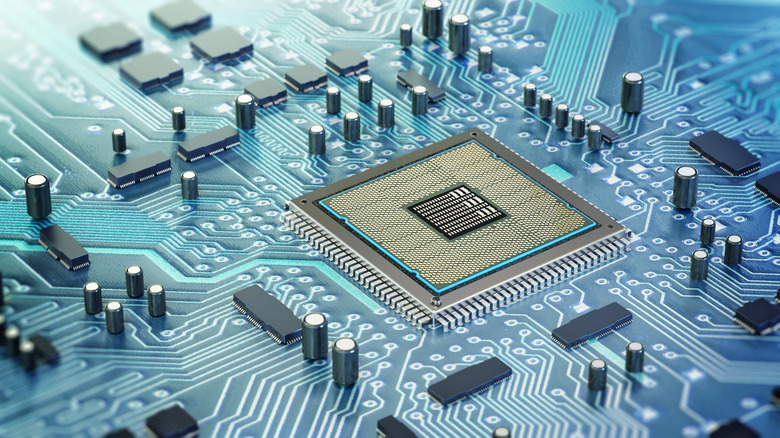
A computer chip is essentially a tiny electronic city containing millions or even billions of microscopic switches called transistors. These transistors control the flow of electrical current, allowing chips to perform calculations, store information, and process data.
For these switches to work, the material inside the chip must meet several demanding requirements. It must conduct electricity under certain conditions while blocking it under others. It must remain stable at high temperatures. It must withstand years of operation without degrading. It must also be easy to manufacture with incredible precision.
Very few materials possess all of these qualities simultaneously. Silicon does.
Silicon Is a Semiconductor
The single most important reason silicon is used in chips is that it is a semiconductor.
To understand what this means, imagine two extremes.
A conductor, such as copper, allows electricity to flow very easily. Electrons move freely through the material, making it ideal for electrical wiring.
An insulator, such as rubber or glass, blocks the movement of electrons, preventing electricity from flowing.
A semiconductor falls between these two extremes. Under normal conditions, it conducts electricity only moderately. However, its electrical conductivity can be precisely controlled.
This ability to switch between conducting and insulating behavior makes semiconductors ideal for electronic devices.
Silicon’s semiconductor properties allow engineers to build transistors that can rapidly turn electrical current on and off billions of times every second.
The Atomic Structure of Silicon Makes It Special
The remarkable behavior of silicon begins at the atomic level.
Each silicon atom has fourteen electrons arranged in different energy levels. The four electrons in its outermost shell are especially important because they participate in chemical bonding.
Each silicon atom forms four strong covalent bonds with neighboring atoms, creating a highly organized crystal lattice.
This crystal structure gives silicon excellent mechanical strength while also providing predictable electrical behavior.
Because every atom fits neatly into the crystal, engineers can manufacture extremely pure silicon wafers with remarkably few defects.
This atomic perfection is one reason why modern chips can contain tens of billions of transistors on a single piece of silicon.
Silicon Can Be Precisely Controlled
One of silicon’s greatest strengths is that scientists can carefully modify its electrical properties.
Pure silicon does not conduct electricity very well. However, by adding extremely small amounts of other elements—a process called doping—engineers can dramatically change how silicon behaves.
Elements such as phosphorus add extra electrons, creating what is known as n-type silicon.
Elements such as boron create spaces called holes where electrons can move, producing p-type silicon.
When these two types of silicon are placed together, they form a p-n junction, one of the most important building blocks in modern electronics.
P-n junctions are used to create transistors, diodes, solar cells, LEDs, and many other semiconductor devices.
Without the ability to precisely control silicon through doping, modern computing would not exist.
Silicon Makes Transistors Possible
Transistors are often called the building blocks of modern electronics.
A transistor acts like an extremely fast electronic switch.
It can allow electricity to flow or stop it entirely.
Inside a computer processor, billions of transistors continuously switch on and off.
These switching operations represent the binary digits, or bits, used by computers.
The numbers zero and one may seem simple, but by combining billions of these tiny electronic decisions every second, computers perform astonishingly complex tasks.
They render realistic graphics.
They recognize speech.
They translate languages.
They simulate weather.
They train artificial intelligence.
Silicon provides the stable, controllable platform needed to build these microscopic switches reliably.
Silicon Forms an Exceptional Natural Insulator
Another reason silicon became the dominant chip material is that it naturally forms an outstanding insulating layer.
When exposed to oxygen, silicon develops a thin coating of silicon dioxide.
This oxide layer is incredibly valuable.
It acts as an electrical insulator while remaining tightly bonded to the underlying silicon.
Few semiconductor materials create such a nearly perfect insulating layer naturally.
Silicon dioxide plays an essential role in modern transistors by separating conducting regions and controlling electrical signals.
Its exceptional quality helped silicon outperform many competing semiconductor materials during the development of integrated circuits.
Silicon Is Stable at High Temperatures
Computer chips generate heat while operating.
Processors inside gaming computers, smartphones, data centers, and artificial intelligence systems can become surprisingly warm.
The semiconductor material inside these chips must continue functioning accurately under these conditions.
Silicon has excellent thermal stability.
It maintains its crystal structure across a wide range of operating temperatures and can tolerate the high temperatures involved during chip manufacturing.
This stability contributes to the long lifespan and reliability of electronic devices.
Silicon Is Extremely Abundant
If silicon were a rare element, modern electronics would likely be far more expensive.
Fortunately, silicon is one of the most abundant materials on Earth.
Large quantities can be obtained from quartz and high-purity silica found in sand.
Although converting ordinary sand into electronic-grade silicon requires advanced purification techniques, the raw material itself is plentiful.
This abundance helps reduce manufacturing costs while ensuring a stable global supply for the semiconductor industry.
Silicon Can Be Made Exceptionally Pure
Modern computer chips require silicon that is almost perfectly pure.
Even tiny amounts of contamination can interfere with transistor performance.
Engineers use sophisticated refining processes to produce electronic-grade silicon with purity exceeding 99.9999999 percent.
This ultra-pure silicon is then grown into enormous single crystals using specialized manufacturing techniques.
These crystals are sliced into thin wafers that serve as the foundation for computer chips.
The ability to manufacture such highly pure silicon is one of the greatest achievements in modern materials science.
Silicon Works Well with Modern Manufacturing
Building computer chips requires extraordinary precision.
Today’s most advanced chips contain microscopic features measured in nanometers, billionths of a meter.
Silicon is compatible with photolithography, the manufacturing process used to create these tiny structures.
Using light, chemical coatings, and advanced etching techniques, engineers can build billions of transistors layer by layer on silicon wafers.
Decades of research have refined silicon manufacturing into one of the most sophisticated industrial processes ever developed.
Silicon Has Proven Reliability
Modern electronic devices are expected to operate continuously for years.
Smartphones survive daily use.
Medical equipment must remain dependable.
Spacecraft function for decades.
Financial systems operate around the clock.
Silicon has demonstrated exceptional reliability across these demanding environments.
Its electrical properties remain remarkably stable over time, making it an ideal material for long-lasting electronics.
Silicon Enabled the Integrated Circuit Revolution
Before integrated circuits were invented, electronic devices relied on individual transistors connected by wires.
These systems were bulky, expensive, and difficult to manufacture.
The invention of the integrated circuit changed everything.
Instead of assembling separate components, engineers learned to build entire electronic circuits directly onto a single silicon chip.
This breakthrough dramatically reduced size while increasing speed, reliability, and manufacturing efficiency.
The integrated circuit became the foundation of every modern computer, smartphone, game console, and digital device.
Why Not Use Copper?
Copper is one of the world’s best electrical conductors.
It is excellent for carrying electricity through wires.
However, it cannot function as a semiconductor.
Copper cannot switch between conducting and insulating states like silicon.
For this reason, copper is widely used to connect transistors together inside chips but is not used to make the transistors themselves.
Why Not Use Gold?
Gold conducts electricity very well and resists corrosion.
However, it is extremely expensive.
More importantly, gold lacks the semiconductor properties required for transistor operation.
Although gold is sometimes used for specialized electrical connections, it cannot replace silicon as the fundamental material inside chips.
Why Not Use Germanium?
Interestingly, germanium played an important role during the early history of semiconductor technology.
The first transistors developed in the late 1940s used germanium rather than silicon.
Germanium offers higher electron mobility, allowing electrical charges to move more quickly.
However, it also has significant disadvantages.
It performs poorly at higher temperatures.
Its natural oxide layer is inferior to silicon dioxide.
It is less abundant and more expensive.
As manufacturing technology advanced, silicon proved far more practical for mass production.
Today, germanium is still used in specialized applications but no longer dominates semiconductor manufacturing.
Are Other Materials Replacing Silicon?
Although silicon remains the dominant semiconductor, scientists continue exploring new materials.
Gallium nitride is increasingly used in high-power electronics and fast chargers because it can operate efficiently at high voltages and frequencies.
Silicon carbide is becoming important for electric vehicles, renewable energy systems, and industrial power electronics.
Researchers are also studying graphene, carbon nanotubes, two-dimensional semiconductors, and quantum materials for future generations of electronics.
These materials may outperform silicon in specific applications.
However, none currently match silicon’s combination of performance, manufacturing maturity, reliability, cost, and global infrastructure.
For most computer processors and memory chips, silicon remains unmatched.
Silicon and Moore’s Law
One of the most famous observations in semiconductor history is Moore’s Law.
In 1965, Gordon Moore predicted that the number of transistors on integrated circuits would approximately double every two years while costs continued to decrease.
For decades, advances in silicon manufacturing made this prediction remarkably accurate.
Each new generation of chips became faster, smaller, more powerful, and more energy efficient.
Although maintaining this pace has become increasingly difficult as transistors approach atomic dimensions, silicon technology continues to evolve through innovations such as three-dimensional transistor designs, advanced packaging, and new manufacturing techniques.
Silicon Powers Artificial Intelligence
Artificial intelligence depends on enormous computational power.
Training modern AI systems requires specialized processors capable of performing trillions of calculations.
These AI chips still rely primarily on silicon.
Whether the processor is a CPU, GPU, TPU, or NPU, silicon serves as the semiconductor foundation upon which billions of transistors perform complex mathematical operations.
As AI continues transforming industries, silicon remains at the heart of this revolution.
Silicon in Everyday Life
Most people rarely think about silicon, yet it quietly powers nearly every aspect of modern life.
It enables smartphones that connect families across continents.
It powers laptops used by students and researchers.
It controls medical equipment that saves lives.
It operates satellites that forecast weather and provide navigation.
It supports data centers that run the internet.
It drives electric vehicles, smart appliances, industrial robots, and communication networks.
From morning until night, countless interactions depend on tiny silicon chips working invisibly behind the scenes.
The Future of Silicon
As semiconductor technology approaches physical limits, engineers continue developing new ways to improve silicon-based devices.
Three-dimensional chip architectures, advanced transistor designs, chiplet technologies, and increasingly sophisticated manufacturing techniques are extending silicon’s capabilities.
Researchers are also combining silicon with new materials to achieve higher performance without abandoning the enormous global infrastructure built around silicon manufacturing.
Even if future technologies introduce entirely new semiconductor materials, silicon will likely remain central to electronics for many years because of its proven reliability, mature manufacturing processes, and unparalleled versatility.
Conclusion
Silicon became the foundation of modern electronics not by chance but because it possesses a rare combination of properties that no other material has fully matched. As a semiconductor, it can precisely control the flow of electricity, making it ideal for building transistors—the tiny switches that power every computer chip. Its atomic structure allows exceptional purity, its natural silicon dioxide layer provides an outstanding electrical insulator, its abundance keeps costs manageable, and its compatibility with advanced manufacturing has enabled decades of continuous technological progress.
From the smallest smartwatch to the world’s most powerful supercomputer, silicon quietly performs billions of operations every second. It has transformed science, communication, medicine, transportation, and entertainment, becoming one of the most important materials ever used by humanity. While researchers continue searching for the next breakthrough in semiconductor technology, silicon remains the remarkable element that made the digital world possible and continues to shape the future of computing.