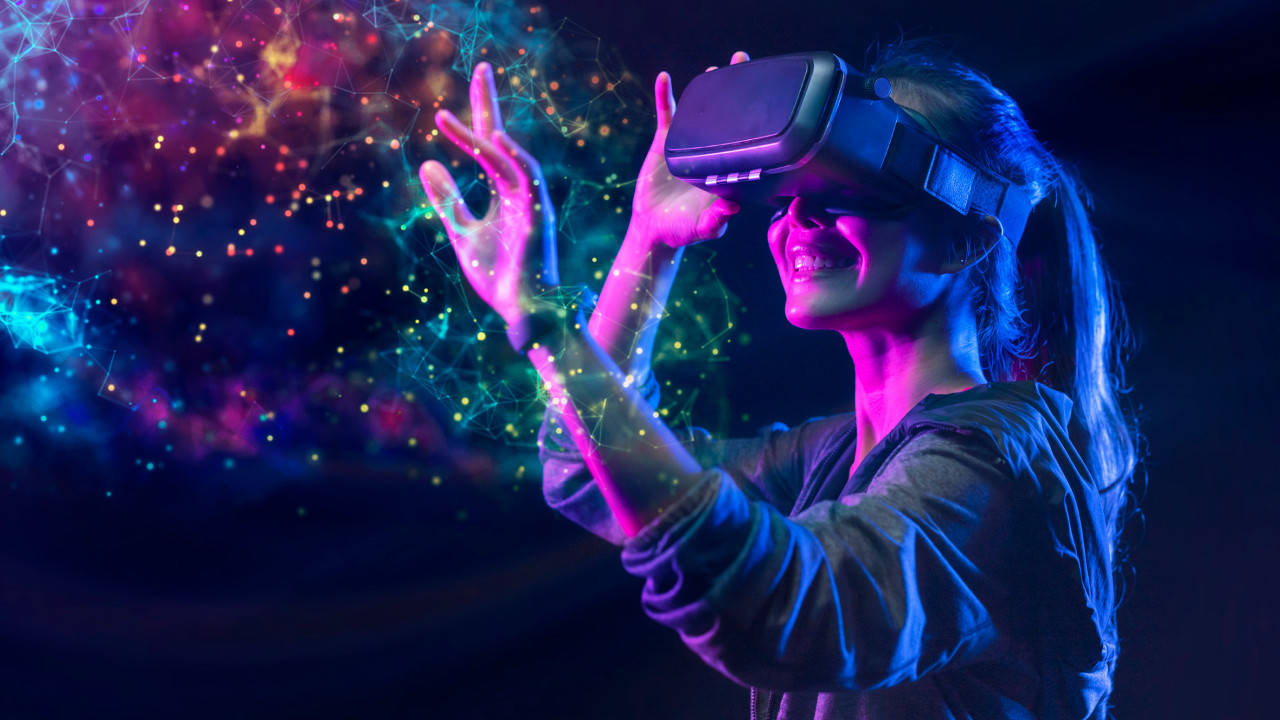
Imagine standing on the edge of a mountain thousands of feet above the ground. You can look in every direction, hear the wind rushing past your ears, and feel your heart beat a little faster. Then, with the press of a button, you find yourself walking through ancient Rome, exploring the surface of Mars, or swimming alongside giant whales deep beneath the ocean.
None of these places are physically around you. Yet they can feel surprisingly real.
This is the remarkable world of Virtual Reality (VR)—a technology that creates computer-generated environments so immersive that users often feel as though they have entered another place. Virtual Reality is transforming entertainment, education, healthcare, engineering, science, and countless other fields. It is changing not only how people play games but also how they learn, work, communicate, and solve complex problems.
Virtual Reality is much more than science fiction. It is a rapidly evolving technology built on decades of scientific research in computer graphics, optics, psychology, neuroscience, engineering, and human-computer interaction. As VR continues to improve, it is becoming one of the most exciting technologies of the twenty-first century.
Understanding Virtual Reality
Virtual Reality is a technology that allows people to experience a computer-generated three-dimensional environment as if they were physically present inside it.
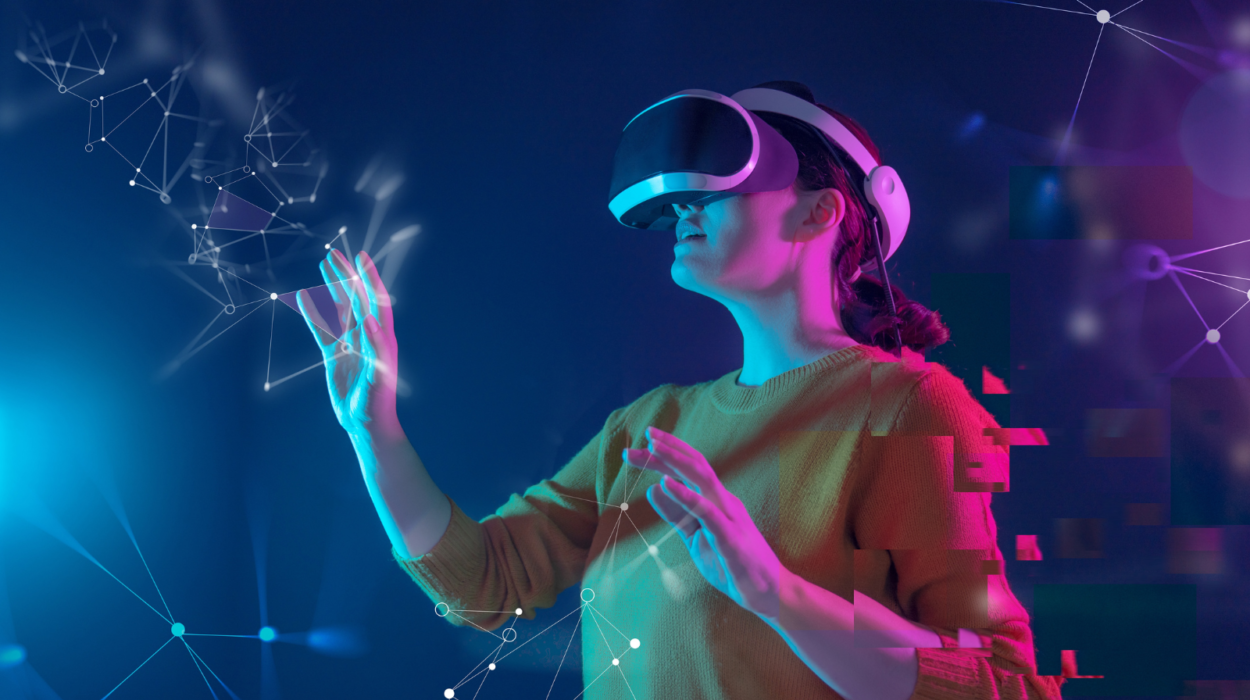
Instead of simply looking at a screen, users wear a special headset that covers their eyes and often their ears. The headset displays separate images for each eye, creating the illusion of depth. Sensors constantly track the user’s head movements, allowing the virtual world to change naturally as they look around.
When users turn their heads, the virtual environment moves exactly as expected. Looking upward reveals the virtual sky. Looking behind shows what is behind them in the digital world. This natural response creates a powerful feeling known as immersion, where the brain begins treating the virtual environment as though it were real.
Although users know they are standing in a room, their senses respond to the virtual world in ways that can feel surprisingly convincing.
How Virtual Reality Works
Virtual Reality combines several advanced technologies that work together almost instantly.
The most visible part is the VR headset. Inside the headset are high-resolution displays positioned close to the user’s eyes. Special lenses help focus the images, making the digital world appear large and three-dimensional.
Motion sensors continuously measure the position and orientation of the user’s head. Many headsets use gyroscopes, accelerometers, and cameras to track movement with remarkable precision.
Powerful computer processors or gaming systems generate detailed virtual environments many times every second. This rapid updating is essential because even tiny delays can reduce immersion or cause discomfort.
Many VR systems also include handheld controllers that allow users to interact with virtual objects. These controllers detect hand movements and button presses, making it possible to pick up objects, paint, build, throw, or manipulate digital tools.
Some advanced systems even track the movement of fingers, facial expressions, or the entire body.
The Science Behind Feeling “Present”
One of the most fascinating aspects of Virtual Reality is the feeling of actually being inside the digital world. Scientists call this sensation presence.
Presence occurs because the human brain constantly combines information from the eyes, ears, muscles, and inner ear to understand where the body is located.
When a VR system delivers realistic visual and auditory information that responds naturally to movement, the brain often accepts the virtual environment as temporarily real.
This does not mean people become confused about reality. Instead, the brain reacts emotionally and physically to what it sees.
For example, someone standing on a virtual cliff may feel nervous even though they know they are standing safely on the floor of their living room. Their body responds because the visual information strongly suggests height and danger.
Researchers continue studying how the brain creates this remarkable illusion and how it can be improved.
The History of Virtual Reality
The idea of creating artificial worlds is much older than modern computers.
For centuries, artists experimented with paintings and architecture that created powerful illusions of space and depth.
During the twentieth century, scientists began developing machines that combined visual displays, sound, and motion to create immersive experiences.
In the 1960s, computer scientist Ivan Sutherland introduced one of the earliest head-mounted display systems. Although large and primitive by today’s standards, it demonstrated the possibility of interactive virtual environments.
Throughout the following decades, improvements in computer graphics, sensors, and display technology gradually made VR more practical.
During the 1990s, Virtual Reality attracted widespread public attention, but the available technology was limited by expensive hardware and relatively weak computers.
The twenty-first century brought enormous advances in processing power, display quality, motion tracking, and graphics. These improvements allowed VR to become far more realistic, affordable, and widely available.
Today, Virtual Reality continues evolving rapidly as researchers develop lighter headsets, sharper displays, and more natural ways to interact with digital environments.
Creating the Illusion of Three Dimensions
Human vision depends on having two eyes that view the world from slightly different angles.
The brain combines these two images to estimate depth, distance, and the three-dimensional shape of objects.
Virtual Reality recreates this process by displaying a slightly different image to each eye.
This technique, called stereoscopic vision, makes virtual objects appear to exist at different distances rather than on a flat screen.
Combined with realistic lighting, shadows, textures, and perspective, stereoscopic displays create convincing three-dimensional scenes.
As display technology improves, these virtual environments become increasingly detailed and lifelike.
Tracking Movement in Real Time
Accurate movement tracking is one of the most important parts of Virtual Reality.
If users move their heads and the virtual world responds instantly, immersion remains strong.
If the response is delayed, even by a small fraction of a second, the experience may feel unnatural.
Modern VR systems use multiple sensors working together to achieve precise tracking.
Internal sensors detect rotational movement, while cameras observe the position of the headset and controllers.
Some systems use external tracking devices placed around the room, while others rely entirely on cameras built into the headset.
These technologies continuously calculate the user’s location hundreds or even thousands of times every second.
The result is smooth, natural movement that closely matches real-life motion.
Sound Makes Virtual Worlds Feel Real
Vision is only one part of immersion.
Sound plays an equally important role.
Most VR systems use spatial audio, a technology that changes sounds depending on the user’s position and direction.
If a bird sings behind the user, the sound appears to come from behind.
Turning toward the bird causes the sound to shift naturally.
Walking farther away makes the sound quieter.
These subtle changes help convince the brain that virtual objects exist in physical space.
Realistic sound greatly strengthens the feeling of presence inside virtual environments.
Touch and Physical Interaction
Although current VR systems mainly focus on sight and sound, researchers are also exploring ways to recreate the sense of touch.
Many controllers provide simple vibrations when users interact with virtual objects.
These vibrations, known as haptic feedback, simulate actions such as pressing buttons, firing tools, or touching surfaces.
Scientists are developing more advanced haptic gloves and wearable devices that may eventually recreate pressure, texture, resistance, and even temperature.
While these technologies are still improving, they represent an important step toward making virtual experiences even more realistic.
Virtual Reality in Gaming
Gaming is one of the most popular uses of Virtual Reality.
Instead of controlling a character from outside the game, players step directly into the virtual world.
They can look around naturally, move their hands, solve puzzles, swing swords, explore fantasy landscapes, or pilot spacecraft.
The immersive nature of VR often creates stronger emotional engagement than traditional gaming because players feel physically connected to the environment.
Developers continue creating games that encourage exploration, creativity, teamwork, and physical movement.
Virtual Reality in Education
Virtual Reality is transforming education by making learning more interactive and memorable.
Students can travel through the solar system, explore ancient civilizations, examine the inside of a living cell, or observe volcanic eruptions without leaving the classroom.
Instead of simply reading about scientific concepts, learners can experience them visually and interactively.
Medical students can study human anatomy in three dimensions.
Engineering students can examine complex machines from every angle.
History students can virtually visit historical sites.
These experiences often improve understanding because learners actively engage with information rather than passively observing it.
Virtual Reality in Healthcare
Healthcare has become one of the fastest-growing areas for Virtual Reality.
Doctors and surgeons use VR to practice complex medical procedures before performing real operations.
Medical students gain valuable experience by interacting with realistic virtual patients.
Physical therapists use VR to encourage movement during rehabilitation after injuries or neurological conditions.
Researchers have also explored VR as a tool for managing pain, reducing anxiety, and helping people gradually confront certain fears under professional supervision.
Although Virtual Reality is not a replacement for medical treatment, it has become a valuable support tool in many healthcare settings.
Virtual Reality in Science
Scientists use Virtual Reality to visualize data that would otherwise be difficult to understand.
Astronomers can explore simulations of galaxies.
Biologists can examine complex molecular structures.
Climate researchers can visualize changing weather systems.
Engineers can inspect aircraft designs before construction begins.
Virtual environments allow researchers to study complex systems from perspectives that would be impossible in the real world.
This ability often improves understanding and supports scientific discovery.
Virtual Reality in Architecture and Engineering
Architects increasingly use VR to allow clients to walk through buildings before construction starts.
Instead of looking at blueprints, people can experience the actual rooms, hallways, and outdoor spaces.
Engineers use VR to test vehicle designs, industrial equipment, and manufacturing processes.
Potential problems can often be identified early, saving both time and resources.
This practical application demonstrates that Virtual Reality is much more than entertainment.
Virtual Reality in Space Exploration
Space agencies and researchers use Virtual Reality to prepare astronauts for challenging missions.
Virtual environments simulate spacecraft, space stations, and planetary surfaces, allowing astronauts to practice procedures repeatedly in safe conditions.
Scientists also use VR to analyze enormous amounts of astronomical data.
Exploring distant planets or galaxies in immersive three-dimensional environments helps researchers better understand complex observations collected by telescopes and spacecraft.
Virtual Reality in Museums and Tourism
Virtual Reality is making museums and historical sites accessible to people around the world.
Visitors can explore ancient temples, castles, archaeological excavations, and famous landmarks without traveling long distances.
Although virtual visits cannot fully replace the experience of being physically present, they provide educational opportunities for millions of people who might never have the chance to visit these places in person.
Many museums now combine traditional exhibits with immersive VR experiences to deepen public understanding of history and science.
Virtual Reality in the Workplace
Many businesses are adopting Virtual Reality for employee training and collaboration.
Workers can safely practice operating complex machinery, responding to emergencies, or performing technical procedures without real-world risks.
Teams located in different countries can meet inside shared virtual spaces to discuss projects, examine digital models, and collaborate in new ways.
As remote work continues to evolve, Virtual Reality may become an increasingly important communication tool.
Challenges of Virtual Reality
Despite its impressive capabilities, Virtual Reality still faces several challenges.
Some users experience motion sickness, also called cybersickness, when visual movement does not perfectly match signals from the body’s balance system.
Improving display quality, reducing delays, and increasing frame rates have significantly reduced this problem, but it has not disappeared entirely.
Another challenge is the weight and comfort of headsets.
Although modern devices are much lighter than earlier models, researchers continue working to make them smaller, more comfortable, and easier to wear for long periods.
Cost can also limit access, especially for high-end systems requiring powerful computers.
As technology advances and manufacturing improves, VR equipment is gradually becoming more affordable.
Virtual Reality and Artificial Intelligence
Artificial Intelligence is beginning to enhance Virtual Reality in exciting ways.
AI can create more realistic virtual characters capable of natural conversations and intelligent behavior.
Virtual environments may automatically adapt to individual users, providing personalized education, realistic simulations, or customized entertainment.
The combination of AI and VR has the potential to create digital worlds that respond dynamically rather than following fixed scripts.
This partnership could dramatically expand the possibilities of immersive technology.
Virtual Reality and Human Psychology
Virtual Reality provides scientists with valuable insights into human perception, learning, memory, and behavior.
Researchers study how people respond emotionally to virtual environments and how immersive experiences influence decision-making.
Psychologists use carefully designed VR environments to investigate attention, spatial awareness, and social interaction.
Because experiences can be precisely controlled, VR has become an important research tool for understanding the human mind.
The Difference Between Virtual Reality and Augmented Reality
Virtual Reality is often confused with Augmented Reality (AR), but the two technologies are different.
Virtual Reality completely replaces the user’s surroundings with a computer-generated environment.
Augmented Reality, in contrast, adds digital objects to the real world while allowing users to continue seeing their actual surroundings.
For example, wearing a VR headset might transport someone into a virtual forest, while using an AR device could display digital information on top of a real city street.
Both technologies are valuable, but they serve different purposes.
The Future of Virtual Reality
The future of Virtual Reality looks increasingly promising.
Engineers are developing lighter headsets with sharper displays, wider fields of view, and more accurate tracking.
Eye-tracking technology may improve graphics while reducing processing demands.
Advanced haptic devices could allow users to feel virtual objects with greater realism.
Faster internet connections and cloud computing may enable rich virtual experiences without requiring extremely powerful local hardware.
Researchers are also exploring ways to make social interactions inside virtual environments feel more natural, allowing people to collaborate, learn, and communicate across great distances.
As these technologies mature, Virtual Reality may become an ordinary part of everyday life, much like smartphones and the internet today.
Why Virtual Reality Matters
Virtual Reality represents far more than a new form of entertainment. It is a powerful technology that changes how people experience information, solve problems, and interact with digital environments. By combining advances in computer science, engineering, psychology, optics, and neuroscience, VR creates immersive experiences that can educate, inspire, train, and connect people in ways that were once impossible.
From helping surgeons prepare for delicate operations to allowing students to explore distant planets, from improving scientific research to preserving cultural heritage, Virtual Reality continues expanding the boundaries of what technology can achieve. It demonstrates how carefully designed digital experiences can influence learning, creativity, and human understanding.
Although challenges remain, the progress of Virtual Reality over the past few decades has been remarkable. As hardware becomes more powerful, software grows more intelligent, and scientific knowledge deepens, VR will likely play an even greater role in education, healthcare, research, communication, and daily life.
Virtual Reality is ultimately about expanding human experience. It gives us the extraordinary ability to step beyond the limits of our physical surroundings and explore places, ideas, and possibilities that would otherwise remain out of reach. In doing so, it opens new doors for discovery, innovation, and imagination, offering a glimpse into a future where the boundaries between the physical and digital worlds become increasingly connected.