The internet has changed the way people communicate, learn, work, shop, and entertain themselves. Over the past few decades, it has evolved from simple web pages to social media platforms, video streaming services, online gaming, and powerful cloud applications. Today, a new vision for the internet is capturing the imagination of technology companies, researchers, creators, and millions of users around the world. That vision is known as the Metaverse.
The Metaverse is often described as the next evolution of the internet—a network of persistent, immersive digital spaces where people can interact with each other, digital objects, and computer-generated environments in ways that feel more natural than simply looking at a screen. Instead of just browsing websites or watching videos, users can experience virtual places, attend events, collaborate with others, create digital content, and even build businesses within shared online worlds.
Although the Metaverse is frequently discussed as if it already exists, the reality is more complex. Today, many technologies that could become part of the Metaverse already exist, but a fully connected Metaverse has not yet been built. Instead, the world is gradually developing the technologies that may eventually make this vision possible.
The Meaning of the Metaverse
The word Metaverse combines two ideas.
The prefix “meta” means “beyond” or “transcending.”
The word “universe” refers to a world or environment.
Together, “Metaverse” describes a shared digital universe that exists beyond the traditional internet experience.
In this digital universe, people could meet friends, attend concerts, explore virtual cities, work in digital offices, play games, design products, learn new skills, visit museums, or even travel through realistic simulations of distant planets—all while interacting with other users in real time.
Rather than replacing the real world, the Metaverse aims to create new digital spaces that complement everyday life.
Where Did the Idea Come From?
The idea of the Metaverse is older than many people realize.
The term “Metaverse” was introduced in 1992 by American science fiction author Neal Stephenson in his novel Snow Crash. In the book, people entered a massive virtual world using digital avatars, where they could socialize, work, and interact inside a computer-generated environment.
At the time, this vision seemed purely fictional.
However, advances in computing, graphics, networking, artificial intelligence, and virtual reality have gradually brought some aspects of this idea closer to reality.
Although today’s digital platforms are still far from the fully interconnected world imagined in science fiction, they demonstrate how immersive online experiences are becoming increasingly possible.
Is the Metaverse Already Here?
One of the biggest misconceptions is that the Metaverse already exists as a single place that everyone can visit.
In reality, it does not.
Today’s online games, virtual reality platforms, social spaces, and collaborative digital environments represent individual pieces of what might eventually become the Metaverse.
Many experts compare the current stage of the Metaverse to the early internet of the 1980s and 1990s. At that time, different computer networks existed, but they were not yet connected into the modern internet that billions of people use today.
Similarly, today’s virtual worlds are mostly separate from one another.
A future Metaverse could allow users to move more easily between different digital spaces while maintaining their identity, digital assets, and social connections.
Whether this vision will be fully realized remains uncertain.
How the Metaverse Works
The Metaverse depends on many different technologies working together.
Instead of being a single application, it represents an ecosystem of digital technologies.
Users enter virtual environments through computers, smartphones, gaming consoles, augmented reality devices, or virtual reality headsets.
Inside these environments, they are represented by digital characters called avatars.
These avatars can walk, talk, collaborate, attend meetings, play games, purchase digital items, or explore virtual locations.
Everything happens through powerful computer servers that synchronize the experiences of thousands—or even millions—of users simultaneously.
The goal is to create digital worlds that continue existing whether or not any particular person is logged in.
Avatars: Your Digital Identity
One of the defining features of the Metaverse is the use of avatars.
An avatar is a digital representation of a person inside a virtual environment.
Some avatars look realistic.
Others appear cartoon-like or highly stylized.
Future technologies may allow avatars to accurately reflect facial expressions, body movements, eye contact, and even subtle gestures using motion-tracking systems.
This could make digital communication feel more natural than traditional video calls.
Instead of simply watching someone on a screen, people may feel as though they are sharing the same virtual space.
Virtual Reality and the Metaverse
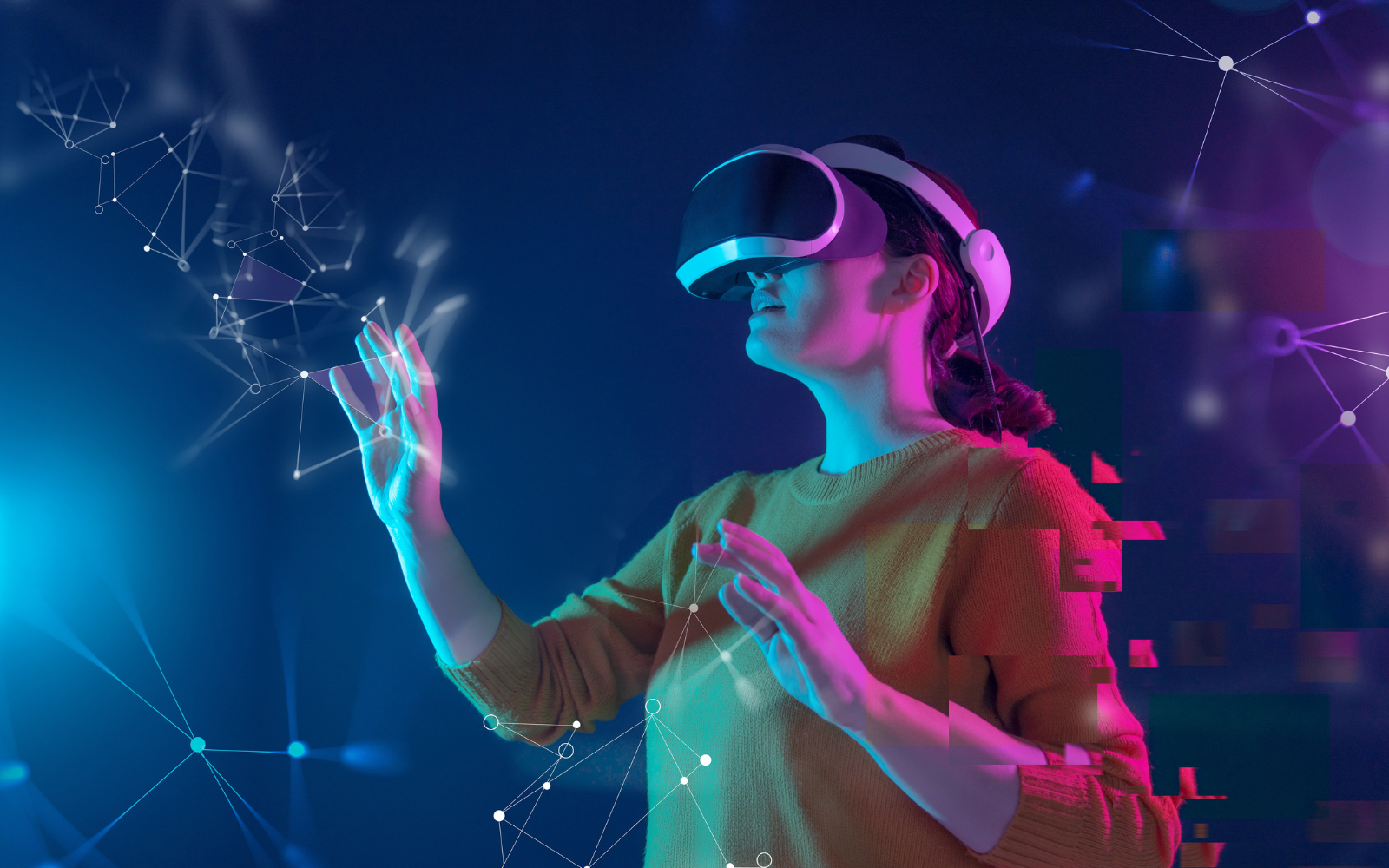
Virtual Reality, commonly called VR, plays an important role in many Metaverse concepts.
VR uses head-mounted displays that block the outside world and replace it with a fully digital environment.
When wearing a VR headset, users can look around naturally, interact with objects, and sometimes use handheld controllers or hand tracking to manipulate virtual items.
High-quality VR creates a strong sense of presence, making users feel as though they are physically inside another world.
Although VR is not required for the Metaverse, it is expected to become one of its most immersive ways of experiencing digital environments.
Augmented Reality Expands the Real World
Unlike Virtual Reality, Augmented Reality (AR) does not replace the real world.
Instead, it adds digital information to it.
Using smartphones, tablets, or specialized glasses, users can see digital objects placed within their physical surroundings.
For example, a student might view a three-dimensional model of the solar system floating above a classroom desk.
An engineer could visualize machine components before construction.
A shopper might see how furniture would look inside their home before purchasing it.
Augmented Reality could become an important bridge between the physical and digital worlds.
Mixed Reality and Spatial Computing
Another rapidly developing technology is Mixed Reality (MR).
Mixed Reality combines elements of both VR and AR.
Digital objects can interact with real-world environments, allowing users to work with virtual tools while remaining aware of their surroundings.
Closely related is spatial computing, which enables computers to understand three-dimensional spaces and place digital information naturally within them.
These technologies could significantly expand how people interact with computers beyond flat screens.
Artificial Intelligence Makes the Metaverse Smarter
Artificial Intelligence, or AI, is expected to become one of the most important technologies behind the Metaverse.
AI can generate realistic digital environments, animate virtual characters, recognize speech, translate conversations between languages, personalize user experiences, and assist with content creation.
Intelligent virtual assistants could help users navigate complex digital worlds.
AI-powered non-player characters may respond naturally during conversations, making virtual environments feel more lifelike.
Generative AI can also help creators build digital landscapes, objects, animations, and interactive experiences much faster than traditional methods.
The Importance of High-Speed Internet
The Metaverse requires enormous amounts of data to move quickly between users and servers.
Smooth virtual experiences depend on fast internet connections with low latency, meaning very little delay between an action and the system’s response.
Fiber-optic networks, Wi-Fi advancements, and modern mobile technologies such as 5G are improving the ability to deliver immersive online experiences.
Future communication technologies may make large-scale virtual environments even more responsive.
Graphics Bring Digital Worlds to Life
Modern computer graphics have become incredibly realistic.
Powerful graphics processors can render detailed landscapes, realistic lighting, complex physics simulations, and lifelike characters.
Techniques such as ray tracing simulate how light behaves in the real world, producing highly realistic reflections and shadows.
As graphics technology continues advancing, virtual environments may become increasingly difficult to distinguish from reality in certain situations.
Sound Creates Presence
Vision is only part of immersion.
Sound plays an equally important role.
Three-dimensional spatial audio allows users to hear sounds coming from specific directions, creating a realistic sense of location.
As someone walks around a virtual room, voices, footsteps, music, and environmental sounds change naturally based on distance and direction.
This greatly enhances the feeling of presence inside digital spaces.
The Metaverse and Online Gaming
Many people first experience Metaverse-like environments through online games.
Modern multiplayer games allow millions of players to explore shared worlds, customize characters, communicate with friends, attend virtual concerts, and create digital content.
While these games are not the Metaverse itself, they demonstrate many of the social and technological ideas associated with it.
Game developers continue experimenting with increasingly persistent and interactive virtual environments.
Working in the Metaverse
Remote work has expanded significantly in recent years.
The Metaverse could introduce new ways for people to collaborate regardless of physical location.
Instead of participating in standard video conferences, coworkers might meet inside shared virtual offices where they interact with three-dimensional models, presentations, digital whiteboards, and simulations.
Architects could examine building designs together.
Scientists might visualize molecular structures.
Engineers could collaborate on virtual prototypes.
Although many challenges remain, immersive collaboration has become an active area of research.
Education in Virtual Worlds
Education may become one of the most valuable applications of the Metaverse.
Students could walk through ancient civilizations instead of only reading about them.
Biology classes might explore giant interactive cells.
Astronomy students could travel through realistic simulations of the Solar System.
Medical students could safely practice surgical procedures using virtual patients.
These immersive experiences have the potential to improve understanding by allowing learners to actively interact with educational content.
Healthcare Applications
Healthcare researchers are also exploring Metaverse-related technologies.
Virtual Reality is already being used in some medical training programs.
Doctors can practice complex procedures using highly realistic simulations.
Patients undergoing rehabilitation may perform guided exercises inside engaging virtual environments.
Mental health researchers are studying how immersive technologies may assist with certain forms of therapy under professional supervision.
These applications rely on scientific evaluation and continue to develop through ongoing research.
Shopping in the Metaverse
Shopping may become more interactive in future digital environments.
Instead of viewing products as two-dimensional photographs, customers could examine realistic three-dimensional models.
Virtual clothing could be tried on using digital avatars.
Furniture could be placed inside accurate virtual versions of homes before purchase.
Retailers continue exploring these possibilities, although widespread adoption remains uncertain.
Entertainment Without Physical Limits
Entertainment has always evolved alongside technology.
The Metaverse could create entirely new forms of entertainment.
Musicians may perform concerts attended by millions of people worldwide inside shared virtual venues.
Sports fans might experience games from immersive digital viewpoints.
Movie experiences could become interactive rather than passive.
Artists could build exhibitions that visitors physically walk through in virtual space.
These possibilities continue to inspire creators across many industries.
The Role of Digital Economies
Many discussions about the Metaverse include digital economies.
Users may create, sell, or exchange virtual clothing, artwork, architecture, music, educational experiences, or digital services.
Some platforms already allow creators to earn income from digital content.
Certain Metaverse discussions also involve blockchain technology and digital ownership systems, although these technologies are not required for the existence of the Metaverse itself.
Many researchers view blockchain as one possible tool rather than an essential component.
Can the Metaverse Replace the Real World?
Despite ambitious predictions, the Metaverse is unlikely to replace physical life.
Humans are social, biological beings who benefit from real-world relationships, outdoor environments, physical activity, and face-to-face communication.
Most experts envision the Metaverse as an extension of everyday life rather than a substitute for it.
Just as smartphones did not eliminate in-person conversations, immersive digital environments are expected to complement—not completely replace—physical experiences.
Challenges Facing the Metaverse
Building a large-scale Metaverse presents enormous scientific, engineering, and social challenges.
Current VR headsets remain relatively expensive and can be uncomfortable during long sessions.
Creating realistic graphics requires powerful computing hardware.
Maintaining secure digital identities across platforms is technically complex.
Privacy is another significant concern.
Immersive technologies can collect detailed information about body movements, eye tracking, voice, and user behavior.
Protecting this information is essential for maintaining trust and safeguarding users.
Accessibility is equally important.
Future digital worlds should be designed so that people with different abilities can participate fully.
Cybersecurity also remains a major challenge.
As digital environments become more immersive, protecting users from fraud, identity theft, harassment, and malicious software will become increasingly important.
Common Misunderstandings About the Metaverse
Many people believe the Metaverse is simply another name for Virtual Reality.
This is not accurate.
Virtual Reality is only one technology that may help people experience the Metaverse.
Others believe the Metaverse requires cryptocurrency or blockchain.
While some companies integrate these technologies, they are not scientifically or technically required components of a Metaverse.
Another misconception is that one company owns the Metaverse.
No single organization controls the concept.
Many companies, universities, and independent developers are researching different approaches to immersive digital environments.
The Science Behind Immersion
Creating convincing virtual experiences involves many scientific disciplines.
Computer science develops software systems.
Physics simulates realistic movement and lighting.
Neuroscience studies how the brain perceives virtual environments.
Psychology investigates human behavior inside digital spaces.
Engineering designs advanced hardware.
Artificial intelligence enhances interactions.
Network science manages communication between millions of connected users.
The Metaverse is therefore not a single invention but the result of progress across many branches of science and technology.
The Future of the Metaverse
Predicting the future of technology is never easy.
Many innovations that once seemed impossible eventually became ordinary parts of everyday life.
Others generated excitement but failed to achieve widespread adoption.
The Metaverse may follow either path—or something in between.
Future advances in artificial intelligence, graphics processing, wearable devices, communication networks, and computing power will shape how immersive digital environments evolve.
Rather than appearing overnight, the Metaverse is likely to emerge gradually through continuous improvements in existing technologies.
Why the Metaverse Matters
The Metaverse represents more than a new digital platform. It reflects an ambitious vision for how people might interact with technology in the coming decades. By combining virtual reality, augmented reality, artificial intelligence, high-speed communication, advanced graphics, and interactive digital environments, it aims to transform online experiences from passive browsing into active participation.
Whether people use it for education, healthcare, engineering, entertainment, scientific research, business, or creative expression, the Metaverse has the potential to reshape many aspects of digital life. At the same time, its future will depend on solving significant challenges related to privacy, accessibility, security, affordability, and responsible technological development.
Today, the Metaverse remains a work in progress rather than a finished destination. It is an evolving idea built upon decades of scientific research and technological innovation. As computers become more powerful and immersive technologies continue to improve, the boundaries between physical and digital experiences may become increasingly seamless. The ultimate success of the Metaverse will depend not only on better technology but also on how thoughtfully humanity chooses to build and use these new digital worlds.